04 Jul 2024
Is SADC violating the terms of its agreement with St Albans BID by proposing to host extra markets in the city centre?
That’s the latest revelation as the row over whether to introduce a seven-day market into St Peter’s Street and Market Place shows no signs of quietening down.
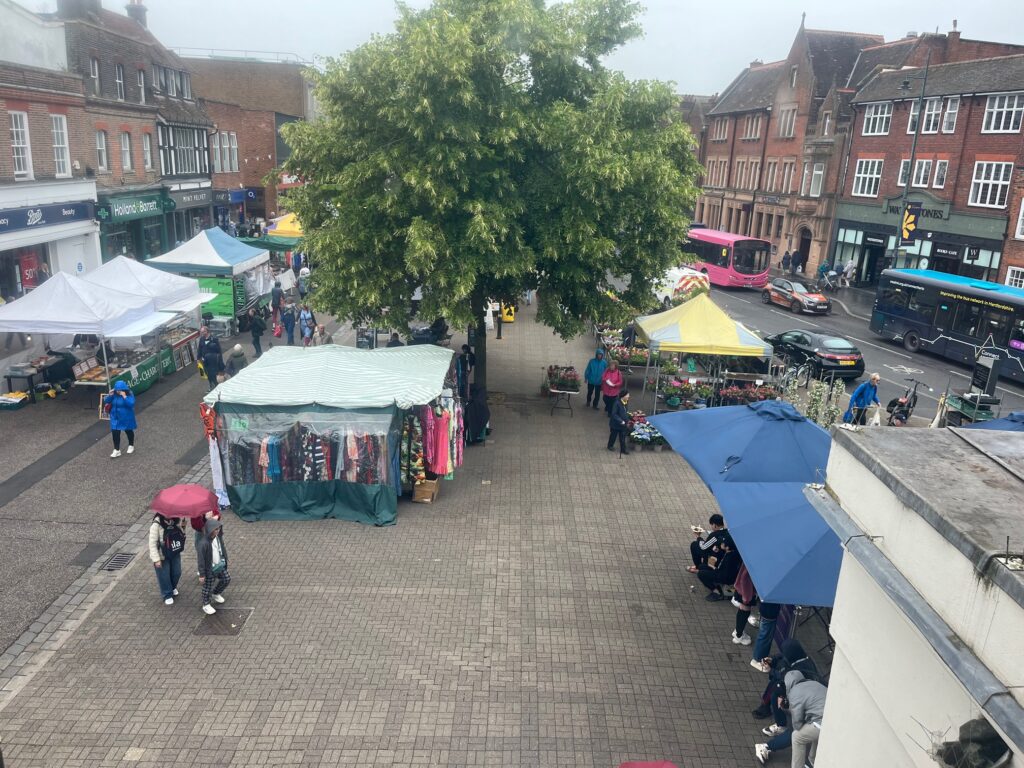
The cash-strapped council wants to provide pitches for at least 10 stalls every day throughout the week, operating as additional markets instead of stand-alone street traders.
Markets manager James Ó Nuanáin insists the changes will provide the high street with additional economic activity, provide greater parity between the terms, conditions and fees of traders working on different days, and to raise additional revenue to support vital council services.
But dozens of city centre businesses have objected to the plans, claiming SADC has failed to consider the impact on bricks and mortar premises, which will lead to unfair competition and an imbalance in the local economy.
Some of the comments submitted to SADC in response included:
“Our shop window is key to our business. Any stalls whether food or pet food can be incredibly smelly if the wind is blowing into us.”
“We personally think the food stalls should be located out of Market Place. There are at least five hospitality businesses in Market Place and at five more in French Row… It’s not good for the hospitality businesses in that area and is certainly not good
for other businesses such as clothing shops and jewellers who often have to keep doors shut to stop the stench of smoke from food stalls.”
“You should protect and support existing businesses already under considerable strain as your number one priority… stick to the principle of the highest quality market with higher feesinstigated to ensure only the best quality of stall holders come on two days only per week… move all stall holders away from the front doors and windows of existing shopfronts andbusinesses.”
“We already find it difficult with such high rates and high utility bills, we had to take on a location on London Road because we couldn’t afford to be in Market Place as a young start-up business and now you are giving locations to businesses at a fraction of the price and this will ultimately take customers away from us.”
“If there were more market days, this could kill our day trade completely.”
“Is the reason behind this proposal therefore solely to generate revenue rather than an actual desire/demand of the general public to have more food choice? Within this proposal we have seen no evidence of actual desire/demand.”
But a meeting of strategy and resources committee last week saw Lib Dem councillors voting overwhelmingly in favour of the proposals, which will see an extended pilot for 12 months aimed at allowing wider consultation and feedback.
An attempt to postpone any decision was rejected.
Greens and Independent group leader Cllr Simon Grover spoke at length at the meeting, and said afterwards: “I found the debate quite extraordinary – unprecedented almost – in the way that Lib Dem councillors spoke around the edges of the issues on the most inconsequential subjects, and completely ignored the huge amount of negative feedback the proposal received during the limited consultation.
“A number of Lib Dem councillors said that as a majority of city centre businesses had not responded to the consultation, they must therefore be either neutral on the issue or in favour.
“This completely ignores the fact that managers of chain stores would not have been authorised to respond to the consultation – only independent businesses would have done so.
“I tried repeatedly to get the committee to focus on the substance of the issue – that we were threatening the livelihood of street traders, and that we had received such a huge volume of responses from other businesses, all against the proposals. That includes 12 city centre pubs, who we are particularly supposed to be supporting.”
He said there has been written opposition from 37 independent businesses, adverse feedback from 19 traders, no publicity or opportunity for the public to comment, despite this being promised, no proper consideration of the alternatives, and no evidence of demand for the new arrangement.
“I asked officers at the meeting why the alternative of ‘doing nothing’ was not proposed. The answer I received was that the main issue was one of equity between street traders and market traders. It seems to me that this change to the market risks replacing one inequity with potentially a much larger one, and one that is opposed by large numbers of retailers.”
Council leader Cllr Paul de Kort, who chairs the committee, explained why his fellow councillors voted 12 to 2 in favour of the proposals, despite the opposition from city centre businesses.
“We received a large amount of valuable feedback from the consultation with local businesses. This raised issues about the scale of the change, the extent of expansion of hot food outlets, the positioning of the pitches, waste collection and more, which were all captured in the documents presented to the committee and placed in the public domain.
“All the points were considered carefully and were addressed in the recommendations put forward. As it was clear that businesses were seeking extra reassurance about the extent of the potential rise in trader numbers, the limit of 10 was re-emphasised in the agreed instruction.
“It was also helpful that the feedback made clear that there was a real concern about the additional competition arising from additional street food. This led to a clarification in the discussion about the portfolio mix that the markets team were seeking and a clear statement that the hot food component would be restricted to three out of the target of 10 traders in total. This is an increase of one prepared food trader compared to the existing situation.
“The feedback from the bricks and mortar businesses that the existing licence fee structure presented unfair competition was recognised from the start, and was addressed by altering the fee structure to one based on daily pitch fees placed at a level judged to be more equitable, dependent on the day of trade.
“In a similar time period, consultation had occurred with the street traders who were proposed to be transferred to the same same arrangement as that of the traditional market days. Their concern was about the increase in pitch fees threatening their ability to compete. This feedback was also taken on board as it led to the alteration of the original proposal that was put forward in March. Now there will be a phased increase in fees for those transferring over to the new arrangements to allow adjustment to the change in this aspect of their cost base.
“There is a tension here between two alternative perspectives on the nature of the competitive impact and on whom it falls. Again, collecting the feedback from these different businesses allowed us to weigh up the conflicting pressures and produce a balanced proposal designed to address the concerns.
“As outlined in the report presented on the night, feedback was received from ten businesses that operate in the close locality. A larger number signed the letter from a much broader swathe of the town. We were grateful for all their input as it has allowed us to understand where we needed to provide clarification and reassurance about the limits of the changes and also to make some considerable adjustments to the original proposal presented in March.”
One of the other major issues raised in response to the plans was the fact that the public was not given an opportunity to comment, something Cllr de Kort believes will be addressed during the pilot scheme.
“Since the March decision deferral, a time limited pilot scheme has been introduced as a key aspect of the new market arrangements. This is considered to be a much more effective means of establishing the public’s viewpoint.
“The public will be able to provide feedback during the pilot phase as will the whole range of businesses, plus organisations such as the Civic Society, who can help represent the public in terms of the heritage impact aspect.
“Furthermore, the councillor discussion did usefully highlight that the most common and accurate means of establishing the level of public support for any High Street change is through footfall.
“In the same way, we know the traditional market has been transformed into a success, not through the gathering of social media or website comments, but by the substantially increased attendance which has in turn, attracted much higher pitch occupancy. The recent national market award is an objective recognition of that success and public approval.”
He insisted the demand for more markets was tangible: “This comes from existing market traders who have been surveyed about the possibility of additional opportunities. And it also comes from residents and city centre workers who want more variety and choice during breaks in their working day. Visiting shoppers should also be attracted by the greater range of products available on days of the week other than the traditional market days.”
But while providing additional revenue for SADC was obviously one of the driving factors behind the changes, he said this was not the only reason: “Balancing the council’s books is a matter that this Liberal Democrat administration takes extremely seriously, in order to protect the most vital services that we provide for our residents.
“We have achieved this under the severe pressure of the ongoing, substantial cuts in real spending power that have been imposed upon all local councils by national government policy. We have closed budget gaps over the past two years of a combined £4.7 million per year, something for which we received praise from our recent local government peer review. The funding crisis in local government is very real and requires urgent action and constant vigilance, as unlike the national government, no council can run a budget deficit.
“However, the new arrangements offer much more than the opportunity to provide additional income which will protect council taxpayers from higher bills or the loss of the services that are so important to them.
“They also establish greater equity amongst traders, improve consumer choice, and are expected to support the city centre’s footfall. Each of these aspects have great value and are substantive justifications in their own right for the changes we are now about to pilot.”
Chris Traill, SADC strategic director for community and place delivery, reiterated the authority’s position on the proposals: “The changes to street trading in the city centre have been carefully considered at both the March and June meetings of our strategy and resources committee.
“Our councillors were provided with two reports outlining the proposals and have had intensive debates about them.
“The proposals were publicised to city centre businesses and councillors were made aware of all the feedback received.
“Indeed, the committee was responsive to the concerns that have been raised and taken appropriate action.
“This has included limiting to three from the current two, the number of hot food stalls that will be allowed to operate on non-Charter Market days. This was in response to feedback from some pubs, restaurants and cafés.
“This is a pilot scheme and we will monitor it closely in the months ahead to assess its impact.
“During this period, residents, businesses, traders and other organisations will have the opportunity to let us know their views. A trial period gives an opportunity for wide consultation. All feedback will be considered before any decision is taken on whether to make the change permanent.”
Liam Judge, on behalf of St Albans City Independent Businesses, said: “We feel completely let down by the councillors who voted this through. We feel our concerns were completely ignored with the exception of Cllr Grover who pushed for answers on those. We feel that classing a year-long pilot as the public consultation is tenuous at best, and we’re very disappointed by that.
“There are businesses in the city which could be so badly affected if there is a high amount of food traders on the new pitches, and it could mean that they are no longer around in 12 months time as a result.
“We feel the council should be spending more time and effort supporting bricks and mortar and not creating new challenges for them.”
But following the meeting, concerns were raised over whether SADC was in breach of its existing arrangements with St Albans BID (Business Improvement District), and whether the latter organisation was responsible to adding extra markets to the city centre package.
Under the Local Government Act (2003), the council is supposed to support the BID and enable it to deliver its business plan. This includes promoting the district by working with key stakeholder attractions to support and complement their offering by providing additional activities such as events, markets, maps, marketing and promotion, art, music and culture.
Any revenue generated from these activities would be reinvested back into the city centre rather than plugging holes in the council’s budget.
SADC’s proposals appear to block the BID from providing options like a seasonal flower, art or street food market if that is what city centre businesses want them to do, effectively removing one of its core objectives.
But the council disagrees this is the case. When asked if SADC would be in breach of its legal agreement with the BID by providing additional markets, a spokesperson said: “There is no breach of legal agreement. The council is responsible for running markets. Any organisation wishing to run a market does so through agreements and licences with the council as the market authority.”