06 Nov 2025
An east-west divide across Hertfordshire seems to be shaping the future look of the country following local government reorganisation.
All 10 district councils, Herts county council and the police and crime commissioner have been working collaboratively to review the options following the Government’s decision to impose unitary authorities in place of a two-tier structure.
They have looked at options for dividing Hertfordshire into two, three or four new UAs, and councillors across the region will now consider their preferences.
So what does this mean for St Albans?
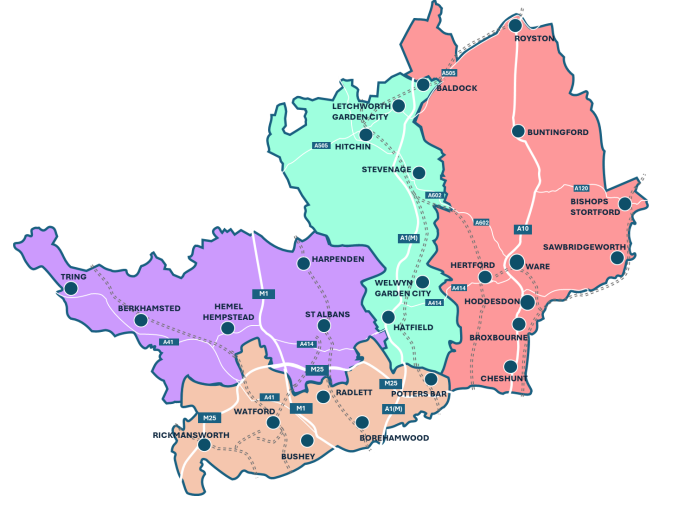
The vision for two local authorities divides the existing districts and boroughs into West Herts (Dacorum, Hertsmere, St Albans, Three Rivers, Watford) and East Herts (Broxbourne, East Herts, North Herts, Stevenage, Welwyn Hatfield).
West Hertfordshire is characterised by strong clusters in creative industries, professional and business services, and clean energy. These sectors are more London-facing and benefit from proximity to the capital and strategic transport corridors like the M1 and M25.
HCC’s report on the proposal states: “West Hertfordshire blends urban vibrancy with rural character, underpinned by a rich civic and cultural heritage. Today, it is home to thriving sectors including film and TV production, professional services and clean technologies, supported by exceptional connectivity to London and beyond.
“St Albans, with its Roman heritage and Cathedral, serves as the spiritual heart of the county. Its civic significance is long standing, from its role in the Magna Carta to its place in the Wars of the Roses…
“This unique mix of history, place and ambition positions West Hertfordshire as a confident and forward-looking region, ready to lead and grow.”-
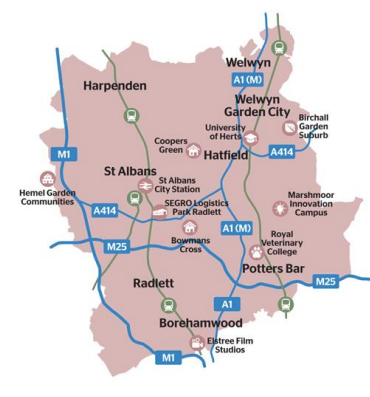
Should the preferred option be for three unitary authorities, St Albans would be included in a central council with Borehamwood, Harpenden, Potters Bar, Radlett, Welwyn Garden City and Hatfield.
The report for this choice states: “The new Unitary Authority will enable responsive, locally focused leadership that can deliver interventions tailored to community needs. By working with the University of Hertfordshire, Oaklands College, businesses and communities, the authority can implement targeted skills programmes aligned with the Get Britain Working and the Post-16 Education and Skills white papers, address labour shortages, tackle economic inactivity and invest in digital skills.
“By enabling sectoral clustering and knowledge exchange across its network of towns – connecting St Albans’ visitor economy, founded on its rich Roman heritage and historically significant Cathedral, with Welwyn Hatfield’s dynamic manufacturing and life sciences and Borehamwood’s globally renowned creative industries – Central Hertfordshire can unlock the scale and critical mass essential for international competitiveness and ensure the benefits are felt across all communities.”
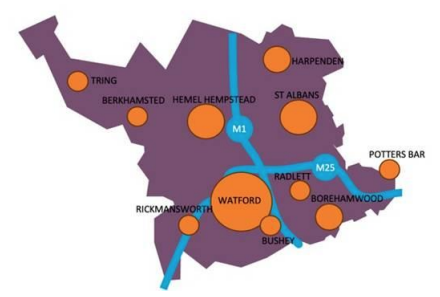
The final choice – and perhaps the least likely option according to local experts – would be for four authorities, grouping the largest settlement of St Albans with Harpenden, Hemel, Berkhamsted and Tring.
A new unitary authority of North West Hertfordshire would bring together the places currently served by Dacorum and SADC into a single council for the west of the county.
“Home to around 312,432 residents, it has the scale to plan transport, housing and regeneration coherently while keeping decision-making close to communities.”
HCC leader Cllr Steve Jarvis responded to the plans: “The debates over the coming weeks will show Hertfordshire’s strong local democracy in action.
“While views differ, all councils will continue to work in partnership whatever the Government’s final decision to make sure Local Government Reorganisation delivers our shared ambition for high-quality services that efficiently meet residents’ needs and enable local people to be at the heart of decision making.
“The creation of the new unitary councils will also unlock the prize of a devolution and opportunity for greater sustainable growth for our county. I have written to the Secretary of State for Housing, Communities and Local Government, with the backing of our public sector partners and business representatives, to request that we progress towards a Mayoral Strategic Authority for Hertfordshire on the same timeline as Local Government Reorganisation.”
SADC leader Cllr Paul de Kort said he was personally in favour of the two unitary option, but would be listening to what other councillors thought ahead of a formal decision at the strategy and resources committee on November 20.
“I am happy to state, that at this stage, and based on all that I have heard and read as the draft was being prepared, that I believe that the two unitary model would serve residents, businesses and other key organisations best overall in the future in terms of quality and depth of service provision, financial stability and value for money.
“I imagine that Cllr Cowley will support the same too, as his party at county council level brought forward an amendment to reinstate the single unitary option they were pushing hard before their electoral defeat in May. It would be odd for him to take a different position from his county one.
“It will be (mildly) interesting to learn what the two Labour councillors have to say, as it seems like the Labour group across Hertfordshire is being expected to follow the line of support for the four unitary model. However, as they seem to distance themselves from Labour policy on most other matters, there is a potential for a surprise there.”
But Cllr Matt Cowley, leader of SADC Conservatives group, said they are actually in favour of four authorities.
“The abolition of our district and county councils and their replacement with a new type of council will be the biggest change to local democracy in decades and it will have a real impact on everything from how we fix our roads to our bin collections, parking charges, and more.
“There are broadly two ways to approach this. You can have a big council that is able to do those things at scale which might save taxpayer money; or you can retain a smaller council that gives local people more of a say in the future of their area.
“The Liberal Democrats have ruled out the option that delivers value for money for taxpayers – which would have been to effectively take the county council we have and merge the district councils into it. I am unconvinced that there is a significant difference in the savings that can be made between the remaining options.
“But what we have seen in St Albans district recently is what happens when you have a council that is completely unaccountable to the people it serves.
“So our Conservative group will be supporting a four council model that will mean decisions on things like parking charges will be taken by people who are truly accountable to their communities.
“Whatever our next council looks like, it is clear that this process driven by the Labour Government nationally and the Liberal Democrats locally will cause significant disruption in the short term for limited benefits in the long term.”
St Albans Greens and Independents group leader, Cllr Simon Grover, feels three authorities offer the best option in terms of accountability.
“It’s right that local government in Hertfordshire needs reform. The current two-tier system is confusing and inefficient.
“But the question isn’t only how to draw the lines on a map. It’s how to bring power closer to people, not move it further away.
“Of the three options, I favour creating three new councils. It strikes the best balance between scale and local identity.
“Two would feel too remote. Four would be too fragmented. Three could work – grouping areas that already share services, while keeping decisions close to communities.
“The Green Party wants councils that are democratic, transparent, and focused on tackling the climate crisis. That means fair funding, real powers for local councils, and a greener approach to everything we do. Reorganisation can’t be an excuse for more cuts – it must build resilient, fair, and sustainable local government for Hertfordshire’s future.”
Finally, Cllr Emma Turnbull, leader of the Labour group of councillors, offered her thoughts on the issue: “Labour councillors in St Albans warmly support the move to unitary councils.
“This will bring an end to confusion and buck-passing between district and county councils and will mean that local residents get a better quality local service. The change will also tackle the remoteness of the current county council which is very poor at communicating with local people.
“This is the right approach for Hertfordshire – we do not need 11 councils, 11 council chief executives and over 500 councillors.
“Labour councillors want to see the benefits of a unitary approach, coupled with the local connection that a truly local council brings.
“This means that we support the four-council option, twinning St Albans with our Hemel Hempstead neighbours in Dacorum. Councils larger than this will find it harder to be responsive to local residents.
“In particular we oppose the three council option. This would leave St Albans as part of a unitary authority crossing two health Integrated Care Boards which would make collaboration between health and social care more challenging.”
A joint submission by HCC and the district/borough councils will be made to the Government on November 28 and will include evidence to support the three different unitary model options.
The proposal document can be viewed at Www.hertfordshire-lgr.co.uk.