03 Dec 2024
Star of Cucumber, The Office, The Thick of It, Gentleman Jack and Happy Valley, St Albans actor Vincent Franklin will be heading out on the road this festive season to bring his one-man production of A Christmas Carol to theatres across the country, portraying more than 20 different characters in a new adaptation of the Dickens classic.
In crafting his own interpretation of infamous miser Ebenezer Scrooge, Vincent Franklin follows in the festive footprints of Bill Murray, Michael Caine, Alastair Sim and, er, Ross Kemp…
But although he admits to having the same hair as the former EastEnder and gangbuster, that’s where the similarity ends. In portraying Scrooge, Vincent has consciously started at his redemption at the story’s end and then worked backwards, looking at the man he could be as well as the man he was.
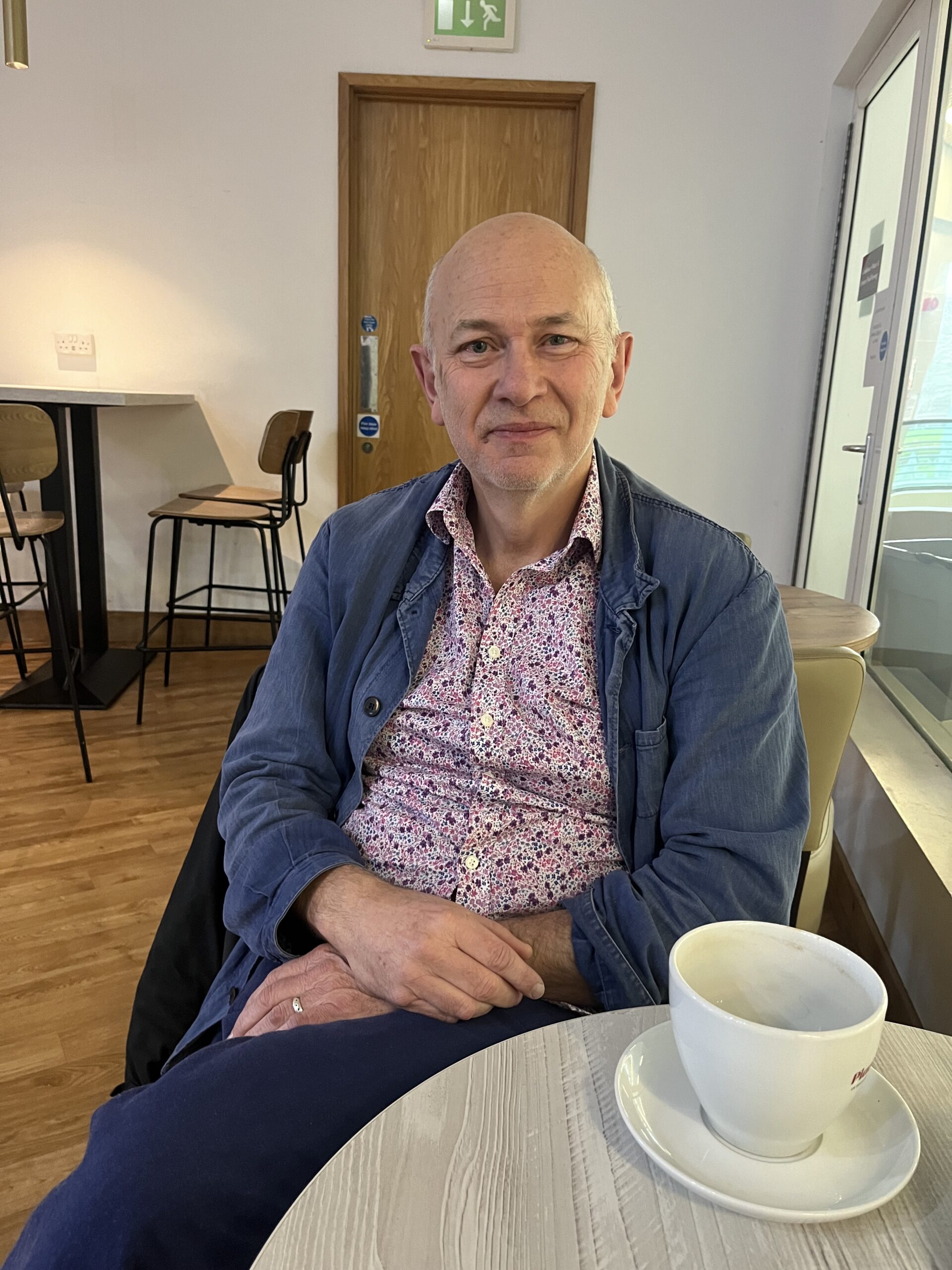
Sitting in the café at Westminster Lodge, Vincent explains the rationale behind his version: “To me that makes more sense than just playing someone mean and then undergoing some sort of transformation.
“I think the real change for him is to realise that looking out and being part of a bigger thing is what gives you happiness not being secretive, self-contained and solitary.
“We know that Scrooge never painted over Marley’s name and he doesn’t care whether people call him Scrooge or Marley, he’s just sitting at his desk with money coming in and money going out.
“You know, Bob Cratchit and [Scrooge’s nephew] Fred aren’t named until the visit by the Ghost of Christmas Present, they’re just called his clerk and his nephew, and I think that’s important because the world is defined from Scrooge’s position, so he doesn’t even see them as human beings, which is a really clever piece of writing by Dickens.
“It’s only when Scrooge begins to see who they are that he realises they’re called Bob and Fred, and at the end he says ‘I’ve come to dinner will you let me in Fred?’ and ‘Merry Christmas Bob’, as if naming people makes them real.
“When I was an actor first starting out and getting small parts I’d get a character who was called ‘man in the office’ or ‘second policeman’ and I’d think, oh Christ what can I do with this, at least give a man a name because without a name you are nothing. That’s what Scrooge does, he just sees people as extras and inconveniences in his life, but by the end he sees them as characters, and for me that’s his journey.
“Before that he’s the kind of man who is irritated by the world and it’s ridiculous and frivolity. He has that kind of Trumpian arrogance of the world, where it’s my way or the highway. Scrooge says that it’s enough for a man to know his own business and not interfere in other people’s, and what he has to learn is that actually we’re all part of society and the joy of life is that connection.
The script is adapted from Charles Dickens’ own performances, which he toured for years both here and in the United States.
“While it’s perhaps not necessarily regarded as his ‘best book’ – which may be Bleak House or Great Expectations or David Copperfield – it is his most popular. It sold out in a week and it’s never been out of print since.
“The Puritans hated Christmas because it was about indulgence and misrule and 12 days of feasting and drinking whereas what the Victorians re-engineered Christmas into being about family and sentiment and warmth and that kind of Nordic thing of everyone round a fire which I think is how we see Christmas now and A Christmas Carol is part of that change in some form.
“Dickens used to tour it with his own one-man readings, and while I don’t imagine he’d learnt it, I imagine if he knew it pretty well and he was very theatrical.
“But he takes out some things I think modern audiences would find weird. For me, right at the heart of this story is the Ghost of Christmas Present saying this boy is ignorance and this girl is want. So we’ve put that back in.
“Maybe this is a kind of post-Freudian view of characters, but it’s also very difficult to know why Scrooge is like he is, and why he has so much animosity towards his nephew.
“When they go into the past you see his absolute love for his sister. He adores her, and when he says there’s a large heart and she died there’s a sort of implication that she might even have died in childhood. So that sort of explains that this boy who turns up every Christmas is a reminder of his dead sister.
“There’s something even earlier than that where the sister says how their father is so much kinder than he used to be, and you go, hang on, this boy’s been sent to one of those schools we know of from other Dickens novels, this miserable place up in the wilds of Cumbria. His father doesn’t want him and hopes he’ll catch influenza and die and not bother him anymore. So he’s had a pretty rough time.
“Scrooge also says that in the even-handed dealing of the world there’s nothing which is so hard as poverty, which is a really good insight and helps to explain Scrooge a bit more. It might be sacrilege but I think he’s sort of converted too soon. He goes into the past and sees his poor forgotten self at school and weeps, job done! I’ve taken out some little moments there because the structure clearly should be that the past and the present make him realise the error of his ways and then the future is just the terror of whether it’s too late to change.
“But I’m not writing my own version of it, which is important because it’s a GCSE set text and I don’t want students turning up to exams and putting in a quote from the Vincent Franklin version, so everything is adapted from Dickens’ own words.”
Unlike the great man, Vincent is performing the story, not reading it: “All the lines are buzzing around my head all the time and I’m constantly distracted from the real world!
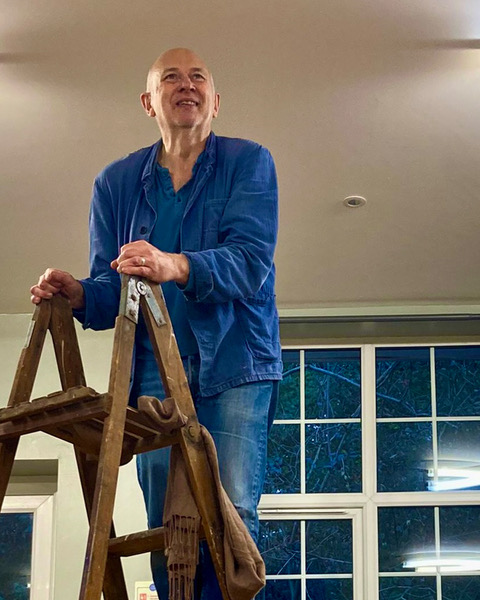
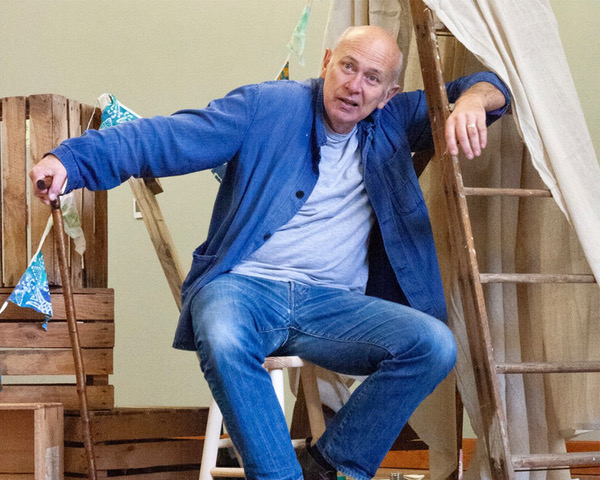
“It’s a traditional storytelling technique. I am the storyteller and I also play those characters and we have a set that I build out of bits of stuff, with the idea being that you should think I’ve literally arrived at the theatre that morning, grabbed some things I need to tell this story from backstage and thrown them together, but actually our designer has thought things through quite carefully.”
Jumping between voices and personae, Vincent demonstrates how he switches between characters, a performance it’s impossible to adequately convey in a written article.
It’s as much physical as it is vocal, something he says is helped by the fact Dickens creates such strong characters.
“When we were doing The Office in 1999 all the characters in the background were actors not background artists, and they might have only had a couple of lines each episode but they were there nonetheless.
“I think Dickens does that too. Whether you’re playing an old charwoman whose stolen a load of stuff or a big fat businessman with a monstrous chin, they’re all bold enough to make the switches between them. Because Dickens is very theatrical they’re set up like little sketches, whereas if you were doing the characters of three women talking in the supermarket with their kids you’d need a subtlety of change between them that’s quite difficult to do quickly.
“Here the characters are so outlined in Sharpie that it makes it easier to switch between them. I do like to physically change. Now obviously when you’re storytelling you have to make those changes subtler and in small gestures, you can’t put on a nose and a wig and all that Olivier kind of stuff, but I do hope there’ll be a noticeable difference between the characters and it isn’t just another funny voice.
“I just want to make sure that when I’m hitting these characters they’re all very clear. I used to do stand-up many years ago, and while there’s a different relationship with an audience there to what you have as an actor, I’m hoping we get a little bit of that so we can properly see each other.
“I mean I’m a northerner and my Ghost of Christmas Present is northern as I think it’s a really warm accent, and the one I’m a bit ashamed of is that the charwoman is from Birmingham as there’s that thing about just being really downtrodden in the accent.
“I think Dickens is always hardest on the middle class characters. I played Wilkins who runs the orphanage in Oliver Twist for the BBC many years ago and while Bill Sykes and Fagin are proper villains, the real villains are always those people who could have changed the world for the better but chose not to. People like Marley. Wilkins says to Oliver Twist that your neck was made for the noose, and I mean Christ that’s a much more wicked thing to say to an eight-year-old who has eaten gruel than ‘go and pick a pocket’, so I think I’ve fallen into that a little.
“We discovered in rehearsal that my Marley is awfully Edward Fox, because when he does that thing of taking off his bandage his lower jaw drops in a sort of Edward Fox way. It also makes him slightly posher than Scrooge, which I like, as it gives the idea that Scrooge was the hard-nosed businessman and Marley was the public face.”
Although Vincent’s version of A Christmas Carol isn’t coming to St Albans, he certainly hasn’t ruled out a future performance in the city, even offering to work alongside OVO who present the story at the Roman Theatre.
“Now we know how this set works, I can also do it in non-commercial venues. I could do it in the corner of a pub ultimately!” How good would it be to see him perform in Ye Olde Fighting Cocks for example?
Before we finish our coffees, there’s just enough time to chat over his wider career, including an anecdote from when he was a young actor studying at Bristol Old Vic.
It seems as though a representative from the BBC told him he was unlikely to win any major roles as he didn’t look the part, being slightly overweight, already balding and with a weak chin. Not exactly inspirational commentary, so how did he end up with major roles on film and television?
“My agent took me on straight out of drama school and said to me ‘your first years are gonna be tough because I look like that, but things will get better’. My best years were definitely in my 40s and 50s, not my 20s and 30s, but I didn’t really have a breakout role, it was more styles. Starting with The Office and then into Twenty-Twelve and The Thick Of It, and working with Debbie Isitt on [2006 film] Confetti, I got known for doing those comedies that looked like we were making it up.
“At the same time I started working with Mike Leigh on improvisation and I think that got me into an area where you wee thought to have a sort of skill and quality that wasn’t just to do with your hairline and your chin.
“I suppose Cucumber was a big change, and then working with Sally Wainwright and doing Gentleman Jack and Happy Valley. You accept that your career will have highs and lows and there’ll be periods when the work is a bit less interesting, but part of the reason I’m doing this play now is that I’ve just done a couple of interesting things so have the time.”
One of these is a role in the new Doctor Who spin-off The War Between the Land and the Sea, a five-part series in which Vincent says “I don’t do much but it’s a nice not much”, reuniting him with Cucumber creator Russell T Davies.
“I’m allowed to tell you I’m doing it, but I think I signed a thing with [co-producer] Disney that says they can have my spleen and firstborn if I tell you anything else.
“It was fun because I remember Doctor Who being men wrapped in a mixture of tin foil and beer cans and now it’s got Disney money, so one day on set with had 160 extras, which you’d never had in the 1970s. So it’s going to look amazing, Russell’s a brilliant writer and it’s got some fantastic actors in it playing the major characters.
“I have a very interesting role, and I think I can tell you that I’m not dressed in rubber. I turned up on the first day and hadn’t even met the director [Dylan Holmes Williams], so said ‘Look, you just shout at me and tell me what you want’. I’m arrogant enough to think that whatever they want I can sort of deliver. I always think you’re making a tile that a director is going to put into a mosaic, and all you can do is give them the tile they want to use in the way they want it, so it’s really important to me that I know exactly what they want from a character.
“If it’s the wrong texture, the wrong colour, the wrong finish it won’t ruin the thing because of all the work being done by other amazing actors, but it will make their life more difficult in the end to tell the story they want.
“I’m very fortunate in that what’s great about Russell’s writing is even for less central characters there’s an arc.
“I know where he is at the beginning, I know what’s worrying him, and not because I’ve made it up but because Russell has made it clear not just for me but also for the audience.
“This is what he’s thinking, this is what’s on his shoulders, this is where he ends up. It’s always pleasing to play a character who is going to be different at the end from the beginning.”
The War Between the Land and the Sea comes to the BBC next spring.
For more information on Vincent’s adaptation of A Christmas Carol, visit www.dickensachristmascarol.co.uk/