18 Nov 2026
Have you ever wondered what an Alcoholics Anonymous meeting is like? One member of the St Albans fellowship describes what it was like when she first went to a meeting and reveals some insights that you may find surprising.
I decided to give it a try because there was nothing to lose. I had run out of convincing arguments for not going.
For months I told myself that things were not quite bad enough. But when somebody said to me “How bad would you like it to be before you think about doing something differently?” And I couldn’t get that out of my head.
Surely I wasn’t the sort of person that needed AA? Why would I want to sit in a cold church hall with a load of old men covered in their own urine? Anyway, I can stop whenever I want…can’t I? What will people think if they see me? (Answer: nothing. They’ve probably known for ages anyway and are also in the same boat as you or have been at some point in their lives)
I had tried switching spirits for Pimms and wine for shandy, tried having days “off” to no avail and couldn’t remember the last time I could remember the night before.
I arrived at the meeting about 20 minutes early and saw a round sign with blue ‘A’s on stuck on a little door. This was quite reassuring as I knew the meeting was actually on and somebody must already be there, having blutacked the sign to the inside of the glass.
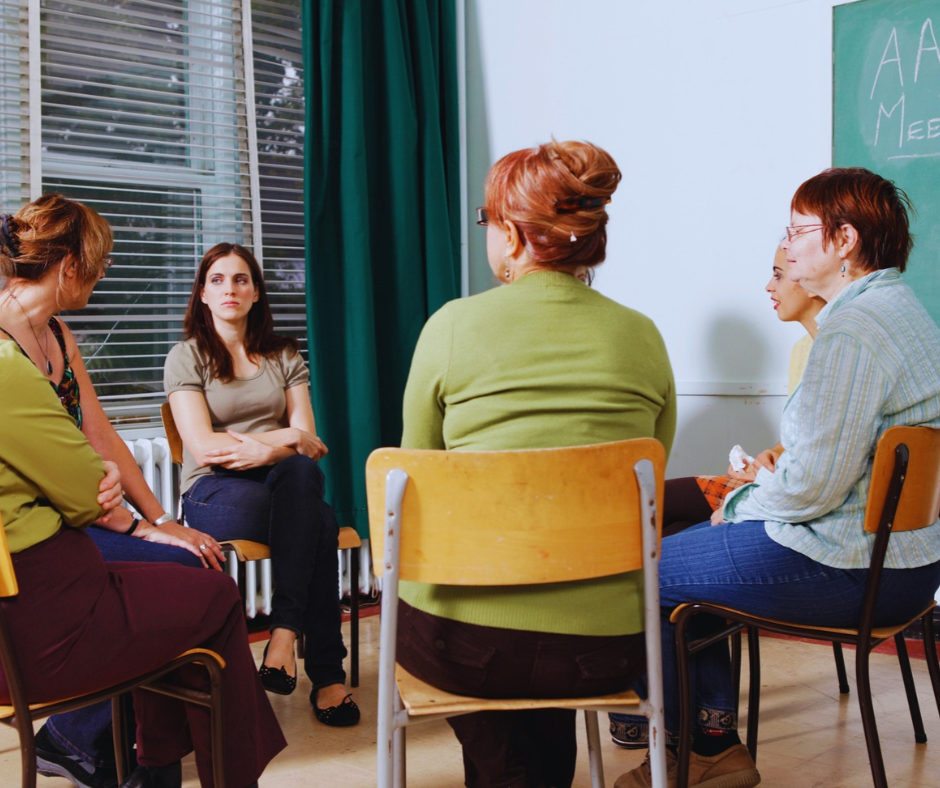
Chairs were arranged in a circle, there was a table with leaflets and books on, the faint smell of coffee and some custard creams and caramel wafers on a plate.
My very first ever meeting was surprising because I thought it would be all doom and gloom but people were laughing and joking. They also weren’t going round patting each other on the back congratulating each other for not having had a drink today. It was actually quite spiritual with readings and a prayer at the end.
There was no soundtrack in my head or anything to suggest this was the start of a dramatic turning point.
People were chatting, making tea or just sitting down – one woman had her knitting with her, another had a baby.
I have spent so long imagining the meeting that I have furnished it with public confessions, people crying, a compulsory introduction in which I am required to explain myself in front of strangers.
Promptly at the scheduled time, somebody started the meeting. They are called the secretary. But they aren’t actually very secretarial at all. It’s a guy with tattoos, muscles and a deep voice.
There is a reading, and then people begin to speak.
They talk about drinking in the morning. About hiding bottles. About the elaborate arithmetic of addiction: how much is left, how much can be bought without anyone noticing, how long it will it take to feel normal again?
I sit very still. These stories and thoughts are basically my own. I thought I was uniquely complicated and I had even developed an extensive personal mythology around it. My reasons are particular; my circumstances are unusual; my capacity for self-destruction is somehow more nuanced than everybody else’s. If you’d been through what I’ve been through…
But as I listen I begin to suspect that I am not a fascinating exception but a fairly ordinary person with an addictive personality.
There isn’t a single person who looks like your typical paper bag homeless man on a bench. Of course, he would be made welcome should he want to attend and we hope he does when he’s ready.
But it’s mainly middle-class professional types and people with trades. There are nannies, plumbers, police officers, grandmas and grandads talking about having enjoyed the day with their grandchildren. It’s a cross-section of society, of course.
Nobody is looking at me weirdly or wondering if I’m sober. I feel safe and welcome and like I could approach any one of these people if I wanted to.
There is something moving about hearing a stranger describe a thought you have been too ashamed to admit yourself. Who knew that Wellington boots are such a popular choice for hiding wine bottles?! Someone shared that they once took a massive carrier bag of clinking bottles onto a bus and then accidentally on purpose left it behind as they got off at their stop. Everybody laughed.
They spoke about getting through today without killing their husbands or kids for not emptying the dishwasher. About making the next right decision. About what happens when you stop drinking and discover that the person you have been trying to escape is still there, waiting for you, with all their irritating habits and unresolved business.
When it is my turn to speak, I say very little. My voice sounds strange in the room. I explain that I am new, that I am not sure what I am doing, that I have been having a difficult time. These are technically true statements, although they leave out enough information to qualify as a continuation of my usual approach to honesty.
Nobody demands the missing details.
Someone nods. Someone smiles. The meeting carries on.
I realised that I had been waiting for a verdict. I thought I would have to prove the seriousness of my problem, submit evidence, demonstrate that I had suffered sufficiently to deserve help. Instead, the only apparent requirement is that I have turned up. Nobody was going to give me a piece of paper with “alcoholic” stamped on it or tell me I’m far too well and to never darken their doors again.
Afterwards, there was more tea and coffee. People talked about ordinary work, family, the weather, the practical business of getting through the week.
I have spent an hour in a room with people who understand a part of me I have been trying desperately to conceal. I have said a few words. I have listened. I have discovered that the world did not end when I admitted I needed help.
St Albans looks the same as it did before the meeting. The Cathedral is still there. The pubs are still there. The town has made no special arrangements for my recovery.
I am oddly glad about this. It means I don’t have to become a different person by tomorrow morning. I don’t have to make a grand announcement or construct a new identity from scratch. I can just come back and I can sit in the circle again. (They aren’t all in a circle – depends on the layout of the room I guess. Sometimes chairs are in rows).

Some misconceptions…
They don’t talk much about alcohol.
I think people imagine there will be a lot of discussion about types of alcohol, which ones they like and how many people was the optimum amount. Or discussions of wild nights out knocking back tequila shots until they vomited.
Obviously drink can be part of people’s sharing but generally – considering it’s called Alcoholics Anonymous – alcohol doesn’t feature as highly as you might expect.
I think it’s because they are too busy talking about how much better their lives are without it. What sobriety has given them and how they work the twelve steps.
There are no leaders.
A person called a ‘secretary’, who is just a regular AA-goer, takes the meeting. By this I mean, they welcome everybody at the start and introduce the person who is going to share their story with the rest of the group. They might then tell people when it’s time for them to “share back” which means to say thanks to the person for their story and to say something about their own recovery if they want to.
But nobody is in charge. Everybody is equal and nobody is paid. The groups run on a democratic basis and hold space to discuss anything practical that might come up such as whether to change the time or day or what to do about the organist having their rehearsal at the same time as the meeting.
That sort of stuff.
It is free (sort of)
A cup or a pot is passed around for people to put in a coin or whatever they can. It pays for the hiring of the room and tea and coffee etc but nobody is forced to give any money and if you turned up without anything to put into the pot that would be totally fine. AA is self-funding.
You will see all types of people from different backgrounds, cultures and classes.
From celebrities to 90-year-old former paratroopers, you’ll see all types of folk in a meeting. People in hoodies, people in suits who might have just come from work, people who have nothing and are at the start of their journey maybe staying in a nightshelter. Everybody is equal and often all share the same feelings, thoughts and experiences. The age and gender balance is pretty even and some people could be under twenty.
There is at least one face-to-face meeting every day of the week in St Albans even on Christmas Day.
There are meetings all over St Albans at different times of the day. There are lunchtime meetings from 1-2pm, evening meetings from 8pm and some morning meetings that start at 11am. People dip in and out as they want and you don’t have to sign up or keep going to the same one. And they are there all year round, including Christmas Day andNew Year’s Eve.
You can take someone with you – and some every let dogs in.
If you feel that it’s too much for you to do on your own you can take a partner, parent, friend or even your dog with you to some meetings. It’s worth checking on the website for whether it’s an open meeting or a closed meeting.
If you are curious or would like to help a friend or relative you can find more information here.