12 Jan 2026
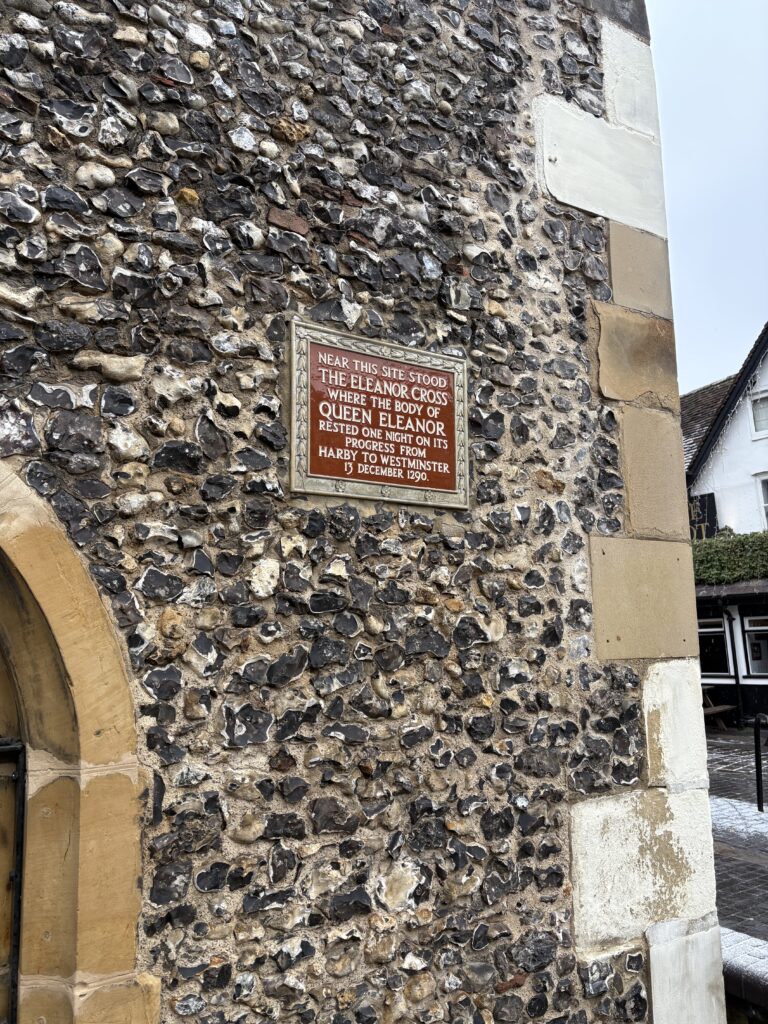
A ceramic plaque on the side of the Clock Tower is all that remains of St Albans’ Eleanor Cross, one of 12 erected to mark the overnight resting places of the beloved medieval queen’s funeral procession.
Installed by St Albans and Hertfordshire Architectural and Archaeological Society in 1929, it reads: “Near this site stood the Eleanor Cross where the body of Queen Eleanor rested one night on its progress from Harby to Westminster, 13 December 1290.”
The cross was built in 1294 by John of Battle at a total recorded cost of £100, with some of the sculpture supplied by Ralph of Chichester.
It was very much a focal point in the town, and in 1381 was the location where the insurgents burnt muniments taken from the Abbey and later read out their short lived charter of freedom, as well as where the “heretical” books of the Lollard Walter Redhed of Barnet were burnt after he recanted in 1426/7.
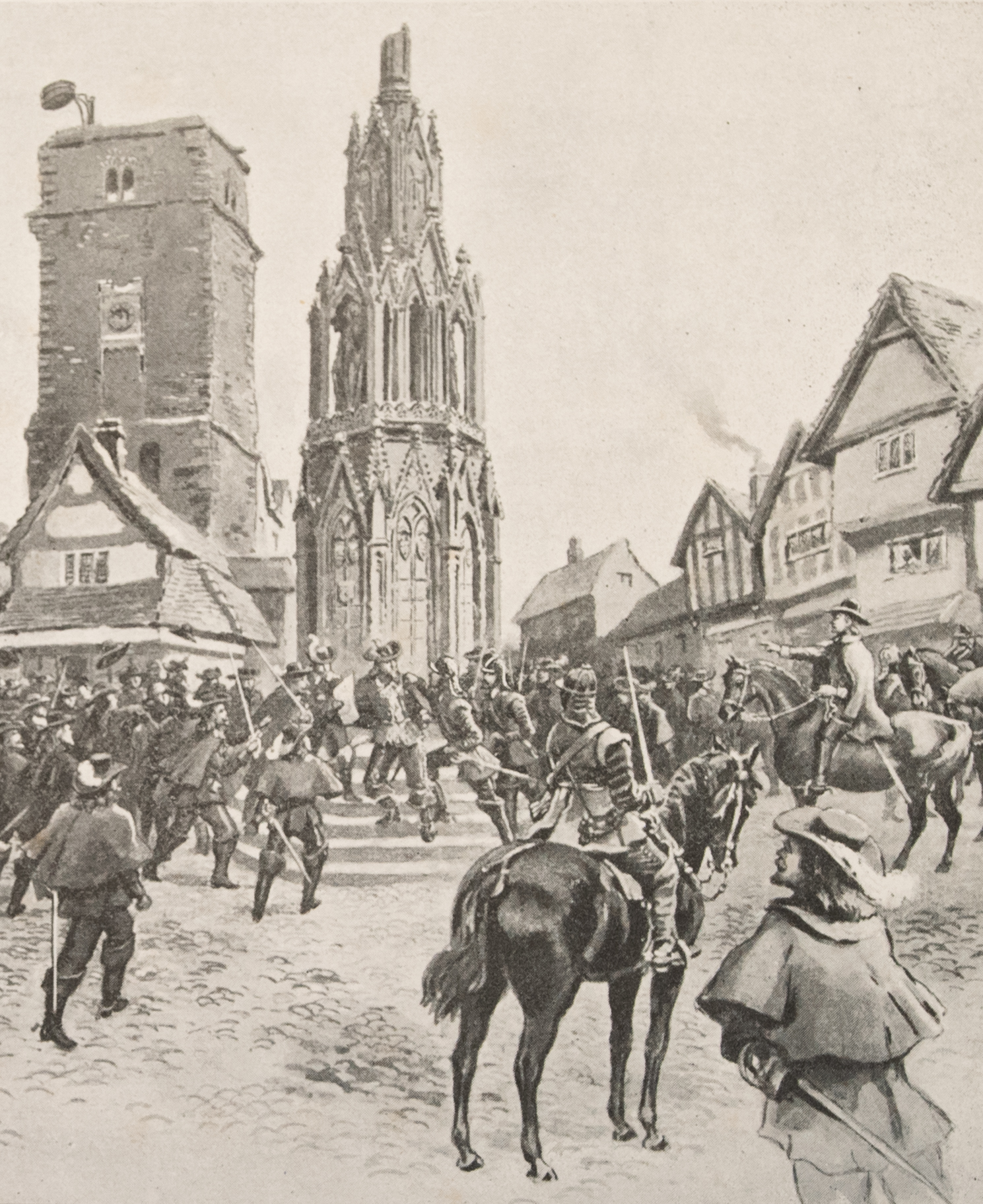
In 1643, the High Sheriff of Hertfordshire is reported to have read a Royal Proclamation from the steps of the Eleanor Cross, advocating the raising of Trained Bands, before his arrest by Oliver Cromwell.
Over time, it gradually fell into decay, and the surviving stump was eventually demolished in 1701-2, although parts were used for the construction of a market cross which lasted until 1810.
No contemporary pictures of the cross survive, although Frederick Kitton did include it in his illustration of the High Sheriff’s arrest, an image now in the collection of SAHAAS president Dr John Morewood.
But now a new book charting the final journey of Eleanor of Castile brings a fresh perspective on St Albans’ role in the ceremony, as well as personal observations on the history today.
Written by historian Alice Loxton, ‘Eleanor: A 200-Mile Walk in Search of England’s Lost Queen’ (Macmillan 2025) celebrates one of our country’s most remarkable – yet little known – monarchs in a mix of travelogue and historical commentary.
Towards the end of 2024, on the exact dates of the medieval procession, Alice walked the route of the funeral cortège from Harby to London on foot, including a section along Watling Street, now the A5183, passing through Markyate and Flamstead before arriving in Redbourn.
There she muses over some of the names of local businesses, referring to the village as ‘pun-land’: “No longer preoccupied with bonnet production, Redbourn seemed to have carved out a new niche: quirky shop names. In this high street, pun-mania abounds.
“I passed a small wooden board advertising ‘The Barefoot Accountant’: ‘accountancy services for creative types’, then saw a tea room whose sign had symbols from Alice’s Adventures in Wonderland – the Mad Hatter’s hat, a pocket watch – and bore the establishment’s name: ‘The Queen of Herts’ – a nod to the county of Hertfordshire.
“Next, a hairdresser’s, named ‘Knock Knock Who’s Hair’. Nearby, a dog-grooming spa and boutique named ‘Clippin Marvellous’ and a fish-and-chip shop, ‘Fishy Fryer’. The Salon of Gems advertised its services with the inspirational slogan: ‘Life is short. Make every hair flip fabulous!’.”
Working her way down the Nickey Line and a path besides the River Ver, she follows the route of the cortège and enters St Albans through what is now Verulamium Park and then on to St Michael’s Church, where townsfolk gathered in mourning in December 1290.
As the Abbey’s chronicler Matthew Paris recorded: “When her body… approached St Albans all the Abbey, solemnly dressed in albs and copes, went out to meet it at the church of St Michael on the edge of the town.”
Making her way into the city centre, Alice gives an amusing perspective on St Albans Cathedral, which she describes as a hive of activity.
“There were primary-school children sprinkled everywhere – some sitting on the nave, looking up to the vaulting; some wandering the aisles, perhaps hearing tales of purple frogs. In the nave – the longest in the country – were a team of flower arrangers preparing the cathedral for Advent.
“In the south aisle were boxes of flowers piled high with all kinds of labels: ‘High altar candle sticks’ and ‘White poinsettias’. A bucket of carnations was labelled ‘Niche 1’. The lilies were for ‘Niche 4’. I enjoyed watching a Mothers’ Union event, where an enthusiastic clergyman did his best to encourage unruly toddlers to sing ‘Away in a Manger’.”
Visiting the Shrine of St Alban, she lights a candle and reflects: “Metres from the shrine is the spot where Eleanor’s body was brought, on 12 December 1290. It was recorded as follows: ‘her body was taken to the choir of the church, before the high altar. That whole night it was honoured by the entire abbey with great devotion, with services and holy vigils’…
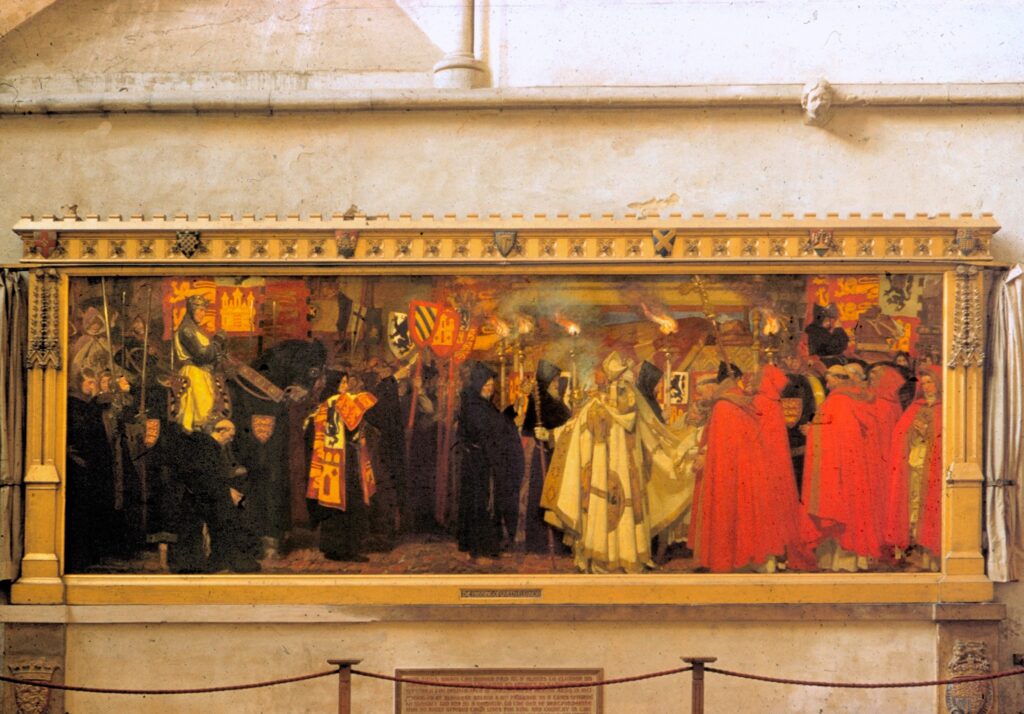
“For some years, a beautiful painting, titled ‘The Passing of Queen Eleanor through St Albans’, hung in St Albans Cathedral, which depicted the funerary cortège. It was painted in the early twentieth century, by a young artist called Frank Salisbury, and was a vast piece of art, measuring 17 feet by 5 feet…
“It was in theatrical medieval style – as if you’re looking at a cast on a stage. In the background, Eleanor’s body is carried on a golden bier. Beside her are hooded figures in red and golden robes, carrying torches of fire. Her shields – that of England, Castile and Ponthieu – are borne, held up high. To the left of the painting, a pensive King Edward rides on a magnificent black horse, followed by a bevy of knights. He is decked in full armour, with a crown perched upon his head.”
Bought by the Mayor of St Albans in 1918 for presentation to the Abbey in memory of local men who died during WWI, she says it was castigated by purists as “a grossly inaccurate parody of a medieval scene”, before being displayed in the south transept. Unfortunately it was cut from its frame by thieves on the night of October 13 1973 and lost forever.
Alice enjoys jacket potato with cheese and beans in the Abbot’s Kitchen before pottering around the shop and adopting an organ pipe, and then wandering into the town.
There are references to the execution of John Ball and the two battles of the Wards of the Roses before Alice finds the Clock Tower and the plaque commemorating the site of the Eleanor Cross.
Rather than holding an overnight vigil in the Cathedral, she spends the night at the White Hart Hotel, recalling how the artist William Hogarth painted Scottish chieftain Simon Fraser, Lord Lovat, there ahead of his transportation to London for execution – becoming the last man in England to be beheaded on April 9 1747.
On Wednesday December 13 1290, 15 days after Eleanor’s death, the cortège left St Albans and headed towards Waltham Abbey in Essex, and seven centuries later, so did Alice…
Additional sources: The Market Place by Chris Saunders, stalbanshistory.org