25 Dec 2025
Although it would be unfair to compare St Albans MP Daisy Cooper to Dickens’ Ebenezer, it is reasonable to suggest that at this time of year she may find herself contemplating the Spirits of Politics Past, Present and Yet To Come.
On the back of a tumultuous year in Westminster, coupled with ongoing challenges faced by residents in her constituency, there is much to reflect on while at the same time considering what the future has in store.
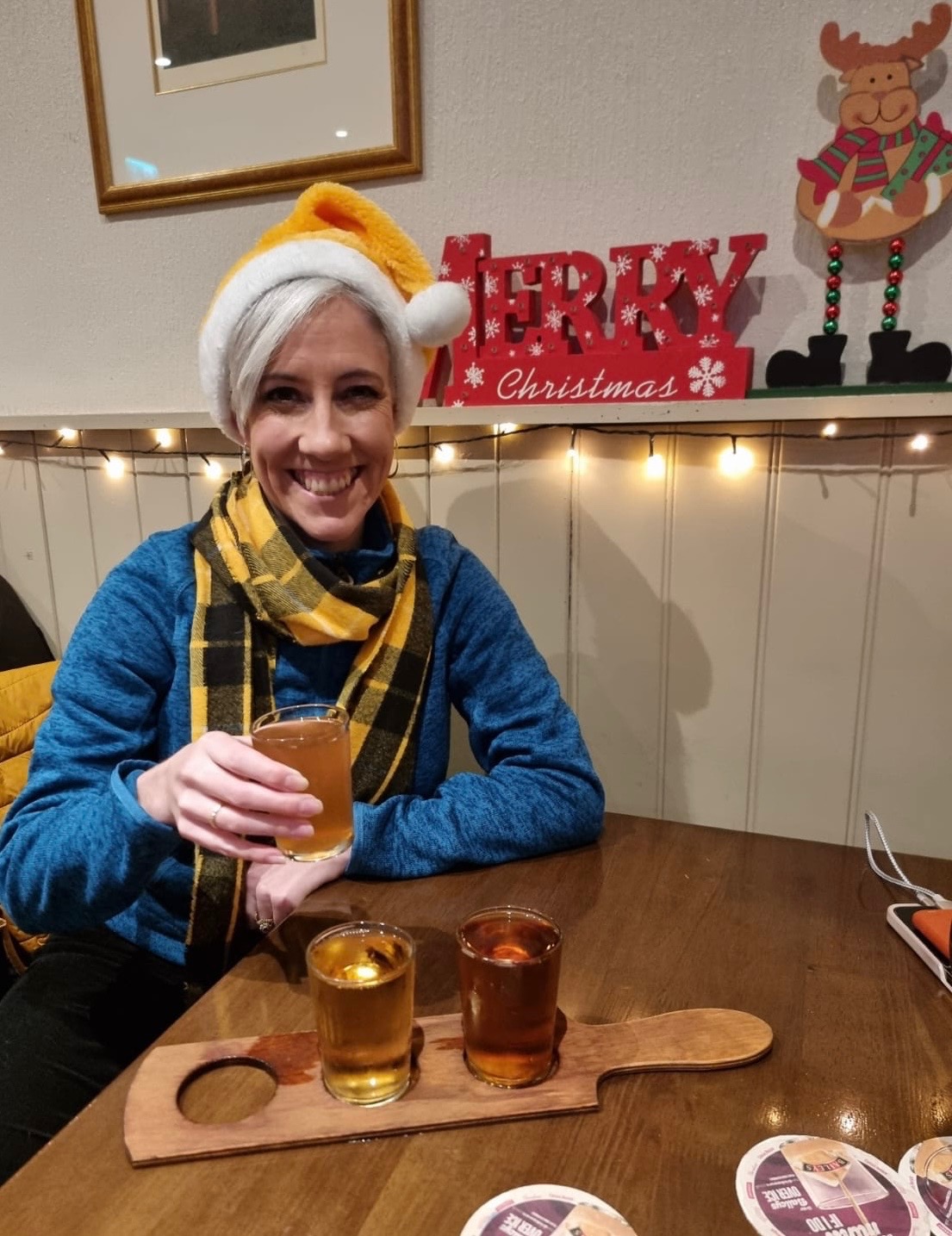
So as 2025 draws to a close, what better way of marking the calendar’s end than catching up with our Parliamentary representative over a mulled wine and some mince pies to muse over what has passed, and what lies ahead…
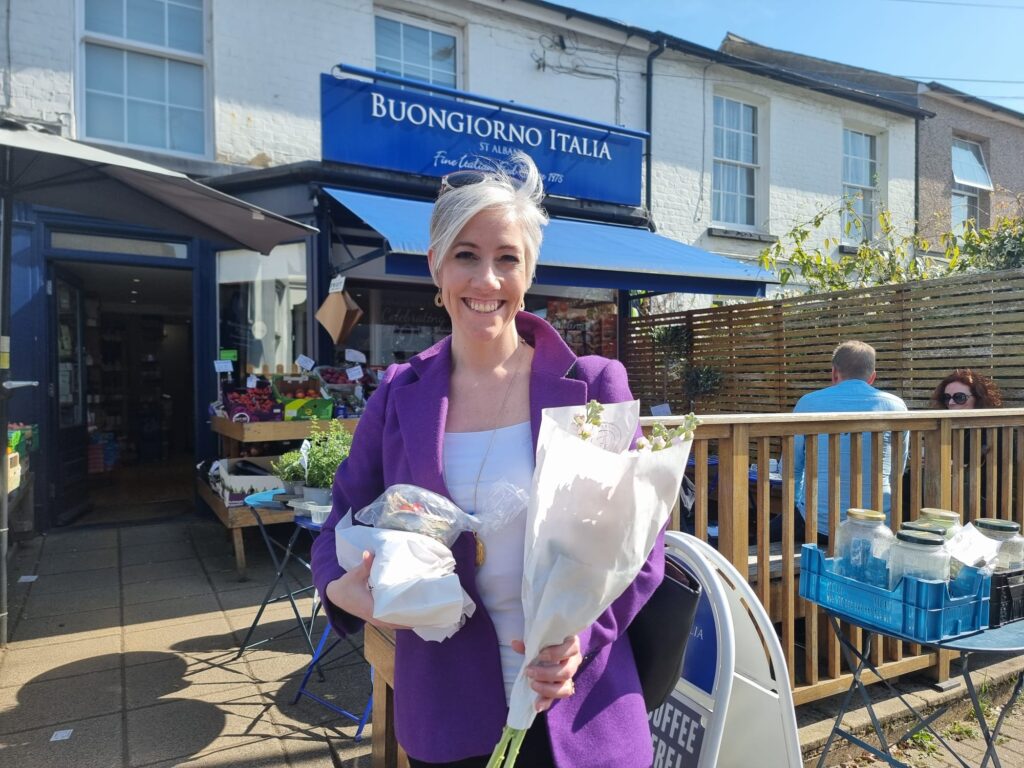
Daisy says one of her personal highlights of the year has been supporting new businesses who have bravely decided to set up in what is obviously a very tough economic environment.
“It’s clearly still a very difficult time for a lot of people with the cost of living and the cost of doing business. But I’m such a believer in the power of our high streets because they are at the centre of our community, so it’s really fantastic to see people starting new businesses and managing against the odds to succeed.
“You see their passion and energy, and maybe it’s just a bit of luck as to whether or not they get the right property at the right rental price in the right part of town, but when those things come together and you see somebody thriving, it’s really rewarding and lovely to see.
“I guess of all the visits I’ve done, I’ve enjoyed meeting those new businesses who are wanting to make a success of it under incredibly difficult circumstances.
“Of course I also meet business owners who haven’t been so successful, and that’s really heartbreaking, because they’re not just losing a shopfront, it’s their livelihood and sometimes they’ve even remortgaged their house, so those moments are really difficult.
“But when someone has a dream or a vision for what they want to do, and they make it work, that’s really joyful.”
Does she not feel impotent in the face of the Government’s lack of compassion for the situation faced by small businesses? Despite hopes of positive news coming out of the Autumn Budget, the situation seems to be getting progressively worse, and nothing the opposition parties say seems to have any impact.
“What I hear time and time again from small businesses here in St Albans, but also from the big trade associations and industry bodies that I talk to at the national level, is that the Government isn’t listening, and I honestly don’t know why.
“I’m not in the head of Rachel Reeves or any of the Treasury ministers, but my take is that it ended up being a Budget to hold the Labour Party together, to deal with internal management rather than delivering for the country.
“It’s really bizarre because two or three weeks before the Budget the take in Westminster was that they were going to do a Year One Budget in Year Two. Now the conventional thinking is that when you get a new Government they do the really big stuff in the first year because it’s unpopular and difficult, but they’ve been given permission by the electorate.
“But they didn’t have a Year One Budget, and the idea they might have had this in Year Two hasn’t come to pass either. What that now means in political terms is it’s too late [for this Parliament] to do all the things they were talking about, such as overhauling business rates and property taxes, looking at council tax and duty together and putting a new system in place that would be fairer for everybody everywhere.
“So it’s too late to have a big reforming Budget because you will need a long period of consultation, which means as a result things will continue to plod along.
“The real frustration is that last year the Government introduced the ‘jobs tax’, which hit businesses that are people intensive like hospitality and the care sector.
“You and I have been talking about business rates since before I was elected in 2019, right? This is a long-standing issue and lots of businesses have closed over the years because they haven’t been able to cope with them.
“Although they’ve reduced the rate for one part of the calculation, everything else has gone up.
“For the last year, [the Government] has been using the word ‘lower’, but when people’s bills arrived they said ‘higher’.
“They made business decisions based on the assumption that business rates would roughly stay the same or possibly go down, but now some of our pubs for example will see their business rates go up by 80 per cent over the next three years. I haven’t worked out how many pints that is, but it’s more than a skinful.”
Although she is widely recognised as a champion of small businesses, Daisy has also been criticised on social media for being guilty by association with the Lib Dem-led SADC, and accused of not doing anything to tackle the vehemently unpopular on-street parking charges which have taken hold across the district.
We all know that successive Governments have underfunded local authorities, and some hard choices had to be made, with parking charges one of the ways the council can balance its books, but in terms of the dynamics between Daisy and SADC, can she sit down with council leader Paul de Kort and parking lead Helen Campbell to open a dialogue on the fees and consider the options?
“Fundamentally there are some services which are at the discretion of the council, but of course I discuss them all. When I go to the district council in nine out of 10 cases it’s knowing there’s a problem and trying to come up with a solution.
“Where there are real challenges I will have a direct line to the lead councillor and say, ‘Look, we’ve got the find a way to solve this’, and between us and the officers and the councillors we’ll sort it.
“The real challenge around parking is that to date I’m not aware of any proposals that would actually work to help the council balance the books.
“I don’t want to make an overly political point, but when the [SADC] budget comes round every year, opposition parties can table amendments. The only amendment tabled last time round by the Conservatives would have seen CCTV slashed in St Albans and Harpenden, and at a time when small businesses are really struggling and we’ve seen an uptick in snatch thefts you can’t be cutting CCTV.
“So if people have other proposals which could work and balance the books, we absolutely are all ears. So I do raise these issues and talk about them with the council, but it’s about coming up with solutions to make it work.
“I really do appreciate that people are struggling and any additional cost can be a barrier, whether it’s for people working on the minimum wage in our shops or people parking near their homes, but nobody comes into politics to put up these charges, it’s a direct result of councils having their budgets cut all the time.”
Daisy has also enjoyed various school visits over the past year, especially as many of the children seem particularly focused on the workings of Government at the moment: “They’ve been really engaging this year. Every so often something happens politically and ends up on the children’s radar. I remember doing school visits after Partygate, and the kids all wanted to know why they hadn’t been allowed to have their birthday parties while Boris Johnson could.
“It was one of those moments they will remember for their entire years, not being able to celebrate their birthdays while he partied.
“We’ve also got children in our community from Ukraine, or Hong Kong, or Afghanistan, and their classmates want to know what’s happening in those countries, and what I’m going to do about it.”

Of course, sometimes the children are fed questions by their parents in advance, so Daisy might be asked about road repairs or why delays to the trains meant Daddy couldn’t get back from work on time on Tuesday night: “That’s par for the course,” she smiles.
“One of the questions I love asking, because they always have questions for me, is if there was one thing they could change – anything at all – in St Albans or the country, what would it be? You get some amazing answers…
“I recently had one little girl in a Brownies group, who just said, ‘my wallpaper’ so clearly she was on a mission to get her mum or dad to agree to change it, it was obviously her number one goal.
“And then another little girl somewhere else said something so charming that I felt quite emotional. She said, ‘when people go into hospital I would like it if every single one of them could come out’. I was quite blown away, it’s a very grown-up thing to say. You never quite know where that’s coming from, so I asked her if she had personal experience of someone going into hospital and not coming out, and she just looked a bit quite and sort of nodded. I said, ‘Do you want to be a doctor when you grow up?’, and she said ‘Yes, I do, I want to be a paediatrician’.
“I thought, flipping heck, how could she even pronounce that word when she’s about seven years old, let alone decide that’s what she wants to be!”
Inspectors from Ofsted and the Care Quality Commission (CQC) recently identified that Hertfordshire’s SEND partnership in Hertfordshire – led by the county council and the NHS integrated care board – has taken ‘effective action’ on two areas for priority improvement since their last inspection in July 2023.
So are things finally turning a corner for the SEND service locally after years of failings?
“It definitely has improved, and objective reports say so. I always say that my inbox is a bit like a sort of canary in the coal mine – it gives you a flavour of what things are like in any given service.
“A couple of years ago I had parents with SEND children coming to me who were about to lose their homes because they couldn’t afford the mortgage payments after they left work to look after their kids. So really, very, very acute cases, and now the acuity isn’t as strong because a lot of these cases are getting caught earlier.
“We don’t get as many of the emails saying an Education and Health Care Plan has someone else’s name on it, or it reports somebody else’s condition, or wasn’t what was agreed.
“That’s really infuriating because parents and families can spend months, if not years, fighting and fighting and fighting to get a diagnosis, to engage with the school and get a health care plan, and then when it finally arrives it’s not even yours.
“So yes I’m really pleased that the service is improving, and there’s the leadership within HCC now to make sure it continues to improve, but my frustration is that for any council anywhere in the country, irrespective of which political party is running that service, ultimately SEND is a broken national system too.
“There’s only going to be so much that any local authority can do while the Government continues to sit on its SEND reforms. These were supposed to be published before Christmas, and now they’ve kicked them into the New Year, and I hope that doesn’t happen again because we’re all waiting anxiously to see what they will look like – whether it will be tinkering around the edges or an overhaul of the system to make sure that fundamentally kids get the support they need as quickly as they need it.”
Looking into the future, Local Government Reorganisation obviously casts a broad shadow, not least because of the uncertainty surrounding Unitary Authorities and how they will align with Parliamentary constituencies.
“I was against this whole reorganisation because I don’t see it as a move towards devolution, I see it as an attempt to cut costs and centralise power so the Government has fewer people to talk to.
“I do think that there’s something very powerful about having very similar boundaries [between a council and MP] because it means you build up a shared understanding of different areas and what the challenges are. It can then be very challenging to have to work with different officers in a different council that has different structures and different issues on their minds because you don’t necessarily know what their priorities are.
“I guess my fundamental concern in terms of reorganisation isn’t so much how I work with the new unitary authority, whatever that looks like, it’s more about how residents access services. Most people in the St Albans district can get to the council offices if they need to, to talk about housing, benefits or anything else, and it gives them a sense that they’re connected.
“My fear is that with any new unitary structure that will just be further away, and people won’t be able to walk into the centre of St Albans and say, ‘that’s my council building’.
“My hunch is that I’ll probably end up picking up more casework because people will be struggling to speak to the council directly, but whatever the unitary authority looks like, whatever area it covers and whichever political party ends up running it, I hope I can build a strong relationship with them.”
Looking to the performance of the Labour Government over the past year-and-a-half, what hopes does she have for the remainder of this Parliament?
“I think the real challenge is that they came into power not knowing what they wanted to do, and they’ve squandered an enormous amount of time and goodwill.
“Everyone accepted Labour had been left a bad inheritance by the Conservative Party, but they were given an enormous mandate to fix stuff and change things, but 18 months on it’s really hard to point to anything that’s fundamentally improved.
“We want to be a constructive opposition, but increasingly I find myself attacking the Labour Government because they’re not listening to any of our suggestions, and that’s very frustrating.”
She said the problem is that they’ve never defined what it is they are trying to achieve: “I’m a big believer in saying, right this is where I want to be, and charting a path to get there. The one thing that Labour hasn’t done is say, ‘this is where we want the country to be in five years’ time’.
“They could have been really upfront about the fact that there was going to be some pain for the first year or two, and I actually think the British public might have been quite forgiving of that. But Labour went into the General Election with the ‘Ming vase strategy’, don’t make a mistake, don’t drop anything.
“The day after the election they should have dropped that vase, rolled up their sleeves and said, ‘this is what we’re trying to deliver’, but there is no shared understanding of what the Government is there to do or who they represent.
“They pissed off the pensioners by messing up the winter fuel reform, they brought in a family farm tax which was a real botched job and could have been done in a way that closed the loopholes, and with this Budget, the changes to the salary sacrifice scheme and sales taxes hit their broad middle-class base, who are the last people still thinking of voting for the Labour Party.
“So it’s really not clear to any of us who they’re speaking up for, and I say this as somebody who wants this Government to succeed, because I want things to get better for the folk who live here in St Albans.”
Does she think there is a potential for a backlash against Labour giving the more extreme parties a chance at seizing power?
“I don’t see it as that much of a threat at the moment, but it could be in the next few years. My overall view is that politics is so febrile at the moment that it’s almost impossible to guess where we’re going to be in a couple of years’ time.
“But I am obviously aware that lots of people are talking about a Reform Government, or at the very least a massive increase in the number of MPs they have. I think that would be very dangerous for the country on many levels.
“I think many of their policies are economically illiterate. Their idea of ripping up the independence of the Bank of England is like Liz Truss’ mini-Budget on speed, I think their failure to apologise for or distance themselves from far right rhetoric is really, really dangerous.
“They’re talking about throwing out illegal immigrants, and not just people who have arrived here through irregular routes, but ripping up the rights of people who were allowed to come here and build their lives, tearing apart families and causing chaos in the economy. I am very, very, very motivated to stop that from ever happening.”
So to return to the Christmas Carol theme once more, what needs to change to stop that future from coming true?
“There are some very big questions facing us all as politicians. How do we manage the welfare bill? What kind of country do we want to be – high or low tax? How are we going to get young people into work? How do we deal with the fact that we’re all living a lot longer, but not necessarily healthier? How do we completely reorganise public services?
“At the same time we’re not ready for war, a very active day-to-day form of cyber warfare in just a few years’ time, with interceptions of supply chains and underwater wires and cables and those kinds of things.
“As a country we’re just not ready for any of these big challenges, and that’s before you get to things like AI, the climate emergency, unreliable allies and the rest of it.
“I want to go through some of that deep thinking about what the answers are, and I am utterly determined that in about 12 months’ time the Lib Dems will be in a position to set out a very strong, compelling and emotional vision for what a liberal Britain would look like, and that’s a big driver for me at the moment because I think there’s an alternative to the other two big parties which have proven themselves to fail in Westminster, and I certainly don’t want Reform to take their place.”
Until now the Liberal Democrats have been the party of opposition, so how do they turn around and become a driving force for something positive which isn’t reactionary and get people to buy in on that?
“It needs to be more forward-thinking and proactive, really. It will just take a bit of time. We’ve got some processes in place at the moment within the party. Nationally, we’ve got a new policy working group looking at our approach to the economy, and I’m playing a very active role in that group.
“We’re looking at the future of the high street. As I’ve said before, I’m a big believer in high streets, and I love going around Britain, seeing different high streets wherever they are. I think they are a fundamental driver of the economy in every village and town.
“So we’re doing that deep thinking on some of these big issues. But it does just take time because you can’t go around blaming billionaires for this or blaming foreigners or immigrants for that. It’s not realistic.
“If we want to be seen as a potential party of power then we have to have answers to those big questions.
“There are two things I would add to that. One is that I’m a big believer in good people. I think good people bring good ideas.
“The other thing is that I was elected, I spent a lot of my life creating stuff out of nothing. So I’m very good at getting people together and saying, let’s create a thing, let’s build an organisation, let’s build a campaign, let’s make something happen.
“We did it in St Albans, and we’ve done it in other parts of the country, so it might take a little bit more time, but we are determined to get to that place.”
One last question then, what is she looking forward to in 2026?
“Nationally, I love the idea that we could have peace in Europe, but on terms that respect the sovereignty of Ukraine and the sovereignty of our continent. I don’t know whether that will come about or not, but I remain always glass half full and hope that that might be somewhere we can get to.
“Here in St Albans, I would just really, really, really like life to just get easier for folk. You know, it goes back to this issue that people were promised change, and I would really like it if they just felt like it wasn’t quite as hard every single day.”