05 Mar 2026
Today marks World Book Day, when children across St Albans will don their favourite literary costumes in celebration of stories and imagination. Katie York, head of English at Beechwood Park School in Markyate, shares her reflections on raising readers in a distracted age…
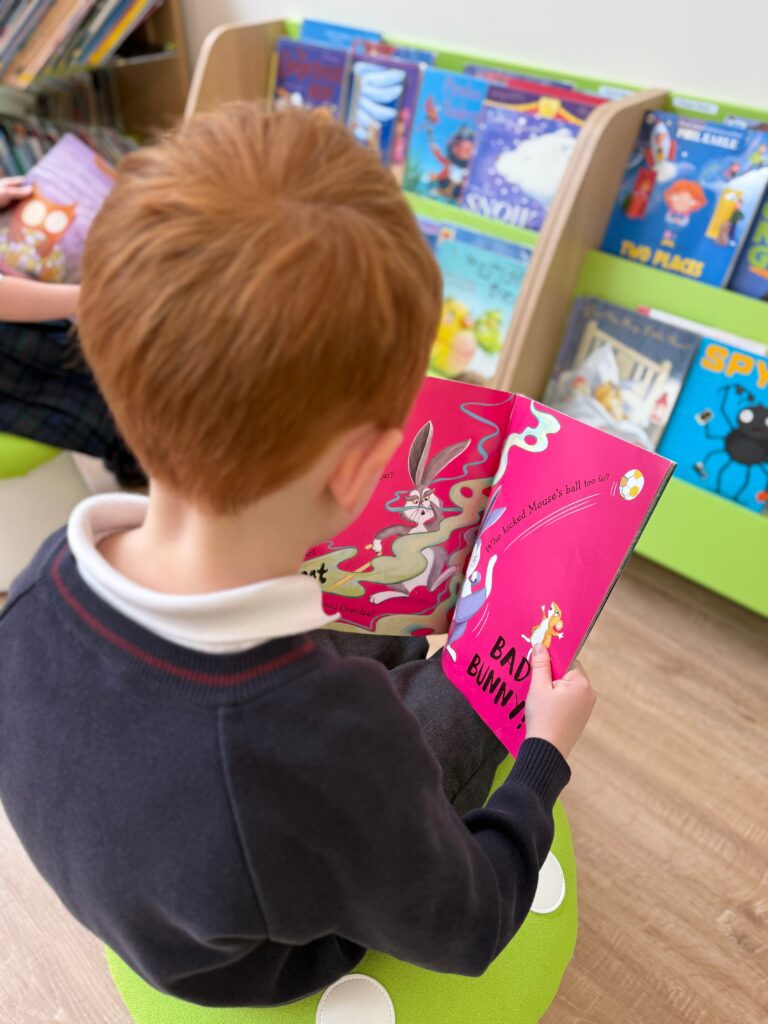
At Beechwood Park, World Book Day is part of a much wider commitment to nurturing a lifelong love of reading. Alongside the ever-popular dressing up, pupils will be immersed in a week of activities designed to champion reading for pleasure and to spark curiosity well beyond the classroom.
But in an age dominated by screens and constant distraction, what can parents do when faced with the familiar refrain: “I don’t like reading”?
It’s a phrase that can strike mild panic into the heart of any parent. Especially when the bookshelf is well stocked, the school reading diary is dutifully signed, and World Book Day costumes have been carefully prepared.
What does a child really mean when they say they don’t like reading?
I don’t like reading that book.
I don’t like reading when I’m told to.
I don’t like reading when I’m tired.
I don’t like reading when it feels like a test.
Very rarely does it mean, “I don’t like stories.”
As teachers, we spend a great deal of time teaching children how to read. Phonics, fluency, comprehension, inference: the essential foundations. Yet alongside this sits something less measurable but equally important: helping children to want to read.

Research from the National Literacy Trust (2024, 2025) consistently shows that children who read for enjoyment perform more highly across the curriculum, not only in English but in mathematics, sciences and humanities. International findings from an OECD PISA study (2010) suggest that reading
enjoyment is a stronger predictor of academic success than socio-economic background. In other words, cultivating a love of reading may be one of the most powerful advantages we can give our children as they navigate through an increasingly complicated world.
Attainment data is not the only thing in question. The University of Sussex found that reading reduces stress by up to 68% per cent (2009).
Reading takes us out of our own world and gives us the opportunity to encounter new ideas. A child absorbed in a story must hold in mind the thoughts, motives and misunderstandings of characters different from themselves. In doing so, they practise empathy – not as an abstract virtue, but as lived experience. They encounter cultures, eras and viewpoints beyond their immediate surroundings, quietly developing the cultural literacy that allows them to move confidently through life.
Perhaps most importantly in an age of constant notification and scrolling, reading trains sustained attention. It builds concentration in a world that increasingly fragments it. We are able to experience other lives, other eras, other possibilities – all from the comfort of a chair, and without negotiating with the addictive dopamine hit of a screen. In a world of computer culture, reading slows us down. I grew up watching my mother and grandmother read voraciously; I never needed persuading to pick up a book, and I ardently wish the same for my pupils and for my own daughter. Reading should not be a task, but a shared language which builds identity and strengthens sense of self.
In childhoods filled with opportunity; fixtures, music concerts, after school clubs and birthday parties, reading often quietly slips down the list. A 2024 study found that children whose parents regularly read aloud, stocked books at home and visited libraries demonstrated significantly stronger reading proficiency. Schools teach children to read but families teach children to value reading.
At Beechwood Park, we believe education is a journey best travelled together, with children, families, and teachers working in partnership. Fostering a love of reading is our collective responsibility, and during the school day, we are intentional about protecting time and space for it to flourish.
Every pupil at Beechwood Park has a dedicated library lesson each week; reading is not an optional extra. Over time, we have worked to build a visible reading culture where books are not simply tools for assessment, but objects of enjoyment and conversation.
Reading is socially valued and proudly visible. Our staff model this daily: we even have a staff book club, and in the older year groups it is not unusual to see teachers reading their own novels during class library sessions, demonstrating that reading does not end with childhood.
Our library itself is the vibrant heart of the school.
A beautiful space, certainly, but more importantly a living, breathing hub of curiosity. Its shelves hold a diverse and regularly refreshed collection, chosen to reflect a wide range of interests, identities and reading levels. Rather than prescribing rigid reading lists, we create reading pathways: if you loved this story, you might be captivated by this one. Choice, after all, is one of the strongest drivers of genuine engagement. And we celebrate reading. Through book awards, pupil recommendations and shared conversations, we make clear that reading for pleasure is an achievement worth recognising.

At school, we can create the conditions for reading to flourish. At home, those conditions become habits. We understand how challenging that can be. In households already stretched for time, asking parents to prioritise reading can feel like one more demand. Family life is full and evenings are short.
Where does reading fit? I have a few top tips to get started, tried and tested with my energetic and independent three-year-old.
1. Protect 10 minutes a day .. or more if you can
Make family reading time a non-negotiable part of your routine (before bed works best). Get snacks, dim the lights, turn devices off, and sit as a family reading whatever you all would like. Children who see parents read are far more likely to do so themselves.
2. Normalise choice over challenge
Graphic novels, fantasy, a magazine, newspapers – all valid.
The ideal is that children enjoy a range of genres, but it is perfectly normal for them to go through phases where they exclusively read one series of books or only enjoy one genre. I’d highly recommend The Week Junior or First News subscriptions if you’re looking to broaden their exposure to different text types.
3. Create “book-rich” environments
When books are woven into the spaces children use every day, it sends a clear message: books belong in our everyday lives and are valued in our home.
4. Avoid turning every book into a comprehension exercise
Don’t feel you have to ask your child about their book, just let them read and enjoy.
5. Use optional extras to add variety: audiobooks and making up stories together
Audiobooks are a simple way to build reading into busy days. On the school run, I connect my daughter’s Yoto Player to the car and she chooses which story she’d like to listen to. She’s still absorbing narrative structure, developing comprehension, and being exposed to rich vocabulary.
You can also nurture storytelling skills by making up stories together. Take turns adding a sentence, invent characters on the spot, or create alternative endings to familiar tales. This not only strengthens imagination and language development, but also helps children understand how stories come together.
Building lifelong readers begins in the small, ordinary rhythms of home life – ten quiet minutes, a shared chapter, a car journey filled with a familiar voice telling a story. In a world that moves ever faster, reading remains an act of gentle resistance. It teaches children to dwell, to imagine, to question and to understand. It must be protected, prioritised and valued – at home as much as at school.
Beechwood Park is an award-winning preparatory school for boys and girls aged 3-13, offering day and flexi-boarding in Hertfordshire. Beechwood Park School’s next Open Morning takes place on May 15. Find out more at beechwoodpark.com