



06 Nov 2026
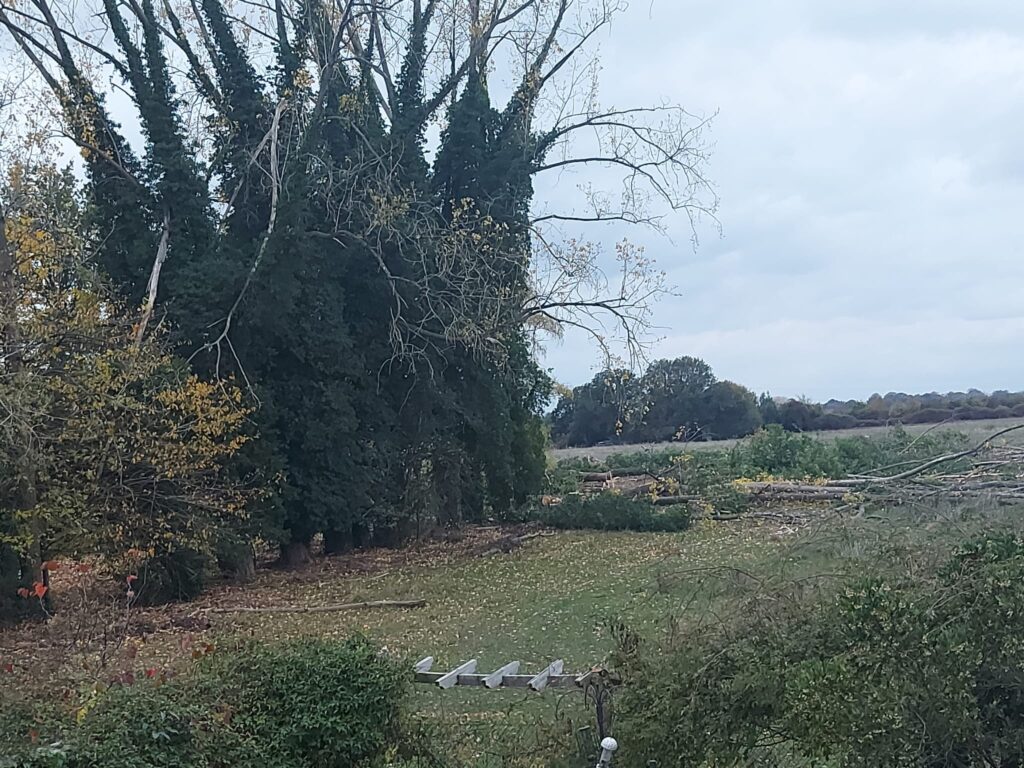
Site clearance of the Green Belt land behind Forge End and Long Fallow in Chiswell Green has started this week with local residents dismayed at the destruction of protected trees, established hedgerows and acres of green fields.
Work is starting on the 150-unit development following an agreement reached on October 14 with residents’ group, Keep Chiswell Green.
The agreement secures additional protections for neighbouring residents and brings to a close a series of fourlegal challenges by KCG to try to protect the Green Belt site south of Chiswell Green Lane.
The agreement cannot reverse the outline planning permission granted by the then-Secretary of State, Michael Gove, in March 2024, nor the reserved matters approval granted by SADC in February 2026, but it secures a number of practical improvements for existing residents, both during construction and once the development is occupied, compared to what was approved by the council.
One of the more immediate benefits will be the installation of 2.1m high close board fencing, with concrete posts and gravel boards, along the boundary with existing properties.
This will be installed at the start of the development, following boundary levelling works.
The arrangements approved by SADC would have allowed Cala to use wire mesh fence panels during construction, only installing wooden fencing at the end, without any obligation to use concrete posts or gravel boards.
Residents of neighbouring Hammersgate and Chiswell Green Lane have been painfully aware of the intrusion on their privacy, the constant noise and the high levels of dust they have had to endure while Taylor Wimpey undertook construction and secured the boundary to their site with Heras fencing – metal mesh – on the land adjacent to the Cala Homes site.
The agreed fencing will give residents bordering the Cala site immediate privacy, although whether they will be able to open their windows, hang out laundry, or enjoy their gardens during the construction phase remains to be seen. However, it will allow these residents to plant immediately on their own side of the boundary to screen the fence, rather than having to potentially wait years. The terms of the agreement also require Cala to maintain the fencing during construction and make good any damage before leaving the site.
The agreement contains commitments by Cala Homes, given directly to KCG, regarding the specific noise protections for the pumping station behind numbers 36 and 38 Forge End.
Following a petition to councillors by the residents of Forge End, the planning committee tried to secure some protections for these residents by imposing a condition on the approval. KCG has secured a legally enforceable route to require compliance by Cala Homes with these protections including for acoustic fencing and an agreed process for assessing background noise and the noise from the pumping station. Additional planting will help shield views of the pumping station from nearby homes.
Shirani St Ledger McCarthy, spokesperson for KCG, explained: “This agreement lays out the very specific terms that Cala has to comply with to protect local residents.
“Residents can now ensure that these protections are locked in without the risk that SADC just lets Cala off, or allows any reduction in protection when it comes to discharging the condition.
“It also specifies when the baseline surveys for ambient noise are to be conducted – from 2pm on a Saturday until 6am on a Monday, when Taylor Wimpey is not working and causing background noise – and where they are to be carried out, being the location where the noise is likely to be at its worst for neighbouring residents.
“The condition agreed by SADC did not contain these protections. Cala has also agreed to install acoustic fencing and to provide additional planting to screen views of the pumping station and fencing from the nearest neighbours. Without these protections, local residents risked having to live with the noise of water sloshing, alarms ringing, noise from maintenance and repair, as well as the low-level hum from the operation of the machinery.”
Further commitments by Cala include a reduction of 225mm in the ridge height of the roofs of two terraces, one behind Forge End, the other behind Long Fallow, both of which will now have shallow hipped roofs instead of gable ends where they give onto existing properties, a nominated residents’ contact with liaison meetings when necessary, and white noise reversing alarms instead of the usual beepers wherever reasonably practicable.
Although SADC approved Saturday working from 7.30am to 1pm, Cala has given written confirmation that it does not usually work on Saturdays, and verbal confirmation that it does not intend to. Cala has also committed not to carry out construction work on Saturdays of bank holiday weekends, except in emergencies or other limited circumstances.
For KCG, the settlement also raises the important question as to why a small group of unpaid volunteers had to bring legal proceedings to secure protections that it says should have been required of the developer in the first place.
“At significant cost and stress to existing residents, our negotiations with Cala have eventually led to a constructive working relationship between us, but what we can achieve now is limited compared to what could have been achieved before the reserved matters application was given final approval; any major changes after an approval is granted might mean re-opening the planning permission – a risk that developers are, inevitably, unwilling to take,” said Shirani.
“However, as can be seen from the commitments given to us by Cala and from our discussions with them, there was plenty of scope in the planning stages for modifications to have been made that would have materially reduced the impact of this development on existing residents while still being acceptable to Cala.”
The rules governing planning in the UK (the NPPF) specifically require local planning authorities to maintain acceptable living standards for existing residents. This can include protecting existing residents from loss of daylight, sunlight and privacy, as well as protecting the road network from severe impacts.
Shirani said: “We know SADC is in a difficult position, that the Government puts pressure on SADC directly to deliver its target quota of housing, but the process of consultation during reserved matters applications gives the council plenty of scope to influence what the final proposal looks like.
“In particular, adherence to the council’s own policies could have enabled it to oblige Cala to position all new properties a minimum of 11m away from the boundary.
“The two terraces whose ridges Cala has agreed to lower are positioned only 2m away from the boundary, and without the modifications we negotiated with Cala, the householders of the adjacent properties were due to have had an 8m high gable end wall 2 metres behind their garden fence.
“While these impacts directly affect specific properties, a key point of discussion between us and Cala during our negotiations was changing the access to the development. The sole approved access for Cala’s 150 new houses is through Forge End, a small residential cul-de-sac that currently serves 53 properties. Anyone who knows Forge End can see why adding traffic from another 150 properties is going to cause problems.”
KCG proposed to Cala and to Convene Construction, owners of the Butterfly World site, that access to the Cala development should be via Miriam Lane – the access road from Noke Lane to the Butterfly World site. They put Cala and Convene into direct contact and facilitated discussions between them that led to a Miriam Lane access being included in the draft settlement agreement. Convene also offered Cala space for its construction compound on the Butterfly World site and access into the Cala site, both free of charge. This could have completely negated the need for a Forge End access.
However, by this stage, Cala already had approval to use Forge End and its leadership vetoed the proposal because of the upfront cost of laying a temporary road across its own site. Shirani explained: “Had Cala been urged to find a better solution to the Forge End access earlier in the process, there might have been the chance to move all the construction and residential traffic generated by the development off the Watford Road.
“With more than 500 new houses to be built along the Miriam Lane border, a better access solution to the Cala site could have been a major benefit to all residents of Chiswell Green.
“When Cala’s reserved matters application was decided by the planning committee, Forge End residents petitioned councillors about the pumping station, the planning committee listened and imposed a condition.
“Even then, we still had to take legal action and negotiate directly with Cala to get basic safeguards we believe the council should have insisted on before approving the plans.
“However, under the new Government rules that came into force on October 31, we are particularly worried that residents will have substantially less say in planning decisions.
“Residents can still submit their comments about an application in writing, but they lose the opportunity to have a clear voice in the process – to speak at a public meeting and to put those concerns directly to the committee in public.
“The council has to fulfil a target of 15,000 new houses under the newly adopted Local Plan, and a further 10,000 under the next Local Plan, but it is of major concern that, from now on, many of the applications in which the district’s residents are most interested will be decided by officers alone, behind closed doors, with no opportunity for public debate.
“Going forward, direct negotiation with developers or claims for judicial review may be the only way that residents can influence what gets built in their area.”
