17 Nov 2024
Surprised by the strength of arguments and the number of comments (184 and counting) on a Facebook post about the Cathedral showing the film Nosferatu on Halloween, Laura Bill was keen to develop some local discussion around faith and just how concerned St Albans folk are by religious ideas and communities…
This is not so much an “Is there a God?” debate as much as a “Do belief systems have meaning to you and how?” dialogue.
As a disclaimer, it’s not meant to be a conclusive piece of research, just an anecdotal musing, based on (mainly) the comments of anyone who was happy to talk.
We live in a country that is still accountable to the Church of England in some ways; the Government works under the Monarchy and the Monarchy holds something of a Christian identity. Yet the very fabric of Britain today is diverse and here in St Albans we have people of many faiths, none which can only ever be a good thing for those growing up in a vibrant, wholesome, cultured city with a whole host of lived-experiences ready to be shared with others.
Sociologists such as Emile Durkheim have referred to religion as a ‘social glue’ which some feel undermines religious experiences as it suggests its function is purely holding communities together. A perspective such as that tends to examine religious belief as a set of moral values and practices which help govern people’s thinking and actions.
I wanted to go beyond that to discover whether faith was still relevant to local people, even it they weren’t believers themselves.
The first person I spoke to was St Albans journalist and author Ian Ridley, who reflected on the Nosferatu controversy in his response: “Faith is personal, and religious teaching is open to interpretation.
“Personally, I can’t get offended by a piece of great art being shown at the Abbey, as long as it is within the confines of public decency.
“We should be open to stories and ideas, and open to contesting them with grown-up debate.”
It would be hard to argue with Ian there.
Naveed Khawaja of community charity One Vision St Albans said he believes that “faith still matters deeply to many in St Albans”.
He argued that the recent debate over the Cathedral’s screening of what is arguably cinema’s first horror film shows just how much people value the sacredness of shared spaces and traditions.
He added: “At One Vision, we see every day how faith serves as a moral compass, bringing people together, inspiring kindness, and strengthening our resilience. Studies show that people with a strong faith foundation are often happier, more resilient, and more likely to find meaning and hope in difficult times.
“For many of us, faith isn’t just a private belief; it’s a way of life.
“It guides how we treat each other and face life’s challenges, grounding us in values that transcend the everyday. Yes, faith still matters in St Albans – it’s a powerful source of purpose and unity that’s as vital today as it’s ever been.”
Associate minister at St Paul’s Church Peter Crumpler made a similar connection regarding support and community: “Faith plays a key part in many people’s lives, sometimes rooted in earlier life. But it can lay dormant until it is stirred by a significant life event. That could be a bereavement or illness, or more happily the birth of a child or wedding. Maybe even the move to a new location.
“We’ve had people come to our church, and say it feels like coming home. They are discovering community, looking for meaning and taking a serious look at the Christian faith, maybe for the first time.”
Monir Ali of The Adda Club, an informal group set up to promote and share Bangladeshi cultural, social and linguistic traditions within St Albans and the surrounding areas, said: “Faith is an important part of identity which helps people shape their views of the world, and how and where we all fit in to ensure St Albans functions well.
“It is also very important for young people in developing their identities and ensuring they feel connected and rooted. We have all faiths living side-by-side, sharing and learning from each other which makes for a strong unified community.”
St Albans resident Omar Kareem agreed: “Faith is still a meaningful part of life for many people in St Albans. This beautiful city, with its historic Cathedral and rich spiritual heritage, holds a special place for people seeking purpose, comfort, and connection.
“For many, faith offers a sense of grounding in a busy world, providing guidance and a feeling of belonging. St Albans is home to a wonderfully diverse community of faiths: Christianity, Islam, Hinduism, Judaism, and others, all contributing to a shared spirit of compassion and kindness.”
He said you can see faith in action in our food banks, youth programmes, day care centres and community events, where people come together to support one another, no matter what their beliefs.
He added: “Faith here isn’t just about personal beliefs; it’s about community and shared values, bringing people together to make life better for everyone.”
Chartered surveyor Louis Maycock, who lives in St Albans said: “It’s interesting how we encounter reminders of faith every day, from our city’s name to the sight of the Abbey as we come home or the sound of its bells on Sundays.
“Yet, despite these reminders, it seems that in our wisdom and maturity, we have sidelined God and faith. History tends to repeat itself; when people are thriving and comfortable, they often overlook their need for God.
“Perhaps we have become so self-sufficient that we forget the source of our blessings. In a way, we have simply replaced Him with something else – for we all worship something, it’s our nature.
“I believe that young people are more receptive to faith. They have access to a vast array of knowledge, experiences, and opportunities. However, many still find themselves yearning for something deeper amid the freedoms of life.
“The superficial portrayals of life on social media only amplify this longing for more meaningful connections. Adults, too, are increasingly questioning their beliefs. A notable example is Russell Brand’s journey toward faith.”
It is perhaps unsurprising that people of faith still believe it is important and a key part of society. There are common themes throughout the comments I gathered which include community action and kindness, a sense of belonging and moral guidance.
Peter and Louis pointed to a deep search for something greater than ourselves and seemed to allude to the fact that suffering in some way may make humans more open to there being a God.
I was also intrigued that people of faith were happy to answer the question but those without a faith tended to say they felt ‘uncomfortable’, ‘unqualified’ or scared to talk to me for this article. One atheist said he was “happy to keep his views private, thank you”.
I found this interesting because it arguably shows a level of reverence for religious ideals rather than an uprising of what I call the evangelical atheists. Ten years ago when I was a Religious Studies teacher, people used to really enjoy the chance to share their beliefs that there is no God, and that religion is a way to control people and society.
But the few atheists I did manage to get to speak to me seemed to have a new type of compassion towards people of faith.
For example, atheist and St Albans resident Spencer James said: “I believe in what I can see with my own eyes, something that can be researched and based on fact-based evidence. I admire people for their beliefs and respect those that do so.”
Could it be that even atheism has adapted alongside society?
Many religious and sociologists have stated that staying relevant is key to keeping faith and religion alive in society.
Examples of the church and other faith groups trying to do that include offering online services, which surged during and since the Covid pandemic. Film and TV have often sparked debate around religious belief as have active social media engagement debates and discussions.
The viewing of Nosferatu is a good example of the church adapting with modernity. They recently had a soft play event in the Cathedral too, which also triggered debate over whether it was the right place for that sort of activity.
Drawing in an audience who may not usually frequent the Abbey is part of remaining relevant and serving the needs of local people which is perhaps not uncommon nor unwise for a religious organisation which wants to remain at the heart of the community.
I think we can see that religion and faith obviously does still matter to the people of St Albans, whether they partake in any active worship or not.
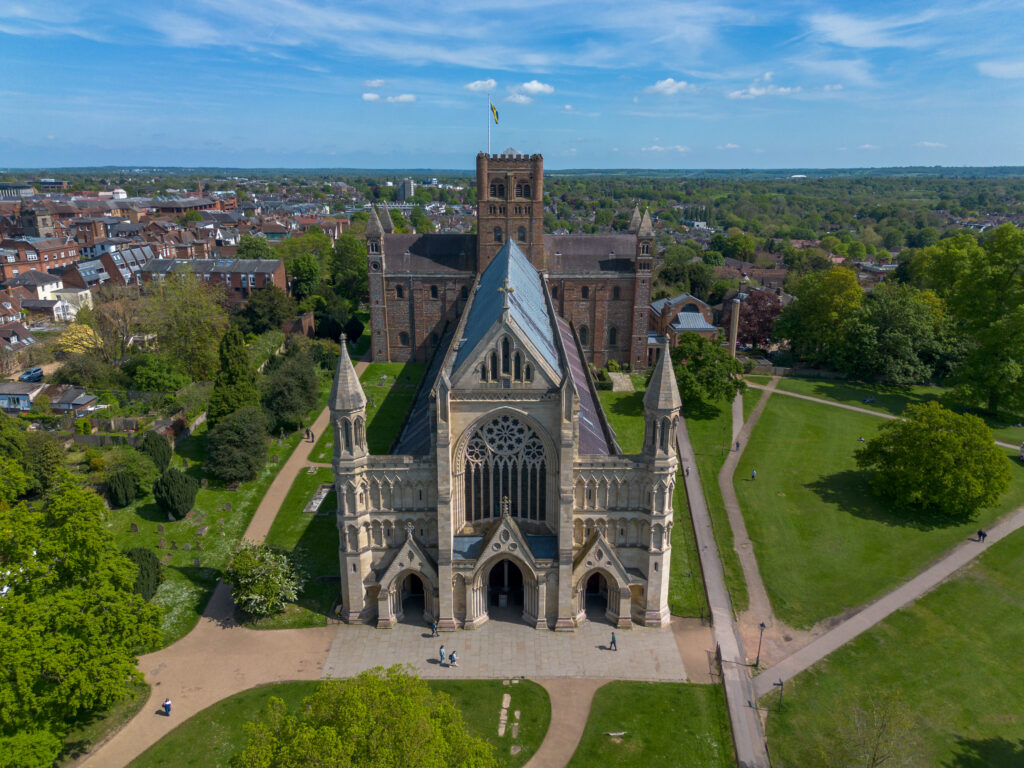
St Albans Cathedral photo by Toby Shepheard.