04 Feb 2025
For viewers of a certain age (myself included), Fred Dinenage was the face of children’s educational programme How, providing entertaining answers to questions on topics covering everything from science and history to maths and geography.
“If I had a pound for every time someone’s walked past me, raised their right hand and said ‘How!’ I’d be a multi-millionaire,” he says, referring to the show’s somewhat un-PC use of the stereotypical Native American greeting.
“It was a groundbreaking show for kids of that time, and people of a certain generation have got such happy memories of How and the slightly more recent How 2. How was invented by a wonderful man called Jack Hargreaves and it just hit the spot for some reason.
“As part of this little show we do, to lighten things up in the second half I play a bloopers tape looking back on my 60 years in TV, and some of that is How, including how you can’t sink in the Dead Sea and I then demonstrate that in fact you can!”
But if you were part of an audience living in the south of England, Fred was also a news anchor of 38 years standing with a selection of ITV franchises, which was what brought him into contact with notorious London gangsters the Kray twins.
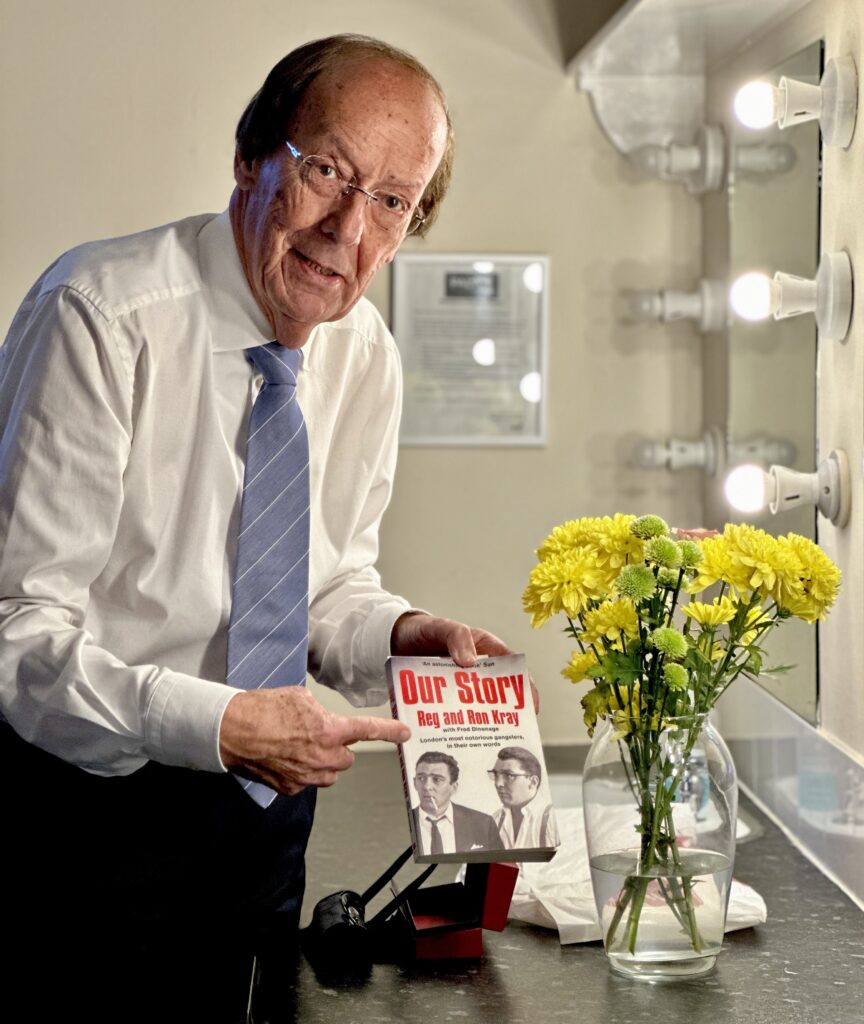
His work with Ronnie and Reggie in writing their autobiographies, Our Story and My Story, is the subject of the ”little show” he alluded to, a one-man tour coming to Harpenden’s Eric Morecambe Centre on March 1, which purports to reveal hitherto unknown stories about the London crimelords.
Now 82, he explains how he established a connection with the siblings: “It all began 30 odd years ago, when I was presenting the six o’clock regional news show for ITV in the south, and we did a story about a little girl from Gosport called Julie Maguire who was dying of liver failure.
“Her dad Peter suddenly got a call from Addenbrookes Hospital in Cambridge to say a donor had been found, Julie was rushed to the hospital, the transplant was successful and today she’s living fit and well in Spain. Peter was so thrilled that her life had been saved that he vowed to raise a million pounds – a huge amount in those days – for transplant research and for the hospital to buy certain equipment he needed.
“He tried all sorts of stunts, including some of his mates from the navy dragging a field gun all the way from Gosport to Cambridge, which is well over 100 miles, and we featured him on our news programme.
“A few days later I received a letter from HMP Parkhurst from Reggie Kray saying he’d seen the film and he was very moved by it.
“He said there were some talented artists in Parkhurst and he could, and I quote, ‘commission some paintings’ from these artists which could be sold at auction for Peter Maguire’s charity.
“Sure enough, eventually half a dozen paintings arrived at our studios, including one terrible little painting of two multicoloured stick boxers in a ring, which was signed Reg Kray. Of course, that was the one that made thousands and thousands of pounds and has since been sold and resold many times.”
Fred then received a follow-up letter inviting him to visit the prison should he ever find himself on the Isle of Wight, an offer he could not refuse.
“He was very gentle, he loved writing poetry, he loved his gardening. Remember, I met the Krays as much more mature men, they weren’t young gangsters any more, and I got on extremely well with both of them.
“On my second visit, he said to me, ‘Me and my brother Ron [who was in Broadmoor Hospital in Berkshire] want someone to tell our story the way we saw it, not the way all these other books and magazines claim they saw it’ and that’s how it started.”
Although Fred had never written a book, he subsequently spent hours interviewing the brothers for their autobiography, a process made longer because they kept changing their minds about the people they mentioned.
“I could only see them each once a month, and the funny thing about both Reggie and Ronnie is they tell you one thing one month, ‘Oh Peter so-and-so is a right bastard’, so I’d write it down, take that back and show them, and then they’d both say, ‘Oh, no, no, no, Peter was wonderful’!
“So they were constantly changing their mind about things, which meant it took about three years to write the bloody thing before it finally came out!”

As a journalist, Fred has been careful to ensure the show presents all sides of the Krays.
“What we try not to do is glamorise and glorify them, but nonetheless, painting both sides of the picture, they gave away huge amounts of money to charity, especially for sick children, so there was another side to them. Although obviously they were both former East End gangsters, and of course, killers, by the time I saw them they were different men.”
A long-lost tape of one of Fred’s recordings of Ronnie in Broadmoor was recently unearthed in his loft, cleaned up by his technician, and included in the show.
“The most fascinating thing of all is he says he wants to give a message to young people saying, ‘Don’t enter a life of crime like be and my brother because it ain’t worth it’. It’s like hearing a voice from the grave, and I think he realised the futility of it all and all the wasted years being stuck in Broadmoor.
“I mean he was always convinced that he was going to be realised, but it was really a very dim and distant hope.
“Ronnie was always hopeful too, and he used to say to me, ‘When I get out of here Fred, me and Reggie are going to buy three houses on the beach in Morocco’. Ronnie would live in one, Reggie would live in the other, and me and my wife Beverly would live in the third! But obviously that never happened.”
Fred took Beverly to meet Ronnie on several occasions: “He loved women and children, and they got on extremely well, he really liked her.
“Ron would sometimes say to me, ‘Look, if anybody ever upsets you Fred, you tell me’, but I resisted that temptation! At that stage of his life, and obviously under medication, he was extremely gentle.”
There’s a tendency for anybody who lived in the East End of London during the 1960s to say they knew the Krays personally, something which has permeated into Fred’s show.
“At least one person will come up afterwards and say they knew Reggie or Ronnie or their father was in the gang or whatever. Everybody likes to feel they’ve got a connection to the Kray twins, which is amazing really after all these years.
“I get students studying criminology emailing me whose parents probably weren’t even born when the Kray twins were in their pomp. It’s amazing how this legend has lived on.
“I think the time had something to do with it, it was the swinging sixties, which so many people look back on fondly, and all these things came together to produce this incredible myth.
“They were such big celebrities, their clubs attracted starts not only from this country, but from America as well, it was incredible the appeal they had.”
Fred stayed friends with Ronnie and Reggie until the very end of their lives.
“The last time I saw them was about a month before they each died. Ronnie had a heart attack in Broadmoor in 1995, Reggie was in Weyland Prison near Norwich, and finished up in a local hotel, dying of cancer in 2000.
“But even after both books had been published, I still kept on going to see them because, I’ll be honest with you, I liked chatting to them.”
Tickets for Fred Dinenage – Ronnie, Reggie and Me at the Eric Morecambe Centre are available at the following link: https://everyonetheatres.com/whats-on/ronnie-reggie-and-me-fred-dinenage/