


27 Jul 2026
St Albans Civic Society has called for unity and cooperation in the face of political unrest over the decision to merge St Albans and Dacorum as part of Local Government Reorganisation.
Under the new structure, Hertfordshire will be divided into four new unitary authorities, replacing the current two-tier system which includes St Albans district council and Herts county council by April 2028.
But the proposals have come under criticism from local Liberal Democrats and Conservatives alike, who believe there will be an impact on grassroots representation.
SADC’s preferred approach was for the county to be divided into West Herts (Dacorum, Hertsmere, St Albans, Three Rivers, Watford) and East Herts (Broxbourne, East Herts, North Herts, Stevenage, Welwyn Hatfield), but this was rejected in favour of four different authorities.
Local experts considered this to be the least likely option for the county, but ultimately the decision was outside their hands.
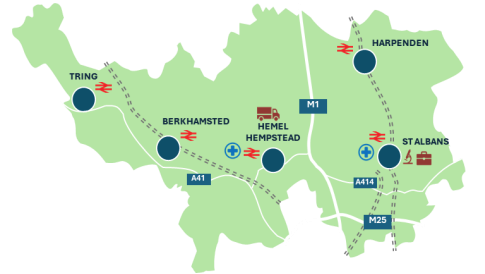
A new unitary authority of West Hertfordshire will bring together the places currently served by Dacorum and SADC into a single council for the west of the county.
The new council will cover around 312,000 people – roughly the same size as a London borough – taking in Hemel Hempstead, St Albans, Harpenden, Berkhamsted and Tring, as well as the surrounding villages and countryside.
There will be 79 councillors representing 41 wards, with elections to a shadow council in May 2027 and the new authority going live in April 2028.
Civic Society chair Mary Conneely responded to the shake-up with a call for a careful transition and constructive collaboration: “While views have differed on the options that were considered, St Albans Civic Society believes the immediate priority is to ensure that the transition is managed carefully and in the interests of residents across the county.
“With the decision now made, the focus should turn to constructive collaboration between councils to help establish arrangements that support efficient services, clear local
representation and effective strategic leadership.
“The task now is to work together to make the chosen structure function well for the communities it will serve.
“HCC has cross-county provision contracts and arrangements in place with care agencies and providers such as Carers in Herts and also looks after SEND.
“What’s clear is there needs to be a clear transition plan to avoid duplication and gaps and this is what we would like to see as a key priority.”
From a St Albans perspective, she said there are aspects of the outcome that merit careful consideration.
“A three-unitary arrangement might have created a separation between St Albans and Hemel Hempstead, and with it a potential weakening of the wider economic links across south-west Hertfordshire.
“Maintaining those connections may be important for future investment and for the continued development of initiatives such as the Hemel Garden Communities programme, which could bring benefits to the wider area.
“In that context, there may be differing views about whether further challenge to the Government’s decision would be helpful. SACS recognizes that councils and other stakeholders will want to consider their next steps carefully. At the same time, it will be important to balance any such discussions against the need to provide certainty and stability for residents, staff and partner organisations.
“Questions have also been raised about the size and viability of the proposed new authority. SACS notes that local government structures of a similar scale operate successfully elsewhere, including London boroughs, which serve average populations of around 300,000. The effectiveness of any new authority will depend not only on its size, but also on the quality of its governance, leadership and accountability.”
She said the society believes that Hertfordshire may also benefit from the creation of a directly elected Mayor as part of the wider devolution agenda.
“Such a role could help provide strategic coordination across the county on matters such as economic development, transport, infrastructure and investment, while strengthening Hertfordshire’s voice in discussions with central government and regional partners.
“St Albans Civic Society will play its part in helping to make the transition as smooth and effective as possible. We will also work constructively to support the establishment of the new St Albans City Centre Parish Council, helping to ensure that local communities continue to have a meaningful voice in the governance of their city.
“The Government has made its decision. The task now is for all those involved to work together in a spirit of cooperation and public service to create a system of local government that serves Hertfordshire residents well in the years ahead.”
