


07 Nov 2026
The fiasco surrounding Local Government Reorganisation for St Albans and Hertfordshire continues to rumble on, with the Government now reassessing its own plans for four unitary authorities.
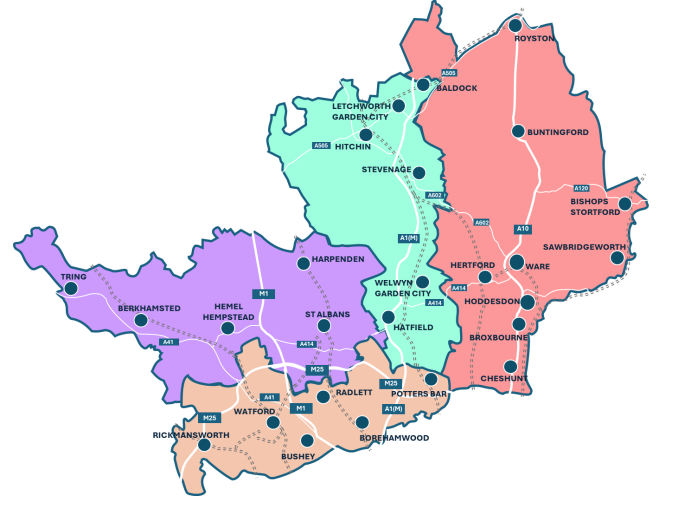
After dismissing SADC’s call for the county to be divided into West Herts (Dacorum, Hertsmere, St Albans, Three Rivers, Watford) and East Herts (Broxbourne, East Herts, North Herts, Stevenage, Welwyn Hatfield), Westminster is now taking a fresh look at the whole process.
A decision on the preferred option will be made in the coming months, although shadow authority elections will take place in May 2028, with the new authorities going live on April 1 2029, one year later than originally planned.
The Government has also confirmed that it will release half of the allocated transition funding, approximately £2 million, to Hertfordshire in November, with the remaining funding provided once a final decision has been reached.
Angie Ridgwell, the senior responsible officer for Hertfordshire Local Government Reorganisation at HCC, said: “While [this] announcement means there is no confirmed reorganisation model for Hertfordshire, work across the county will continue.
“We will now carefully consider the implications of this announcement on Hertfordshire’s LGR programme and the work to establish a Mayoral Strategic Authority for Hertfordshire as soon as possible following the announcement in the Budget.
“Hertfordshire’s councils remain committed to working collaboratively, engaging constructively with Government and ensuring that we are prepared for the next stage of the process once further clarity is provided.”
Local politicians have offered their thoughts on the revised process.
SADC leader, Lib Dem Cllr Paul de Kort, said: “I am pleased that the Government has confirmed that Hertfordshire with have a Strategic Mayor from 2028. This represents real devolution rather than the false one that Local Government Reorganisation was presented as.
“We wait to hear exactly what the scale of the financial powers will be. We need to watch carefully that the transfer of business rates income to the new mayor does not negatively impact the provision of local services currently funded by it, but it does not need to.
“Allowing local residents and businesses a stake in the economic growth of the county is a powerful idea as it provides a balance of incentives which the current system does not. For far too long, the burdens of growth have fallen locally whilst almost all the rewards are taken centrally.
“The withdrawal of the four unitary model, although a shambolic episode, does at least allow the new Minister to properly assess the proposal St Albans District and Herts County Council strongly favoured, which is a two-way split between west and east Hertfordshire.
“We were baffled by the decision of the previous minister to choose the four unitary option; a view shared by many other important stakeholders. I urge the new ministerial team, which has committed to look at the data fresh, to arrive at the correct decision as soon as possible. The uncertainty, dithering and delay is costly and wasteful, and the case we made was very clear.”
Labour group leader Cllr Mike Hobday has always supported the four unitaries model: “I am eagerly looking forward to Hertfordshire moving to a new system of unitary councils. It is ridiculous that one council collects our bins while another disposes of the waste; and that one manages parking regulations while another owns the road and verges.
“This is hopelessly inefficient and leads to residents being confused at best, passed-around at worst.
“Creating unitary councils will end this runaround, establishing a single, clear authority accountable to our community for local services.
“When it arrives, Local Government Reorganisation will benefit local residents. It will stop administrative waste. Hertfordshire does not need 11 council chief executives and 11 senior management teams. Streamlining local governance will allow us to redirect money into frontline services – fixing roads and improving early years education and social care support for our children.
“Of course, I am disappointed by the delays in delivering this change, but it is worth the Government taking the time to get this important change right. I support the Government’s July proposal for four unitary councils across Hertfordshire, pairing St Albans with our Hemel Hempstead neighbours in Dacorum. Four councils was the choice of six out of 11 Hertfordshire councils. It was the choice of the largest number of residents consulted.
“I hope that we will return to this proposal after the Government has thought again about all the options.”
Cllr Simon Grover, leader of St Albans Greens and Independents, said: “This is a mess, and it is residents and council staff who’ll pay for it. Councils across Hertfordshire have spent months planning for four new unitary councils. Now that decision’s been withdrawn, and we don’t know when a new one will come or what it’ll be.
“Greens never wanted this reorganisation. Merging our councils into fewer, bigger ones moves decisions further away from the people they affect. But if it has to happen, we’ve always backed four councils for Hertfordshire, because they’d stay closer to local communities than two or three larger ones. I’d urge the Government to stick with that.
“What we need now is a clear decision and a proper timetable. Council staff need to know where their jobs will be, and residents need to know who’ll be running their bins, parks and planning. Another year of uncertainty helps no one.”
Tory group leader Cllr Matt Cowley said: “The Government’s local government disorganisation programme has cost taxpayers in Hertfordshire dearly. Rather than getting on with fixing our roads and cleaning our streets, Council officers are locked in an endless purgatory of Government demands about the internal workings of future councils. That’s politics at its worst.
“Labour initiated its plan to abolish our councils in Hertfordshire without any clear vision for what it might replace them with. That lack of vision is why we are now back at square one, because politicians in Westminster and officials in Whitehall can’t decide where the boundary of our councils should be. It is no way to run a Government; and no way to establish new councils that will deliver for our residents.”
