


21 Jun 2026
The outcome from the Community Governance Review is now out and a parish council for St Albans city centre is being proposed, but will it reflect the whole community? Mary Conneely, chair of St Albans Civic Society, considers the options…
The creation of a new parish council for parts of St Albans currently not represented has been mooted following months of public consultation as part of the Community Governance Review (CGR).
This considered whether to create one or more parish councils to represent 28,000 households in Batchwood, Bernards Heath, Clarence, Cunningham, Hill End, Marshalswick West, Sopwell, St Peter’s and Verulam wards.
A campaign in support of the proposal was run St Albans Civic Society with the backing of local residents associations and other bodies, who feared without such an authority the city would lose local representation and ownership of heritage assets.
Next Tuesday (June 23), SADC’s strategy and resources committee, will take the opportunity to outline their response to the Community Governance Review and set out the next steps. Overall, its clear that a parish council for the city centre is on the cards. Key actions must follow, firstly the requirement to establish a shadow parish council for St Albans, one that will bridge the gap until a fully elected parish council can
be voted on in 2027. A new shadow council enables a distinct body to be created, which will help avoid the perception that the parish is simply an extension of the district council, or will it?
The proposal to create a shadow parish council for St Albans marks an important milestone in establishing a new parish council for the city. The Community Governance Review involved years of discussion, consultation and public engagement and earlier this year, the votes were cast in their thousands in support of the creation of a parish council for the city of St Albans – this will mark the greatest political upheaval in the city for decades.
The committee paper sets out a position which should “allow different voices the opportunity to contribute” but the governance structure itself excludes those voices from being heard. Instead it proposes that members of the shadow council be restricted exclusively to nine district councillors. This is a missed opportunity.
Another significant proposal is that officers will recommend using the name ‘St Albans City Centre Parish Council’ as the new name for the parish council, to reflect the historic city status of the area.
The proposed composition of the shadow parish council deserves closer scrutiny as the decisions it makes will influence the character of the future parish council from day one. A shadow parish council is not merely an administrative body, its role will include helping shape priorities, preparing the first budget and precept, developing governance arrangements, engaging stakeholders and establishing the culture and direction of the new authority.
Yet despite emphasising community engagement and legitimacy throughout the review process, the council has proposed restricting membership exclusively to district councillors, to be made up of one from each ward within the unparished area, this would mean eight Liberal Democrat councillors and one Green Party representative. If the purpose of the shadow parish council is to prepare the ground for a vibrant and representative parish council, surely it should itself reflect the diversity of the community it seeks to serve and avoid accusations of capture by any one group.
The council’s own report acknowledges there is no legal requirement for shadow parish councils to be composed solely of elected councillors. As non-statutory bodies, they can include residents and community representatives. The proposal before councillors is therefore a choice, not a necessity.
The case for councillor-only membership rests on democratic legitimacy, however this ignores a key fact; they were elected on a different mandate, that is a district council one, not to a parish council. Elected representatives bring experience and valuable local knowledge, but is this enough?
A parish council is fundamentally a community institution, intended to be close to residents and rooted in civic participation. Its creation should draw on the widest possible range of local knowledge and expertise.

St Albans has a strong network of community organisations, residents’ associations, faith groups, cultural bodies, voluntary organisations and business representatives. Together they bring practical knowledge, lived experience and deep connections to the communities the new council will serve.
Residents’ associations understand neighbourhood priorities; the Civic Society offers expertise in planning and heritage; business groups understand economic challenges; voluntary organisations work closely with vulnerable residents; and faith and cultural organisations can help ensure underrepresented voices are heard.
The irony is that the council’s report identifies community engagement as a key reason for creating a shadow parish council. It argues the body will provide legitimacy, facilitate consultation and ensure local voices are heard.
Yet under the proposed structure, those voices would be limited largely to brief public speaking opportunities of three minutes maximum. That is consultation, not participation. There is a significant difference between being invited to comment on decisions and being involved in shaping them.
Others have recognised this, the report references Horsham District Council, which adopted a more inclusive model involving elected councillors alongside representatives from residents’ associations, civic organisations and other community stakeholders. The result combined democratic accountability with community expertise.
That approach reflects an important reality: establishing a new council is not simply a political exercise but one of institution building. Developing a budget, identifying priorities, considering service delivery and shaping the council’s identity all benefit from perspectives beyond the council chamber. Business leaders, community organisations, heritage groups and younger residents can all contribute insights that strengthen decision-making, such voices would not diminish the role of elected councillors.
Nor need inclusivity come at the expense of accountability. Community representatives could serve in advisory or voting roles, selected through an open and transparent process. The precise structure matters less than the principle. If the purpose of the shadow parish council is to prepare the ground for a vibrant and representative parish council, then it should itself reflect the diversity of the community it seeks to serve.
The debate over whether St Albans should have a parish council is drawing to a close. The focus now is on what kind of council will emerge. Decisions made during the shadow period will have a lasting influence on that outcome.
This is not simply a question of committee membership. It is a question of the values that will underpin the new council from its inception.
Councillors have an opportunity to set the right tone by revising the proposed model to include representatives from across St Albans’ civic, voluntary, cultural, business and neighbourhood communities.
Doing so would demonstrate that the new parish council is being built in partnership with the people it will serve. An inclusive shadow parish council would combine democratic accountability with community expertise, strengthen public confidence and help create a council that is representative from the outset.
If the goal is to strengthen local democracy, broaden participation and give residents a genuine stake in local decision-making, the next step is clear: adopt an inclusive shadow parish council model and community representation to help shape St Albans’ future.
Professor Tim Boatswain, chairman of Conservation 50, said: “It’s good news that the officers are briefing on a parish council, as it will be a statutory consultee over planning. The bad news is that the shadow parish council would consist of already-elected city councillors. That is a democratic deficit, and leads to a secondary concern that the community is being excluded, whether that’s residents’ associations, groups like Conservation 50 or any others. The danger is that the public will see the shadow council as the legitimate authority and lose interest in the real parish council. My hope is that people who form the parish council have a real emotional attachment to St Albans city centre and not just be part of a party political machine.”
St Albans Times editor Matt Adams added: “There are worrying signs that the proposed new St Albans City Parish Council might just be a case of jobs for the boys and girls, with existing district councillors seconded into roles on a shadow council which will shape the direction, priorities, culture and finances of the official body when it eventually becomes a reality.
“Of course the danger of this is that the parish council will by its very nature be the product of Lib Dem politicians (oh, and one Green), with all of the implications this carries, rather than a non-partisan community organisation run by a broad cross-section of local representatives whose decision-making abilities are not clouded by orders from their party leaders.
“This is a once in a lifetime opportunity to create a body which truly reflects the rich and diverse make-up of St Albans city centre, instead of being merely a legacy of the soon-to-be defunct district council.
“Of course we recognise the valuable experience and expertise which long-standing councillors will be able to bring to the table, and nobody is saying they should all be excluded, but they should definitely not be the only people who make up the new parish council. It would be reassuring to see members from residents’ associations, heritage bodies, faith groups, Community Interest Companies, and many other local organisations.”
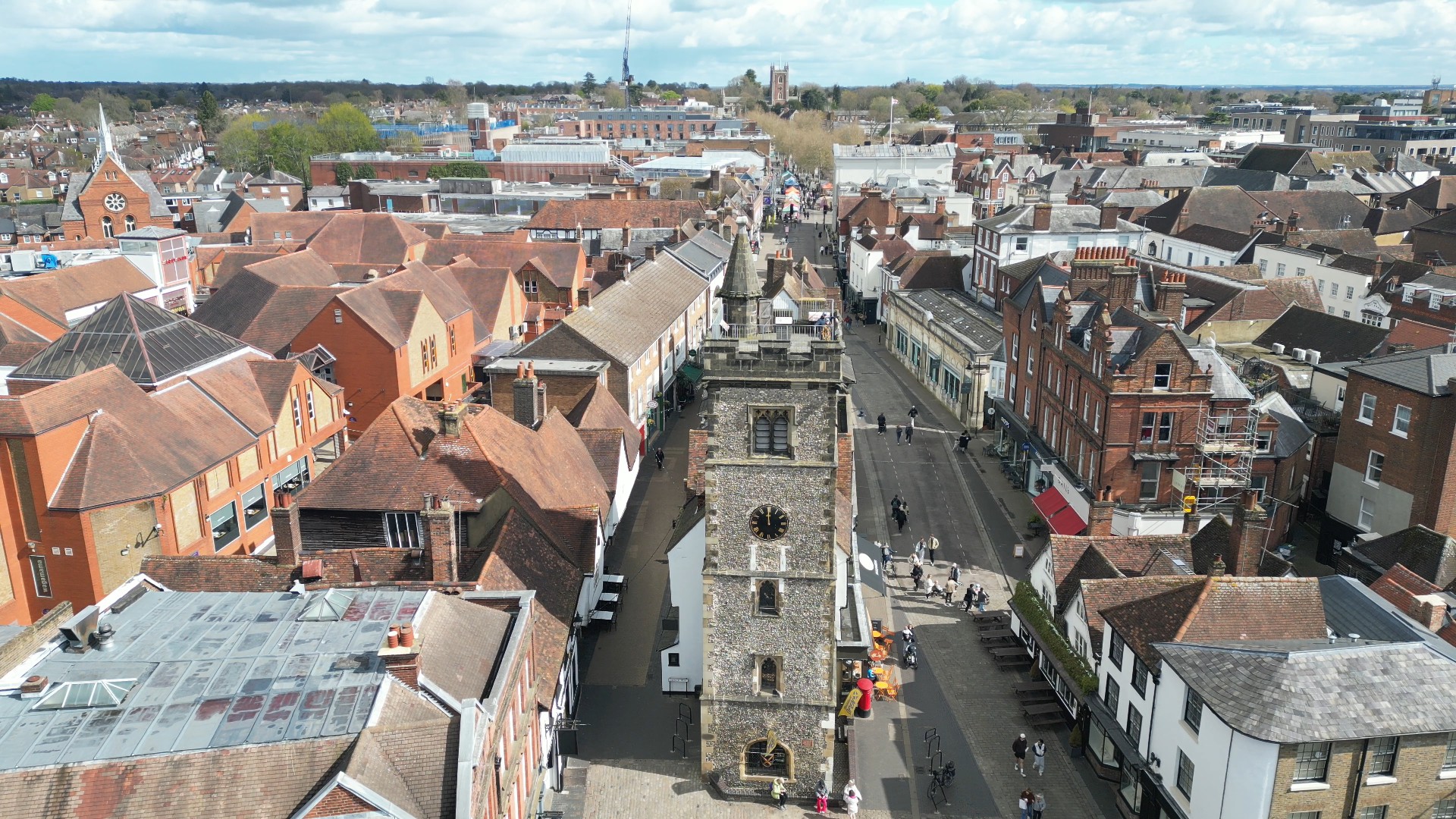
Drone photo by Andy Lawrence.
