14 Nov 2025
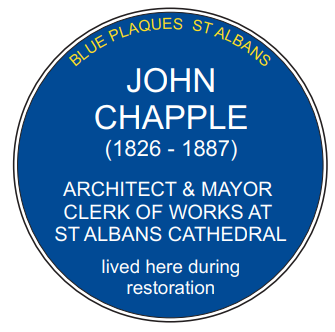
St Albans’ next Blue Plaque commemorates John Chapple, who saved St Albans Cathedral’s tower from collapsing during the Victorian age.
It will be installed at 2 Romeland at noon on November 22, the house where Chapple lived during the Cathedral restoration works (1871-1878).
The plaque will be unveiled by James Gaffney, who will be giving a lecture about Chapple for St Albans and Hertfordshire Architectural and Archaeological Society on November 25.
This is the 15th plaque to be installed by Blue Plaques St Albans (BPSA), a voluntary organisation that was established to commemorate significant men and women who have lived and worked in St Albans, by placing blue plaques on buildings or sites associated with their lives.
Professor Tim Boatswain, the Chairman of Blue Plaques St Albans, said: “Without John Chapple’s vigilant eye and managerial genius, St Albans might have lost its most
iconic landmark, as he, just months after his arrival in 1870, discovered the perilous state of the central tower and raised the alarm, triggering the urgent work to stabilise it. He is the pivotal reason St Albans Cathedral was saved for future generations.”
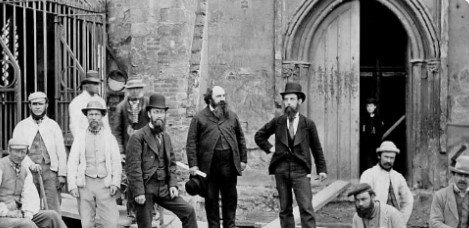
For the last 16 years of his life, John Chapple (1826-1887) made St Albans his home and the restoration of its Abbey Church his life’s work. Appointed Clerk of Works in 1870, he was the on-the-ground mastermind responsible for the day-to-day execution of the Cathedral’s monumental restoration, managing the teams of craftsmen and complex logistics that transformed the decaying Abbey into the magnificent Cathedral we know today.
His legacy at the Cathedral is profound. Working under the renowned architect Sir George Gilbert Scott, Chapple not only managed the critical stabilisation of the tower and foundations but also went on to coordinate the restoration of the nave and, most significantly, the rediscovery and painstaking reconstruction of the shrines of St Alban and St Amphibalus from fragments found in the Lady Chapel.
Parallel to his cathedral duties, Chapple immersed himself in civic life, rising to a position of great influence. He served as a city councillor, was elected Mayor in 1879/80, and acted as the council’s architect for key projects like the new art college and library. He was also a magistrate, Justice of the Peace, Abbey Church Warden, an active Freemason, and a director of the St Albans Permanent Benefit Building Society.
Born in Dulverton, Somerset, in 1826, Chapple’s journey to St Albans was one of remarkable ascent. From taking over his father’s saddlery business, he gained experience, potentially with the great Isambard Kingdom Brunel, before joining George Gilbert Scott’s practice. After proving his worth on several church projects, he was entrusted with the most significant assignment of his career: the restoration of St Albans Abbey.
His influence was such that he was reportedly the only man from whom the formidable Lord Grimthorpe would take building advice. Chapple documented the restoration in papers and a book, leaving a valuable personal account of this critical period for local historians.
He designed and built Torrington House on Holywell Hill, moving in during October 1885, but his enjoyment of his new home was cut short by his death on February 6 1887. He was buried with full civic honours in the Cathedral churchyard.
The Blue Plaque seeks to secure a permanent, public acknowledgement of John Chapple’s dual legacy: as the guardian of the city’s spiritual heart and a chief architect of its civic growth.
For details on James Gaffney’s talk about Chapple see https://www.stalbanshistory.org/events/event/lecture-john-chapple-saving-the-tower