14 Jun 2025
Small business owners can use a number of allowances and planning measures to ensure their exit is tax-efficient, and that they make good use of post-exit assets. Lumin Wealth’s Managing Director, Martin Cotter, explains more.
Whether you’re passing on the business to younger family members, or selling up, there are plenty of ways to ensure you keep your tax bill to a minimum – and make savvy future financial decisions.
This article outlines options available to business owners who are planning to sell up or pass on the company.
Business Asset Disposal Relief
Business owners currently benefit from a reduced capital gains tax (CGT) rate, under the Business Asset Disposal Relief (BADR) regime. BADR allows business owners to pay CGT at a rate of 10 per cent on the first £1,000,000 of lifetime gains on qualifying assets when selling a business. This beneficial rate rose to 14 per cent from April 6 2025, increasing to 18 per cent from April 6 2026.
IHT planning and Business Relief
If younger family members are taking over, then gifting the business – or your shares in it – may be an option. After seven years these assets would be outside of your estate, and exempt from inheritance tax (IHT).
Replacement property relief under the Business Relief regime allows IHT relief to be maintained after disposing of a qualifying business asset – if you reinvest the proceeds into another qualifying business asset within a certain timeframe. In addition, enterprise investment schemes can be very helpful, as an investment into qualifying shares benefits from both replacement property relief and CGT advantages (such as CGT deferral).
Replacing company benefits
Directors may enjoy a number of company benefits, including life insurance, favourable pension contributions, and income protection. Once you have exited the business, you may need to consider alternative planning solutions, to ensure you have adequate personal protection in place. This will ensure family members are not left financially vulnerable in the event of an unexpected death or serious illness.
What to do with the proceeds
Long-term financial planning and investment needs may require some significant changes if you’re retiring.
You will also need to determine the most effective way to manage and capitalise on what is likely to be a substantial financial windfall from a sale or share transfer. Options can include investing via the use of tax-efficient ISAs and pensions.
More niche tax-efficient investment solutions, such as venture capital trusts and family investment companies, may be suitable for investors willing to take on more risk.
The use of trusts may be appropriate if your post-sale/exit assets are significant and you are concerned about your estate planning position.
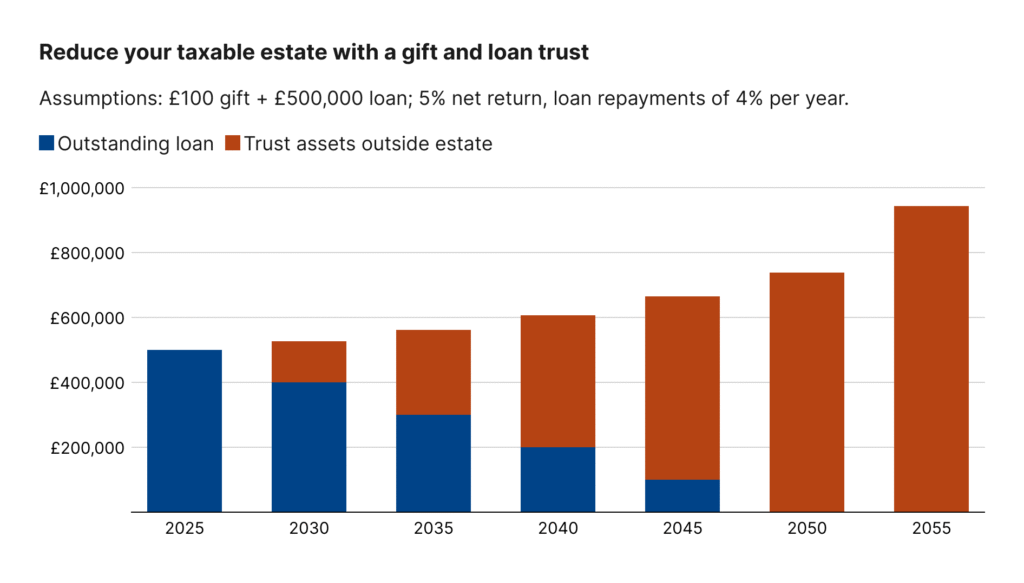
Unlike a regular gift, a gift and loan trust allows you to maintain control over assets, while mitigating IHT liabilities and benefitting from investment returns.
This may be more suitable than regular gifting if your beneficiaries are younger children.
The chart highlights how a gift and loan trust can be used to move assets outside the estate, while benefitting from investment growth. In this scenario over £940,000 is outside of the estate for IHT purposes after a 30-year period, with the £500,000 loan fully paid off after 25 years.
A detailed financial plan can help business owners make suitable long-term financial decisions, both in the planning stage before exit, and in the aftermath. Call 03300 564446 to discuss your options, or get in touch via our contact form.