


22 Mar 2025
Savers have one final opportunity to buy missing National Insurance years from 2006 to 2016, before April 5 2025. Filling gaps in your record can provide a significant boost to your annual State Pension, as Martin Cotter, Lumin Wealth’s Managing Director, explains.
Do you have an incomplete National Insurance record between April 2006 and April 2016?
Are you a man born after April 5 1951, or a woman born after April 5 1953? If so, making voluntary National Insurance Contributions (NICs) to fill gaps in your record could prove to be very lucrative.
How the new State Pension works
You need to have made 35 years of NICs to get the full new State Pension (currently £11,502 per year). If you have fewer than 35 qualifying years, you will receive less, depending on the number of missing years.
For instance, if you only had 28 years, your State Pension entitlement would be reduced by 20 per cent (seven missing years accounts for 20 per cent of the required 35 years). You need at least 10 qualifying years to receive any new State Pension at all.
Plugging NIC gaps
People often have gaps in their National Insurance record because of prolonged full-time education, time spent abroad, low income over a particular period, or a career break.
Usually, gaps can only be plugged for the past six tax years, but until April 5 you can go as far back as April 6 2006 (for men born after 5 April 5 1951 and for women born after April 5 1953). The previous deadline to fill these gaps was July 31 2023, but this was extended to April 5 2025.
Gaps can be filled by making voluntary Class 3 NICs, which are £824 if you haven’t worked at all during a tax year. After April 5 2025 you’ll only be able to pay for voluntary contributions for the past six years.
Break even in under three years
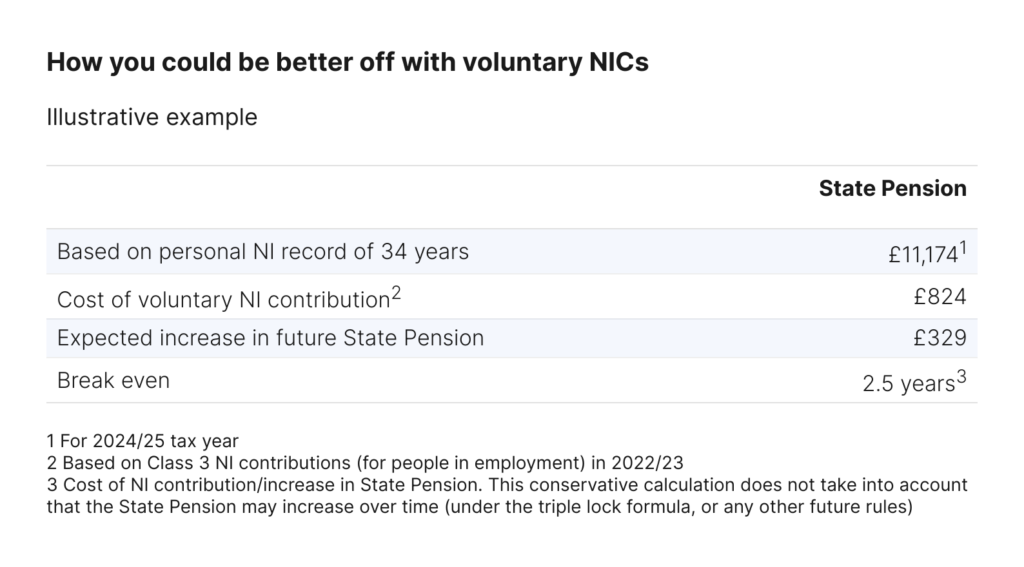
Making voluntary NICs to fill gaps can be lucrative, as the illustrative example opposite shows. An eligible person with 34 qualifying years at the end of their career could boost their State Pension by £329 annually by adding an extra year. In this scenario, you would have to live for just over 2.5 years to hit the ‘break even point’, whereby you would be better off by making the top-up.
The average life expectancy for a 67-year-old is 20 years for women, and 18 years for men, with a one in four chance of living until 94, or 92, respectively. If you lived until age 85, you could receive almost £6,000 (£5,922) more by spending £824 now.
How to go about it
You can check how to calculate your NIC/State Pension status by following the below steps:
1. Check for gaps in your National Insurance record (this may include credits for looking after children under 12): www.gov.uk/check-national-insurance-record
2. Check your State Pension forecast: www.gov.uk/check-state-pension
3. Check if National Insurance gaps can be filled (depending on age/eligibility)
4. Check the applicable National Insurance rate
5. Compare voluntary NICs with the expected increase in your future State Pension.
You can contact the Future Pension Centre on 0800 731 0175 if you’re unsure what to do and you’re yet to reach State Pension age.
A financial adviser can help you understand if/when and how you can achieve your desired living standard in retirement.
Call 03300 564 446, or get in touch via our contact form to arrange a chat over a coffee.
