


24 May 2023
Left over middle, right over middle, left over middle… There’s something almost mesmeric about plaiting hair, as your conscious mind relaxes control over your fingers and lets instinct take over.
In fact, the very process of learning to braid rewires the brain in the same way that learning to drive does, and you soon forget the actual process and go into some sort of automatic pilot, relying on your body to perform the repeated pattern without focusing on the action itself.
It’s a remarkable thing to learn, and having barely managed anything more complicated than a ponytail before, I was keen to fulfil a long-standing promise to my almost 11-year-old daughter to ensure she at least spent the last few months of primary school with a hairstyle like her peers.
In fact, dads learning to plait their daughters’ hair was what made St Albans-based business Braid Maidens into a global phenomenon, with founder Annis Waugh enjoying appearances on the likes of This Morning, in the pages of The Washington Post, and a host of other media slots at home and abroad.
We’ve covered Annis’ journey from producing to plaiting in the St Albans Times recently, so won’t go over old ground here, focusing instead on the courses she teaches and how easy it is for an absolute newbie to learn some hairstyling tricks to wow offspring and partners alike.
Over a two-hour session in the comfort of my own home, using a plastic head rooted with a blend of real and fake hair, I found myself embracing a skill I never knew I had, as I immersed myself in a new world of plaits and ponytails, buns and braids.
Of course, as you can imagine, the rhythmic process of plaiting hair allows conversation to flow, and proved the perfect opportunity to chat to Annis about her experiences since taking the bold decision to make Braid Maidens her fulltime career.

“It all started with Frozen. My daughter Gracie had been a fan for five years and so a friend and I decided to run an Elsa and Anna hairstyle stall at the school fair. The kids were delighted, but what I noticed was how the parents watching wanted to know how to create the different styles, and I realised there was a gap in the market to teach people.
“There are many teachers in my family, but never did I think I would end up learning how to teach, that was the biggest surprise.”
Following delays caused by the pandemic, Annis eventually started her business in October 2021, since which time she has taught more than 1,000 people the craft.
“All I do is give people the confidence to try,” she told me. “I tell you what to do with the hair and your hands will find their
own way. The thing to do is not have a negative mindset, to worry about being all fingers and thumbs, but just to have a go and see what happens.”
It really is a case of teaching old dogs new tricks, as I discovered once I started work on my first plaits.
“It’s two-thirds preparation,” Annis said. “Brushing the hair properly, having the right tools [I was armed with a brush, pintail comb, crocodile clips and assorted hairbands]… and only then do you start plaiting.”
We started off by creating a simple ponytail, dividing it into two plaits, before moving onto more complicated styles featuring multiple flourishes, but all relatively straightforward to create, and definitely impressive to behold.
Some of the other styles included a half-up butterfly bow-bun, a pull-through braid, and how to bubble braid – good for high ponytails or bunches at a party or school disco.
Weirdly, having had long hair at various times in my life, I was used to putting in hairbands into ponytails without seeing the actual action, and found I had to look away in order to add them to the end of my plaits, letting my fingers work automatically. The brain is indeed a very complex, very wonderful machine.

The more advanced courses cover things like Dutch braids, fishtails and French plaits, if you decide this is something you’d like to take further. Annis said the learning continues after classes, as your brain things through the process subconsciously, and it is true that when I came to tackle my daughter’s long locks a few days later my hands went to work almost without any thought.
Working on an actual human is very different from a doll, but although tilting her head meant my plaits were a bit lopsided, I found actually doing them came instinctively, and it was a wonderful bonding moment for us both.

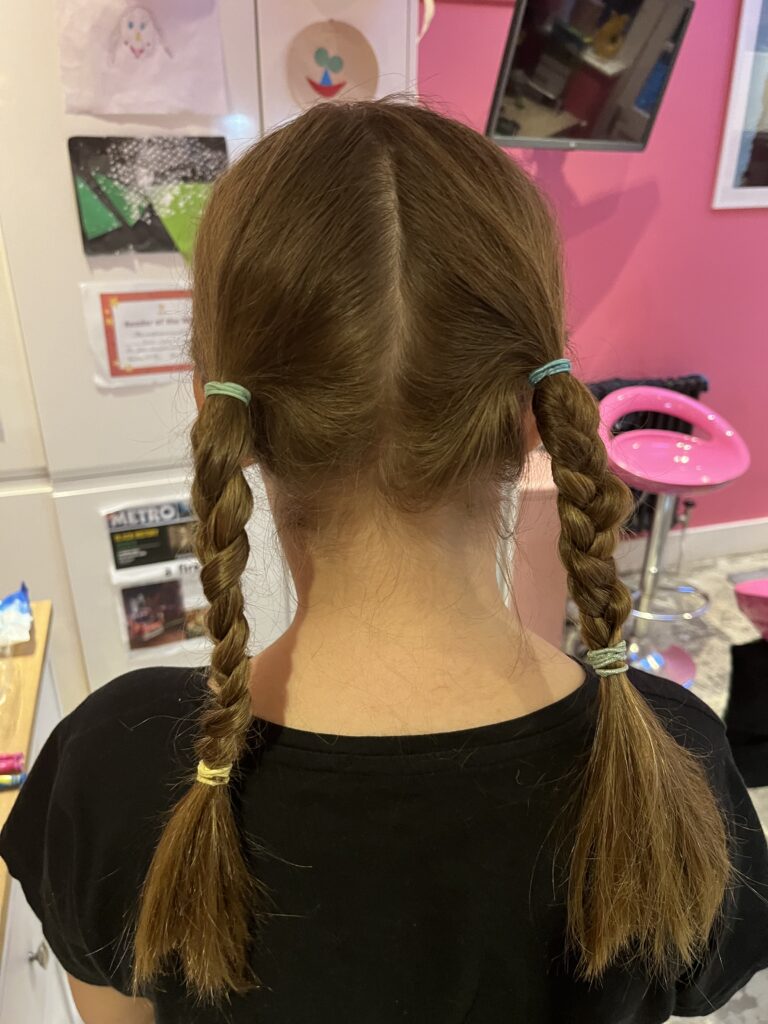
I dropped Annis an email with some photos, and she came back to me later with some very reassuring feedback: “Lovely parting and a great job! This is the start of such a lovely thing for you both, I love it.
“Great to hear it’s coming naturally too – I could see it was on your last plait yesterday. You got the flow!”
I’m now planning on expanding my braiding repertoire with further styles, ensuring I’m fully up to speed when my youngest daughter – just three-and-a-half with some shoulder length curls – sits still long enough for me to give her the Elsa plait she has always longed for!
Find out how you can learn to plait at braidmaidens.com – solo courses, group sessions, fundraiser events and parties are all available to book in person, as are online sessions you can take part in from the comfort of your own home. You can also pick up all the necessary equipment from her online shop.
