


15 Jul 2025
Sandy Walkington examines the origins of Asian cuisine in St Albans, and how it reflected the city’s changing culture and ethnic make-up…
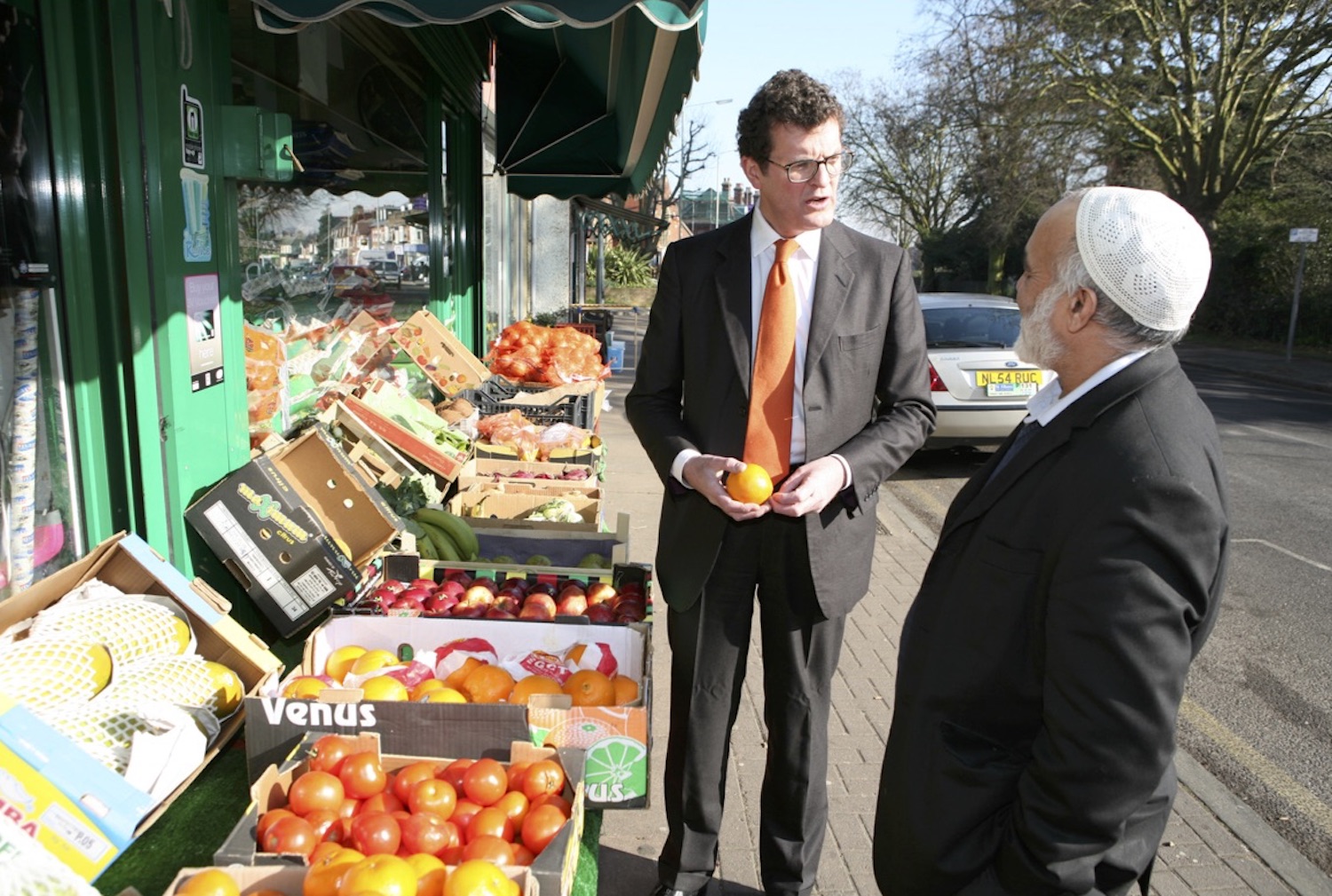
As the county councillor for the most ethnically mixed area of St Albans, I have always had contact with the Bangladeshi and Pakistani communities across the city. I also served three years as President of the St Albans & Hertfordshire Architectural & Archaeological Society (SAHAAS).
In both roles I became acutely aware of how much the ethnic minority experience of living in St Albans had been overlooked, with at best fleeting mentions of their lives and contribution. So I went back to school – or rather university – undertaking a History MA at the University of Hertfordshire to look at migration into St Albans in the second half of the 20th century using oral history – ie taped interviews – as my tool, carrying them out during 2020.
For my dissertation I had to focus and I chose food as the prism. Everybody has to eat. Cooking familiar recipes after seeking out their ingredients was a way of holding on to home. It’s a non-threatening subject to talk about. It’s a trigger of memory (think Proust who wrote his seven volumes on the flood of memory unleashed by eating a biscuit!). And the white British population of St Albans had their own tastes transformed as “going for a curry” became an accepted and normal part of British life.
St Albans also had the first Indian restaurant in Hertfordshire, opened as little as one year after the first Indian restaurant in Leicester, often seen as one of the centres of Asian ethnicity in the UK.
I focussed on arrivals between 1960 and 2000. This period mostly predates the rise of cheap air travel which was later to transform the relationship between new migrants and their countries of origin by allowing much more frequent home visits and also enabling cheap air freight of exotic foodstuffs, so reducing the challenge of shopping for familiar ingredients.
Looking at the 2011 census, the population of the county divisions making up the urban area of St Albans (ie not Harpenden or the villages) was 58,528.
The largest single ethnic minority was of Bangladeshi origin, totalling 1,975 persons or 3.37 per cent of the total population. The largest proportion (532 residents) of this Bangladeshi population lived in the Sopwell district council ward.
Next door Verulam ward covering the historic centre round the Abbey (but in the same St Albans South county council division) was the sole St Albans district ward to have no Bangladeshi origin residents at the date of the 2011 census.
The second largest ethnic minority group in the city was the Indians numbering 1,060, fairly evenly scattered across the city though with a slight preponderance in the Fleetville area. Third largest was the Pakistani community numbering 840, with the biggest concentration also living in Fleetville. Then came the Chinese, Afro-Caribbean population and Mixed Race populations.
The relative size and importance of the Bangladeshi population in St Albans is significant in national terms and in marked contrast to most neighbouring Hertfordshire communities, where Indians and Pakistanis form the majority South Asian population.
As well as my taped interviews, I found Facebook to be an invaluable resource and particularly the St Albans Past and Present Memories page with its nearly 20,000 members, who between them threw up some fascinating recollections.
The way I teased out more information about a particular butcher’s shop is a good example.
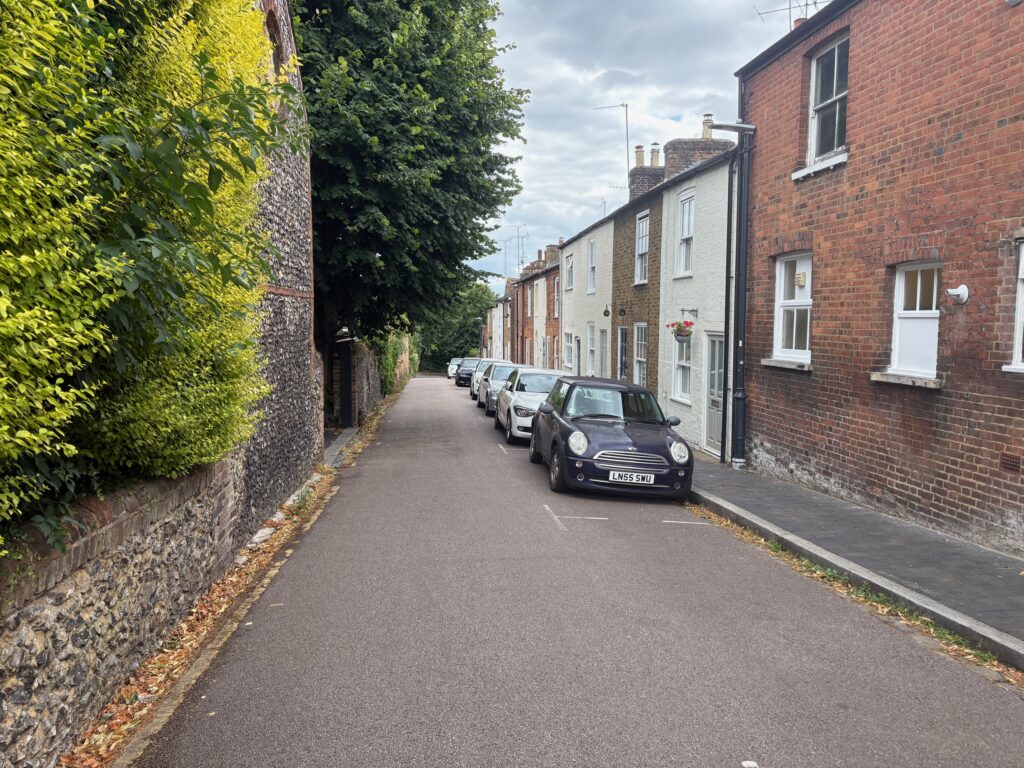
The shop was first mentioned to me by interviewee Mohammed Akhtar when describing his early days in St Albans as a 15-year old in 1966: “So at that time because we not able to get much meat, we had like lentils and some vegetable curries and things, and here in St Albans what I remember, again very sad only last month that gentleman passed away – he English gentleman – down London Road by the Odeon Cinema… there was a little shop thing and in the shop there was a yard where the men used on Saturday, he used to get all the live chickens and we used to go there and slaughter them ourselves.”
And then an interview with Jenny and Rick Taylor from the Jewish community (at the time I had not yet determined to focus on the South Asian community).
Jenny’s parents came to St Albans in the 1930s: “There was also a butcher in St Albans in Alma Cut I think it was that sold kosher chickens, he had them specially slaughtered. That was in my childhood, I can remember that, that would be in the early ‘50s…
“I just remember my mother going there but I can’t remember going there myself and seeing it, and I know she went to Alma Cut and bring back chickens on a Friday and I think he only did it once a week, he only did it on a Friday because that was the day the Jewish community wanted their chickens.”
Jenny’s husband Rick named the butcher as Tom Dunham.
I was struck by this overlap between the Muslim and Jewish communities as to where they were able to source meat which had to be slaughtered according to strict religious ritual.
I used the St Albans Past and Present Memories group to ask, ‘Can anyone give me any information about the butchers that used to be down Alma Cut – what was it called, what was it like, did you use it?’
I did not name it or ask specifically about Muslim or Jewish customers to avoid any leading questions. I stated that I was asking this question in connection with my MA dissertation for the University of Hertfordshire.
“I remember a butcher’s being there but can’t remember what it was called or when it closed.”
“Maybe Dunems.”
“Dunham’s. Father and several sons business. Tom Dunham. One son also Tom, another called Gerald/Gerard. This info from xxx who lived in Old London Road.”
“I lived in Alma Cut 1970-1974 with my young family, and although we had no money to speak of, we would pop into the butchers on the odd occasion. One thing that I do remember was that certain days and times were set aside to allow customers to enter and prepare their foods in accordance with their religious beliefs. I cannot in all honesty say whether it was Halal or Kosher.”
“I remember Dunham’s in the early to mid 1960s. When I was a young child, my mother would take me there. They had chickens running around the yard, the customer would choose which one they wanted, and they would kill it there and then, in front of you!…. We would go there regularly. I think everyone shopped there. We were not Jewish or Muslim. Most of us did not have fridges in those days, so could not store meat for long. Slaughtering them to order makes sense in this context.”
“I can remember it was a but [sic] smelly!! Sorry.”
So why did migrants come to St Albans? Work was of course the main driver and always had been.
The Nicholson & Co raincoat manufacturing plant in Sutton Road attracted many Jewish workers from Manchester, many of whom lived in specially built worker housing in Hedley Road.
Coincidentally Mohammed Akhtar, who had come to St Albans from the Pakistani side of Kashmir, was also employed at Nicholson’s for his first ‘proper’ job in 1968.
“I had a job there doing these Hoffman machines you press clothes with, steam irons, so that was my job doing this Hoffman thing, lots of steam and warm.”
Humayun Akhtar, the first community relations officer for St Albans district council, in post from 1986 to 2007, talking about the post-war period said: “At that time we had a rubber factory there in St Albans and other small-scale industries which needed labour – semi- and unskilled labour. Rightly or wrongly, the local population, the local ethnic population, white, they would avoid doing that particular service so the employers had no option to get the labour and this ready-made labour was available to them.”
In fact the whole tide of post-war South Asian migration to the United Kingdom needs to be understood in the context of British labour shortages, mirroring similar flows from North Africa to France and from Turkey to Germany.
The employer which is highlighted over and over again with particular emphasis on the Bangladeshi community is St Albans Rubber Company. The company began in 1913 as the Grimston Rubber Company (the family name of the founder, the Earl of Verulam).
Throughout its history its main focus was on supplying the motor industry, first with tyres and then with rubber gaskets, floor mats and other rubber accessories. In the late 1970s the company’s premises were on Camp Road St Albans and it employed some 360 employees, two-thirds engaged in direct production, the rest in engineering, inspection, management and back office functions.
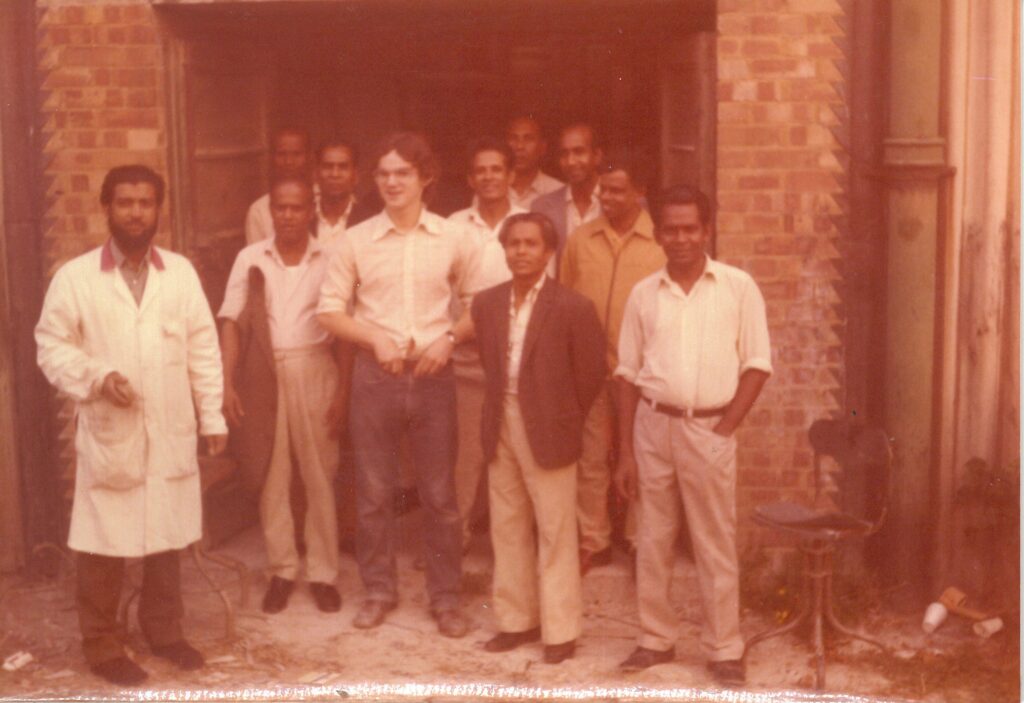
Andrew Freeman, who worked there in the mid 1970s after leaving school, describes the working environment as “very dusty and very smelly, got into your hair and your skin quite a few hours after you finished work. Not the nicest place to work”.
He added: “One of the first things I was told when I joined there was that the safety mechanisms weren’t the best thing and a chap actually disappeared between these two rollers one evening and was killed during the night shift.”
But the crucial thing was that they needed labour: “It was very easy to get a job in the Rubber Company. I think I just like most people did, just phoned and said do you have any jobs and they came back and said, ‘Pop in and start on Monday’. There was a constant turnover of staff there.”
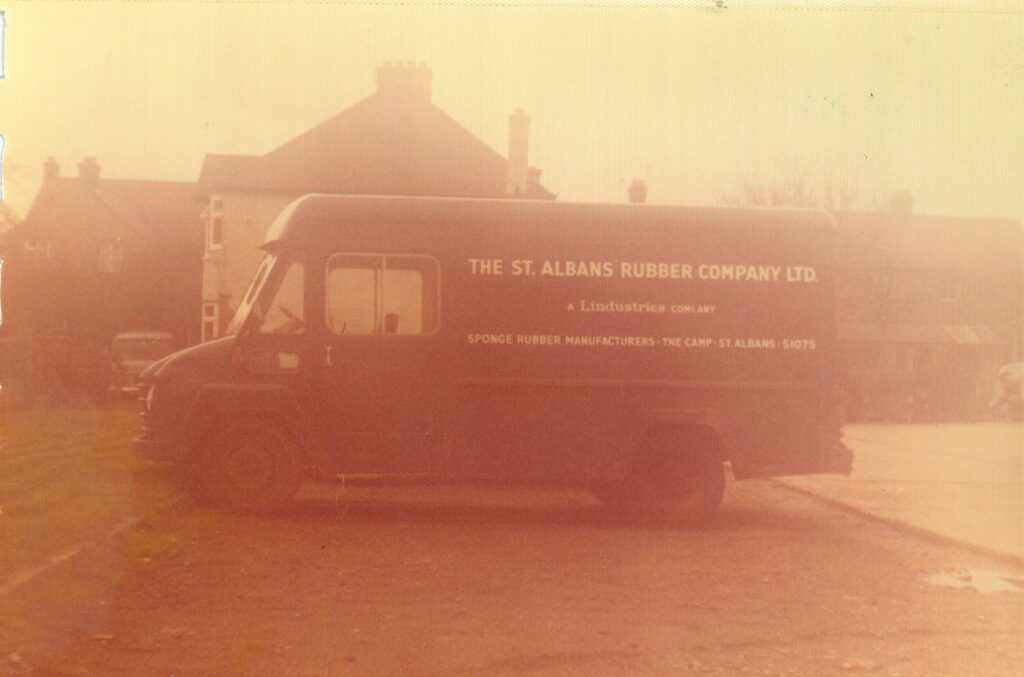
Mohammed Rahman, who was born in St Albans but whose parents came from Bangladesh (he thinks his father worked ‘maybe for a short time’ at the Rubber Company), related the following account: “Another story I remember, the foreman of the factory used to literally come outside, sit outside the factory and when he used to see any Asian people walking past he used to call out ‘Hey Ali!’ – just calling out at random an Asian, a Muslim name – ‘Do you want a job?’ and he would say ‘Yes, can I start’.
He described this as a story, but it is clearly part of a shared community memory of the significance of St Albans Rubber as an employer. In Andrew Freeman’s last few weeks at the company he supervised the night shift and the entire crew was Bangladeshi.
As Freeman relates: “I was there for a bit of ’75 and quite a bit of ’76. At that point there were a significant number, I would have thought probably half the workforce at least.
“I certainly remember some, they came and they went so you would see somebody every day for six months and then they would disappear for three months and somebody would say they’ve just gone back home and then they would be in after a time and the company certainly seemed if not encourage then were happy to have workers with experience coming backwards and forwards as long as they kept the total numbers up.
“I can remember my first experience of meeting somebody working through Ramadan, it was that boiling hot summer of ’75 or ’76 and feeling that understanding somebody was working a 12-hour shift, seven to seven, in a hot factory on a machine and not drinking anything or eating anything the whole time really was an eye-opener to me.
“I was staggered, of course your first thought is that just doesn’t make sense, that can’t be, it must be horrible to go through and hardly safe but that’s what happens and when Ramadan falls in the summer it’s a long old day isn’t it?”
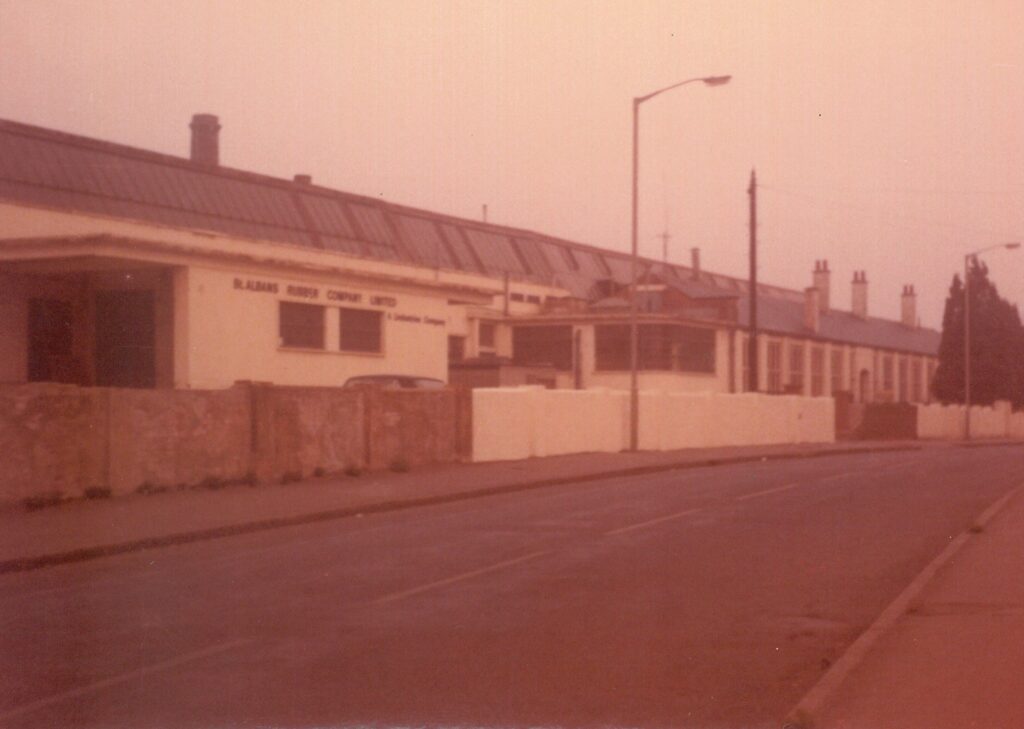
In terms of the proportions quoted by Andrew Freeman, he is probably referring to over half of the production staff numbering approximately 240, given the huge gulf between the shop floor and back office operations.
But that would still mean over 100 Bangladeshis at any one time, a significant number particularly given the flexible comings and goings and regular recruitment of new blood described above.
Freeman could not remember any Bangladeshis in supervisory roles and when asked about food: “You asked what happened at lunchtime. I have absolutely no idea. I think they would have come into the canteen with everyone else, I don’t remember there being any separate area that they would have used and we had a relatively short lunch so even if they had managed to get home, very few employees would have gone home for lunch in those days.
“I think they would have come to the canteen but strangely enough I don’t have any recollection whether they did or didn’t.
“You could take your own food in so it may well be they would have done that and of course in terms of taking your own food in, all the machines, a good selection of the machines would have been hot so you would have just put your foil dish or metal can on it and it would have heated up fairly quickly, it may well be, if they had done that, they would just have eaten somewhere near the machine or outside.
Freeman also illustrates how the factory still operated as though its workforce had remained entirely White British:
“There were social events at the company but they were very traditional, they would have just been discos or parties or things like whist night but nothing very ecumenical in a way that would have got other people than the normal crowd turning up.
“Looking at photos I took of business events that was certainly born out that they were all, you know, local people.”
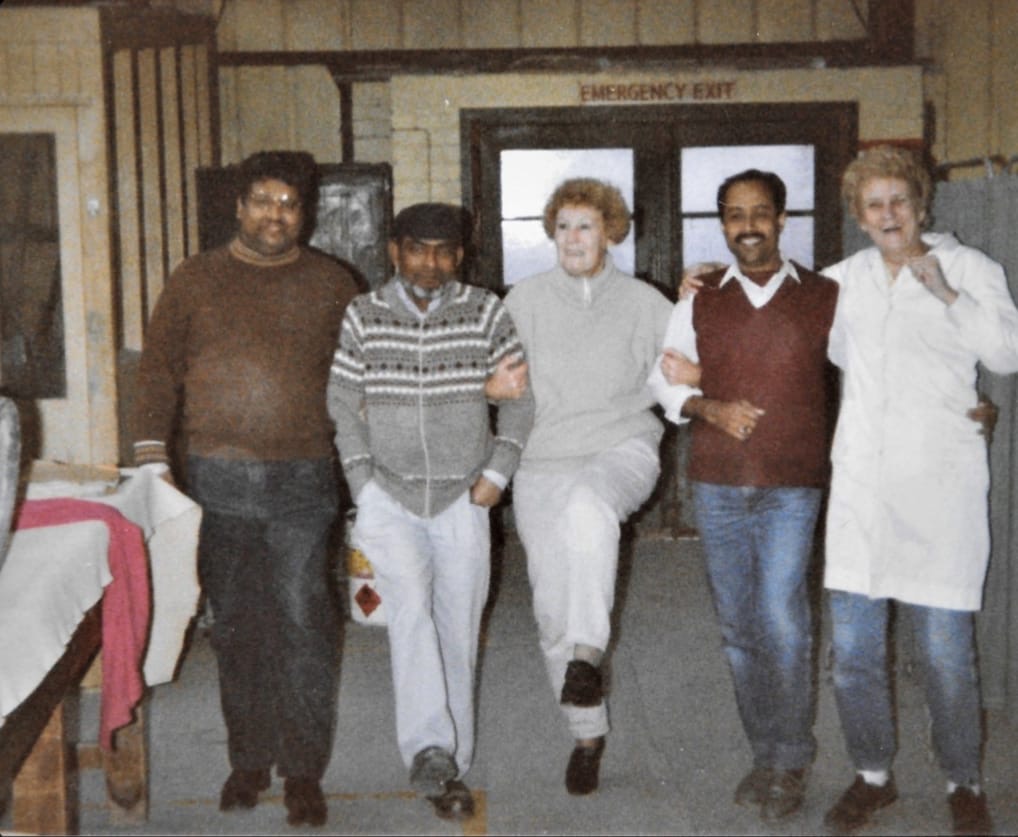
However, a different story is told by Andy Mackenzie whose mother and aunt worked at St Albans Rubber. He has photographs from the late 1980s showing Bangladeshi workers arm in arm with white female staff suggesting a welcome relaxation in the space of a decade in relationships between the ethnic groups.
While the focus of this description of St Albans Rubber has been on the Bangladeshi community, other migrants also worked in the rubber factory.
It was the first place of work for Ghulam Sarwar Khan, Pakistani husband of interviewee Mumtaz Begum.
Another interviewee, Velma Richards, recalled that her grandfather – who came to St Albans from St Kitts in the 1960s – worked during the day as a porter at Harperbury Hospital, came home, and then worked the night shift at the Rubber Company.
St Albans Rubber moved away from St Albans in 1989 with the site being redeveloped for housing.
The company has since closed and has left oddly little footprint, digital or otherwise. There seems to have been something about rubber manufacture and the attraction of migrant labour. The movement of Sikhs to Southall, which became the major centre of settlement for this particular South Asian community, was initiated by a former British officer in the Indian Army who was working for the Woolf Rubber Company.
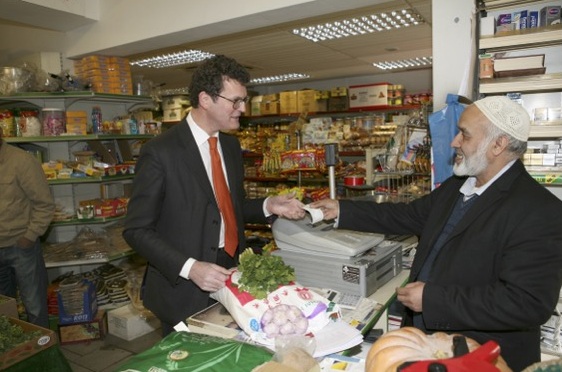
Mohammed Akhtar, proprietor of the former Madina Store on Hatfield Road, did not come to Britain from Pakistan planning to be a shopkeeper. He had been diagnosed with typhoid almost immediately after he arrived and spent six months in hospital in Stoke on Trent where his father was working:
MA: But being Muslim you did not eat meat, funny thing was when I was in hospital, I did not know English, hardly ABC, this nurse was talking about food, I was saying “no meat, no meat”, and this nurse comes up to me and she says to me “No meat, cluck cluck, not meat, that’s chicken”.
SW: [Laugh] But not halal chicken presumably?
MA: So I say no no. [laughter]
His father then took him and his newly arrived older brother to St Albans in 1967 where they lived in one room in a house in Laurel Road. Because he was still convalescing, Mohammed did not have to work but cooked for his father and brother instead. His experience of buying halal chicken from the butcher in Alma Cut is described earlier.
MA: Don’t forget there were no families, it was all single men so therefore cooking in different dishes didn’t exist, you only had basic. And that’s it.
SW: So what were your basics then?
MA: Well as I said that time was not so many different dishes, you were lucky to have what you have so I remember more about chickens, making a pot of curry which will last you maybe if not three days, two days certainly because at that time there were not these fridges and things available so we would cook one day which we would eat that day and the following day, like that.
SW: And spices you could get from shops, could you?
MA: Yeah basic, like chilli powder, turmeric. Cooking was very simple like that. That’s how we survived.

Another interviewee followed her husband from Bangladesh to St Albans in 1975 – he had arrived 13 years previously on a Commonwealth work permit and worked in a furniture factory in St Albans.
When she first arrived, they lived with three children in a single room in Beaconsfield Road and her husband went to shop. For their halal chicken the men would go to a farm in Smallford to slaughter chickens in the proper way. After they got their council house in Dellfield, the farmer (‘Mister Tom’) delivered live chickens in a van which they kept in the garden and slaughtered in the bath.
She experimented with growing vegetables and herbs in her garden but not very successfully, and although St Albans market was a source of fruit and vegetables, she could not get all the vegetables and beans for a typical Bengali diet, and most of all she missed fresh fish.
Her son described the family sitting round the pot on the floor of the front room of their council house and eating with their hands: “It’s more sensual and you can control how much you eat. I used to collect the beans on either side and eat the beans at the end.
Mike Neighbour, instigator of the Fleetville Diaries project, writes: “There was no local provision for what we might call cultural food in the local shops which served an increasing number of migrant families…
“As now earlier settlers adapted their provisions based on what was available, grew what they could in gardens and allotments… and later made arrangements with existing shops to add lines from their own wholesalers. I understand that more established networks enabled them to supply informally to more recent community groups of families (the typical van travelling to North London suburbs and returning brimful of products to be shared and resold.
In my own interviews it has to be recorded that Southall, Tower Hamlets and Luton were more often mentioned as sources of bulk items.
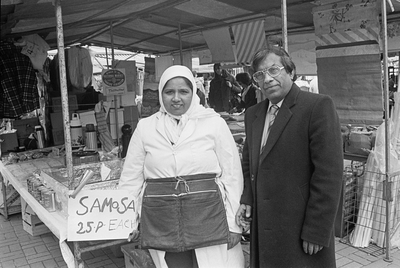
So what about the supply of food in St Albans itself? It was while working as a 17-year old with the steam pressing machine at Nicholson’s that Mohammed Akhtar formed the desire to become a shopkeeper. At break time he and his team mates used to go up the road to a grocery store belonging to Mr Addington to buy chocolate and a drink: “So I used to see Mr Addington standing by the till and taking money and I used to say ‘Look I am sweating inside there and he’s standing there’.
“I come home and say to my father ‘I want to open a shop, I don’t want to work there, I want a shop. Because I see that gentleman standing there in a white coat and taking money and I want a shop.’
“My father laughed and said ‘OK when you are able to do that, you buy a shop’ and that’s it, that’s how it happened.”
After five years and numerous false starts he scraped together the deposit and multiple loans using his father’s house as security and an older cousin as a guarantor to buy a small grocery store from Mr John Watt, ‘very clever man’, in Camp Road opposite Camp School in the Fleetville area of St Albans. He particularly remembers the bank manager from the NatWest branch at the top of Victoria Street.
MA: He listened to me, he said ‘I like Indian people because they work hard.’ He was in the army, he was in India…
SW: So there you are in a shop in Camp Road in 1976 which is full of English food?
MA: Full of English food. And I didn’t know where is bacon, somebody ask me ‘Give me a tin of baked beans’, I wouldn’t know, I’d never eaten baked beans or sausages or anything so I would not know what they looked like.
But when we bought the shop, that gentleman had one lady who lived on the corner who, she used to work for him, so I asked her, I said to the lady can you please stay and help us, we will pay you, and she said OK so that’s how we, she stayed, she helped, we had lots of ups and downs, we nearly lost everything, we were going to go bankrupt because that gentleman was very experienced, the stuff the way he bought, he could sell stuff cheaper.
I could not do that, I used to go to Cash and Carry and because we had no money, every day I used to open the shop and whatever money we take during the day I used to run to Cash and Carry to get stuff for the following day.
SW: Did you sell any Asian food at all?
MA: No you couldn’t get any Asian food, we didn’t know where to get any Asian food till later.
It is noteworthy that both the person recruiting Sikhs into the Woolf rubber factory in Southall and the bank manager who gave Mohammed his first break had served in the Indian Army.
Mohammed stayed in that shop in Camp Road for 10 years, then tried running a post office, a newsagents and for a time a café.
SW: And when did you start selling Asian food?
MA: Asian food? Later I remember because that time Southall in Middlesex was well known among Asian folk here. People from Bangladesh, they went to Brick Lane, it was more for them, East London, but other Asians, we went to Southall.
SW: Which is Sikh of course?
MA: Because Southall, because at that time they had lots of Asian people and they had cinemas that used to show Indian films and things, so that’s why old men, they used to go when they have a day off, like Sundays and that, they would sometimes go to Southall.
SW: And watch a movie and you would go as well?
MA: Watch a movie. So I’ve been there with my cousins and that and then I find out there is a cash and carry in Southall where you can get Asian foods.
That’s later in ‘80s I used to go there when there was more Asian stuff available in the jars, Patak paste and certain things like that so I used to go there maybe once a month but at that time English people did not eat much Asian food, that time, I had not had personally experience, but curry everybody used to say stinks, smells, you know the garlic, smell this, smell that, so not many people, certainly English people, not into Asian food until well later in ‘90s when more and more people tried these restaurants, takeaways being opened and that’s when curry becomes famous but first of all people didn’t
Farhat Zia, who was coincidentally brought up in Camp Road in the house immediately next door to Mohammed Akhtar’s first shop, remembers that her father Ghulam Sarwar Khan – who first came to St Albans from Pakistan via Birmingham in 1965 and who also worked initially at St Albans Rubber – always insisted that they close the windows when cooking curry for fear of offending the neighbours.
And her mother, the late Mumtaz Begum, used to learn the colours of tins and other packaging because she could not read the labels.
In terms of English food, Mohammed Akhtar ‘loves’ fish and chips – “even now, there is a shop in Harpenden, I have it if not every week, every two weeks”.
Farhat Zia remembers that her family had fish and chips every Friday. For both of them, the enthusiasm was evidently genuine, it was not just an attempt to culturally fit in. It should be noted fried fish was ‘migrant food’ originally associated with 19th century Jewish immigrants who came to Britain before being adopted as the British national dish.
A common theme amongst all the interviewees was that their children had developed eclectic tastes and were not wedded to their traditional cuisine. Mohammed Akhtar commented that there is now: “more stuff available, spicy burgers, mix of noodles, they cook what they like. People are richer. At the beginning it was hard.”
In terms of cultural crossover I was particularly struck by the notice advertising ‘Halal Turkey’ at the Asian Foodstore in Hatfield Road, St Albans at Christmas 2019.
As the children of migrant communities began to eat a multicultural fusion cuisine, so the White British population of St Albans had made its own culinary journey, learning to enjoy ethnic cuisine.
Middle class households in St Albans at the start of the 20th century would have understood a concept of ‘Indian’ food. The 1911 census shows a not insignificant number of residents had either been born in India or were visiting from there on the day that the census enumerator came to call.
The 1899 edition of Cassell’s Dictionary of Cookery boasts of sales of 145,000 volumes, so its 1,170 pages must have graced at least some St Albans kitchens and given them ‘the largest and most complete collection of recipes ever produced in this country’. Amongst the 9,000 recipes are 50 prefixed by the word ‘Indian’ beginning with ‘Indian Bread and Meat, or Koobe’ and ending with ‘Indian Veal Collops’ plus an additional 13 recipes for curry.
Even after discounting the recipes which should have been filed under ‘N’ for Native American, it is still clear that, while the indigenous populations of the subcontinent might have struggled to recognise the meals being described, the influence of the British Raj was already having its impact on British cuisine.
However, it took until the 1960s for this to have an impact on eating out in the city, when St Albans turned out to be something of a pioneer in the development of Indian restaurants. Kelly’s Directories for St Albans were produced on a biannual basis until 1975 and they show that up until the 1960s, the restaurant offer in St Albans was for the most part stolidly British apart from a ‘Danish Café’ on Holywell Hill and a French bistro Chez André which briefly occupied premises at 8 George Street.
Kelly’s then shows that the George Street premises had become the Lucky Indian Restaurant by 1964 (subsequently renamed the Koh-i-Noor before 1968) while the Taj Mahal had replaced the Cottage Café in London Road some time prior to 1962.
They were the two first Indian restaurants in Hertfordshire. At that time there were only 300 or so ‘curry restaurants’ in the whole of the United Kingdom. It is interesting to speculate why St Albans should have been a trailblazer in this way, and whether it reflected a particularly adventurous restaurant-going demographic. Neither restaurant was located particularly close to the centres of Bangladeshi population which were in Fleetville and Sopwell, though the Taj Mahal was opposite the main town cinema.
By comparison, in the much bigger city of Leicester, the first Indian restaurant had opened in 1960 and by 1969 there were still only four in the whole city.
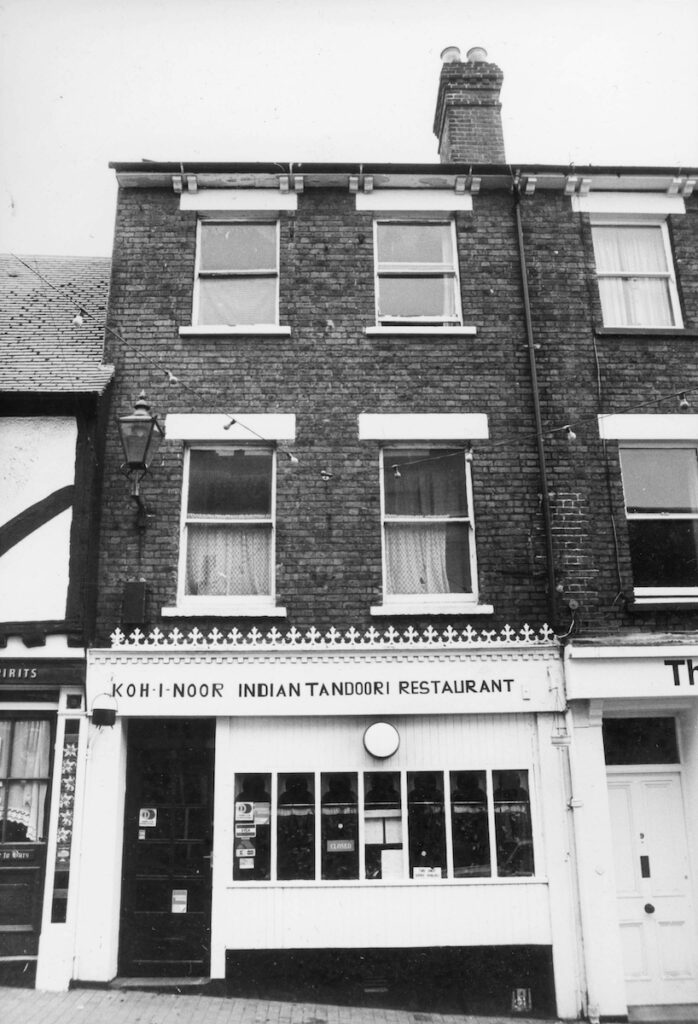
Kohinoor Choudhury relates how his father, Mujammil Hussain Choudhury (MH Choudhury) had been working in restaurants in London and heard about a restaurant for sale in St Albans.
He bought it from the Miah brothers in 1963 who had themselves bought the former Chez André restaurant in 1961. This 1961 date would confirm the Koh-i-Noor (though not always under that name) as the first Indian restaurant in Hertfordshire.
Kohinoor says that the early menu catered for European tastes with steak, roast chicken, chicken Maryland or plain omelette and chips as well as simple curries and it may have been that the Miah brothers were slow to change the name although it had certainly become the Lucky Indian Restaurant by the time that Kohinoor’s father bought the restaurant.
MH Choudhury had his firstborn son in 1966 and named him Kohinoor, simultaneously renaming the restaurant.
Jasim Uddin continues the story in the late 1970s. He was interviewed in 2013 as part of the Sopwell Memories project. His father had been a farmer in Sylhet, who came to Britain on the voucher scheme, working initially in Welwyn Garden City in a factory, then in Luton and coming to St Albans in the early 1960s:
JA: He had his own restaurant after a few years. That’s where we stayed in George Street, it used to be called the Koh-i-Noor. They were the first Indian restaurant in Hertfordshire and now we have thousands and thousands of them all over Hertfordshire. My dad said they only had a few basic curries, we just had chicken curry and chicken madras and over the years we invented other things and it just grew and in those days we didn’t serve alcohol, people used to bring their own alcohol because it was forbidden in our religion to drink and touch and serve alcohol.
Over the years – I think he done it with his uncle and his cousins, he was in partnership with them and then in 1983 he decided because it was the forbidden work, not right for a Muslim to do, he packed it in and then he went and worked in St Albans Rubber Company for a number of years until they shut down, there are a lot of flats there now. He was a machine operator.
The Koh-i-Noor certainly inspires many memories on Facebook. Sharon Linney, administrator of the St Albans Past and Present Group on one occasion posted a picture of the restaurant and asked ‘Remember this in George Street? ‘This generated a lot of responses including:
“Was the best curry house in St Albans, miss it loads”
“Charlie’s had my first curry there. Chicken Tikka and rice x”
“Many a drunken feed in Charlie’s”
“Used it, when Charlie had it back in 1965 the best ruby in St Albans ever.”
“Who dares to have a Phall at the Koh I Noor at the end of a very liquid Friday night!!!”
“Who remembers long tongue, one of the waiters?”
Kohinoor Choudhury explains that it became known as Charlie’s because that was the closest early customers could come to pronouncing his father’s name, Choudhury. He relates the stories told to him by his parents about those early days:
KC: They were tough days running an ethnic restaurant in those days. There used be fights every other weekend or every weekend. One incident my mum recalls, she says she could see from the upstairs window, one guy, a customer, took a chair outside and threw the chair through the restaurant window and my mum was new to this country and she was quite scared. There are various stories like this. This was not an isolated case. There were fights in the restaurant, sometimes he had to chuck people out, there was one incident where a customer got really rough and started to fight and my dad called the police and the police were quite late in getting here and in the meantime they had to defend themselves and there was a fist fight and there was some blood spilled and the police got quite angry with my father saying why did you call us and my dad reacted and said ‘what do you want us to do, just get beaten up?’
A St Albans Past And Present Memories posting on July 9 2020 asked, ‘Lived in st albans [sic] till 1969, anyone remember an Indian restaurant from those days.’ and elicited the following responses among many:
“Khoi nor I remember being there with Martin xxx and a few other boys one night and Martin put he’s chicken leg on a wall light and started dripping fat and smoking then we all did a runner the good old days when life was fun and carefree”
And then later in the same thread when discussion widened to other restaurants:
“The Taj Mahal in London Rd was definitely open c.1964 it was very popular and stayed open very late, the manager used to lock the front door around 11pm to stop people running out
without paying, this caused panic with my brother and his mates one night when they realised they were locked in and while they were standing at the till looking at the bill then the one big tough guy pulled his jacket over his head and charged down the passage and hurled himself against the door and burst through with glass flying into the street the rest followed in hot pursuit with manager and waiters chasing and yelling after them but never to be seen again. I remember seeing the door boarded up for about a week after, I know it is wicked but I couldn’t stop myself from laughing at the ridiculousness of it all.”
These Facebook memories are presented as a piece of banter, but it clearly cannot have been comfortable for people at the receiving end.
For me it was a fascinating experience and a privilege to be able to record the memories of some of the city’s previously unsung ethnic minorities. It was clear that interviewees were surprised and delighted to be asked about their history and indeed had much to say beyond the topic of food. They had previously assumed that local history was not for them. St Albans Museum + Gallery is to be congratulated for further illuminating St Albans’ remarkable South Asian history in its new exhibition.
