


12 Apr 2023
In 1988, St Albans city centre ground to a halt following issues with the controversial one-way system recently introduced by the county council.
A contemporary television news report – now available online – looked into the impact of the £750,000 computerised traffic system, which saw some motorists trapped in their cars for three hours after it was introduced.
“Shoppers are unwilling to give the new system a second chance, and the streets of St Albans are uncannily quiet.
“Shopkeepers say their trade is suffering, and in the traditionally busy run-up to Christmas their markets and shops are deserted.”
Jenny Williams from St Albans Street Traders Association, speaking on the report, said: “We are very concerned. I’ve spoken with the Chamber of Commerce, with shoppers and people in the shops, and they’ve all said the same thing, ‘We don’t want St Albans to turn into a ghost town’.”
Reporter Paul Anstiss revealed how The Maltings Shopping Centre had witnessed a 30 per cent reduction in usage of its car park compared to the week before the system was introduced.
Resident Betty Lyon told the cameras: “I live a mile outside of St Albans and last Wednesday it took 55 minutes to come in; this morning it took 35. Quite honestly it just isn’t worth the hassle getting on the bus anymore.”
The report said one of motorists’ biggest complaints was the poor road signs surrounding the scheme.
District councillor Agnes Hill – later an alderman of the city and now sadly no longer with us – told Paul Anstiss that HCC was largely to blame for the mess.
“There should have been a lot more local consultation. There’s no doubt about that at all… The county council have given us a problem and it’s their responsibility to sort it out.”
Does all of this sound strangely familiar?
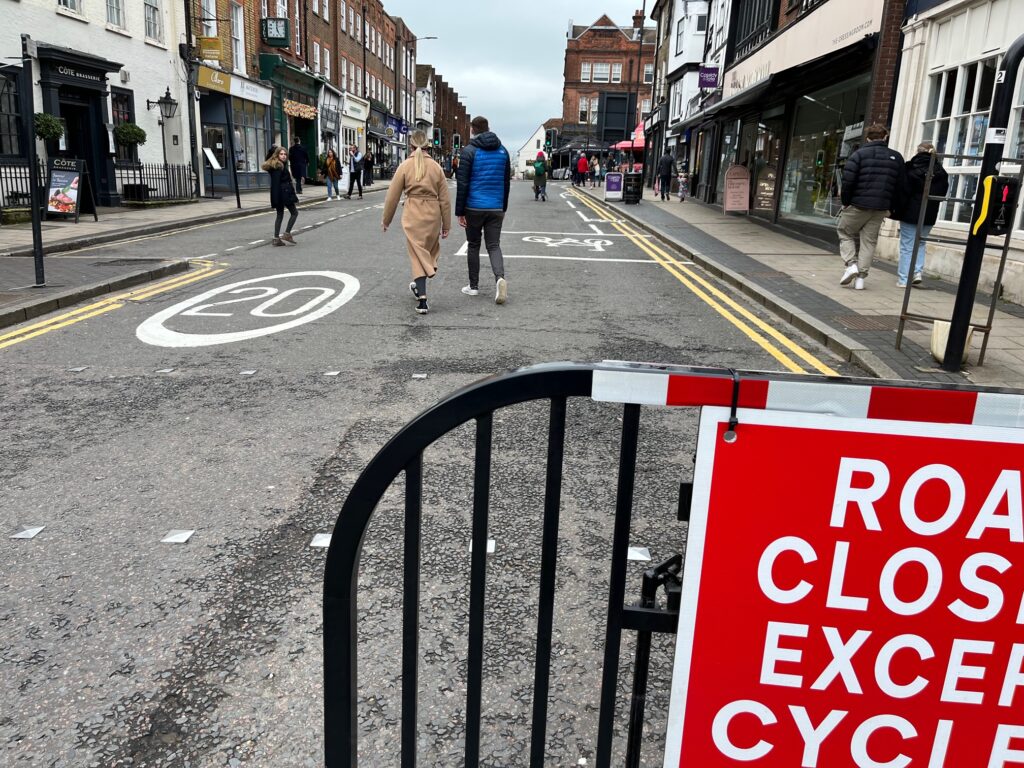
Flash forwards 35 years and many of those comments could have been said about St Albans over the past few months, as once again motorists visiting the city centre have found themselves caught up in traffic jams caused by another controversial road scheme – also largely the responsibility of County Hall.
The closures of High Street, George Street and part of Verulam Road were originally introduced by Herts county council in the wake of the first Covid lockdown to allow for social distancing measures. At the time, nobody could have predicted that the restrictions would still be in place three years later.
Although the closures were temporarily lifted, they returned at weekends in October as part of an experiment into pedestrianisation which also saw Market Place, Spencer Street and Upper Dagnall Street permanently closed throughout the trial, which is expected to last between a year and 18 months.
Last July, HCC sent out 4,463 letters to residents in the city centre offering them the opportunity to comment on the introduction of Experimental Traffic Regulation Orders (ETRO) for High Street and George Street.
Key internal and external stakeholders, including the emergency services, public transport operators and residents’ groups were also contacted via email.
A lacklustre total of just 85 responses were received: 75 from residents, seven from businesses, one from St Albans School and one from Historic England.
Of these, 30 per cent supported the trials, while 49 per cent were opposed. For the other 16 responses, support or opposition to the scheme either way could not be satisfactorily determined.
Of the responses received, 18 indicated support for the closure of both High Street and George Street, seven suggested closing George Street but keeping High Street open, and 20 emails stated an objection to the proposals.
A number of businesses throughout the city, including Christopher Place, The Maltings Shopping Centre and St Albans Chamber of Commerce raised concerns about the wider impact of the scheme.
Since the weekend closure of High Street and full closure of George Street were introduced in October, weekends have seen major congestion at both The Peahen junction and St Peter’s Street roundabout, as motorists struggle to find alternative routes across the city, with many flouting pedestrian crossings in order to get across the lights.
And as reported by the St Albans Times, takeaway couriers were seen cutting through the High Street barriers between Verulam Road and The Peahen junction rather than taking a major diversion, forcing the introduction of CCTV measures to prevent the practice.
St Albans county councillor Sandy Walkington would not be drawn on whether the scheme has worked: “In 1972 Zhou en Lai, the Chinese premier, was asked about the success of the French Revolution and is alleged to have replied that ‘it was too early to say’.
“It’s certainly too early to judge the overall success or failure of the city centre road closures. A cold winter and an unusually wet and miserable March have not helped.
“There was a delay in installing the gates due to supplier problems and an unnecessarily protracted negotiation with the fire service about how much of the roadway can be used by restaurants and other activities. There’s little point if there is just tumbleweed rolling down the streets. The proof of the pudding will be in how businesses and people now respond as the sun comes out.
“Of course it’s Marmite. People love it or hate it. I aim off from some of the more strident comments on social media since I knock on doors all the time (particularly at this time of the year) and I am in constant contact with residents’ associations.
“It means I am always polling – and with a far larger sample than a commercial pollster would get. On the doorstep reactions are much more nuanced with many people really pleased with the new arrangements. “However the people who support retention of the scheme tend to be less vociferous than those opposing it.
“The county council’s tracking as well as that of the BID both show footfall in the city centre increasing and dwell time in the city centre seems to be rising too.
“But far more needs to be done to alleviate traffic problems to the north of the city centre. And I am also very aware that some disabled people are clearly finding accessing shops much more difficult. So the officers running the scheme need to keep tweaking what is currently in place.
“The jury is clearly out. Ask me again in six months!”
St Albans district council leader, and county councillor Chris White, is also hoping the onset of milder weather will highlight the advantages of the road closures.
“The mission critical for the High Street is whether it’s actually going to make a difference. Whilst it’s just become spring by goodness it’s not a very warm one.
“I think the proof of the pudding will be the next few weeks, because if the traders start expanding out and people start flocking there then it will be worth it. If it doesn’t happen then ordinary people and the traders themselves will say it’s not worth it.
“A lot of this all depended on the fact that many traders were initially enthusiastic, but now they’re saying they’re not seeing anything yet.
“In one sense it’s obvious because a lot of the trial has taken place over the winter, but now it’s spring it’s got to get better,” he insisted.
Cllr White couldn’t comment on George Street as it was outside his ward, but said he thought the Market Place closure was actually working: “I never get any feedback about there. Interestingly county want to take it one step further once they can get some funding and make it properly pedestrianised on one level, which would be an improvement and make the place more cheerful.”
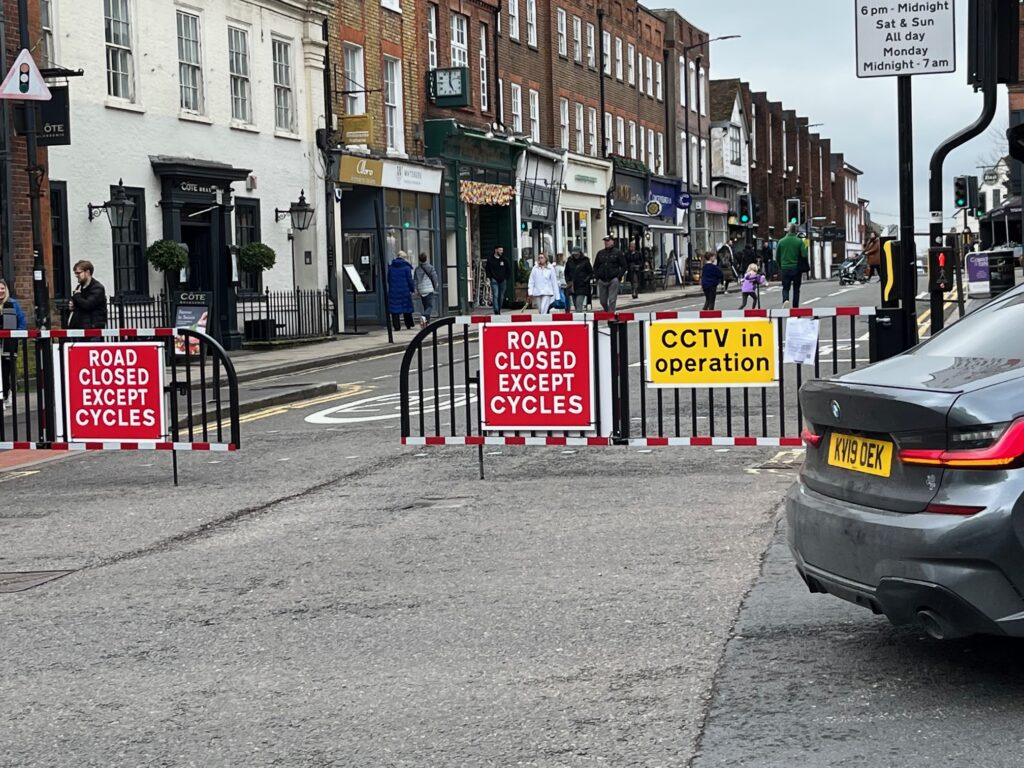
Meanwhile, St Albans BID (Business Improvement District) is supporting businesses to make the most of al fresco dining and outdoor shopping when the roads are closed.
Traders in High Street and George Street are to be given licensable areas which can be used to set up tables and chairs or stalls.
To ensure the emergency services have clear access, a 4m wide channel must be maintained through High Street and a 3.4m wide channel must be maintained through George Street while the streets are closed to motorised traffic.
The minimum lane width on UK roads that are used by buses and HGVs is actually 3m wide, however on roads that are for cars and light vehicles only, the minimum width is 2.5m per lane.
Should the emergency services report not being able to pass when required due to a trader operating outside the realms of their licence, the offending retailer will be reviewed and this could involve the revocation of the pavement licence.
Cllr White said: “The emergency services was an odd debate last year – fire and ambulance are at all the meetings, ambulance never were that fussed as they come from any direction, whereas by contrast the fire service are driving what amounts to a big lorry from one end of London Road, and they have demanded what the Americans would call ‘fire lanes’ on the High Street and down George Street, and that’s all been agreed.
“It hasn’t wildly helped how George Street operates and that’s one of the things that’s going to have to be tested over the spring and summer months – to see there’s road space left over from businesses spilling out a bit. But there are no hidden agendas here.”
As part of the closures, HCC was supposed to introduce air and traffic monitoring systems to determine what sort of knock-on impact there was for other streets in the city centre, including around Holywell Hill.
Cllr White said: “The air monitors are largely in place, I wouldn’t say wholly, and that’s one of the things I’m a bit bothered about. There are some concerns in the roads behind the Jubilee Centre, with more dispersal than they would have liked, and that needs to be checked out.
“I’m trying to get the residents’ association talking to the county council so any further measurements that are needed are put in place.
“You can go to Folly Lane on Saturday and an hour later it’s a nightmare. Some of that is possibly the general problem with too many roadworks going on across St Albans at the moment, but it does still need to be looked at.”
As the discussion moved onto the repeated traffic violations seen at The Peahen junction, Cllr White dropped in a final comment which suggested not all of the closures were set in stone.
“We’ve all noticed the way some people have been driving lately. I get more reports of one-way violations than I used to. I’ve also noticed taxis cheekily parking by the gates when the roads are closed. It’s a stupidly complicated junction, and I suspect if we ever got to the stage where the High Street closure became permanent – which I don’t think is very likely to happen – you’d actually completely reengineer that junction.”
So what next? Further down the line were plans to close High Street, George Street and the affected section of Verulam Road all week, increasing the chaos seen on Saturdays and Sundays to the full seven days.
But this part of the trial is now well behind schedule, and HCC has yet to confirm if or when it is taking place.
What do you think of the road closures so far? Have your say at https://surveys.hertfordshire.gov.uk/s/stalbans-highstreetrecovery
