


30 Apr 2024
Febrile (adj): having or showing the symptoms of a fever; characterised by a great deal of nervous excitement or energy.
A febrile world, a febrile General Election and febrile politics are how Daisy Cooper perceives the current state of affairs both in Westminster and closer to home, as she gears herself up for the Parliamentary campaign trail by supporting fellow Liberal Democrats seeking to make their mark in the district come May 2.
Surely as an overwhelmingly popular incumbent MP, with opinion polls predicting her re-election with a landslide majority, it might be tempting to rest on her laurels?
“I never would,” she says. “I’ve been a member of the Liberal Democrats since 2008 and I’ve seen the highs and lows. I’ve seen the surprise results of previous General Elections and I would never ever take votes for granted.
“I think the fact that now I’m an incumbent comes with pros and cons. The pro is that a number of people will know that I’ve worked incredibly hard for them and their families through the 35,000-plus pieces of casework that I’ve done in the local area.
“On the other hand, there will be those people who will have seen my voting record and may not agree with some of the things that I voted on or some of my views. And there’ll be other people who will just think that because of the political situation at the moment I’m a shoe-in.
“That’s a very dangerous assumption to make, politics is incredibly febrile, and I’ve always taken the view, if you want to have good people in politics, if you want to have good MPs, you have to get involved and you have to campaign for them and you have to vote for them, there’s no getting away from that.
“I think people have to remember that the short campaign hasn’t actually started, the General Election hasn’t been called yet and a huge amount can happen in a small number of weeks.
“If you remember back to 2017, Theresa May was hoping she was going to get a huge majority and then there was the Corbyn bounce, and then in 2019 the Tories were completely on the floor having had a terrible result in the local elections and the European elections, and then they got an 80 seat majority.
“As I said, politics is incredibly febrile, a huge amount can happen. That’s why I’m knocking on doors every single week to make sure I speak to local people, work hard for them as their MP, and they can make their mind up when the General Election is called.”
Under the Dissolution and Calling of Parliament Act 2022, Prime Minister Rishi Sunak has until December 17 to name the date of the next General Election, which may be how things end up playing out regardless of the national mood.
“I was convinced the General Election could be in May on the basis that I genuinely didn’t think the Conservatives could hold their party together for much longer.
“We’ll see what happens immediately after the local elections in May, and what reckoning there is within the Tory party.
“In terms of why it is that they’re waiting and waiting and waiting, people in Westminster who’ve been around for longer than I have are saying it’s because when you’re down in the polls, you wait as long as possible in the hope that something comes along.
“I mean, it could be international events, it could be domestic events. I think there’s also the hope that the economy will be looking in a slightly better situation by the autumn.
“Quite frankly I think given how appalling the situation is at the moment, how much money people are having to spend on their mortgages, their rents, their food bills, their energy bills, I think any uptick at all in the economy is going to be very, very slight and not have an impact in people’s pockets.
“Rishi Sunak has said that he wants to be judged on his performance on growth and inflation rather than actually how people experience the cost of living and he may well be waiting for some kind of improvement hoping that that’s reflected in the ballot box.”

For Daisy, the worst case scenario when the election is finally called would be if the Conservatives manage to hang on to a majority, no matter how slight.
“I think people forget that they are an incredibly well-funded national party. All of their campaigning is done nationally. By waiting late, the election could be in the autumn or the winter, when it’s cold and it’s wet and when people don’t go out to vote.
“It’s obviously hard for other political parties like the Liberal Democrats and Labour who rely on volunteers to go door knocking.
“The Conservatives are also changing a lot of rules in their favour, so they’ll be able to spend up to £35 million in the General Election, not the £18 million that they spent at the last election.
“They’re changing GDPR rules, so they can buy up lots and lots of data across the country, so they can target people. This will be the first General Election where photo ID is required, and there will undoubtedly be loads of people who won’t have realised they’ll need this. You can’t underestimate how hard they’re going to fight this.
“So yes, a worst case scenario for me is that they do get back into power. But of course, there’s all sorts of different results that could come from this election. I think it’s incredibly febrile.”
(There’s that word again…)
“If you look at the polls, the guesstimations of how many seats each of the parties win is all over the place. It’s a huge kind of margin for each of the political parties. So I think it’s a very uncertain election.”
Despite promises that disinformation on social media will be monitored by the big tech companies – especially in the wake of what occurred during the EU Referendum – there are still fears from many quarters that this coming election will be skewed by social media.
Daisy agrees: “I’m incredibly worried about this. I think there is a potential for it to be a lot, lot worse in this General Election.
“It’s not just a case of misinformation. We’re now in the world of AI, with the potential for deepfakes being circulated without the people portrayed even knowing about it, and this strikes me as being incredibly scary.
“At the moment Parliament isn’t being asked to look at legislation for the use of AI in the production of campaign videos, and that really, really worries me.
“I think more than ever, people will have to make up their own minds based on whether they know the candidates, whether they trust them. I think given that in a lot of places around the country, different political parties are going to be running new candidates who are not known to local people, there’s a very real risk that people will just say, ‘well I don’t know who I can trust’ and step back from the process. I think that would be devastating for our democracy.”
Although a coalition between the Liberal Democrats and the Conservatives will probably never be repeated, does she think the party would consider a partnership with Labour if required?
“You know what, I’m not even thinking about the day after the General Election. I’ve been through four now, 2010, 2015, 2017 and 2019, and in each of those elections, my party sort of overstretched and then underperformed against the targets we set ourselves.
“I am firmly of the view that every single second, every minute, every day, every week that a political party spends thinking about what they want to do after polling day, they are not focusing on how they’re going to win on polling day.
“I often draw comparisons with my brother, who competes for Great Britain as an ironman athlete. You would never say to an athlete, what are you going to do the day after the race? What are you going to do next? They’d just sort of blink and say, what? Because all they can focus on is the finish line.
“That’s very much where I’m at. I know that we’ve got a short period of time. We don’t know how much, potentially weeks or months. And there are a huge number of seats that we want to win off the Conservatives. We’re only going to do that if we level down and work really hard for the next few weeks and months.
“To use another sporting analogy, it’s like saying to someone, you’ve got to be running the London Marathon, but we’re not going to tell you when the starting gun is fired. That is quite tough, because it means both MPs and candidates are trying to work out how to pace themselves.
“Fundamentally what we know is that the public want a General Election. It’s clear to me when I knock on doors that everyone to a large degree has stopped listening to the Government because the Government is not talking about the issues that really matter to people.
“They’re talking about things like the Rwanda scheme and the regulation of pedicabs in London, rather than how you fix the NHS, how you sort out the cost of living, or protect our local environment.”
Our conversation coincided with the Mark Menzies scandal, which saw the Lancashire MP quite the Tories after being accused of misusing campaign funds to cover medical expenses.
“There’s a side of you when you look at these stories and you just think, these are extraordinary, but actually it’s quite serious. When you think about how febrile the world is at the moment, and world security and our national security are really quite fragile, there are lots of countries and groups that wish us ill, then we actually have, apparently, a number of MPs who are open to traps and influence and persuasion. It’s really alarming.”
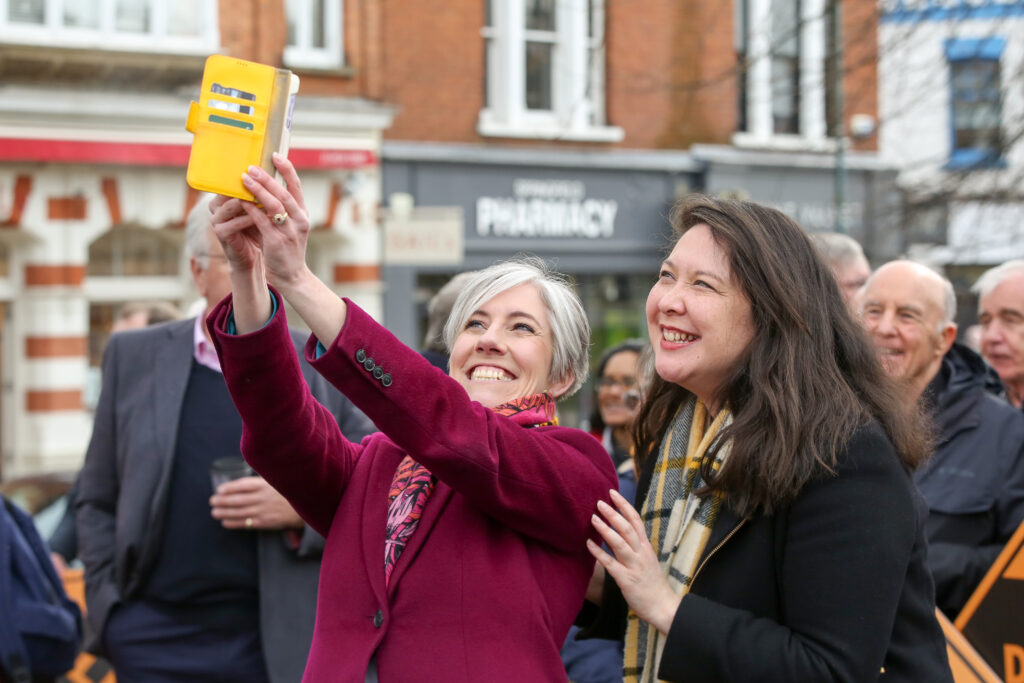
Moving away from the national and international stage, we refocus the conversation on a local level, where, it seems, there are some councillors riding on the wave of popularity their rivals call ‘The Daisy Effect’.
The idea is that her widespread appeal has apparently cascaded down into regional politics, with many voters choosing to place an X next to any Lib Dem candidates as a result, something opposition politicians claim resulted in their overwhelming district majority.
“I’ve heard the concept, but I haven’t heard the phrase,” admits Daisy.
Not only is she accompanying district council candidates on the campaign trail across the district, but she is regularly seen alongside Harpenden and Berkhamsted would-be MP Victoria Collins in the neighbouring constituency. Is there a sense of responsibility in supporting them which comes with having successfully snatched St Albans from the Conservatives?
“I’m a big believer in people, and I’ve always, always been convinced that if you find good people, and you get good people involved, then you get good outcomes.
“Part of the reason why I love working so closely with so many of our Lib Dem councillors is because they’re really good.
“I’ve invested a lot of my time trying to find good people who are competent, passionate, dedicated to their local community, and therefore that’s what makes them really good councillors. That’s why it’s a kind of self-reinforcing mechanism in both ways.
“I like to think that actually, yes, there might be what you call the Daisy Effect, but equally, there’s also the kind of reverse Lib Dem effect as well, which is when we get good Liberal Democrat councillors elected. I go to a lot of people, they say, ‘oh, that councillor was brilliant, they helped with this or this’. So it works both ways.
“If you support good people then they in turn will help change communities and change people’s lives, and that’s what it’s all about.
“Around International Women’s Day this year, I was speaking at a number of events and saying how women often discount themselves from politics. They often say,’ I’m too brash, I’m too quiet, I’m too young, I’m too old, I’m too busy, I don’t know about politics, I’m too outspoken’. I’ve heard every single excuse under the sun. And when I say that, you see women looking a bit guilty thinking, ‘oh, that’s me’.
“All that matters is, do you want to make a difference and if so, get involved.”
Leading on from that topic of conversation is a discussion on an issue which has also received a lot of coverage in recent months, especially from her Parliamentary opponents. Have the Liberal Democrats become a victim of their own success in terms of how they are perceived as the dominant political force within SADC? Criticised for their lack of accountability, could they not afford to see other parties take a larger piece of the pie to balance things up somewhat?
“I think for any political group of that size they have to remain conscious of that perception and of that risk but I think our Lib Dem group at the district council have been acutely aware of that from the get-go and that’s why under Chris White’s leadership they’ve actually opened up the council to more public scrutiny.
“Our councillors pride themselves on going to speak to residents associations where they can be scrutinised and asked questions. Chris has been very proactive in engaging with the local business community where he can ask questions as well. And of course we’re a party that’s known for knocking on doors and speaking to people all year round.
“When we are challenged on the doorstep and asked questions, we take that feedback and we do something about it.
“I don’t believe in opposition for opposition’s sake. I think if you want to be in opposition you have to prove your worth as an opposition. I think people earn their right to stay in power, and people have to earn their right to be seen as a credible opposition as well.”
Some of the issues she has encountered on the doorsteps are obvious ones – the cost of living crisis, access to your GP, and in Park Street, the huge amount of noise and disruption that’s coming from construction of the rail freight interchange.
“The communication from Segro has been utterly appalling. The lack of communication, the delayed communication, the failure to turn up to public meetings when they’ve been invited, I think is appalling. They’ve claiming they want to be a good neighbour and so far they haven’t been, so I continue to lobby them on that.”
She continues to actively push the county council to provide better support for children and parents with SEND, especially after HCC was blasted for widespread and systematic failings by Ofsted last year.
Since then, County Hall claims to have set out a plan for improvements, but this is not something Daisy has found evident.
“I’ve yet to see any signs,” she said. “I’d asked the county council to set out a new triage system, and they wrote back to me and set out a system which is basically the same as what it’s always been. I’ve been pressing the Minister to ask if they’ll them give more money. At least the government now accepts that Hertfordshire is underfunded, but they’re not going to do anything about it, which is really frustrating.
“I continue to ask for updates on their so-called transformation project. I really, genuinely, hope that we don’t have a lost generation of children in St Albans and across Hertfordshire. I sincerely hope that there are some improvements and I want to see some tangible examples of that. But so far I haven’t seen any change.”
When the St Albans Times exclusively broke the news that Chris White was standing down as council leader and district councillor, he made mention of Daisy as one of the people who have been hugely supportive during his tenure.
It’s clear that this has worked both ways: “Chris and I have worked hand in glove on a number of campaigns in the area.
“We often have the same view on things, we often have very different views on things, but we have that friendship and close working relationship where you can challenge each other in a way that often you wouldn’t be able to challenge other people.
“So there have been times where we sit down and really sort of interrogate each other’s views, and as a result we often come to a much better outcome. That’s been a feature of our working relationship for years and years and years.
“I first met Chris when I was part of the Liberal Democrat tour to the European Parliament in 2008. I was a complete newbie to the party and sat down and said, what on Earth are you talking about? What is a bar chart? What is a focus leaflet? How do you do campaigning? And I learned a huge amount from him.
“Now he jokes that he learns a lot from me as well. Of course I’ll miss him when he steps down from the council, but he’ll remain involved in our campaigning, so it’s not like the working relationship will come to a harsh end.”
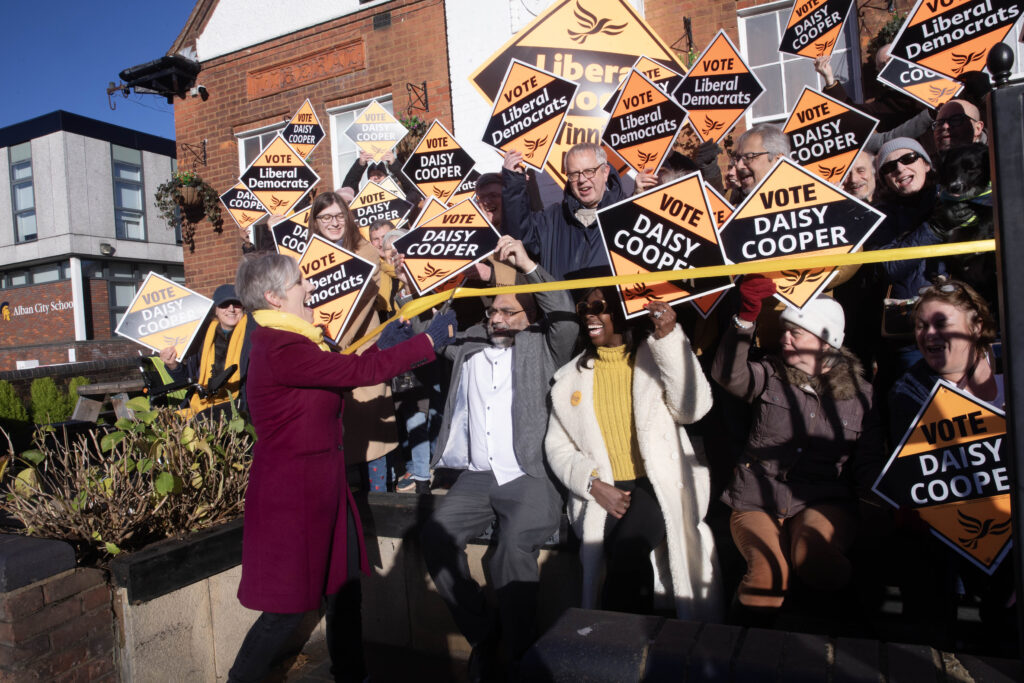
Daisy worked closely with Chris and fellow county councillor Anthony Rowlands to help resolve the Beaumont School places crisis earlier this year.
“I think it’s one of those examples where being able to work hand in glove with good councillors on an issue is really important. The county council said it’s not our fault guv’, it’s the school’s fault, and they spent an entire week saying that, which I thought was pretty outrageous, to be honest.
“I then wrote to the Secretary of State for Education and said what on Earth is going on? Clearly something happened behind the scenes, somebody knocked heads together and magically a U-turn happened within 24 hours. That’s the kind of decision where it shouldn’t have taken an intervention from me and the Secretary of State for Education, to get this overturned. Clearly Hertfordshire County Council were at fault and they didn’t want to own up to it, they thought it would just die down.
“Clearly, the parents of children who were in the Beaumont area had different ideas. It’s all credit to them for campaigning so hard on it and raising the alarm, to the local councillors who pressed Hertfordshire County Council on it, and for the St Albans Times and others for raising awareness of it as well.
“Fundamentally, it was fantastic that we got the U-turn, but we do need to make sure that this happens for the long term. It’s slightly more complicated for the long term, in as much as Beaumont School is part of a school rebuild programme that the Government is running, and we just need to make sure that the plans to have an extra form of entry is included in the proposals that go to the Department for Education.
“The Department for Education knows how hard I’ve campaigned on special educational needs funding. I’ve had several meetings with ministers on that issue, and I think they probably saw that we were a community were not going to let the issue drop.”
Almost five years since her election, she is no longer the rookie MP amazed by Parliamentary protocols and procedures, but has being a Member of Parliament met her expectations?
“That’s a fascinating question. I’m not sure what expectations I had to be honest, because I wasn’t entirely sure what to expect because it’s a job like no other.
“I think before the 2019 General Election, before I got elected, I sort of had an idea of the kind of issues that I might want to campaign on.
“But it does feel like a large portion of this Parliament has been entirely out of our hands and world events have just taken over. Within three months of getting elected, we were in full lockdown, then we had the fallout of the pandemic and the impact on schools and education and on hospitality and businesses and on the NHS backlog as well.
“Then we’ve had global events like the invasion of Ukraine, withdrawal from Afghanistan, now the conflict between Israel and Hamas, so it’s been an incredibly busy Parliament in terms of big, meaty, difficult and politically sensitive events where you almost feel like you’re seeing history unfold in real time.
“It’s about balancing that whilst also dealing with lots of local issues, which is everything from signposting people on how to sort out their potholes and their hedges and dealing with changes to planning guidance and all those kind of things.
“I think to some degree this entire Parliament has been a very reactive one, added to the fact that the Conservative Party has been in complete disarray. We have three different Prime Ministers and lots of different Chancellors and huge churn in ministerial portfolios.
“Every time there’s been a campaign that we’ve wanted to advance you feel like you’re starting again every time there’s a new minister, so you have to be incredibly persistent about it to make sure that you’re constantly re-briefing the new ministers that come along.
“But that is a huge part of what politics is about, reacting to what is going on on the domestic front in national politics and in global politics, and responding to them based on your set of values.
“As a Liberal Democrat, I have a set of guiding principles. I am an internationalist, I’m an environmentalist, I’m pro-business, I’m pro-public sector, I’m pro-diversity and pro-inclusion and those are the values that drive the way that I respond and the way that my party responds to events that are happening around the world.
“I hope very much that at the next General Election people see that I have managed to reflect and speak up for their values.”
