05 May 2025
Many people have large amounts of money in savings accounts, but holding too much cash in short-term products can be detrimental to wealth-building efforts. With savings rates falling, you risk sabotaging long-term returns. Lumin Wealth’s Managing Director, Martin Cotter, explains more.
Analysts may be expecting a slower rate cutting cycle, due to inflation fears, but the Bank of England is still likely to make further cuts to the base rate during 2025.
When the base rate is cut by the central bank, high street banks and building societies are often quick to slash interest rates on their own products. Long-term savers/investors who have favoured cash accounts and short-term bonds face a number of challenges in this landscape.
What do base rate cuts mean for cash savings?
Many people have opted to plough large amounts of cash into savings accounts and short-dated bonds, in light of attractive interest rates. However, recent cuts to the base rate are being replicated across the wider market, with the rates on offer for both savings accounts and bonds being reduced over the past few months. This trend is likely to continue in 2025.
Once cash accounts and short-dated bonds peak, and are no longer as attractive, where do private investors put their money?
Cash is not ‘risk-free’
Historically, equities have outperformed cash over every metric over the long term. But with savings rates still relatively high, investors may be tempted to put money back into cash accounts, when their current offers expire. But this strategy can have a negative impact on long-term returns.
Savers who believe cash is ‘risk-free’ overlook inflation, which erodes purchasing power over time. Interest rates may be attractive now, but cash has historically yielded negative or minimal real returns over long periods when accounting for inflation. Long-term investors must also account for the reinvestment challenge – i.e. finding an appropriate point of entry into the market – if they continue to hold cash in accounts that are designed for shorter-term needs.
The dangers of trying to time the market
Some savers, attracted by the prospect of headline savings rates above 4.5%, may opt to delay investing in the hope of entering the market at a later date. But this can backfire.
Predicting successful exit and re-entry points into the market is a very challenging task, even for the most sophisticated private investors.
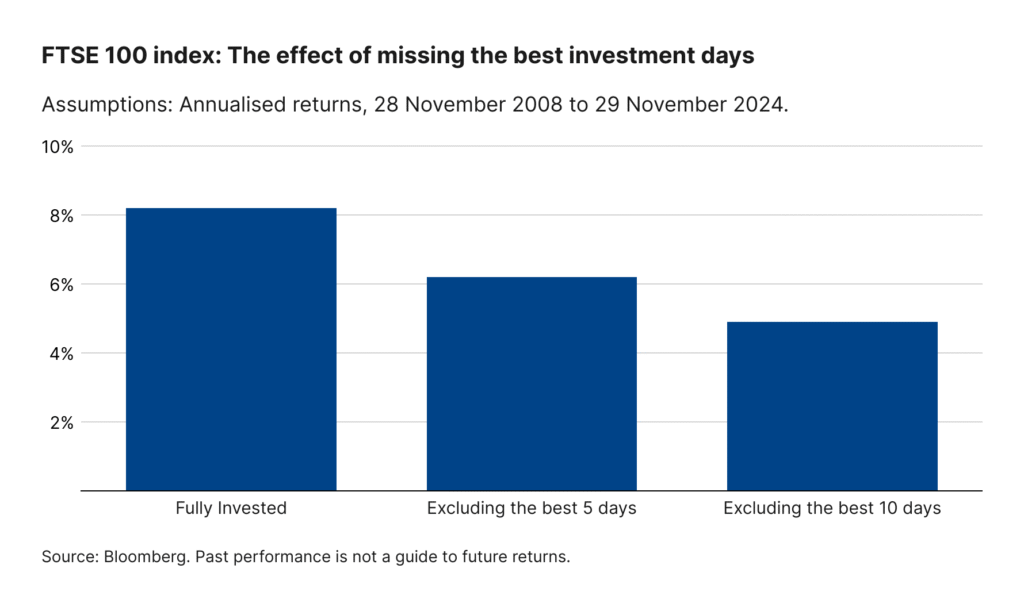
The chart outlines the risk of staying on the sidelines, in the hope of trying to time the market. From 2008-2024, investors who missed the 10 best days for UK equities (FTSE 100 index) would have seen their annualised returns reduced by over 3% per year.
A long-term approach
Long-term investors are still vulnerable to making short-term mistakes, which can include holding too much cash (beyond an emergency amount that can be deployed in the near- term), and trying to time the market.
As always, investors are best-served by sticking to a clear and defined investment strategy, in line with their appetite for risk and long-term goals.
Have you got questions about optimising your investment strategy, or how to deploy cash effectively? Call 03300 564 446 to find out more, or get in touch via our contact form.