


04 Mar 2024
Ten years ago, nobody was talking about vintage clothing, sustainable fashion or the circular economy, but Caroline Jones was already ahead of the curve.
If you suggested to someone today that they could get an outfit a day from their local charity shop it would barely raise an eyebrow. Yet what she did back in 2015 was to take that concept and create a fashion campaign which was to transform the potential of charity fundraisers.
Knickers Model’s Own was a 12-month initiative focused on “frugal fashion”, which saw Caroline wearing 365 different outfits sourced from charity shops, culminating in a book and a string of accolades including JustGiving’s Creative Fundraiser of the Year and a Pioneer of the Year Flame of Hope award from Cancer Research UK.
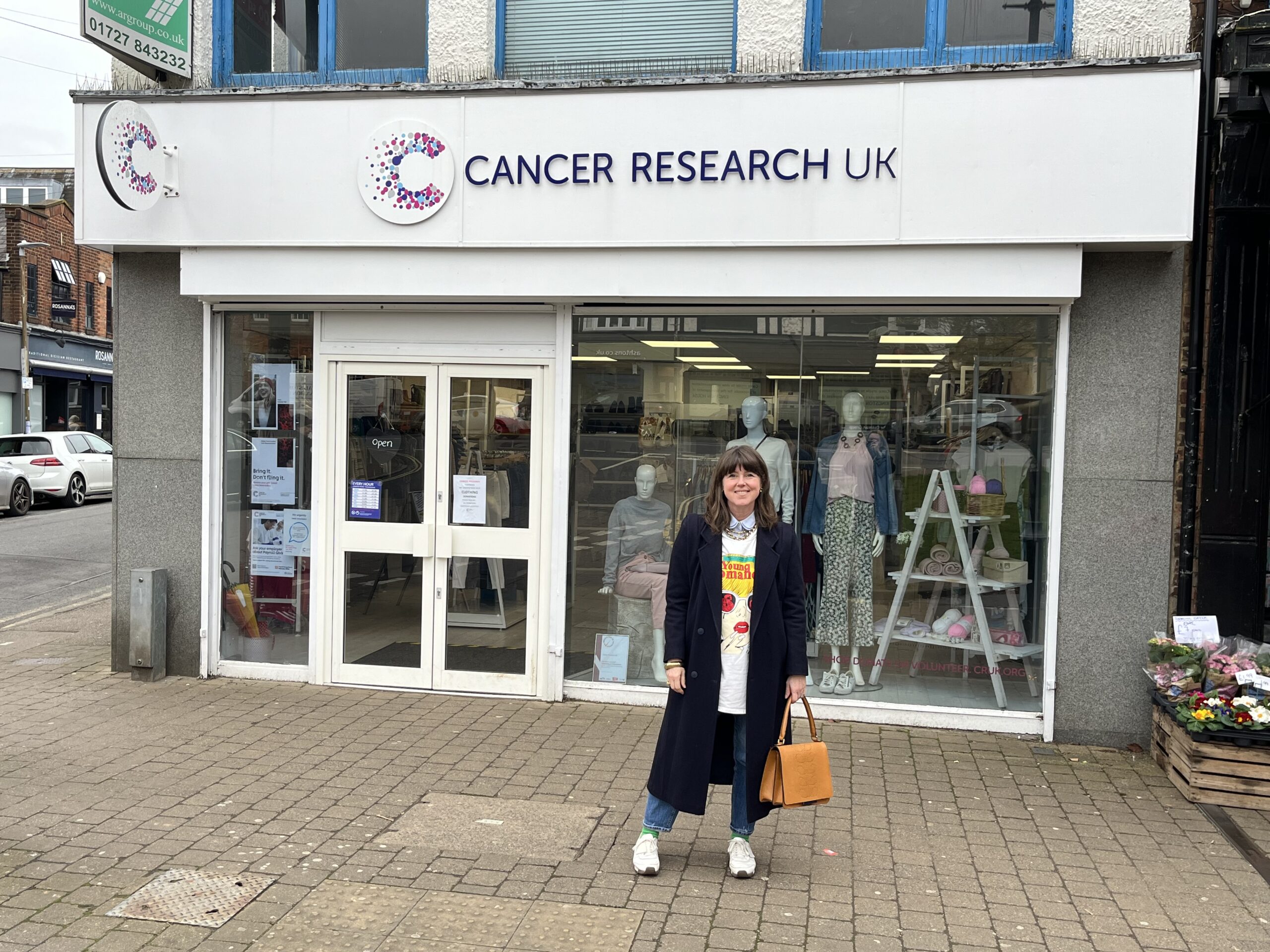
It was inspired by her mum, Mary, who volunteered in the Harpenden Cancer Research UK shop for 13 years before she was diagnosed with breast cancer and died aged 72 in October 2014.
To celebrate Mary’s love of fashion, the following New Year’s Eve Caroline posted her first outfit on Facebook, inadvertently setting off a second career as stylist, fundraising pioneer, author, and now host of her own podcast series celebrating the achievements of various other innovative philanthropists.
Having worked closely with Caroline over the past decade, we caught up in one of Harpenden’s various Costa branches to look back on her achievements and what follows next.
“I think the fact I called my account Knickers Model’s Own was the hook that the press liked to write. They loved writing the word ‘knickers’ as it was cheeky, quite British quirky.
“But I was literally that slightly kooky charity shop woman styling myself up.
“It was the early days of Instagram, before many of the selling apps like Vinted, and if you wanted to style secondhand you needed to go into the charity shops. That was the space that I absolutely wanted to be in.
“I never felt radical, or if I was doing something particularly avant garde, as I had always worn secondhand, I had been brought up in that generation of hand-me-downs, it just felt entirely normal.
“But I remember saying to people, this is kind of charity fundraising light, I’m just putting on different outfits every day.”
Of course, it was the visual element which lured people in. At that time nobody could have predicted the popularity of social media sites like Instagram and Pinterest, which rely on images to sell a story.
“I’m very visual, and I thought that was a great way of me expressing myself and showing women my age – I was in my mid-40s then – that you can nail a look by shopping secondhand. So I wasn’t really looking at it from a climate change perspective, I’ve always felt that was an obvious benefit of wearing secondhand. I’ve just always liked to look slightly different in my style. I’ve always liked the distinctive take that shopping secondhand gives you because no one else can find the things you’re wearing. Once it’s sold, that’s it.”
Inevitably, the incredible charity shops around Harpenden and St Albans proved a rich mine of potential outfits, but she didn’t just stop there.
“I’ve managed to shop across the UK. Very often if I was working away I’d nip into shops in somewhere like Peterborough and find myself an outfit at the local Cancer Research UK shop.
“That would be a lower grade shop with different stock, but for me I actually quite enjoyed that challenge because I would really, really have to look. Sometimes I’d browse the men’s section for T-shirts and jeans for example, but you never know what’s in the back of a shop, in the middle of a shelf or hidden in a rail that’s very often overlooked, and I suppose I can see the style potential of quite a few things.”
Immediately after finishing her initial fundraising year, Caroline published a book of her experiences and tips, ‘A Year of Frugal Fashion’.
“I felt it was a really nice follow-on, and meant people could pick up the book and have a style journal throughout the year. Regardless of the fact that everything you see in the book is secondhand, I wanted it to be inspirational, I wanted women to look at that and think, OK, styling is a much better way of dressing than thinking about fashion.
“Fashion pushes a look on you all the time and if you’re on that track, you’re led by what brands are pushing out to you. But if you go into the style lane, very quickly you work out what suits you, what you can collect, how you can update your wardrobe. So I’d like to think if you’re picking up the book now in 2024, that you can still get influence and inspiration.
“I’m still very proud of it, even though I’ve changed and obviously it was almost 10 years ago.”
Caroline’s public presence eased off somewhat over the following few years, as she allowed herself the time to slow down, to breathe, and to grieve. Her mother had only died six weeks before she started the Knickers Model’s Own campaign, and she had been on a rollercoaster ride ever since.
“Your grief stays with you, always. My grief is always there. I miss my mum dearly. But I knew that to do Knickers Model’s Own successfully, I needed to put a different persona on for the camera, for the public side of things. It’s something you have to overcome, and I knew that.
“I remember my mum saying to me, ‘you’ve got to live your life and be happy’. That always rings in my mind, in my head, but I don’t think anyone prepares you for losing a parent.
“My mum had lived with breast cancer for 12 to 13 years. She was really involved in the [Harpenden Cancer Research charity] shop. So for me going into the shop all of that year was very cathartic. It still is a really important place in my life, in my heart.
“So it was always something I thought, now I need to push forward. She wouldn’t want me being like this, crying all the time. I needed to find something that drove me forward. I think she would have loved Knickers Model’s Own, she would have been telling everybody. So I felt when I had difficult days and difficult moments, I needed to draw on her.
“She would have been saying to me: ‘Of course you were going to do this, of course you were going to stand on stage and give a speech or receive an award or style other people or meet Mary Portas or get Rankin to photograph you’. I think she always saw the potential that I had. I didn’t know I had all of this. It definitely drove me forward, it still does now. And yeah, I think she’d be very proud.”
Caroline used the time after the initial campaign to consider the enormous success of Knickers Model’s Own and work out what the next stage of her life was to involve.
“If you’re fundraising intensely like I was for a whole year, you can’t possibly stop the next day and think, ‘oh that was that then’. You need to unravel it and you need to reflect on it all. So although I was quiet for the following couple of years, I was still online, I was still dipping in and out and working quite closely with Oxfam and other charities that I like to connect with.
“I was exploring other things. I love talking publicly about fundraising as much as I love talking about styling.”
But a turning point came when Covid hit and she found herself ruminating about how other people could have had similar experiences to her own.
“When the pandemic hit you couldn’t help but be touched by all the charities that were suddenly stuck for revenue with no income streams, people were just shutting the doors of charity shops, there was a crisis in the charity sector and that really concerned me.
“I could see that some charities were never going to bounce back really. In parallel to that I was also reflecting on my own story and the other fundraising campaigns at the time: Captain Tom, the Skipping Sikh… So I rang up JustGiving, with whom I have a really good relationship, and said I had this idea about telling longer stories about inspirational fundraisers.”
Caroline’s podcast, What Have I Done? launched on January 1 this year.
“I had that feeling of creating something that hadn’t been done before. I knew that no one else was talking at length, peer to peer, about where their fundraising idea came from, what impact it had on their charity of choice, what those people are doing now, how they’re feeling emotionally and all the highs and lows.
“We thought we’d start with a series of 10 episodes, and I approached each interviewee to ask if they’d agree to talk to me. I was in the deep end when it came to podcasting and interviewing, learning that skill, but I knew what it felt like to be interviewed and I like the format of listening to a conversation.
“I also felt very, very honoured to be speaking to these people and so I did a lot of research for each interview because I wanted to know everything. I absorbed their campaigns. And the conversations were really wonderful. Some of them were funny and some of them moved me literally to tears, but all of them are inspiring.”
Caroline’s guests included:
- Phil Heckels, who raised over £170,000 for Turning Tides, a charity dedicated to ending homelessness. During lockdown, Phil, under the artistic pseudonym, Hercule Van Wolfwinkle, began drawing what he described as “rubbish” pet portraits using his young son’s crayon collection, which he then sold for charity. His work quickly caught the eyes of the nation and even the attention of Boris Johnson after he drew a portrait of the former Prime Minister.
- Leah Chowdhry, who became the first British Asian woman to take on the gruelling challenge of swimming the English Channel. Leah’s 13-hour swim raised an incredible £50,000 for the British Asian Trust. She has also written a children’s book about swimming to raise money for Cancer Research UK.
- Max Woosey, the 13-year-old ‘boy in the tent’. After losing a family friend to cancer, Max decided to raise funds for the hospice that helped care for his friend. For three years, Max spent every night sleeping in a tent and raised a very impressive £650,000 for North Devon Hospice.
A new episode of What Have I Done? is released online every Monday, and it is also available on Spotify.
You can follow Caroline at: @whathaveidone_podcast and @knickers_models_own
