18 Aug 2025
Elena Hogg, founder of local culinary company FOOD by Elena, continues her journey through the summer fruit season…
Watermelon season is fully upon us and I don’t know about you, but I’m making the most of it. I can be seen at least twice a week holding watermelons up to my ear and knocking on them. Most people who see me do this move away quickly, assuming I might at any moment display other unlikely behaviour and lob the watermelon right at them.
But no, there is method in my madness: I am listening for either a dull thud or a hollow, twangy sort of noise. The former indicates a lack of water content, meaning it’s likely to be a juiceless, under-ripe fruit. The latter sound is more what you’re looking for – a fruit brimming with liquid and sweetness.
My mum taught me this trick, and she learnt it from her mother who probably learnt it from hers. I’m teaching it to my children too, though they are rather too self-conscious to try it in the supermarket. My mum remembers watermelon being quite the protagonist of her summers because, while these days watermelon (of questionable ripeness) can be found all year round, when my mum was a child, of course you could only get them in season.
She recalls going for the ritualistic evening ‘spasso’ (stroll) on her holidays in Calabria, where my grandfather was from. The whole town would be out promenading because it’s a summery, no-work-tomorrow thing to do, and it would be too hot to sleep, anyway. The streets would be peppered with ‘bancarelle’ – stalls selling chunky, glistening slices of watermelon laid out on big blocks of ice. Mum remembers observing what looked like a Mexican wave of bowing people as she looked down the street, with people leaning forwards as they took bites of their watermelon in an effort not to dribble any juice down their fronts.
My own childhood summers spent in Italy were filled with watermelon too. I remember one summer in Tuscany, when I was about 11 , attending a ‘sagra del cocomero’, or watermelon festival. Sagre feature heavily to this day in rural Italy, where particular foods are shared, celebrated and devoured. The whole of my aunt and uncle’s village piled into a big field filled with long tables and chairs under marquees, and everyone chatted, drank and crunched on watermelon, while we kids ran in and among the tables, swiping slices as we went.
This childish behaviour evolved and by my student years, we were infusing watermelons with vodka, each time using a new inventive technique. There was the pour-down-a-straw method, where we’d insert straws into the flesh of a halved watermelon, then try and pour vodka into the straw and let it slowly get absorbed, before realising that making deep holes with the straws (or chopsticks because they worked better) and pouring the vodka into the holes was a less messy and wasteful process. We also tried turkey basters and even a syringe from an old chemistry set someone brought back from a visit home. All fun and games.
Nowadays, I prefer my watermelon less liver-damaging and more flavourful, such as chopped up into tiny cubes with cucumber and mint for a lively salsa to adorn pork or mackerel. Yes, mackerel – believe me! Especially if it’s been slightly charred on a barbecue – there’s something about the earthy, charcoal taste that’s perfectly complemented by the freshness of watermelon and cucumber.
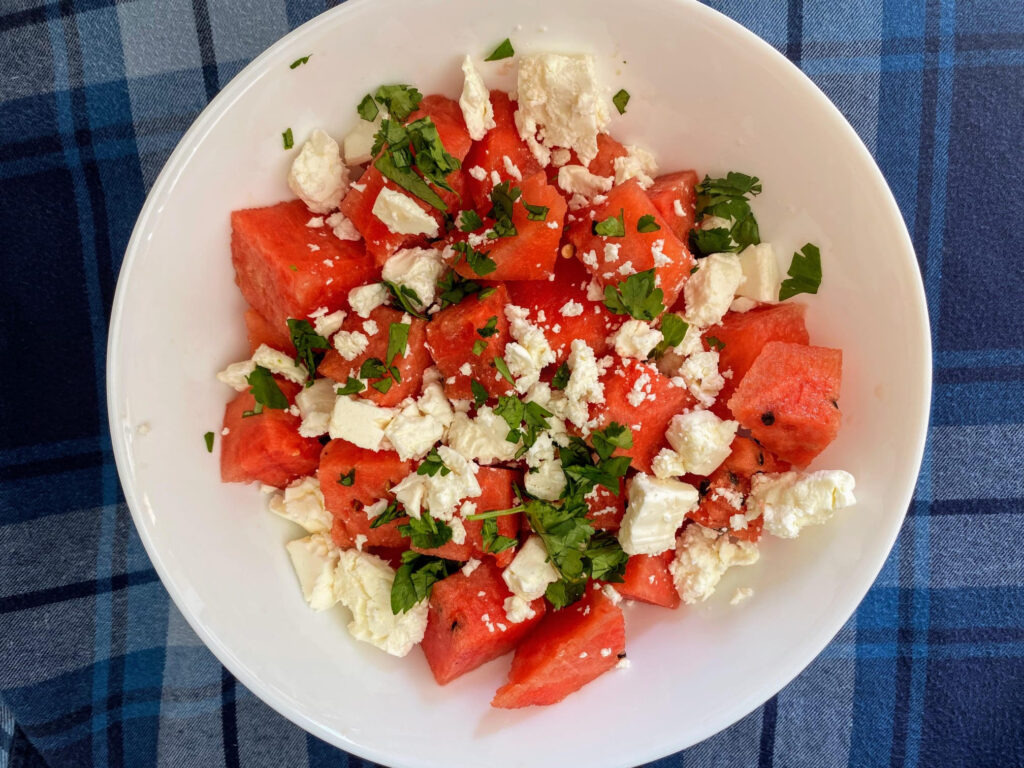
That same vibrant, clean mouth-feel is what contrasts so appealingly with creamy cheeses like feta. Eating something soft and crumbly in the same bite as a crunchy fruit evokes little explosions in my brain, no doubt also because of that salty-sweet flavour combination which, frankly, I live for. I add coriander sometimes for a grassy vibe and, when I can muster sufficient self-control, leave the crumbled feta and watermelon pieces to sit for half an hour before eating because the salt draws some of the liquid out of the watermelon, resulting in a sugary brine that I slurp shamelessly from the bowl at the end.
Something I’ve yet to do is find a tasty way to use up watermelon peel. Tom Hunt in The Guardian’s ‘Feast’ magazine suggests making a pickle using vinegar, salt, sugar and chilli, then boiling small chunks of peel in it for five minutes before jarring and cooling. It keeps for a month or so, and is apparently delicious in a cheddar cheese sandwich or alongside a curry.
It doesn’t surprise me that watermelon can play so many different culinary roles – savoury, sweet, main player or side-kick. It’s all in its name, in fact. Many fruits share a derivative at least across the Latinate languages – think of the word orange, which has exactly the same spelling in French, and very similar spellings in Italian (arancia) and Spanish (naranja). Watermelon, however, bucks the trend completely. There’s the French pastèque, the Spanish sandía or patilla, and the Italian cocomero or anguria. No cognate seems to exist, which makes watermelon pretty unique. The only constant is that it brings sweetness and joy wherever it goes (though look out for those thuddy ones…).