26 Jun 2023
If you were able to travel back in time nearly 2,000 years to the streets of Verulamium, you would probably stroll past scurrying slaves, braying goats and soldiers doggedly marching northwards. You might also expect to see Romans draped in snowy white togas. However, you would have been much more likely to see muddy Britons in muddy-coloured tunics.
Because, although the common perception of Roman-British towns is of men swathed in pearly white togas and women dressed in revealing silk, how likely is that in our climate? And how practical for everyday life? In fact, only Roman citizens were permitted to wear togas and only for special occasions. The local Catuvellauni tribespeople would have carried on wearing what they had always worn – warm, woollen tunics. For men these were knee-length with short sleeves and could be simply thrown over your head. For extra warmth there were cloaks, known as mantles, sometimes lined with sheepskin or fur and fastened by brooches. Zips, buttonholes and Velcro were centuries in the future, so clothes had to be pinned together.
Women’s tunics were similar but longer. Boudicca, warrior Queen of the Iceni tribe, was described as tall with a great mass of tawny hair, wearing a large golden necklace and a tunic of different colours, over which a thick mantle was fastened with a brooch.

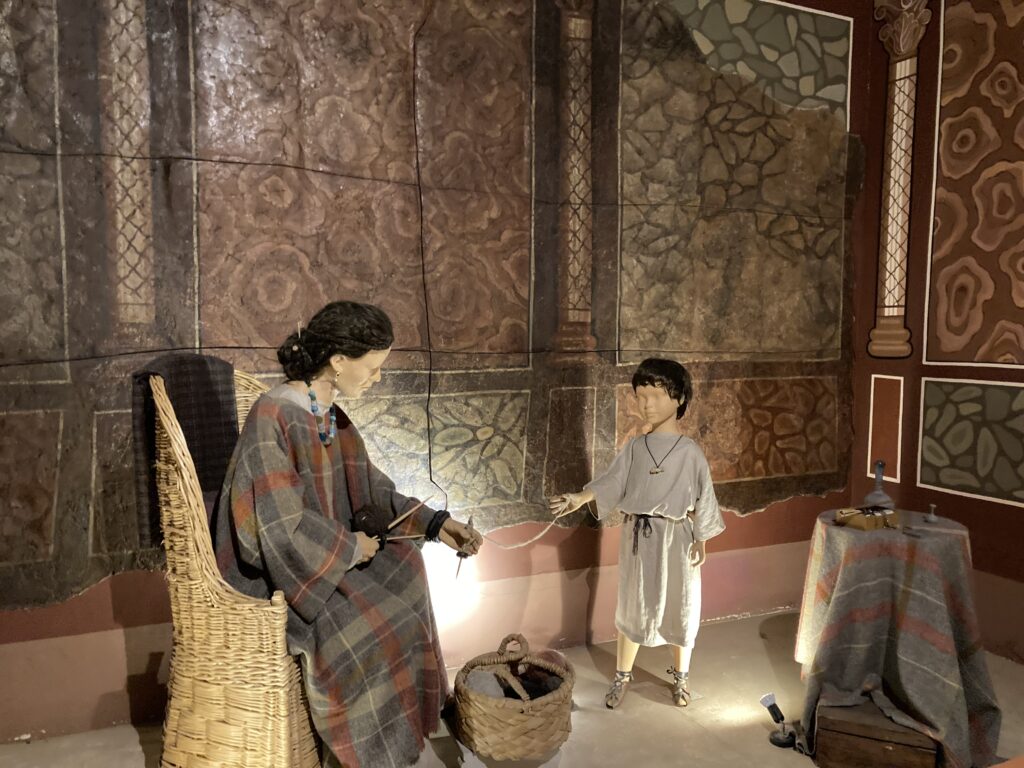
If you go to Verulamium Museum, you will see an example of the plaid-like cloth woven using wool coloured with plant dyes. Chestnut hulls provided brown shades. Yellow came from the weld herb, blue from the woad plant, and red from madder root. As time went on saffron, indigo and other dyes were imported. Most valuable was the vibrant Tyrian Purple dye, produced from sea snails. It was so highly prized that by the 4th century the Roman Emperor decreed that only he was allowed to wear it. You can see several of these shells in Verulamium Museum in the child’s grave in the Death and Burial room.
As Verulamium became more Romanised, women adopted fashions and hairstyles inspired by the Empress of Rome, probably copied from coins. Verulamium Museum has recreated a scene with Regina, a local woman, wearing a stola, a sleeved long tunic, covered by a mantle.
Jewellery and cosmetic tools on display, including mirrors made from highly polished metal, show the care she would have taken in her appearance.
Even after the Romans left, taking their ceremonial togas with them, tunics still featured for the next 1,000 years or so. The Anglo-Saxon women of St Albans wore long tunics with belts which could carry knives, weaving tools and keys. The tunics were still fastened with brooches at the shoulder, sometimes decorated with beads suspended between. Clothing was made from wool or linen, and making clothes was seriously hard work. Women spent much of their time spinning and weaving fabrics.

Men wore tunics over ankle length trousers, belted at the waist. Or, instead of trousers, there were strips of cloth wound around the legs, or leggings of cloth or leather. Leather became an important industry for medieval St Albans. By the early 1300s, there were 22 leather workers recorded in the market place, clustered in the area around The Boot pub. Indeed, The Boot was originally two leather workshops. The tanneries themselves were always on the outskirts of town to avoid the smell of urine and dog poo used in the process. In St Albans, a tannery was in Fishpool Street, on the site of St Michael’s Manor Hotel.
Practicality continued to rule clothing trends up to 1300 or so. The tunic reigned supreme, albeit with variations. Then things began to change with fashionable trends, whether practical or not. The invention of the button hole allowed clothing to be tailored to hug the body and show off natural curves. This created more variety between men and women’s fashions. Men who could afford it wore a shorter tunic with wider sleeves over a linen shirt. Under everything would be loose fitting linen breeches, known as braies,
held up by a cord around the waist. Legs were covered by hose – fine wool stockings.
Around the 1350s doublets – shaped, padded jackets reaching the waist or hips – became fashionable for male courtiers. And by 1400, men proud of their athletic thighs could choose to wear a doublet so short, it left little to the imagination, especially as only coloured hose were worn underneath. This revealing style didn’t go down well with those trying to uphold standards.
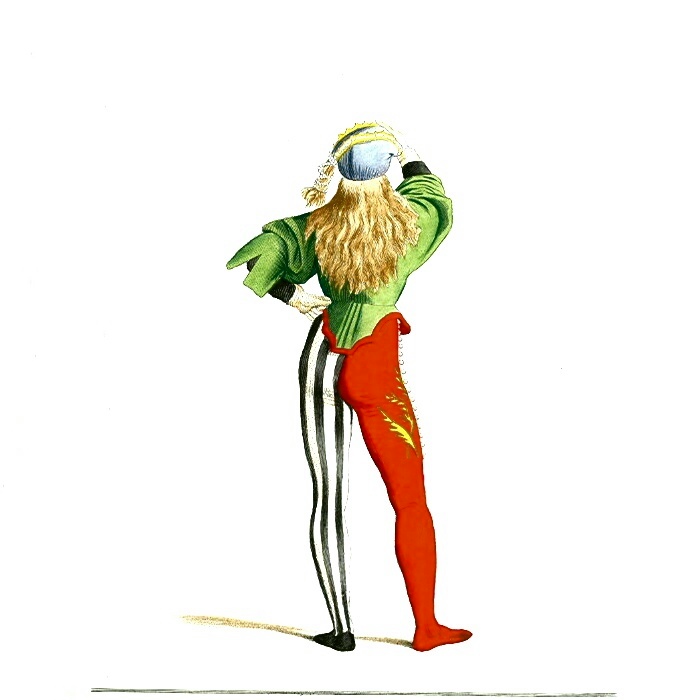
Clerics, looking for causes of the Black Death of 1348-9, blamed lax morals and fashions, particularly French fashions. And by 1463, Edward IV had passed a law ensuring that doublets were long enough to cover “privy members and buttokes”. The aristocracy, however, were exempt from this rule.
Shoes also began to follow fashion. Originally made with little difference between left and right, gradually the shoemakers began to shape them more appropriately. It was a thriving market – everyone needs shoes. By the early 1300s, there were 13 shoemakers, or cordwainers, working in St Albans’ marketplace.
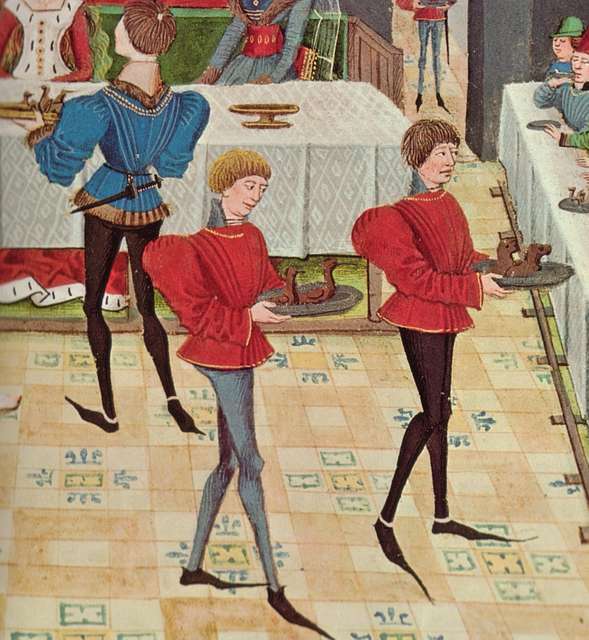
However, by the 1330s, it became fashionable for toes of shoes to be lengthened, and stuffed with wool, moss or horsehair. This fashion got more and more silly with toes up to 7 inches long, making it difficult to walk,
especially upstairs. But these, as with the buttock skimming tunics and well-filled hose, all helped to attract attention from the opposite sex. By 1465, however, long shoe-toes had been banned and didn’t return until the arrival of winklepickers in the 1950s.
Women had to be much more circumspect. Although restricted from publicly showing naked arms and legs, wealthy women began to wear lower necklines and daringly bare shoulders. Over a chemise of fine linen, long gowns fitted snugly, with corsets added to exaggerate the waist and a belt decorated with jewels encircling the hips. They wore their hair long, often plaited and wound into a bun over each ear. Over this would be a hood,
veil or hat. If married, a cloth covering known as a wimple was attached. Hair had to be hidden in public – long, loose hair was seen to be a tool of seduction.
Talking of which, prostitutes had to differentiate from ‘decent’ women by wearing yellow hoods.
Your appearance revealed your status which meant that, as well as rules about shoes and tunic lengths, Sumptuary Laws ensured that you had to dress according to your station.
By 1337, only people with an annual income of £100 could wear fur. Peasants could only wear simple materials like linen and ‘blanket’. The more assets you had, the more choice you had, so lords could wear whatever they could afford – cloth of gold, precious stones, fur and silk – all proclaiming power and wealth.
And meanwhile, what about the nuns quietly going about their business at Sopwell Priory and St Mary de Pré, Gorehambury? They were expected to wear simple clothing – long tunics with veils over short hair.
Nevertheless, in the 1310s, the Council of Vienne issued regulations preventing nuns from wearing silk and fur and banning long hair, and these rules were repeated frequently, implying that not every nun was listening.
Sometimes, fashion just has to be followed and damn the consequences.
To discover more about medieval St Albans, join us on our new Medieval walk, 2.30pm, Sunday, 27th August; www.stalbanstourguides.co.uk