22 Oct 2024
A deep dive into the film industry will uncover a wealth of different careers, all contributing to the greater purpose of shaping the finished product ready for release in our cinemas or streaming platforms.
St Albans native Tom Barrow is a production sound mixer, which means he is in charge of recording the audio on film sets.
This could be dialogue, music and sound effects, basically anything that happens that’s in front of the camera which needs to be recorded for the film, and he has worked on the likes of Bond film No Time To Die, Jurassic World Dominion, Mission Impossible: Dead Reckoning, and the live action versions of The Little Mermaid and Aladdin.
He generally works with a crew of four others: two boom operators, a second assistant, and a trainee, although on musicals they might also have a pro tools operator and more assistants.
“I have until recently been recording the sound for the second units or stunt units. This tends to be a bit more technical and fast-paced, for instance, the car chases and other stunt sequences in No Time To Die.
“I specialise in coming up with and/or facilitating bespoke technical solutions for complex films, either by building the microphones and communication devices into costumes or props or complex audio systems for monitoring.”
But Tom’s background was actually in music: “I was always interested in mixing desks and stuff, but the reason I got into music was because I wasn’t good enough at playing the piano or the guitar or anything like that, but I did like the equipment and the mics and that whole side of it.”
After completing a college course he worked in-house at a recording studio in Shoreditch called The Strongroom.
“It was a lot of electronic based music, but big stuff like Depeche Mode, and I worked there for about a year, and did a little bit of freelance stuff after that as an assistant engineer.
“My flatmate was working as a camera assistant, having just moved up from being a runner, so he started throwing me all his runner jobs, which were infinitely better paid than anything in the musical industry, and I just thought, ‘Oh, let’s do this’.”
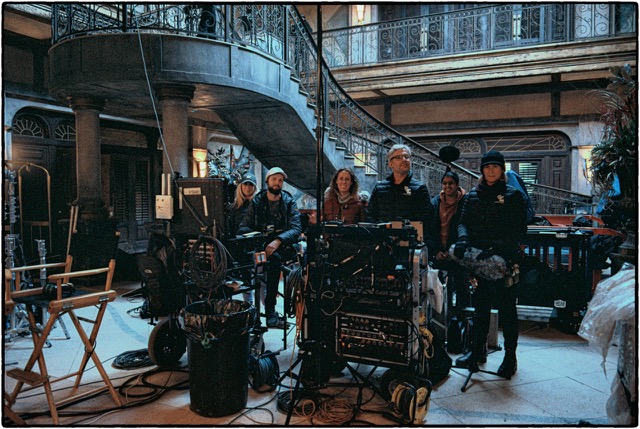
His background in recording studios gave him a bridge into doing musicals, including the magic carpet unit on Aladdin.
“It was an absolutely insane rig. They built it on a Boeing 747 simulator base, with another rig on top of it with 36 pneumatic rods that just made the carpet undulate, and another which was a repurposed car paint-spraying robot that they put the camera on the end of.
“Wicked was another one we did, which is coming out next month, and Snow White is coming out March next year.
“I’m on set the whole time. I sit in the mixer and orchestrate my crew, mix all the mics together and basically record the dialogue.”
On some films this is more challenging than others. The science fiction film Life – starring Jake Gyllenhall, Rebecca Ferguson and Ryan Reynolds – was set on the International Space Station, and required everyone to wear comms earpieces, which the production team also wanted to be practical.
“They looked like Bluetooth earpieces, and we put professional mics on the end of them. They all had a transmitter and receiver, and I was there on set for maybe two months before we started filming, building 25 of them from scratch with the props department.”
His other projects have involved completely animated sets, as in Mary Poppins Returns, or dealing with CGI dinosaurs like in Jurassic World Dominion, but ultimately it comes down to trying to preserve the audio alongside the visual, so an actor is not required to re-read their lines at a later date.
“My job in movies is to provide the building blocks to build it up later, which 90 per cent of the time just requires dialogue, but if you’re got shots in a car for example that can be difficult in itself placing the microphones around seatbelts and all this other stuff.
“Movies can be a lot more complicated, but in some aspects it can simpler than doing a TV drama, where they don’t have the money to go back and rebuild everything, so you’ve got to give something closer to your finished product at the end of the day and obviously the pressure’s a little bit higher.”
Is it this attention to detail which drives him then?
“I think so, but you have to be able to relax a little bit, as you’re never going to be able to do everything. When I first started, we’d record audio onto two tracks, and now on my machine I use 34 tracks, and every single microphone has its own track.
“The camera department used to be like one, maybe two cameras. I was in the action unit for No Time To Die and they used up to eight cameras at times, so where do you put the microphones? There’s nowhere to hide! So you know, it’s a lot of negotiation.
“For Mary Poppins Returns they built an entire street, Cherry Tree Lane, which doesn’t sound like you’re outside, so there’s lots of little tricks and bits and pieces you have to do. And even with that there are machines with little motors, and so you’re forever going around with WD-40 just trying to keep them quiet.”
At the end of the day, he has to walk away with what is recorded on the day: “You don’t have a choice. I can’t go back and remix it, because what we’ve recorded is what we’ve recorded, so we just try and do the best we can on the rehearsal, and then what I get out at the end of that is what I have to live with.
“As long as everything under the bonnet of what I’m doing is OK, it usually sounds good.
“The technology is so good not that if, for example, someone drops a bit of scaffolding, you can put a loop around that sound and it just disappears. I don’t talk about these things much when I’m at work because it gives people a bit of a green like with talking on set and stuff like that, so we don’t let them know what they can get away with.
“Now most things are shot on digital cameras, whereas film stock is really expensive, and where people used to be a lot more regimented in how they did things, they’re a bit looser in the way they behave now.
“They just keep the camera rolling, do it again, do it again, do it again, while my poor boom operator is standing there shaking with a transmitter and a microphone at the end of a 15 foot boom pole.”
How would someone looking to break into his particular field take their first steps? “There’s a really good course at the National Film Television School which is run by people who actually still work in the industry, and they’re well-respected. One of them is a guy called Simon Bishop who did the last two series of House of the Dragon and every episode of New Tricks, if you remember that.
“Learning the equipment itself, learning the job, what types of microphones to use, where to put them, how to deal with the actors, how the rest of the film set works, because it’s so easy to step on people’s toes from other departments.
“I try to train people up as best as I can, and I think that’s the best way, as long as they’re interested in it.
“The way I got my first job was to send my CV out to all these different sound mixers, and one of these, Tim Fraser, was looking for an assistant. He said, ‘If I don’t give a job to people who send their CVs out and don’t have connections via someone important in production, then they’re going to stop doing it’.
“My trainee at the moment, Jamie, got in touch with me on Facebook and I met him in a pub near where I live in Tyttenhanger. The first movie I did with him was Wicked, so he was lucky as that’s a big movie, but I made him work for it!”