24 Sep 2024
To mark the 90th anniversary of Verulamium Park and Lake, Dr Robert Wareing, who regularly walks the park with his wife Linda, has undertaken a labour of love to research its history and to celebrate its place in the heart of St Albans residents.
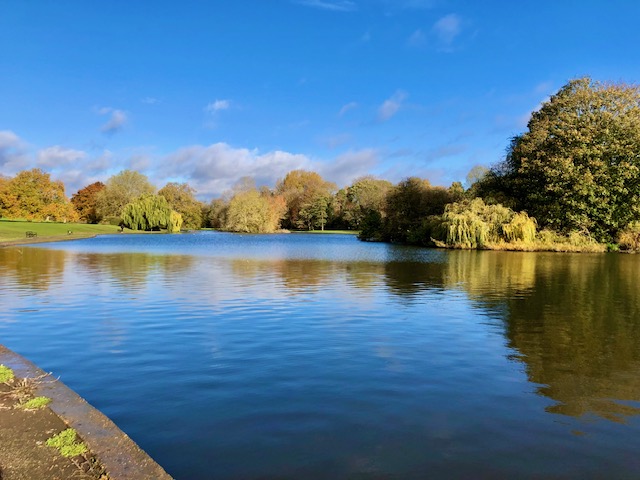
The birth of the lake can be narrowed down to just two dates in 1932. It was on 11th January that work on the lake was reported to be completed.
However, a considerable amount of “surplus earth”, left dumped on the footpath by the lake, was not removed until 4th February, and so this could be considered the completion date for the lake.
Either way, this year, it’s timely to wish the lake: “A happy 92nd birthday … and many happy returns!”
The lake project was therefore finished ahead of schedule and the last of the remaining workforce paid off. Most of the “transferred labour” are believed to have returned to their homes far away. Some, however, are thought to have brought their families and adopted St Albans as their home.
Only months after its completion, during the heatwave in July 1932, hundreds of people took to bathing in the lake (even though it was only one metre deep!). Late night bathing led to “some complaints of unruly conduct”.
A debate then followed as to whether bathing should be authorised and, if so, what facilities should be provided, including those required “in the interests of health and public decency”. Legal liability was another point of contention. Eventually, though, bathing whilst not actually banned, was discouraged.
I think it extremely unlikely that anyone would now choose, or be able, to bathe in the lake, (given the build-up of all kinds of detritus on the bed of the lake over the past 50 years) … other than, perhaps the most exuberant labrador dog! Although, to be fair, the small lake has been cleared, at least once, in the past few years.
It is thought that the birth of the park was in June 1934 although there is no direct evidence of a formal opening ceremony in either the council minutes or local newspaper. Nevertheless, on the balance of probabilities, I believe it’s appropriate to wish Verulamium Park a very happy 90th birthday this summer, and hope there are many more happy returns of the day! Below, I describe steps in the formation of the park and the way its use has evolved – and multiplied – over time.
Returning to the history: landscaping of the park continued through 1932 to 1934 and followed what I believe to be the distinctive naturalistic principles of Lancelot “Capability” Brown. He was the most famous figure in the history of the English landscape, a grand designer who became the UK’s most famous landscape designer of the 18th century.
‘Capability’ Brown redesigned hundreds of parks and gardens throughout Britain – especially on large country estates – and developed the natural-looking English landscape style that became renowned throughout the world. He designed and created landscapes on an immense scale, which provided a setting for mansions which were surrounded by woodland, parkland dotted with trees and carefully contoured ground. His landscapes also incorporated serpentine shaped lakes and carefully designed architectural features including bridges. He copied nature so cleverly that his work is often mistaken for a natural landscape.
In Verulamium Park, existing hedgerows and trees were preserved, hundreds more trees planted and bulbs sewn. The park’s natural undulations echoed those typical of the English landscape and when linked to the sculptured serpentine shape of the lake together with the bridge, reflected the essence of “Capability” Brown’s famous and very popular style.
A vivid example of the extent of tree planting is apparent from reports of the parks superintendent at that time. He variously refers to “the sixty odd trees planted by the lake and on the islands”; and “in all, 116 trees of 24 different kinds” being planted in groups and individually in the area later known as the arboretum (now shown as Dell Field on the map: ‘The Historic Fields of Verulamium Park’). As an aside, this map – although now out-of-date in some respects – clearly shows the name of different areas of the park and was taken from old maps showing field names in use when it was agricultural land in 19th century.
In January of 1934 the area known as Bell Meadow was conveyed to the council by Captain Gape, of St Michael’s Manor. You may recall it was he who gifted the earliest embryonic form of the park (the narrow strip of land that now forms the Ver riverside path).
It wasn’t long before young men took to playing football in the park on Sunday mornings (it seems that nothing changes!); the tennis courts were laid … and by 1934, Verulamium became a municipal park of unexpected popularity.
This popularity has continued to the present day. On a warm summer’s day, over 8,000 visitors have been recorded in the park. The park and lake are ubiquitous in catering for the many and varied needs of this large number of visitors including people enjoying family outings, those just out for a stroll or relaxing, dog walkers, picnickers, joggers, footballers, cricketers, those playing basketball and beach volleyball or using the outdoor gym, photographers, model boat enthusiasts, kite flyers, and cyclists, to name but a few.
Attractions of Verulamium Park and lake abound. Foremost is the natural beauty of the landscape and the abundant wildlife. The lake is fed by the River Ver and is home to a wealth of waterbirds, including mallards, swans, Canada geese, herons, great crested grebes, coots, pochards and tufted ducks. Kingfishers can also be occasionally spotted.
Then, of course, there are the invaluable remains of Roman Verulamium. Verulamium Park is named after the Roman city of Verulamium, most of the remains of which lie buried beneath the soil on which the park stands.
As well as a superb exhibition of Roman treasures displayed at the museum, some of the ancient city walls and recreated outline of the main London Gate can be seen in the park, together with the remarkably well preserved mosaic and Hypocaust. But most Roman remains are hidden from view, safely nestling below ground, as the park acts to safely cloak these treasures for posterity.

Other park attractions include many sports pitches (especially for football and cricket), basketball and beach volleyball courts, the splash park, miniature golf, children’s playground and the new outdoor gym. The park is also home for Westminster Lodge swimming pool and leisure centre, athletics track, Inn on the Park, Grebe House (the Hertfordshire and Middlesex Wildlife Trust head office), St Germains Barn, Verulamium Museum and the Abbey Theatre. These permanent features are supplemented by events such as the St Albans Festival, Pub on the Park, other music events, comedy nights, a fireworks display, the half marathon and other organised runs, some for charity and some competitive (plus the weekly Park Run)…
And there’s an infinite range of walks, some in woodland and others in open meadow, as well as wide areas of pristine managed grassland. The list is endless.
Yet somehow our remarkable park meets all these divergent needs … and still retains its beauty and safely cloaks its Roman treasures below, recently winning two prestigious awards. First, the internationally accredited Green Flag Award that recognises and rewards well-managed parks and green spaces; and second, the rare and much sought after Green Heritage Site Accreditation from Historic England, for the excellent management of the park’s ancient Roman features.
Returning to the history, it is thought that the birth of the park was in June 1934 but there is no evidence of a formal opening ceremony in either the council minutes or local newspaper. I would welcome any information on this as it would be the final piece in this complex jigsaw.
Help in discovering the very first piece would also be appreciated. Just who was the architect responsible for this “Grand Design”? (Our very own, yet anonymous, protégé of ‘Capability’ Brown). And the question of precisely which depressed areas the “transferred labour” came from remains tantalisingly uncertain. Can any reader of the St Albans Times provide direct evidence about any of these?
Before concluding this section, I should mention that there were two late additions to the park. In 1956, the former Abbey Mill Cottage was conveyed to the council by the Society of the Faith. And the area now known as Seabrook Field (adjacent to Bluehouse Hill) was transferred by the Earl of Verulam and Gorhambury Estates, in 1958.