05 Aug 2026
Elena Hogg, founder of local culinary company FOOD by Elena, has just returned from her choir’s visit to eastern Europe…
I’ve just returned from four days in Prague. Every year, my choir goes on tour, performing in churches, theatres and plenty of quite esoteric venues, too. This time, for example, we sang at an equestrian centre that was nothing like the rustic, hay-strewn stables I’d envisioned, but rather a huge, art-lined hall bathed in light and exuding elegance – with excellent acoustics to boot.
Choir tours always guarantee a good injection of culture. We’ve been to places like Paris, Barcelona and Tuscany, where the art scene and the history feel familiar to me. But I wasn’t prepared for the jolt Prague would deliver.
Czechia’s early history starts with the building of its famous and beautiful castle overlooking the Vltava river back in the ninth century, around which the city grew, marking its place as an important trading post between northern and southern Europe.
Several hundred years later came the reign of Charles IV who brought in the ‘Golden Age’ and Prague’s iconic Charles Bridge, as well as a huge swathe of gothic architecture that lines the capital’s streets even today.
The next half-millennium saw great unrest in the form of Hussite wars and the Habsburg rule, before huge expansion and industrialisation in the 19th century. The Second World War and Nazi occupation took its toll, however, leaving the country wide open for a Communist coup in 1948, which lasted until 1989, when the playwright Václav Havel toppled the Communist regime in the Velvet Revolution.
On the second day of my trip to Prague, my friends and I were lucky enough to spend an hour and a half being driven round the city in what I dubbed a “Noddy car” by a very knowledgeable and friendly woman called Vera.
There were quite a fleet of these tourist cars, which can get through the small streets better than an open-top bus.
Vera spent the first 15 years of her life under communist rule and talked openly about what it was like for her growing up. We were quite astounded to hear about the pay structure and how everyone worked three days a week to make sure there was enough work to go round and was paid the same amount no matter the job type (disclaimer: this is what Vera remembers).
Vera explained how the arts were restricted to government-approved commissions and there was no freedom of expression. She recalls how her father would sometimes illicitly procure recordings of popular music, which were banned at the time, and how delighted she would be to hear them.
Food was another aspect of Vera’s childhood that suffered from a lack of creativity. Under communism, food was intended to fuel a workforce and tended to be robust and heavy enough to see through the harsh Bohemian winters. Vera recalls foraging for herbs and berries, all of which would provide some welcome flavour or colour to an otherwise fifty-shades-of-brown plate of food.
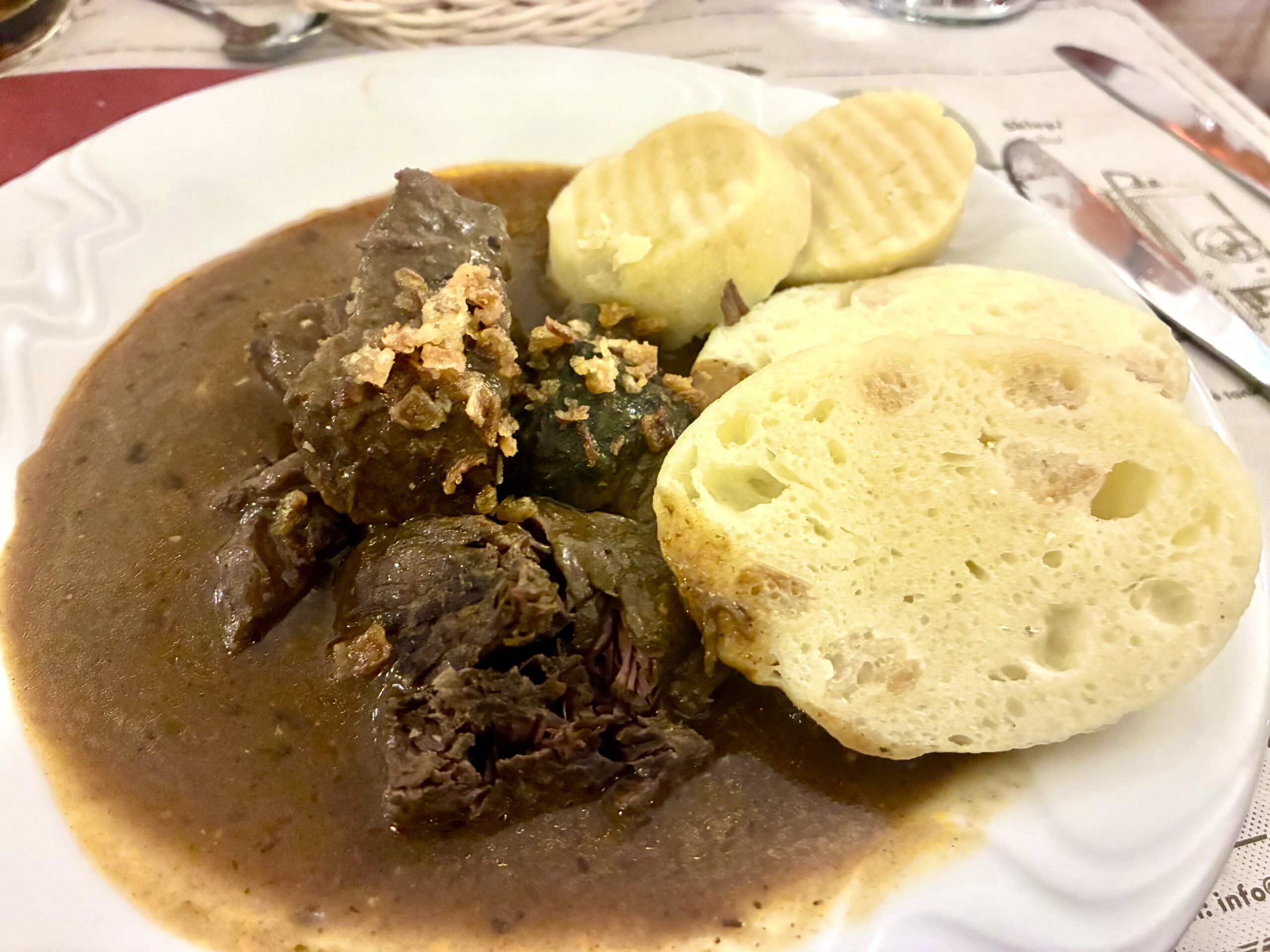
There’s a lot to celebrate about this kind of hearty fare, though. One of our post-performance group activities while on tour involved watching traditional Czechian dancing whilst munching our way through a plate of beef goulash and dumplings. I have never been a huge fan of stews, by and large, but what we were served was rich and intensely flavoured; a far cry from its lowly origins.
The beef was tender and yielding, and the dumplings were moist and comforting.
Alongside some dense and delicious bread, they provided the perfect vehicle for mopping up the gravy which, frankly, could have been served to me in a pint glass to drink, it was so tasty.
But this was an evening dedicated to the traditional Czechia of yesteryear; the country’s food scene, like its political backdrop, has evolved.
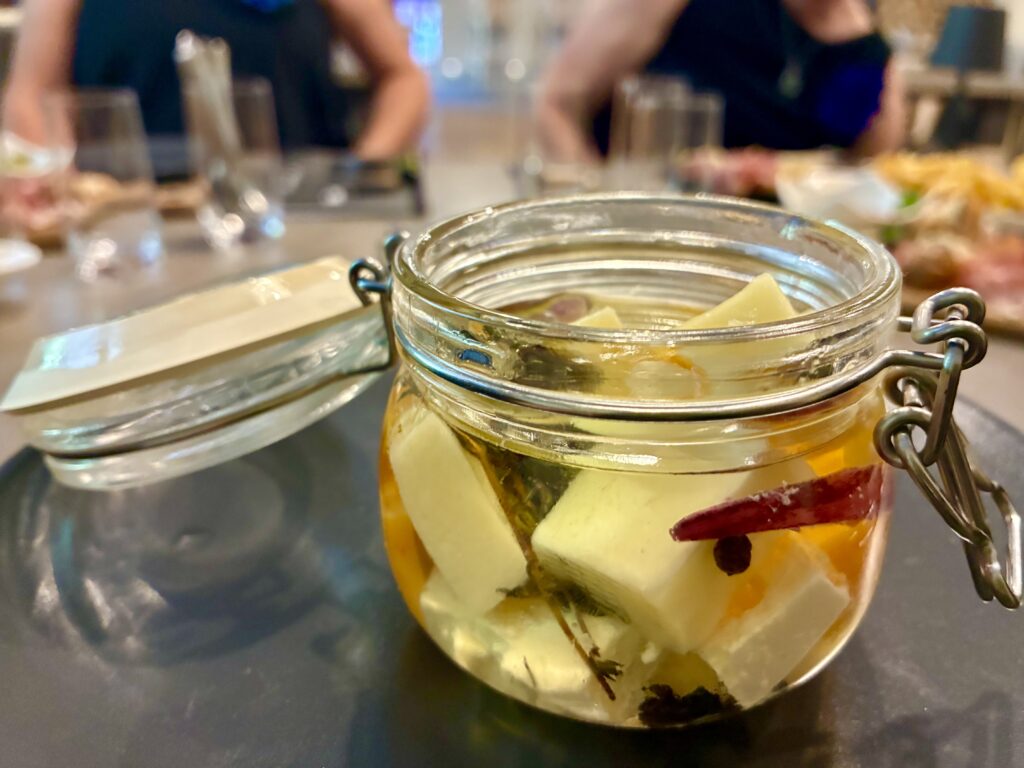
We came across several delicious examples of how typical food has been given a modern make-over, such as some sumptuous ‘pickled’ cheese marinated in light olive oil infused with red onion, thyme and peppercorns, and served on a very trendy wooden board filled with charcuterie, roasted new potatoes and the mildest, softest sundried tomatoes I’ve ever had.
My favourite morsel of the tour, however, was a true celebration of old and new, ordered by my clearly very wise friend Patsy.
It featured on a menu listing ‘beer snacks’, and chimed in with that old, trusty British pub classic, pork scratchings.
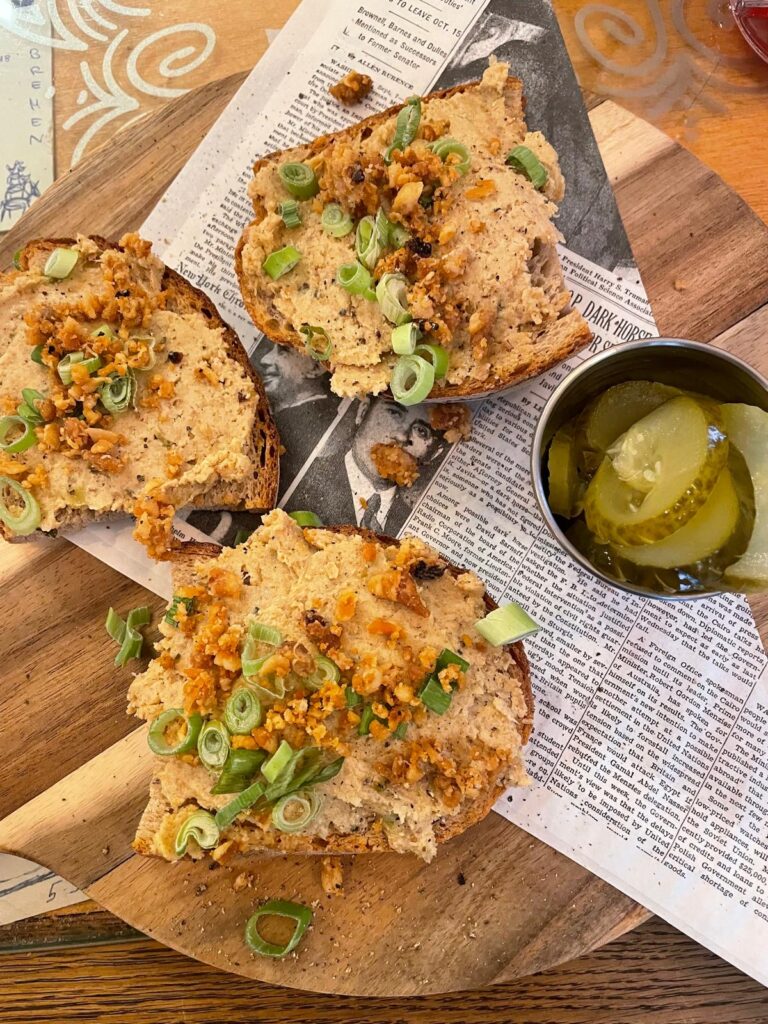
At U Schnellu, however, the beer snacks don’t come in greasy foil packets. They serve crusty homemade bread slathered with skvarkovou, or pork crackling spread, then topped with spring onion and served with slices of pickled gherkins to cut through the richness.
Sinking my teeth into this slice of culinary vision was a joy.
The dish is a tribute to the lowly and humble beginnings of the Czechian food tradition, but also a riot of colour and flavour – a triumphant heralding of how Czechia deserves its place among the food giants of Europe. Hurá!