


07 Jun 2025
Following the Prime Minister’s recent commitment to reducing immigration and making it harder for people to become British citizens, Laura Bill says this fails to appreciate how much we rely on migration for society to function.
Sir Keir Starmer has said he will reduce the number of people who migrate to the UK by 2029, making it more difficult for people to apply for citizenship as they will have to have lived here for ten years, rather than the current rule of five.
The standard of English required will be raised and the visa which allowed care workers to come to the UK due to a
shortage will be abolished. Migrants coming as ‘skilled workers’ will have to have a degree as a minimum.
People who migrate or seek refuge here might do so for a number of reasons. They could be fleeing violence or persecution or they come to fill job roles that are not popular with British citizens.
So how will the changes impact those people already living and working in St Albans?

Twenty-eight-year-old Kriti Gandharba grew up in a village in the mountains of Nepal and now works in St Albans as a care worker for Abbots Care.
She said: “I knew from a young age that I wanted to work in the caring profession. In my culture, younger family members are devoted to elders, honoured to look after them as they get older, and I used to love sitting with my grandparents and hearing their stories.
“I was lucky enough to train and work as a nurse specialising in geriatric care in Nepal, and this led to an opportunity to work with Abbots Care 18 months ago.
“I support families and individuals in St Albans with care and company. It is a privilege and pleasure, and I am proud to do this work.”
The family of one of Kriti’s patients recently nominated her for a Dementia Care Home Worker Award and she was thrilled to make the shortlist.
The nomination said: “Kriti is an excellent hard-working and skilled carer providing high quality, responsive care to my father. She always smiles and has natural warmth.
“She always aspires to make my parents’ lives as good as they can be, providing all-round care which she administers with gentleness, great kindness and sensitivity.
“She has endless patience and never ever complains, despite the long hours and the work being physically quite hard and emotionally challenging at times.
“She has been interested and curious about my parents’ life stories as well as the wider family and keen to learn the way the family does things which has allowed her to mirror what my parents are used to.
“She has been flexible and creative in the care she provides.”
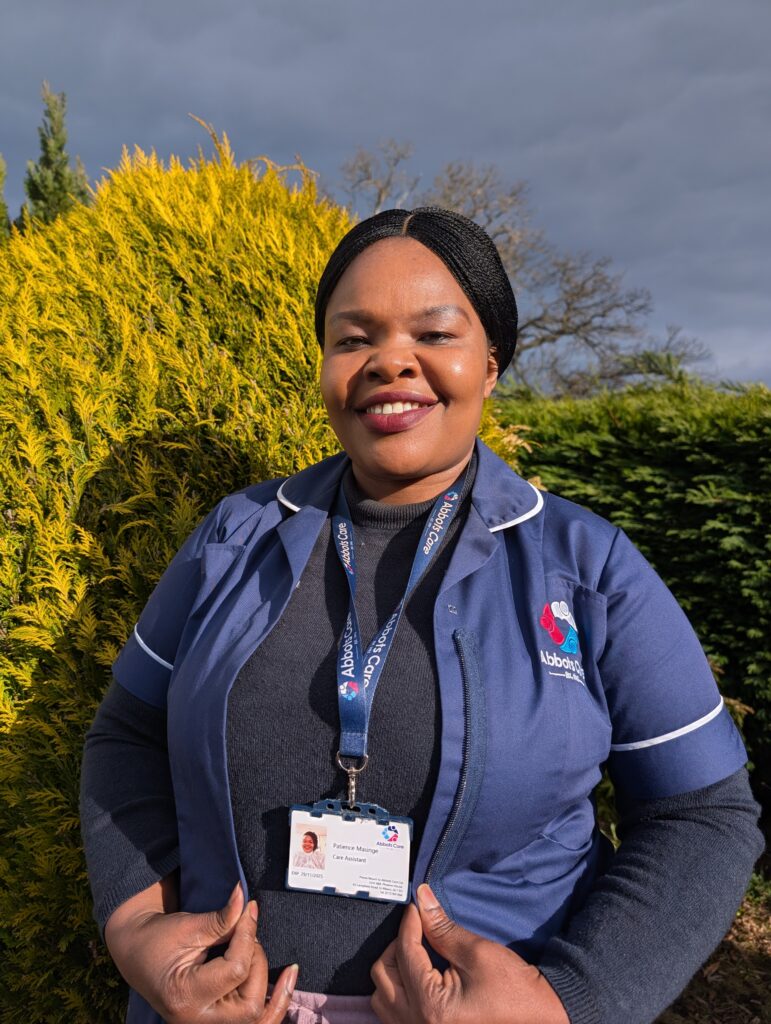
Kriti’s colleague Patience Masinge is from Zimbabwe where she developed her skills by looking after her sick grandmother: “When I moved here, I saw an opportunity to train, complete an internship, and work in a care home.
“I visit clients between 8am and 11 and then again in the evening.
“Many are lonely, so even small things like chatting, making tea, or playing games mean a lot. Each day is different, but my goal is always to bring a smile to someone’s face.
“One of my favourite moments was helping a client get out of bed and dance when he was sad about his wife who had recently passed away.”
“Every client is different, so you need to adapt to their needs and interests. The training is great, but experience is the best teacher. Most of all, love people – if you come to work with the mindset of giving back, you’ll find it so rewarding.”
Abbots Care CEO Camille Leavold said these new restrictions on the use of overseas workers, if not immediately accompanied by urgent and significant investment in the UK’s care infrastructure, risk being catastrophic.
“The UK care sector is already at breaking point.. Our ageing population is growing rapidly, demand for care is rising every year, and despite tireless recruitment efforts, we simply do not have enough UK-born workers entering the profession.
“We have always focused on recruiting from the UK as a priority and still do. We offer full training, qualifications and have supported thousands of care workers to qualify and progress their careers in the last 30 years. However, there are simply not enough people to fill the 120,000 vacancies the sector is short of from the UK workforce nor the 450,000 that Skills for Care predict we will need by 2040.
“For many providers like ours, overseas talent recruitment has been a lifeline. Immigrant care workers are not just essential – they are the backbone of modern home care in Britain.
“Without a viable alternative workforce strategy ready to go now — not in two or five years — restricting overseas workers will mean: clients going without vital daily support; families under pressure to provide care they are untrained and unequipped for; carers stretched beyond safe limits; and thousands of jobs will be left unfilled, not because providers won’t hire locally, but because local applicants simply do not exist in the numbers required.
“To withdraw this critical labour pipeline without first shoring up our domestic workforce is not a reduction in migration — it’s a reduction in care.
“We urge the Prime Minister and his Cabinet to sit down with the sector immediately. We need a clear, well-funded national workforce plan: one that includes a professionalised pathway for care workers, fair wages, proper training, and the kind of support that makes care a respected and sustainable career. And we need transitional measures to avoid devastating service gaps while that plan is put in place.
“Millions of people – older people, disabled people, people with long-term health needs — rely every day on the compassion, skill, and dedication of our carers. This is not an immigration issue. It is a care issue, a workforce issue, and ultimately a human issue.
“We remain ready to work with the Government to find a solution. But we cannot do it alone — and we certainly cannot do it overnight, without the overseas colleagues who have kept our services running.”
Registered nurse Sawyer Johnson migrated from Canada to St Albans last year to work in neurology. His partner is British and is a trainee physiotherapist, and they want to build their lives together here in the UK.
He is working for the NHS in a very much-needed role, as are many other migrant workers in our country.
According to The Migration Observatory at Oxford University website the New Home Office issued 106,000 visas to social care workers in 2023.
Health and care visas – including doctors and nurses – account for three quarters of all long-term skilled workers who come here on a work visa.
Sawyer said: “I’ve really enjoyed living here so far – I love St Albans. I feel like I’ve been really supported by friends, my partner’s family, and the local community.
“It’s a new area of nursing for me but I’m enjoying it a lot so far. The team at my facility is really passionate and it comes across in the quality of care I see there. I think I can speak for all nurses when I say it’s exhausting but rewarding.
“I’m still a new transplant in the UK so I’m still forming my political opinions. I would say we’ve had some anxieties relating to my immigration process potentially becoming more difficult or taking longer than we anticipated but we’re trying to stay positive and keep an eye on the changes that are upcoming.”
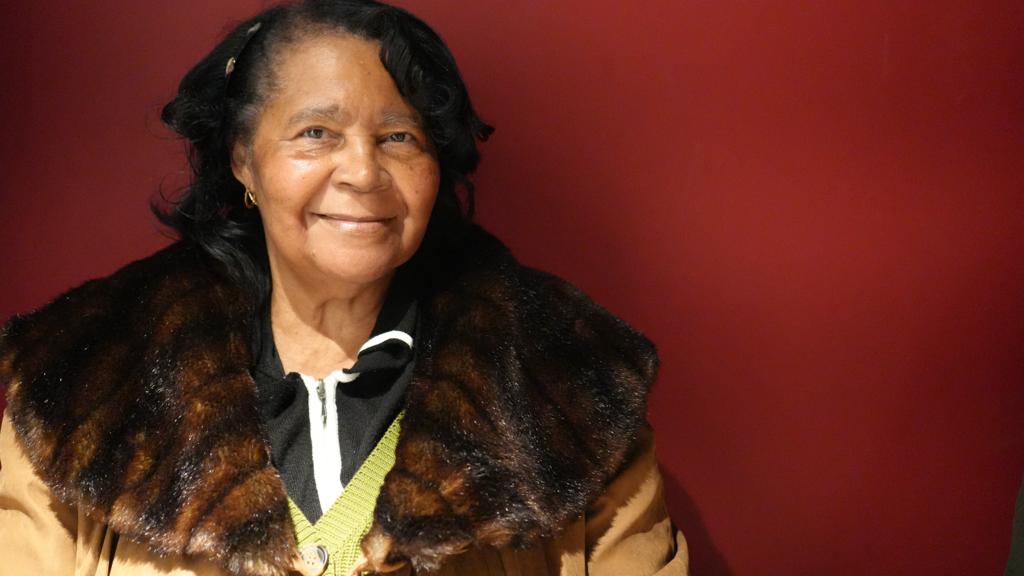
80-year-old Aliethea Barnes came to the UK from Angulla in the West Indies in 1962 when she was just 17 years old. Her mother sadly died when she was three so she was looked after my family members. She travelled here with her brothers who came over to work – one as an electrician on the railways and the other as a train driver.
She recalled : “The boat took 21 days – it was lovely and they treated me so well. When we got to Harlesden it was summer so it wasn’t so bad. Then the winter came and we played in the snow but we were crying because we didn’t know that snow was so cold.
“In London colour really didn’t matter… everybody would speak to each other. Then when I moved to St Albans, I really noticed a difference – there was racism.”
Aliethea trained to be a bereavement counsellor shortly after arriving in St Albans, but said her fellow students were not kind to her. One refused to pour hot water into her coffee cup, excluding her deliberately.
She said: “I said ‘You may never have seen a black person before, but I am black and beautiful and proud to be black’.”
She went on to work as a bereavement counsellor in St Albans for Cruise for 16 years, then as a hospital care worker for more than 40 years, giving decades of her life back into the local community.
Helen Singer of Herts Welcomes Refugees (HWR) said that despite the recent rhetoric from the Prime Minister, at HWR they are “constantly inspired by the refugees and asylum seekers” they support.
She added: “They are facing huge challenges every day and may not have picked up on the connotations of Keir Starmer’s negative words.
“We would like to give an example of some more positive attitudes. More than 100 volunteers, partners and refugees took part in our Annual General Meeting held recently.”
Violet, who comes from Nigeria, is on the board of HWR and also volunteers at Oxfam and her local church playgroup. She said at the meeting that she “doesn’t want her life to just centre on being an asylum seeker” and so she wants to go out and volunteer and help others too.
Dania Alrefai, from Syria, who is now studying dietetics at the University of Hertfordshire and volunteers for HWR as a board member said: “The UK is the home that welcomed me when no other place did.” Dania faced extremely tough circumstances in Syria, as, of course, do many of those people who seek refuge in the UK.
Also on the advisory board is Jamshaid from Afghanistan, who recently obtained a distinction in his MSc in Software Engineering at the University of Hertfordshire.
He said: “It’s really important to give back to a community that embraced me during my difficult time and I want to help other refugees navigating their own journeys with dignity and hope.”
The Refugee Council, a national charity supporting refugees, works with community groups, partners and volunteers to help people who have escaped war and persecution to rebuild their lives and integrate into communities.
Their research found that by the end of March 2025, 106,771 people seeking asylum were being supported by the UK Government. They receive just £7 a day and crucially are not allowed to work.
Asylum seekers can wait many years for their claim to be sorted and in the meantime are left in limbo and with very little.
Aliethea added: “Even though I haven’t always found people welcoming I have always been committed to my job and worked really hard. People say I have a very caring personality and that I’m a people person. I have been happy to to serve the community here.
“Imagine Keir Starmer making people speak A-level English to be allowed to be a citizen or to work. People wouldn’t risk their lives and leave where they are to come here if they didn’t have a good reason.
“Keir should be more grateful for immigrants. People have come here whocouldn’t speak English and look how they helped the community.
“They built the country really. Take the hospitals – no English people wanted to work in them.
“Immigrants have done a lot for this country and we still are doing volunteering, working, and being kind people. We make sacrifices too when we leave our own countries. We leave some of our family, it isn’t easy to go and visit because it is so far away and so expensive.”
