13 Dec 2023
In December our beloved Odyssey cinema is showing the much awaited, and much hyped, latest blockbuster by the acclaimed film director Ridley Scott. Dr John Morewood, President of St Albans and Hertfordshire Architectural and Archaeological Society, and also Secretary of The Waterloo Association – the UK’s leading organisation dedicated to improving understanding of the period of The French Revolutionary and Napoleonic Wars with 690 members worldwide – looks at what we can expect from the film and whether the criticism of it by historians worldwide is justified.
The film charts the rise of Napoleon from 1793 when he was a young French artillery lieutenant to his exile on St Helena where he died in 1821.
We see the main elements of Napoleon’s career: his rise to prominence following his masterminding the taking of the key fort at Toulon in 1793 and his ‘whiff of grapeshot’ which crushed a royalist uprising in 1795. We see him leading a French army to Egypt, his seizure of power in 1799 and coronation as emperor in 1804.
Scott concentrates on what Napoleon referred to as his greatest military victory, the Battle of Austerlitz in 1805. The disastrous invasion of Russia in 1812 then follows as does Napoleon’s exile to Elba and his return leading to Waterloo and final exile on St Helena.
It is told through the lens of his relationship with his first wife Josephine who Napoleon divorced in 1810 when she failed to give him an heir.
The film is 158 minutes long, it was shot in 62 days and is visually stunning. There has been great attention to costume detail and Paul Biddiss, British ex-paratrooper who advised on the battlefield scenes, has done an amazing job. For perhaps the first time we get to see how British troops at Waterloo actually deployed into squares to repel the French cavalry attacks.
Unfortunately, the same praise cannot be given for the film’s attention to historical accuracy.
Of course, at 158 minutes long (Scott worked very hard to avoid what he calls the ‘bumache’ factor – where you get uncomfortable sitting for longer than three hours in a cinema) Ridley has had to miss out great chunks of the Napoleon story.
There are no references to Napoleon as the reformer of France’s educational, legal, administrative, and financial institutions, nor to his army reforms which made the French army invincible for so many years.
Great parts are missed out on the military side.
Napoleon was forced to abdicate when the Allied powers invaded France in 1814 following his 1813 defeat in Germany not simply because of the defeat in Russia (itself as much due to hunger, typhoid, and Russian military tactics as the winter). The 1813 and 1814 campaigns are omitted from the film.
Only the British infantry and cavalry at Waterloo feature in the film whereas British troops only made up 33 per cent of Wellington’s army. And are we left with any better understanding of the relationship between Josephine and Napoleon as Scott concentrates on the sexual aspects?
Admittedly, the Napoleon story is complex – in 1927 Abel Gance produced a 330-minute silent film which took the Napoleon story from 1783 to 1796 and planned another five films to complete the story which never materialised. Perhaps it would have been better if Ridley had followed other directors in making two films instead of one, or a trilogy?
Of course, one can’t fault a director for adopting artistic licence where there is an absence of evidence. As Scott has riposted to historians ‘How do you know? Were you there?’ But the problem is that, given how fascinated people were with Napoleon, many eyewitnesses left detailed accounts and the film on many occasions flies in the face of these. Napoleon was a poor horseman and never led a cavalry charge and yet we see him doing so at the Battle of Borodino. He did not engage in actual combat at Waterloo, but the film portrays him fighting sword in hand.
Wellington and Napoleon never met but the film shows them having a conversation on HMS Bellerophon. The wonderful film depiction of the Austrian Russian army crashing through the ice at Austerlitz caused by Napoleon personally ordering a massed French artillery to fire at the ice did not happen. We know this because the French army drained what were actually shallow fishponds to retrieve the fish in the days after the battle. They found only three Russian bodies!
Perhaps it would have been better if Scott had followed Gance who stressed his portrayal of Napoleon was his own interpretation and not to be taken as a historical depiction: Napoléon vu par Abel Gance, meaning ‘Napoleon as seen by Abel Gance’.
Cinematography can make a great film but let’s not try and portray the film as an authentic depiction.
So, the film is I believe, a missed opportunity. But Ridley Scott doesn’t pull his punches. At the end he tries to calculate the butcher’s bill. What cannot be doubted is the immense impact of the conflict known as the French Revolutionary and Napoleonic Wars.
Some historians claim the wars caused four million civilian and military deaths in Europe during this period.
But as this was a conflict that, apart from the Arctic and Antarctic, spanned the globe, this was by no means the total butcher’s bill.
For Britain, the impact was immense. We were officially at war with France for 20 years during the period 1793-1815. Mothers saw their sons serve in the same war as their husbands. A million men and boys fought in Britain’s army and navy in the period (the equivalent of eight per cent of the population) – at least a third died.
The commitment was very visible to contemporaries, including residents of Hertfordshire.
They saw regiments marching through St Albans and prisoners of war trudging on their way to the world’s first purpose-built prisoner of war camp at Norman Cross near Peterborough.
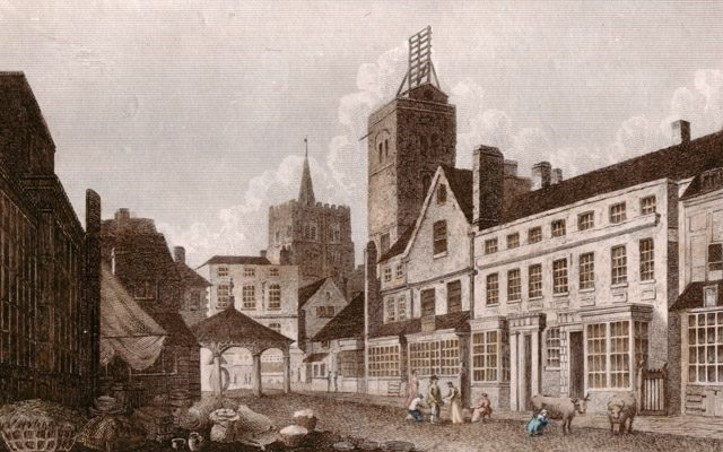
A shutter telegraph station was constructed on the Clock Tower at St Albans to allow messages to be sent between the Admiralty in London and the anchorage of the Baltic fleet at Yarmouth.
In 1810 the Local Militia mutinied in St Albans. The jail in the Abbey gatehouse was rendered inoperable and, after being held in what is now W.H Smith in Market Place, the mutineers were flogged the next day. In 1795 and 1796 food shortages and inflated price of food led to riots.
Memorials in our local churches show Hertfordshire men fought in Africa, India, Ireland, North and South America, the West Indies, Portugal, Spain, and other parts of Europe including, of course, Waterloo.
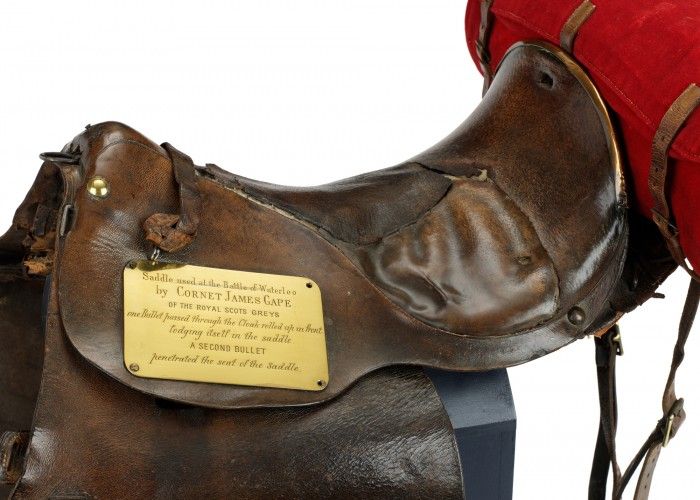
Cornet Gape of St Michael’s Manor, St Albans charged with The Scots Greys at Waterloo.
Two French musket balls holed his saddle. Surprisingly he survived.
Nor should we forget those who joined the Royal Navy. Indeed, men and boys from Aldenham, Baldock, Hertford, St Albans and Tring were present at the Battle of Trafalgar.
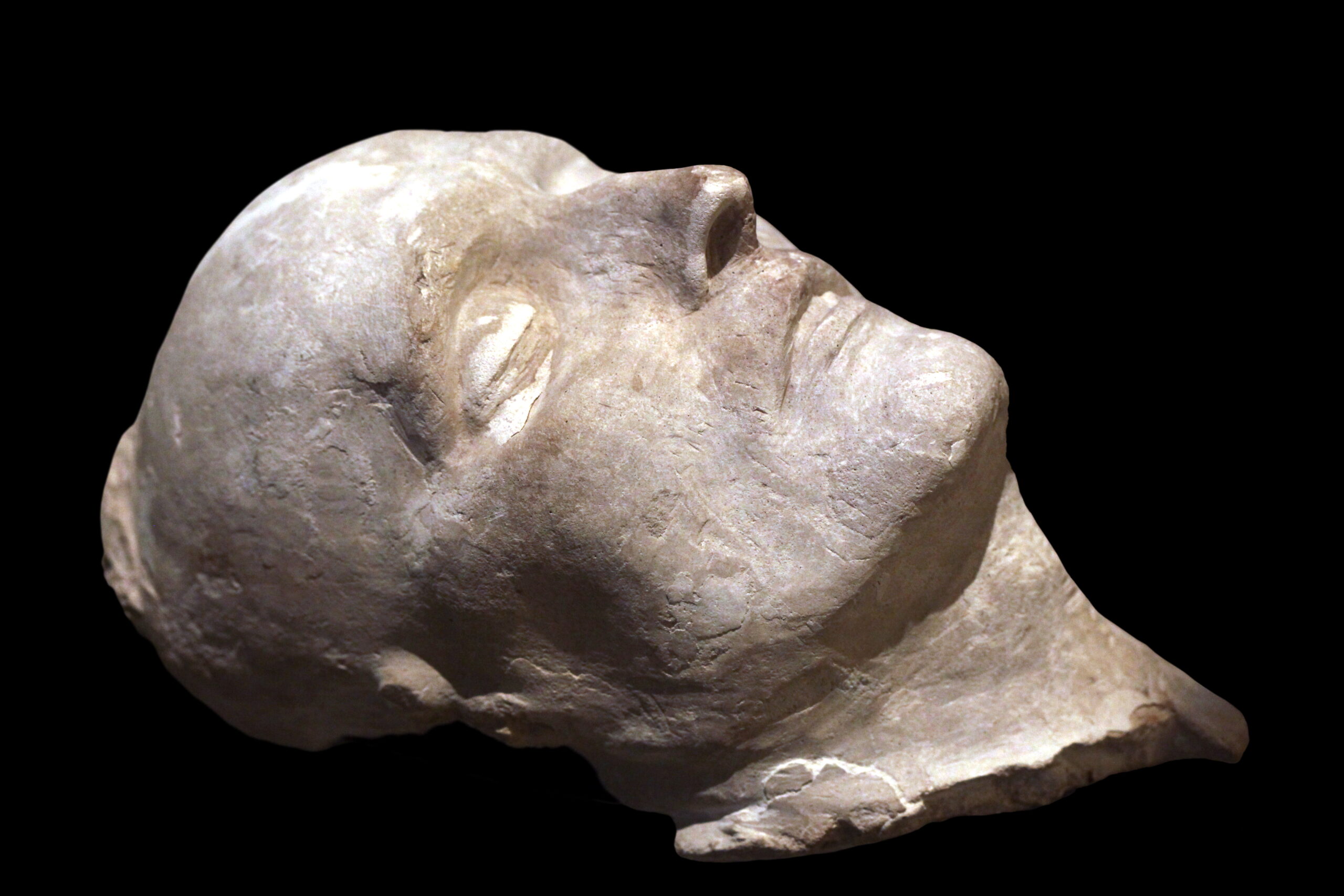
One local connection got very close to Napoleon. Francis Burton was a surgeon, originally from Ireland, who had served in the Peninsula War, North America and at Waterloo. In 1819 he was appointed to the 66th (Berkshire) Regiment stationed on St Helena. Burton was one of the Army Medical Officers who supervised Napoleon’s autopsy and produced Napoleon’s death mask.
In those days, with no photography, producing a cast was a popular way of recording an individual’s features.
Replicas today adorn the studies of Napoleonic devotees throughout the world. Burton returned to England. He and his brother married the two daughters of the wealthy Richard Baker of Barham House at Elstree. Burton died prematurely in 1828 and is buried in the family vault in St Nicholas’ churchyard Elstree.
The new film encourages us to remember these times.