10 Feb 2025
How often have you wandered through the environs of St Albans Cathedral and taken notice of the stones beneath your feet? Much of the Abbey’s footprint, and indeed its grounds, are the final resting places of priests and parishioners, nobles and knights, monks and merchants.
Following previous articles examining the fascinating lives of some of those people buried at Hatfield Road Cemetery and the parish churches of St Michael’s, St Peter’s and St Stephen’s, it’s time to discover more about those buried at the Cathedral.
This particular journey of discovery was led by author Stephen De Silva, who has an almost encyclopaedic knowledge of this subject, honed over decades spent as a Cathedral tour guide.
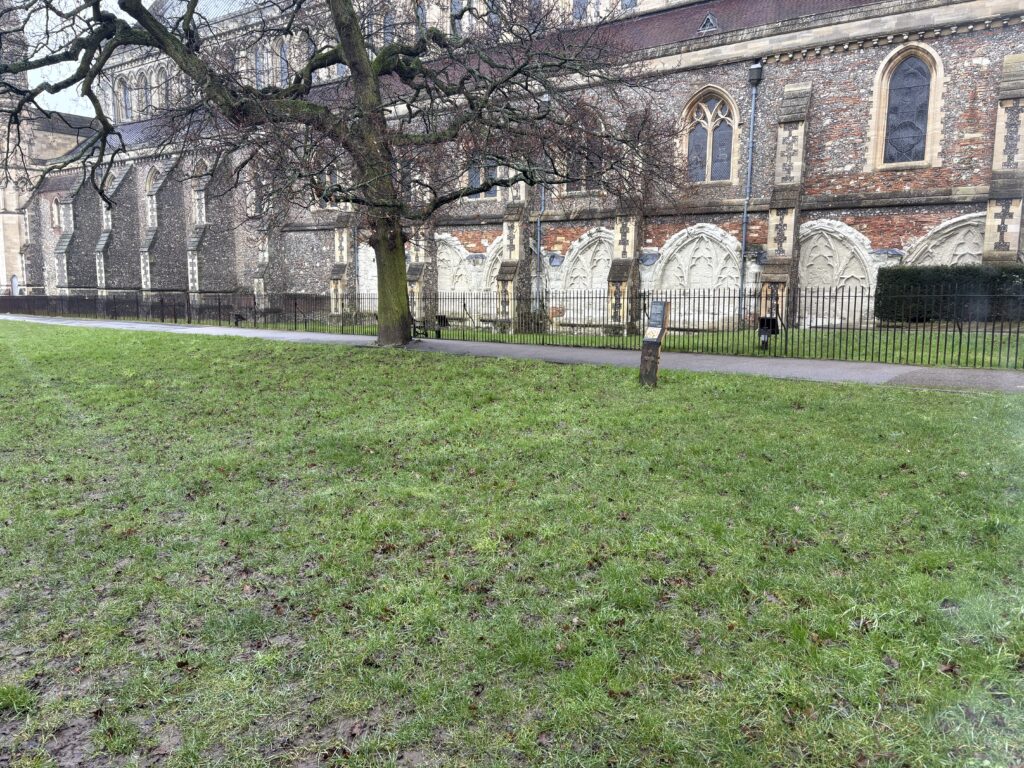
We started off outside the building itself, close to the path which runs along its southern side, which could very well have been the original burial site of St Alban himself.
Evidence that England’s first martyr was initially laid to rest on the hillside was discovered by archaeologist Professor Martin Biddle during excavations of what was the medieval cloister in 1982-3 and 1994-5.
Although he did not find the saint’s actual grave, he did uncover a Roman burial ground dating from the 200s to late 300s, with signs of festival activity including coins, pottery and food vessels on a pathway in the south-west corner. This suggests that pilgrims may have used the path to reach a shrine of some description, with Alban being the most obvious candidate before his body was relocated inside the Abbey.
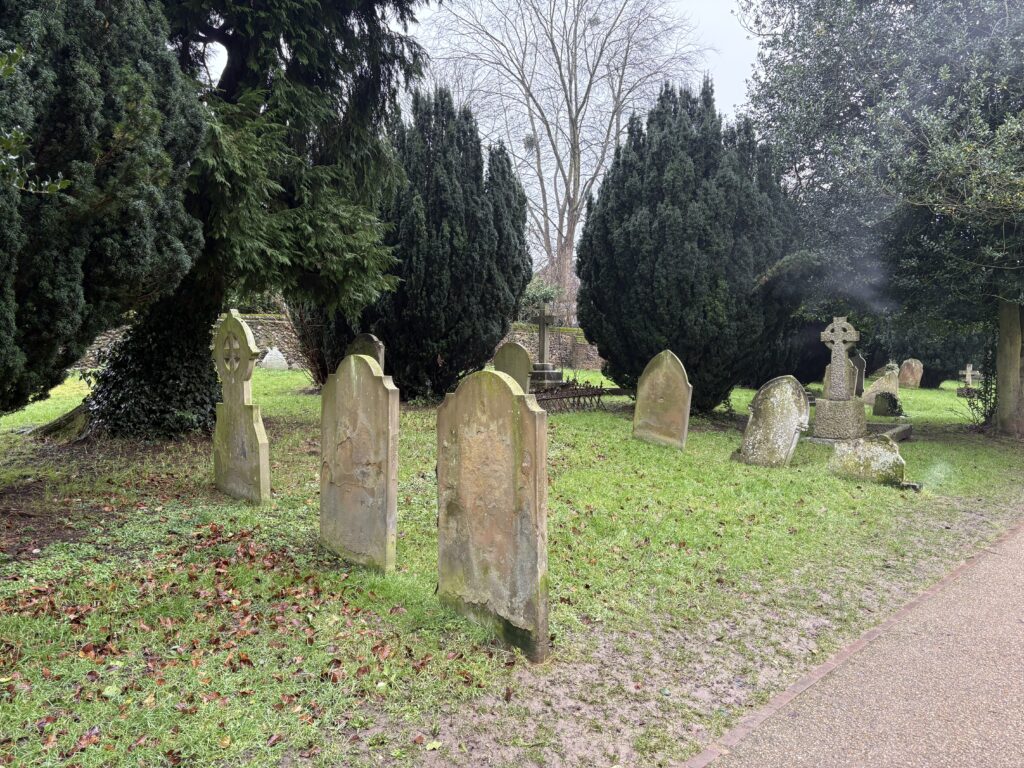
The north churchyard, once the location of the parish church of St Andrew’s before it was demolished, includes various memorial stones and graves.
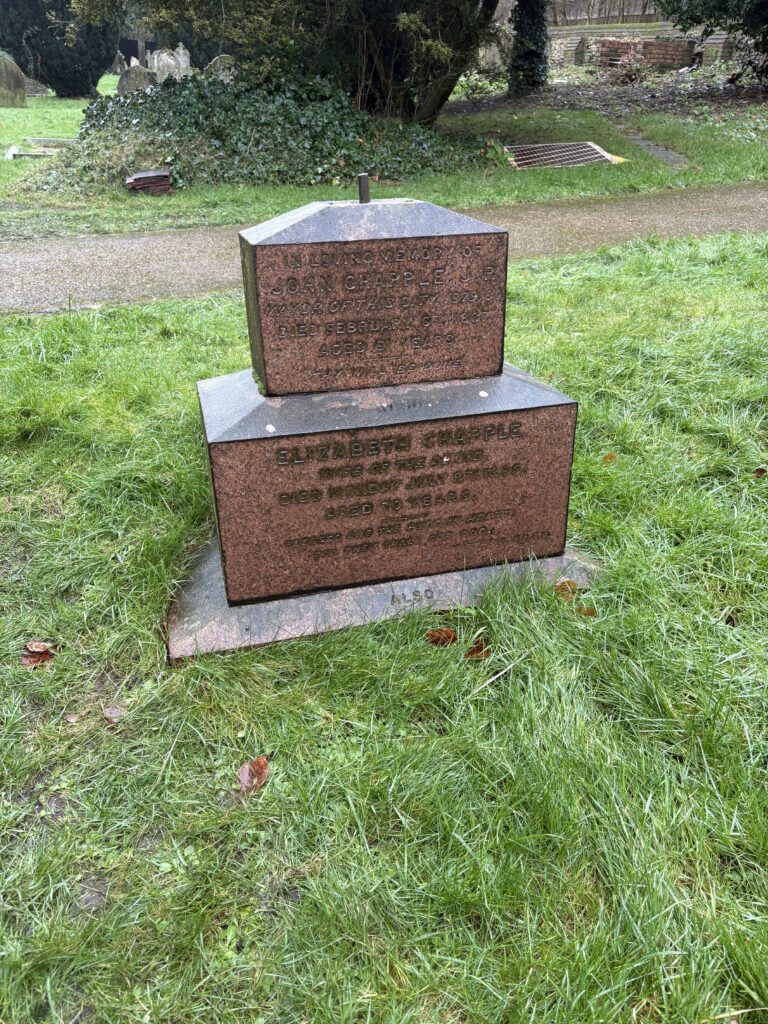
One is that of John Chapple (1826-1887), one-time Mayor of St Albans who not only built Torrington House but was also clerk of works to George Gilbert Scott during the restoration and repair of the Abbey, crucial work which was overshadowed by later efforts.
He was most famous for his role in saving the tower from collapse in 1870, having noticed suspicious ‘cracks and crushing’ in the fabric around the presbytery and Ramryge chapel.
After closer inspection revealed the tower was in danger of collapsing, he oversaw work to shore up a huge cavern in the foundation of the south-east pier, backfilling it with cement, grout and brickwork to make it safe.
Unfortunately his grave marker is currently damaged, although there are hopes it will be restored. On the occasion of his death, Canon Glossop of the Cathedral said: “It was only this morning that God called one whose name will always be associated with this building as Clerk of Works in restoring one portion after another. He has left a memorial to his skill and industry in these stones.”
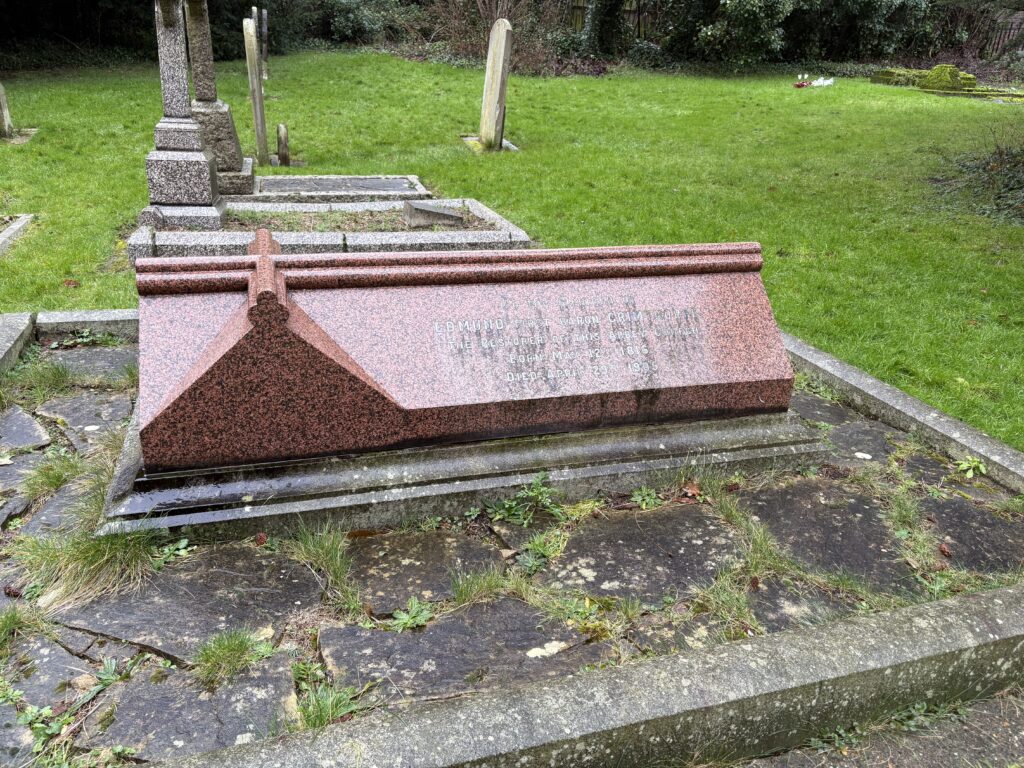
The infamous Edmund Beckett, better known as Lord Grimthorpe (1816-1905), who spent the 1880s and 1890s rebuilding the west front, roof, and transept windows of the Cathedral at his own expense, has been criticised for his unsympathetic restoration work, which was at odds with that already achieved by Scott and Chapple.
His distinctive red tombstone can be found close to the north entrance to the Cathedral grounds, and he is remembered in the Dictionary of National Biography: “Although a man of arrogance and bile, Beckett was capable of generosity, strong friendships, and kindness towards people in need of help.”
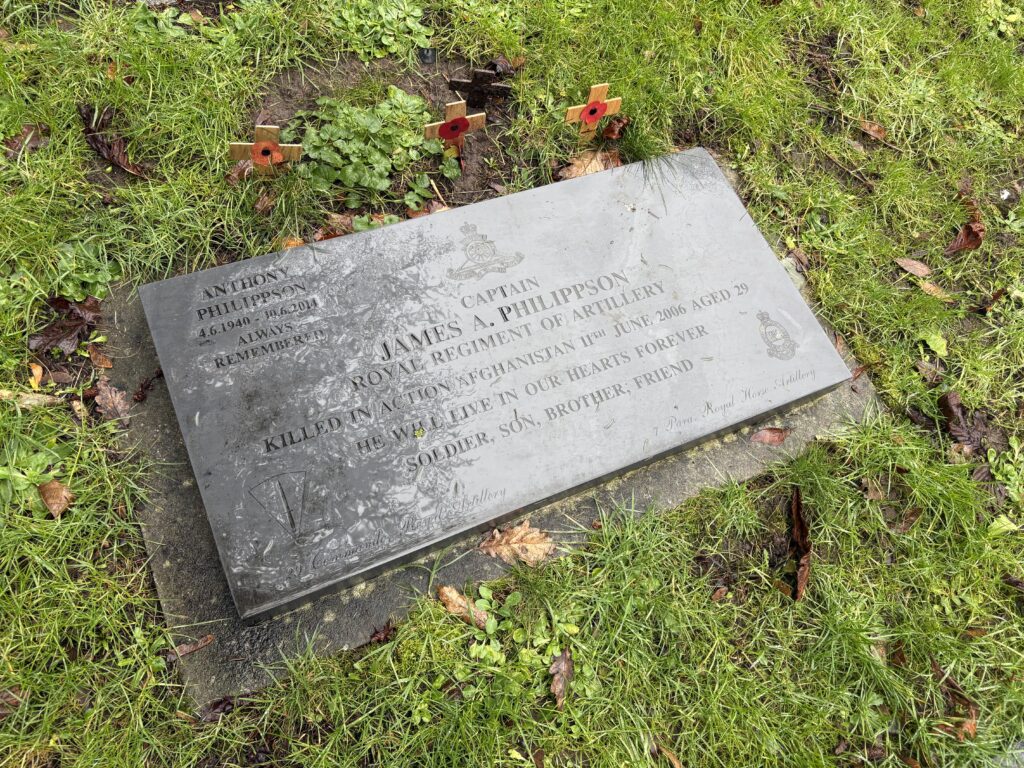
Close to Grimthorpe is a memorial to Captain James “Jim” Phillipson, a former St Columba’s College student who became the first soldier to die in the modern Afghanistan conflict. While on operations in Helmand Province on June 11 2006 he was killed after his mobile patrol was engaged in a firefight against suspected Taliban forces.
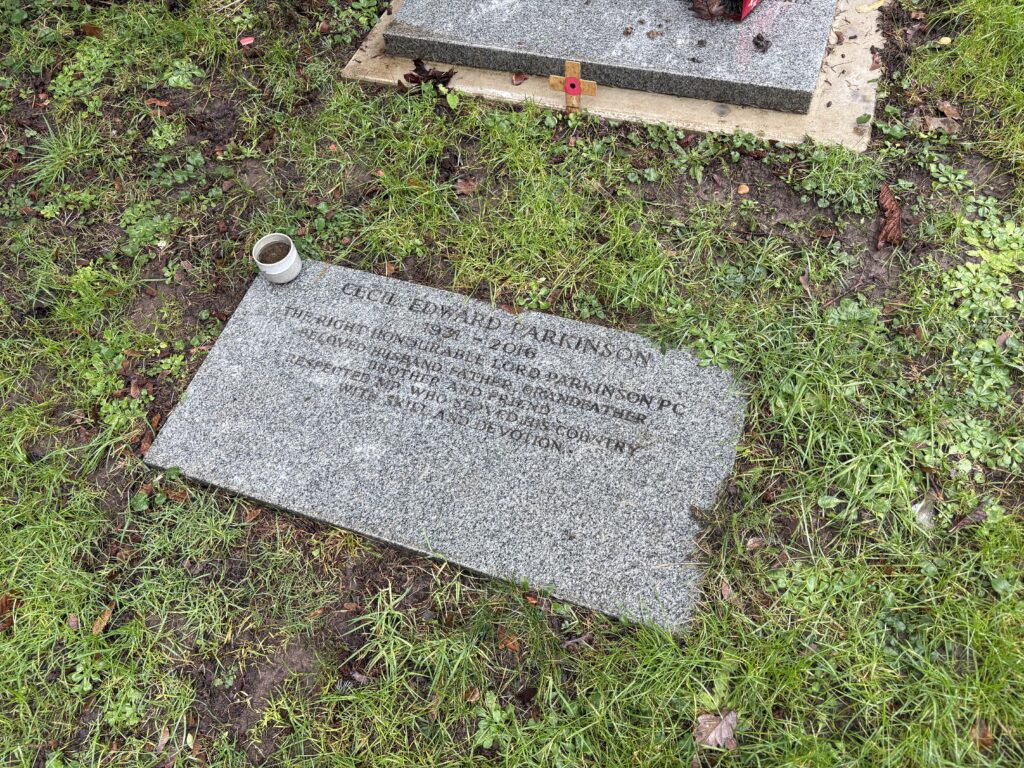
Close by is a memorial stone remembering former Cabinet minister and Hertsmere MP Cecil Parkinson (1931-2016), who served under Margaret Thatcher as Secretary of State for Trade and Industry until the revelation that his former secretary, Sara Keays, was pregnant with his child.
His wife Anne Mary Jarvis was the daughter of the founder of Harpenden building contractors Jarvis, and Cecil was a regular figure around the district when MP.
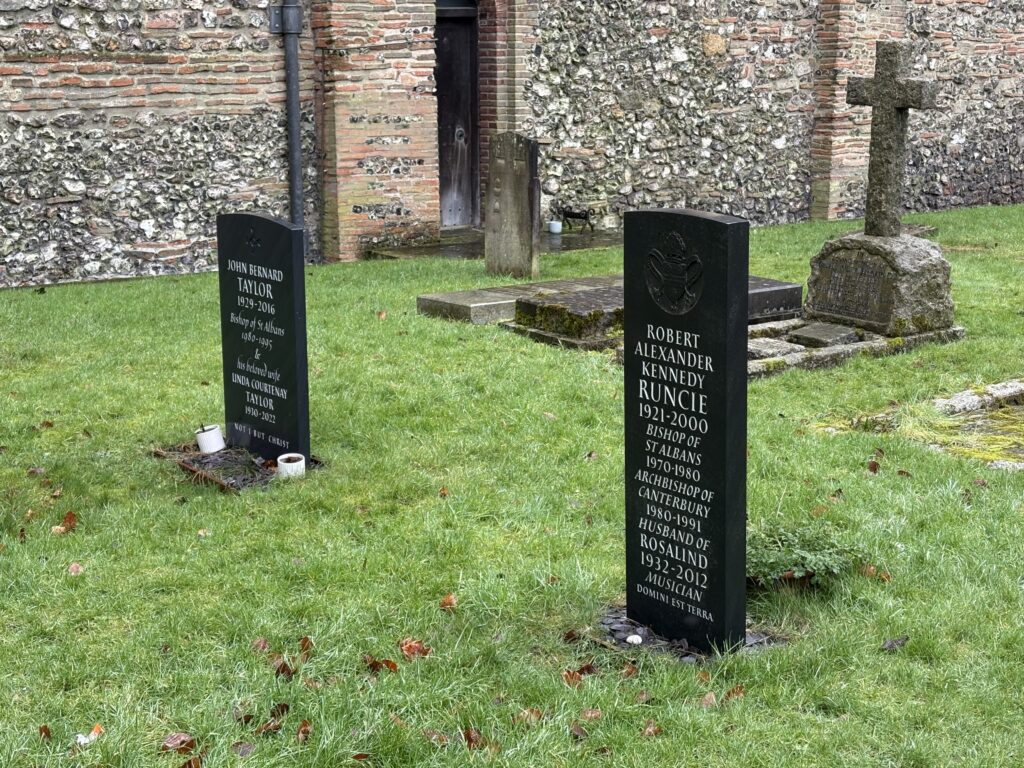
Several Bishops of St Albans are also buried in the churchyard, including Robert Runcie (1921-2000), who later became Archbishop of Canterbury, and his successor John Taylor (1929-2016), along with various canons and clergy.
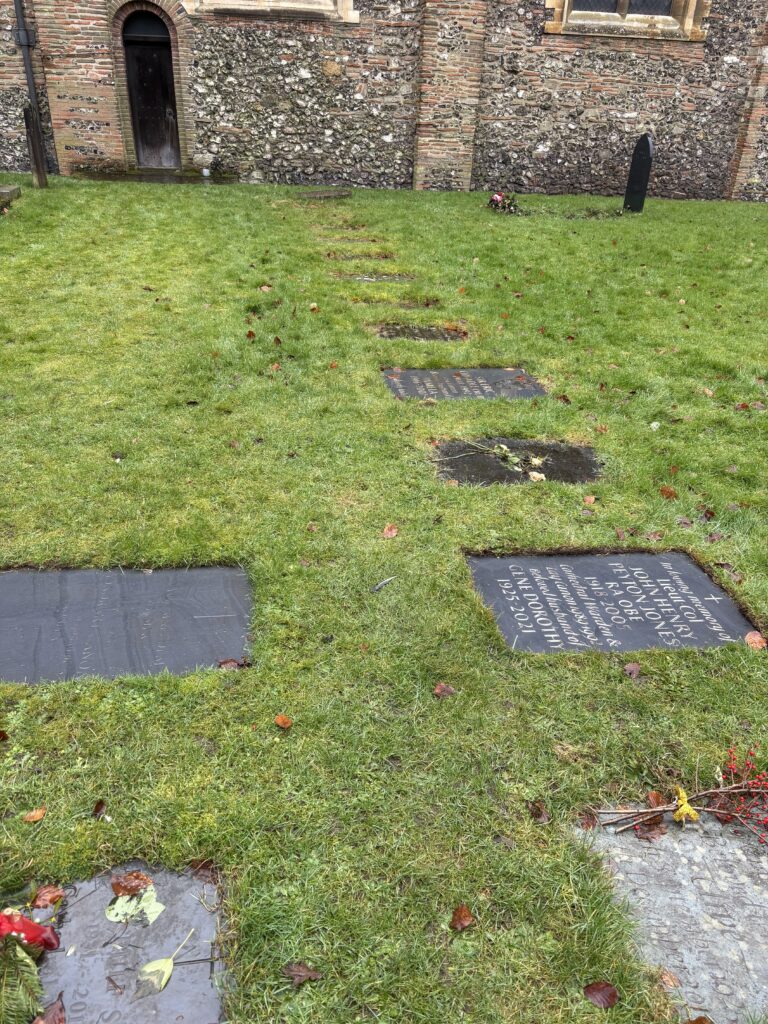
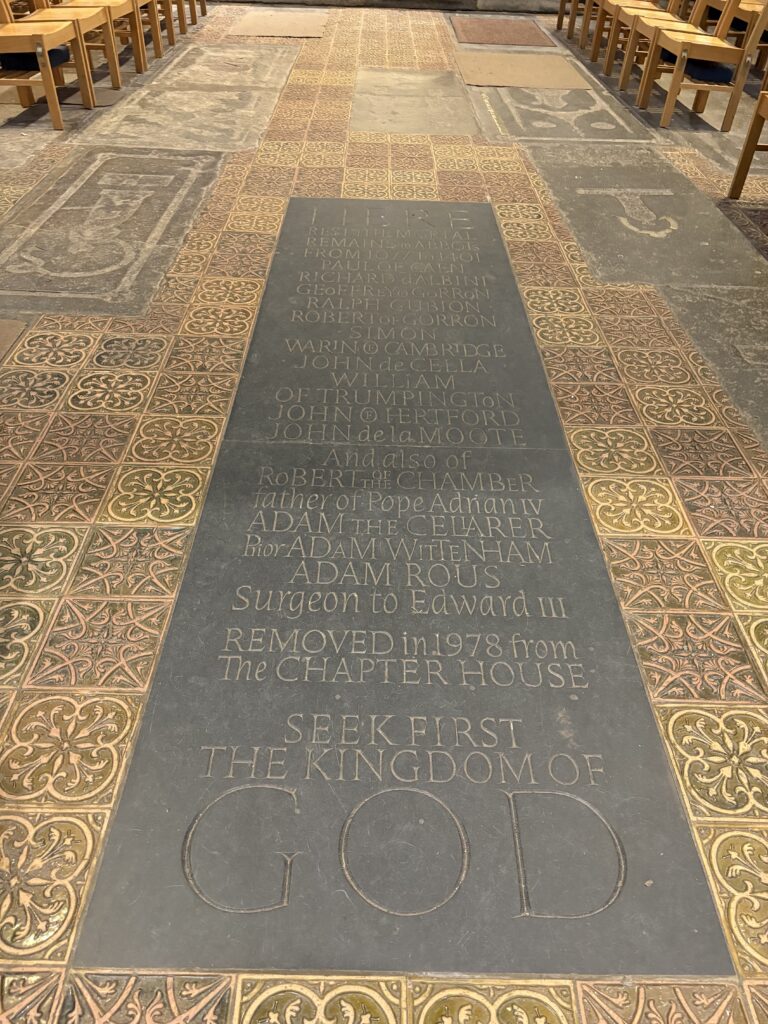
Before the modern Chapter House was built, excavations in 1978 revealed the remains of 14 Abbots and four others, who were reburied beneath the sanctuary floor inside the Cathedral.
A memorial slab of Welsh slate records the names of these “Fathers of the Abbey”, carved in Roman letters by David Kindersley and Lida Lopes Cardozo. It was unveiled on November 21 1979 during Vespers in Latin sung by English Benedictine monks accompanied by monks from Bec in Normandy.
Aside from the Abbots, those remembered include Adam the cellarer (the person in a monastery responsible for provisioning and catering), Robert of the Chamber who was the father of the only English Pope Nicholas Breakespeare, Adam Wittenham (died before 1396) who was cellarer, forester and prior of the monastery, and Master Adam Rous (died 1379), the surgeon to King Edward III.
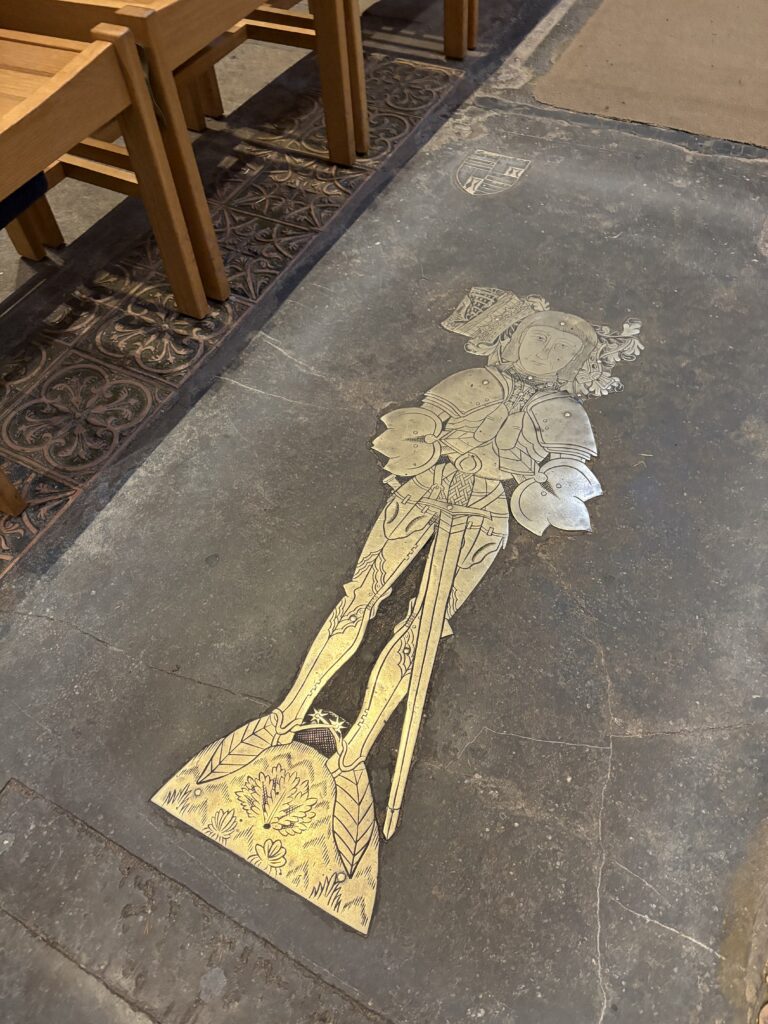
Hidden away under simple floor mats are the Cathedral’s surviving brasses, which escaped being destroyed during the Reformation or stolen afterwards. The first is of Sir Anthony Grey (born circa 1446, died 1480), wearing elaborate plate armour including the distinctive collar of suns and roses adopted by the Yorkists after the Battle of Mortimer’s Cross in 1461.
Another brass shows Brother Robert Beauver, wearing the monastic cowled robe which was typical of the Benedictines who lived at the Abbey. He died in 1454 at an age in excess of 70, and the brass is thought to date to that time.
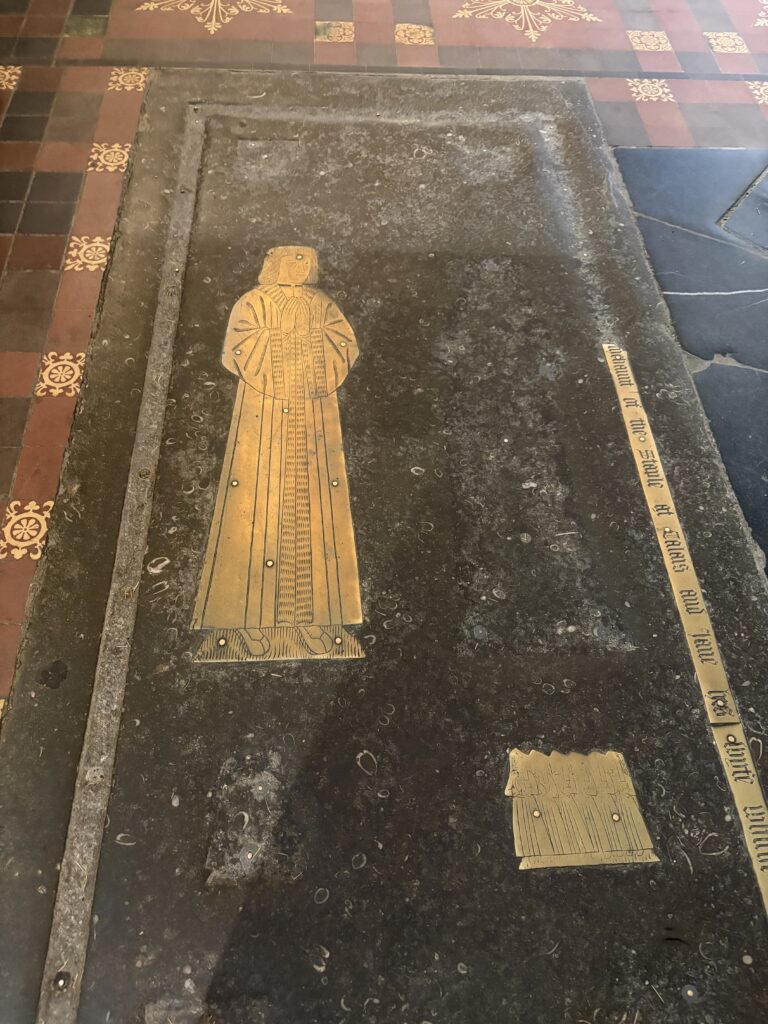
Hertfordshire Sheriff and City of London merchant and goldsmith Ralph Rowlatt (died 1543) is also remembered with a brass, having previously profited from the closure of the monastery.
Rowlatt took the lease of a large share of the monks’ tenements in the town centre as well as tithes from outlying parishes. He had previously testified against Brother William Ashwell, who, a few years before the dissolution, had condemned the King’s marriage and the influence of Anne Boleyn and Cromwell, whom Ashwell judged to be “maintainers of heresies and new fangleness”.
Rowlatt was also Master of the Mint during the reign of Henry VII, an ancestor of Diana, Princess of Wales, and one-time owner of the Gorhambury Estate.
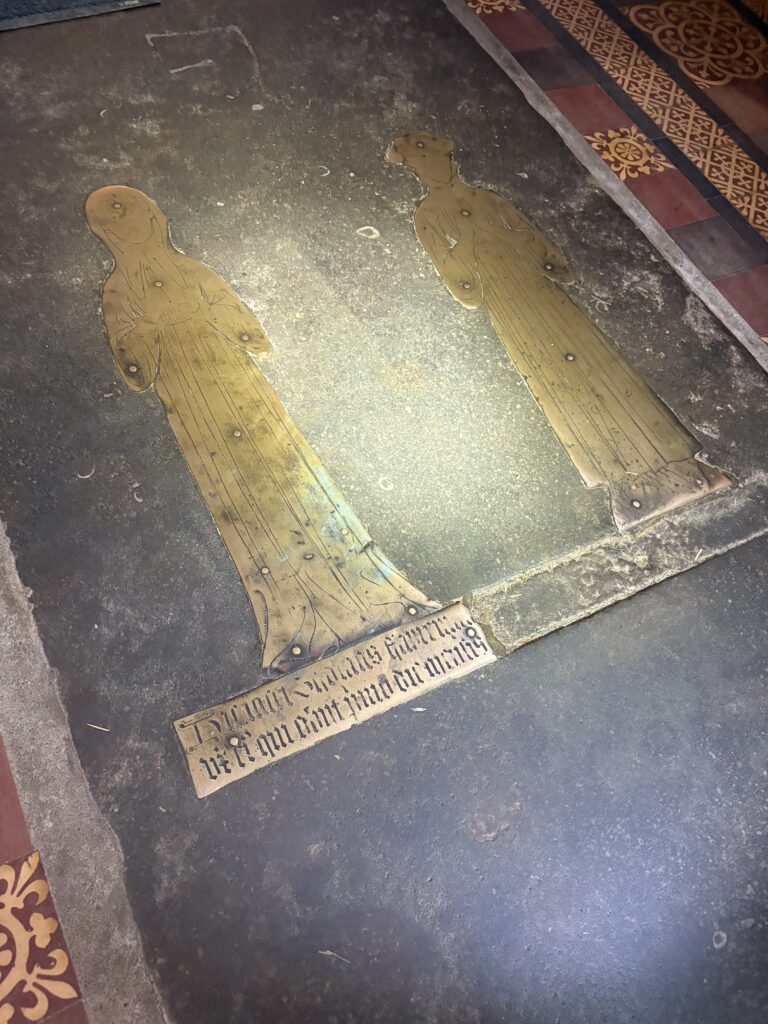
Then we have Thomas Fayrman, described as a merchant and Staple of Calais and bailiff of St Albans, who died in 1411, with Alice, his wife. She survived him by several decades and became an extremely generous benefactress to both the Abbey and St Andrew’s chapel.
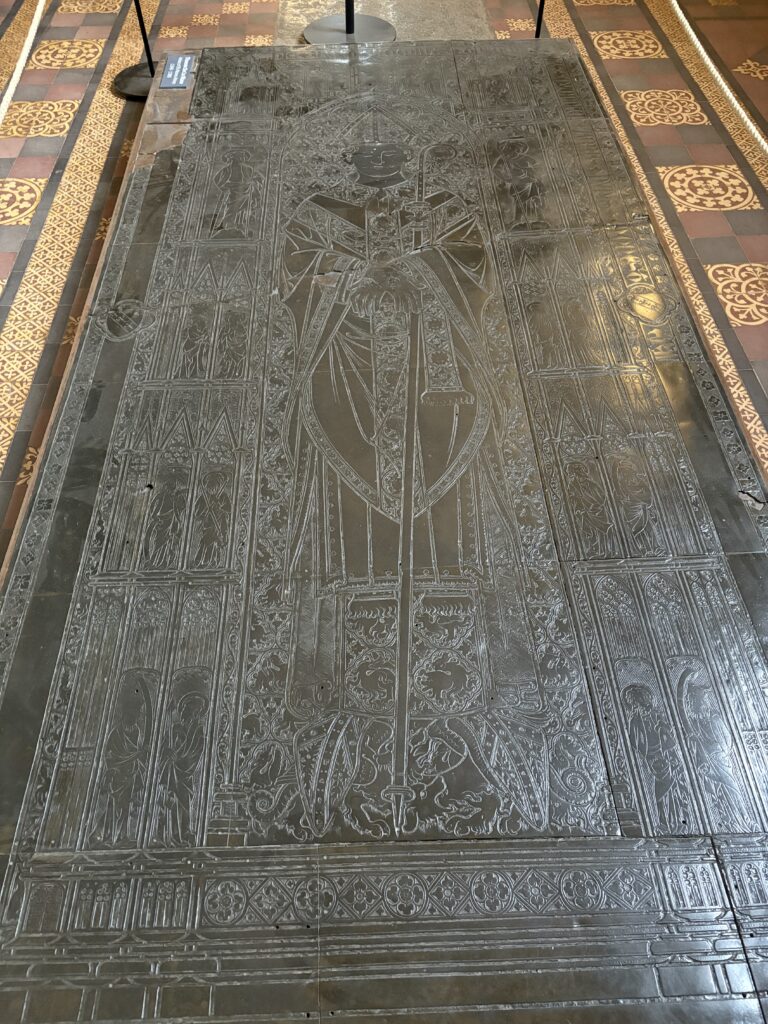
Finally, there is the brass of Abbot Thomas de la Mare, which is thought to be one of the highest quality brasses in the country.
After the turmoil of the Black Death, Thomas journeyed to receive his blessing and pallium from the Pope. It it thought that it was during this journey that he ordered the brasses from Flanders.
During his visit, two of his entourage died and he was gravely ill but recovered to return, perhaps collecting the brasses on his way back. He built the Great Gatehouse and was held in great esteem by the community. He dealt with the local rebels during the Peasants’ Revolt and died in 1396.
Thomas Flemish brass was commissioned circa 1355, most probably from Tournai which is in modern day Belgium, and set in a limestone slab.
The brass seemed to have survived the Dissolution of the Monastery – the story is that it was turned over and hidden and was also saved from destruction during the Civil War in the middle of the 17th century.
It was then sited near the High Altar and the crack in the brass matches the crack still visible in the memorial slab.
Moving around the Cathedral we find the Chantry Chapel of Abbot Thomas Ramryge, the 37th and last Abbot of St Albans, who died in 1521, which now includes Perspex angels representing the six stages of grief designed by Claudia Ashley-Brown.
Strictly speaking he was the last of the great medieval abbots. After him was Thomas Wolsey, who was not resident, and then two more who never functioned as powerful abbots.
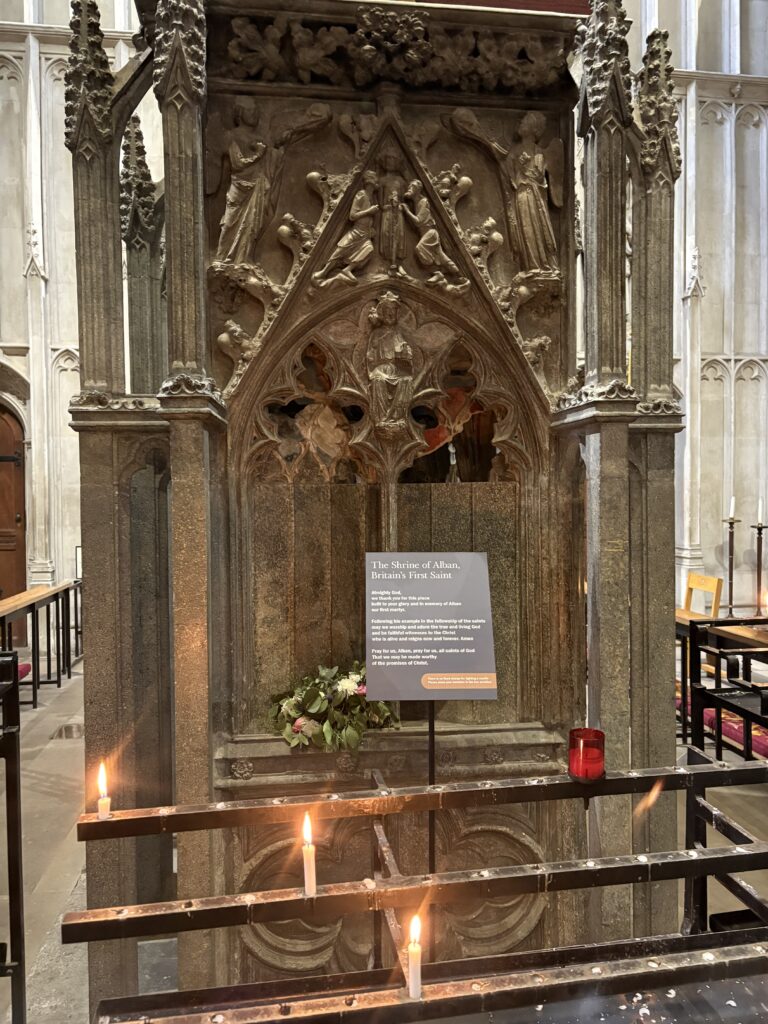
The current Shrine of St Alban was built around 1308, smashed to pieces during the Reformation at some point after 1539 and rebuilt in 1872. Missing sections were discovered being used as infill for walls separating the Lady Chapel from the Abbey church when they were removed in the late 1800s.
The shrine contains within it a scapula (shoulder blade), a gift from St Pantaleon’s church, Cologne in 2002. This was a former Benedictine abbey church which had possessed remains believed to be those of the saint since the 10th century.
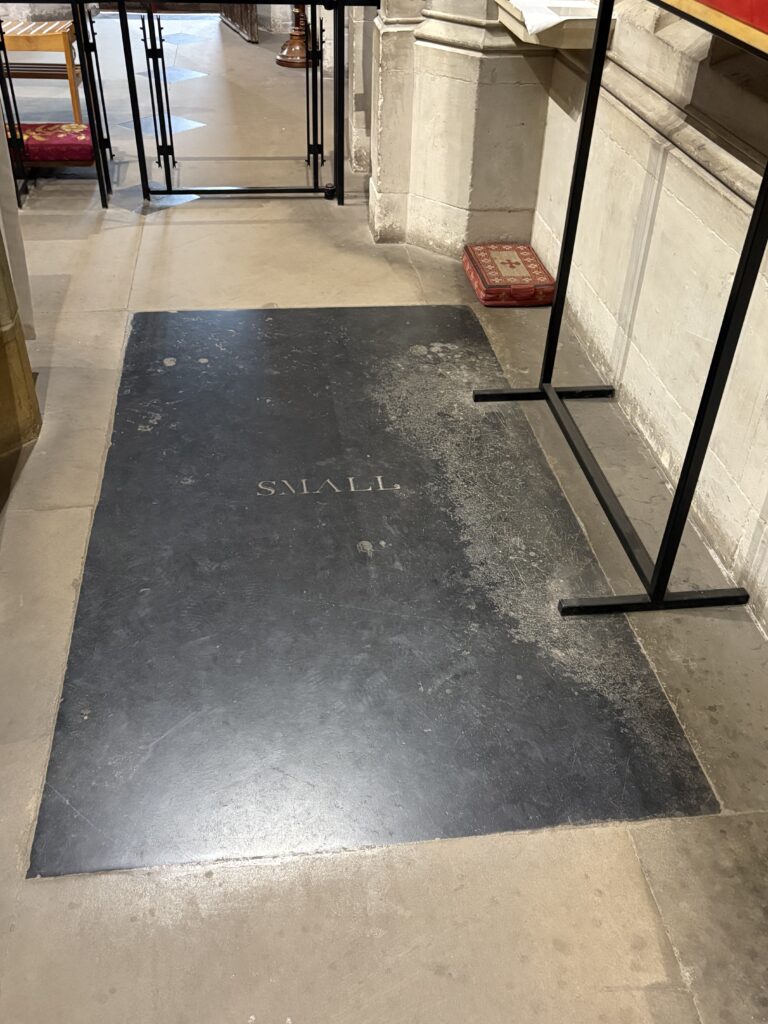
In front of the shrine itself, a memorial slab with the single word ‘Small’ is said to be the tomb of Henry Small, Rector of the Abbey from 1817-1835, who fled to France with £20,000 embezzled from his parishioners.
In an interview published by the Herts Advertiser in 1896, one Thomas Kent said: “He cheated everybody. He formed a bank for one thing, and it went wrong.
“It was a shocking thing. I knew him before he came to St Albans. He was curate of Redbourn. He was a tall man with only one eye.”
The bank in question was the Hertfordshire Savings Bank, in which Small ran the St Albans branch.
Adventurer, scholar, patron of learning, a pursuer of love affairs and a politician, Chantry of Humphrey (1390-1447), Duke of Gloucester, was the son of a king (Henry IV), the brother of a king (Henry V), and the uncle of a king (Henry VI).
The only Royal buried at the Cathedral, Humphrey’s collection of books now forms the nucleus of the precious manuscripts at the Bodleain Library in Oxford.
He died three days after being arrested on a treason charge, but might have been deliberately killed by political rivals for power at Bury St Edmunds. Shakespeare describes his murder by the agents of the Earl of Suffolk, but modern opinion is undecided.
His body was claimed by St Albans monks, embalmed and brought to his prepared underground vault, the location of which was lost for years. It was eventually rediscovered by workers in the 18th century, and when they opened his lead coffin his body was found to be perfectly preserved.
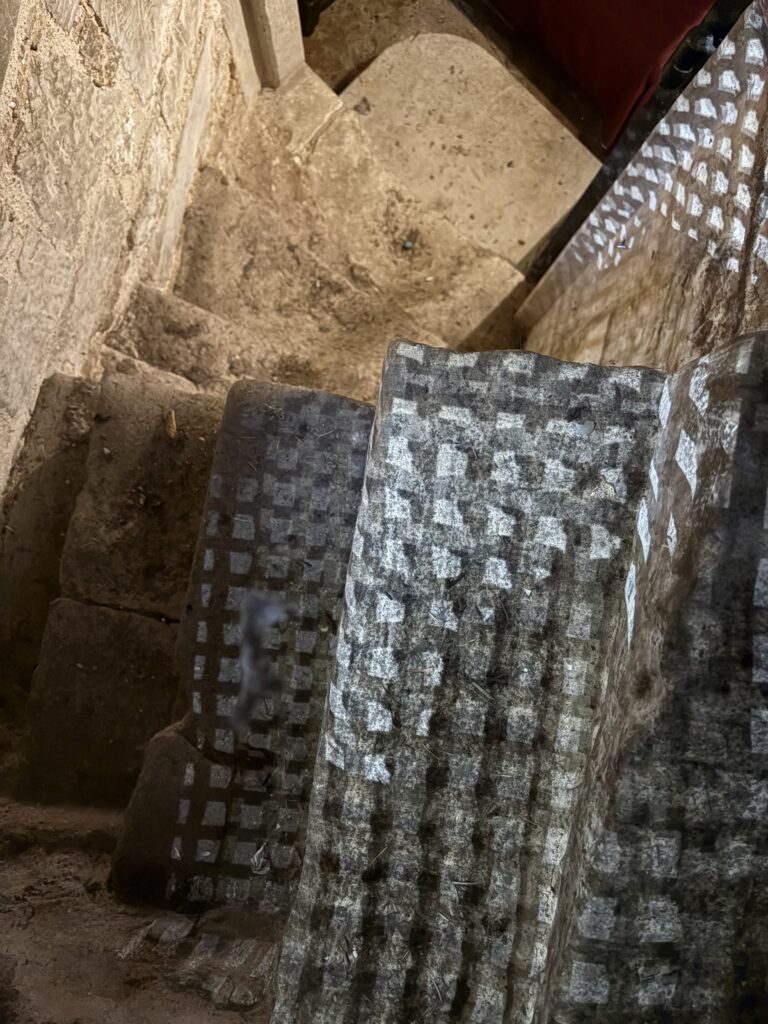
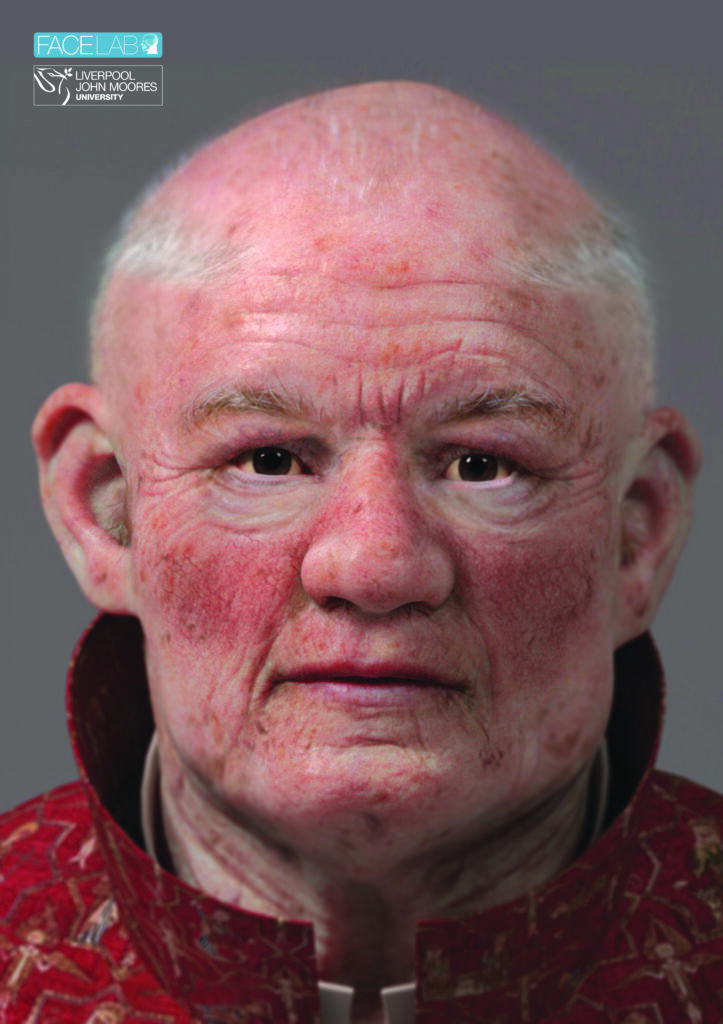
The coffin, now draped in red, can be seen adjacent to the ossuary of his university friend, the man who later became Abbot John of Wheathampstead (died 1465), who was buried there in 2022.
After early schooling at the Abbey School (now St Albans School) he entered St Albans Abbey when only 16. He was chosen abbot of this Benedictine monastery in 1420, but resigned his post in 1440. In 1451, on the death of his successor John Stoke, he became abbot for the second time, and went on to greatly improve the buildings at St Albans, which had suffered somewhat during his later years owing to the Wars of the Roses, and also introduced internal reforms and promoted the Abbey’s property interests.
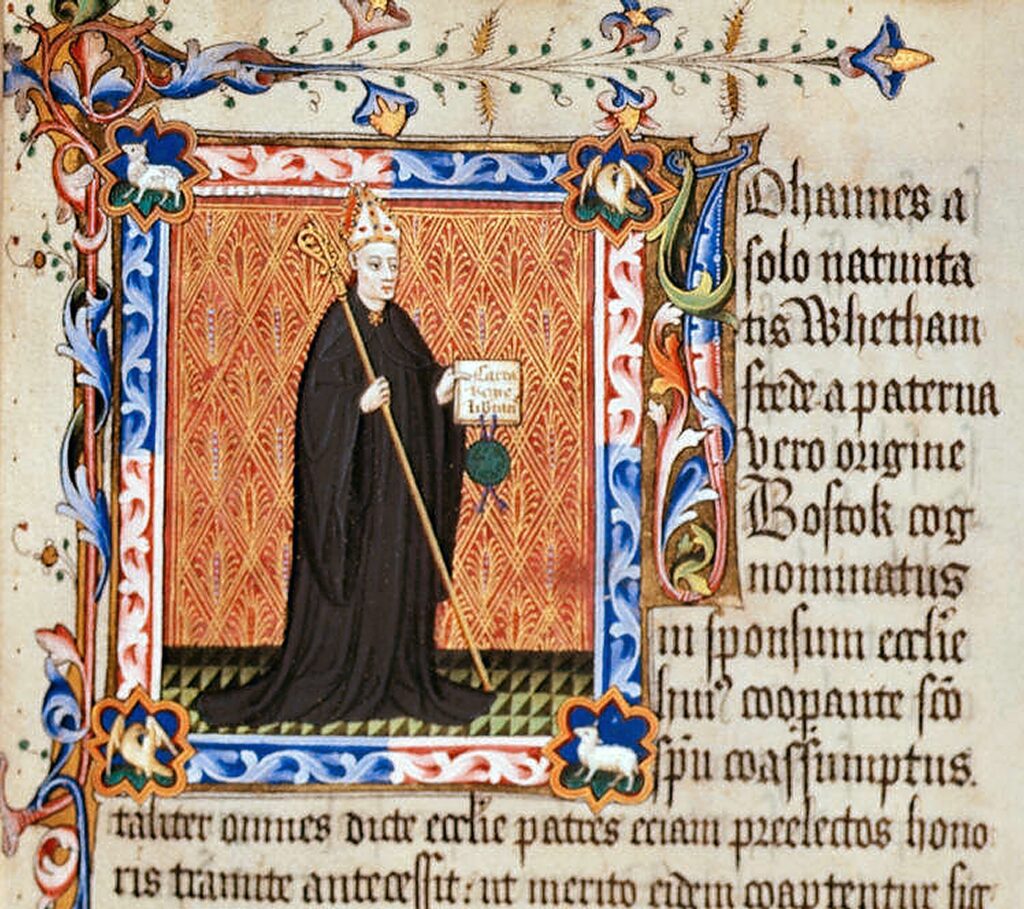
His body was rediscovered in 2017 when the foundations for the new Welcome Centre were being excavated, alongside three papal bulls that Pope Martin V had given him 40 years before, confirming the papal privileges he gained in 1423.
The Shrine of St Amphibalus remembers the Christian priest that St Albans sheltered from persecution, who was later martyred at Redbourn. His grave was discovered in the village in 1178 and a shrine for his relics was built soon after they came to the Abbey in the 1100s.
They were relocated a couple of times and this shrine was originally bult in the late 1300s and located near Alban’s shrine. It was also destroyed after the dissolution of the monasteries, but pieces were discovered in 1872 with the other parts of the Alban shrine, although unfortunately more than 55 per cent of the stone was lost.
The Victorians supported what remained using house bricks, but by the early 1900s the shrine was moved to a dark corner of the north ambulatory aisle and largely ignored.
In 2019 the decision was taken to move it into the Chapel of Our Lady of the Four Tapers as part of the ‘Alban, Britain’s First Saint’ project, and to restore some faults made during the 1872 restoration.
But after being dismantled and sent to the workshop of stonemasons Skillington’s, the Covid pandemic hit, delaying much of the project until restrictions had lifted sufficiently to allow work in isolation on site. The rededication eventually took place in 2021, with some of the new carvings representing the global crisis of that time, including a small head wearing a facemask under the top ledge.
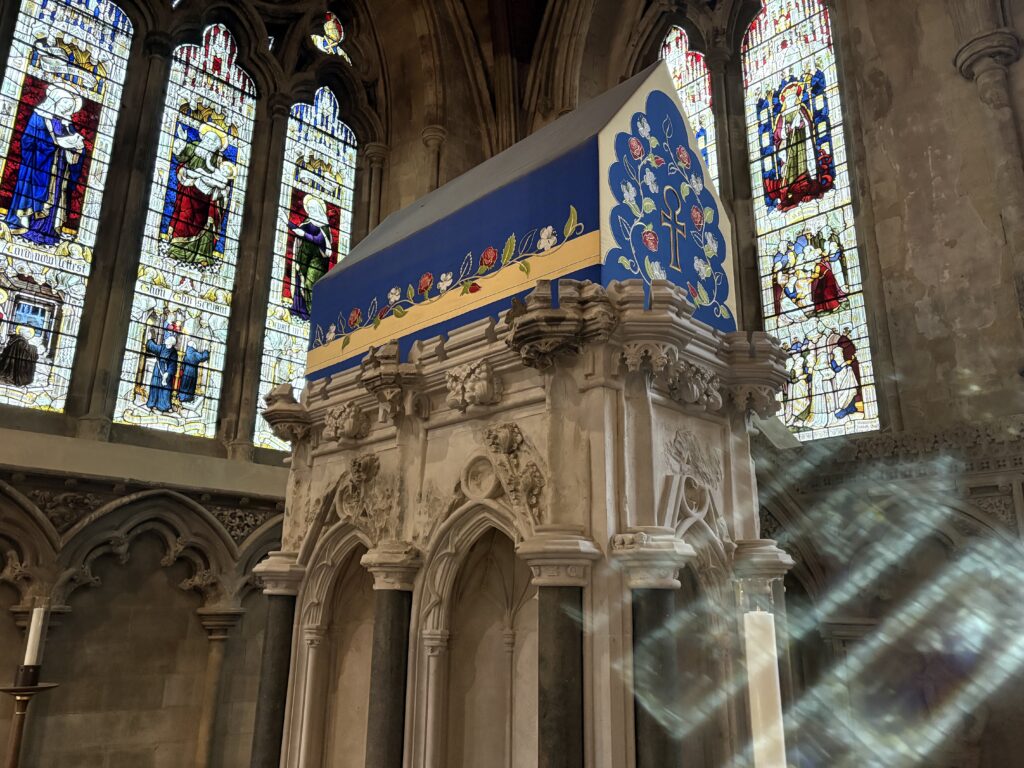
There are no longer any physical remains within the shrine, but there is a small piece of fabric said to be part of the saint’s cloak, donated by Italian Catholic pilgrims in 2016.
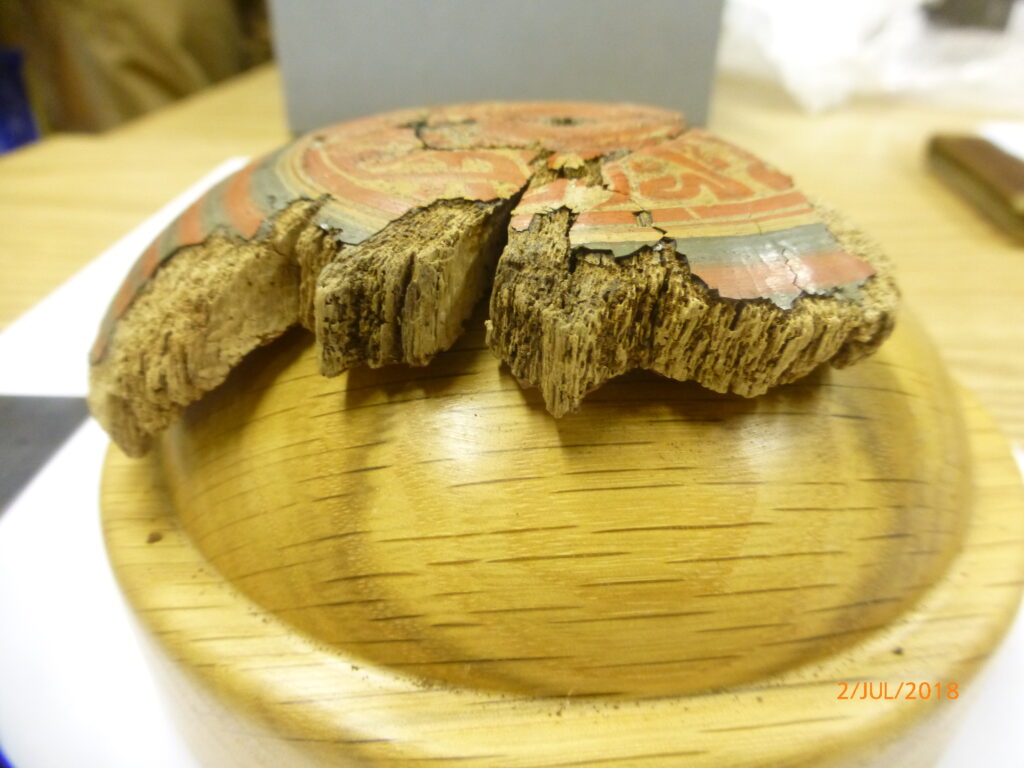
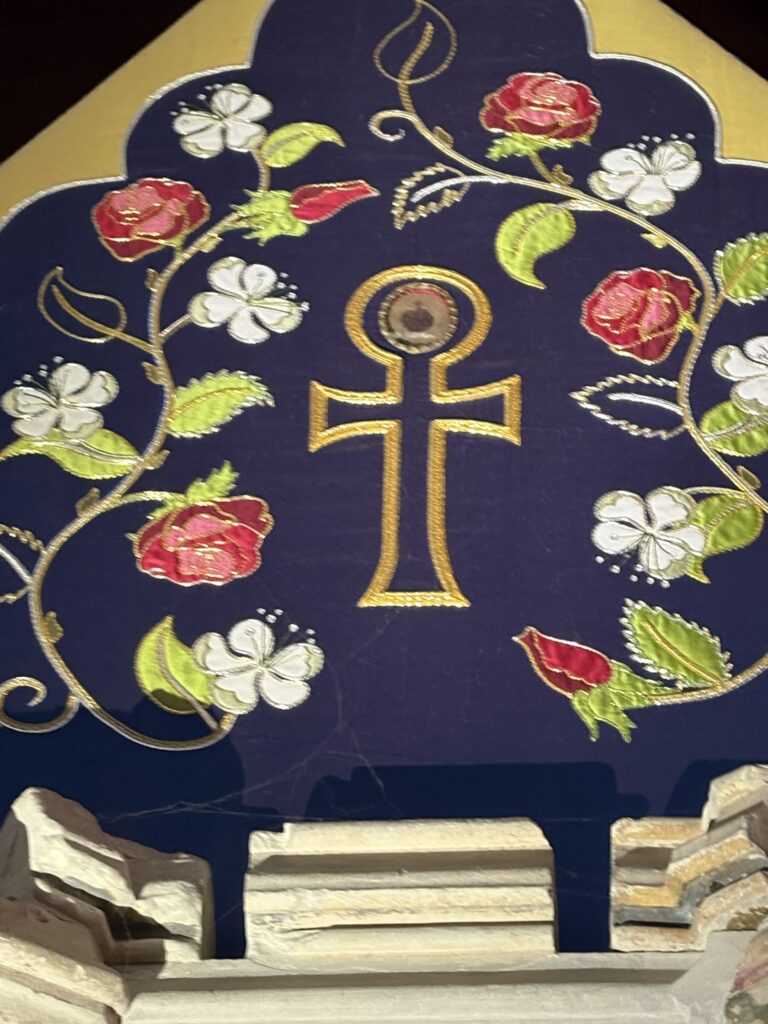
In the area where Amphibalus’ shrine now stands, Victorians discovered a small wooden box, believed to have contained the heart of Abbot Roger de Norton (died 1291).
The box had been buried in a cylindrical hole in the floor before the altar of St Mary of the Four Tapers and is thought to originate from 10th century Afghanistan.
The lid had an Arabic inscription which reads “Everlasting glory and good fortune for him”.
Inside the North Transept is a memorial to Frederica Sophia Mure (1763-1834) whose daughter Eleanor Mure wrote the oldest version of the folktale The Three Bears in rhyming verse for the fourth birthday of her nephew Horace Broke in 1831.
She illustrated them with original watercolours to show the bears as residents of Cecil Lodge, an elegant mansion in Abbots Langley where the Mures lived (now demolished). In contrast to other versions of the story, her bears had milk instead of porridge.
One of the most fascinating memorials Stephen leaves until last, that of a medieval Baron Munchausen whose account of his astonishing adventures became the most celebrated book of the Middle Ages.
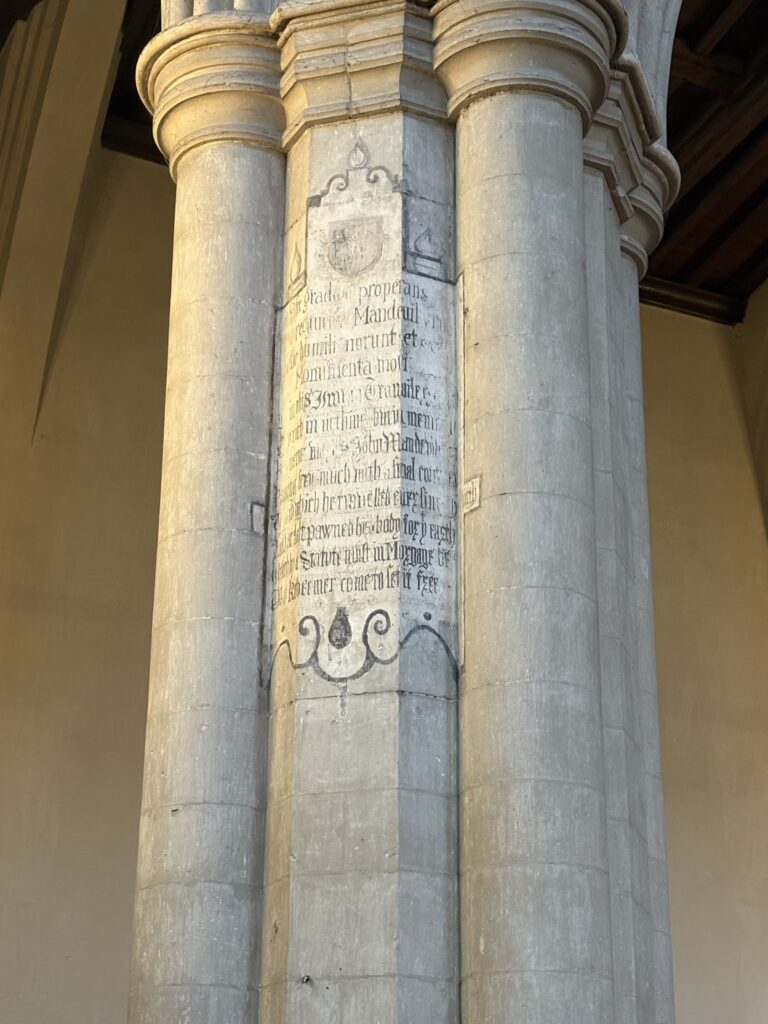
The book, commonly known as Mandeville’s Travels, was written between 1357-1371, auspiciously by someone known as Sir John Mandeville (died 1372), the subject of an inscription on a pillar towards the West End of the Cathedral.
Accordingly, John de Mandeville travelled across the Islamic world as far as India and China, inspiring the likes of Christopher Columbus and Leonardo da Vinci with his picturesque descriptions of the various lands he visited.
The narrator Mandeville identifies himself as a knight of St Albans who was writing of his past exploits to stave off boredom caused by incapacitating gout.
He recounts his time serving in the Great Khan’s army, and encounters with dog-headed men, cannibals, Amazons and Pygmies.
But although there is no contemporary evidence of a John Mandeville from that period, it is said that the Abbey was presented by a gold sapphire ring which he owned, and this is listed in a 15th century inventory.
There was also a local legend that a statue of Mandeville, cross-legged and in armour with sword and shield, once stood in the building.
There is evidence both for and against Mandeville being a real person, with claims he was a fictional character invented by either John of Burgundy or John d’Outremeuse
His Travels, which were discredited in the 19th century, quote extensively from other works of the time, suggesting they were not an original work..
There are also conflicting claims about his burial place, although a church in Liege also had a memorial to Sir John – but this has since burnt down.
However, Abbey chronicler, Thomas Walsingham, lists Sir John as one of the ‘Worthies of St Albans’ in 1370, and one has to ask why would a medieval French writer claim to be a knight from St Albans?
Giles Milton defends Sir John’s reputation in ‘The Riddle and the Knight’, which was published in 2001.
My whistlestop tour of the Cathedral’s dearly departed was brought to life largely by the enthusiasm and wisdom of my guide, although it’s easy enough to find most of the features mentioned in this article if you don’t want a formal tour.
We’ll be wrapping up this series with a final article later this year, looking at those people buried in some of the churchyards in Harpenden and the villages.
In the meantime, why not take the time out to enjoy a tour around St Albans Cathedral in the company of one of the expert guides. It really will cast a new light on the city’s most celebrated building.
Sources: Stephen De Silva, anhistorianabouttown.com, St Albans and Hertfordshire Architectural and Archaeological Society