12 Nov 2025
A quick science lesson: the human body relies on electrical impulses from the brain to muscles, which trigger contractions to create movement, and the harder you engage those muscles using resistance or cardiovascular exercise, the fitter you become.
But what if you could harness this process to mimic the effects of hours spent lifting weights or pounding the treadmill in the gym?
That’s the principle behind an innovative process which promises to completely shake-up St Albans residents’ approach to fitness.
Bodystreet involves positioning electronic conductor panels next to the skin to send an electrical current to the area, causing rhythmic muscle contractions.
It’s a similar process used to help treat some muscle injuries, as the currents also help improve blood flow and stimulate muscle fibers.
It has been introduced in St Albans by husband and wife team Chris and Dina Hart, who recognised that there were a lot of people locally who wanted to keep fit, but were too time poor to devote hours at the gym.
Chris explains the concept: “My wife and I worked in the corporate world for 20 odd years, and always tried to keep fit and look after ourselves. Last year we discovered EMS (electrical muscle stimulation) which is the technology behind Bodystreet, and we were so impressed with what it did we thought, wouldn’t it be brilliant if everyone could do this?
“Everyone should have the chance to keep fit even if they’re short of time.”
Bodystreet is a German company which has been running for around 18 years on the continent, but is slowly taking hold in the UK, with the St Albans set-up the 13th in this country.
Chris says: “Because it’s a very new thing, we do trials to give people the chance to understand what a session looks like and how it feels. It’s an unusual feeling, it’s not painful or anything, it’s just odd.”
With just a few months to go before I hit my mid-50s, the fat has started to build up on my chest and around my waist despite the occasional run along the Alban Way. Juggling the demands of the St Albans Times with family commitments takes up a lot of my free time, and gone are the days when I could fit in a few weekly HIIT sessions at Nuffield.
So an innovative new exercise regime which takes just 20 minutes a week ticks all the boxes, and I agreed to embark on a three-month programme to see what benefits it could bring, while reporting on my progress over a series of articles.
Bodystreet St Albans is based out of one of the historic shops down Holywell Hill, with large glass windows designed to show to people sitting in the traffic queues exactly what they do as exercise takes place in full view of passers-by – something we have the Germans to thank for, apparently, although Chris has fitted blinds for the more self-conscious participant.
Things start off with a simple consultation, measuring my height and weight, checking my blood pressure, and then it’s time to don one of their special suits to begin a calibration process.
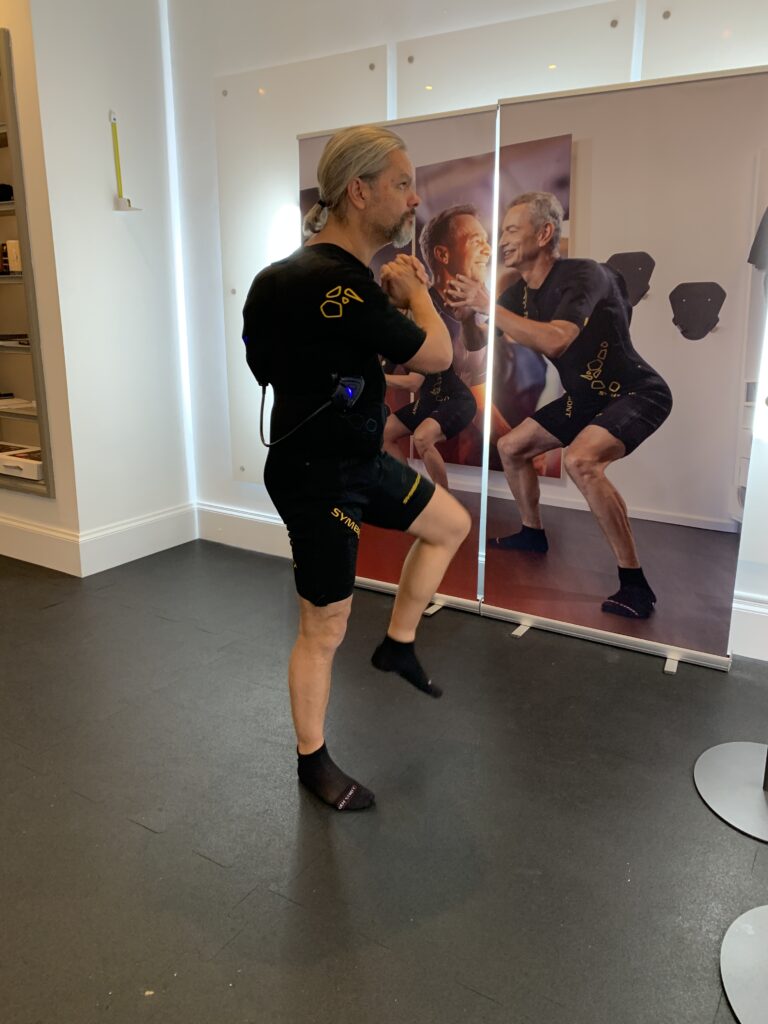
Imagine wearing a skintight dry suit, cut off at the elbows and knees. This has 24 panels inside which deliver electric pulses to all of the major muscle groups, and are controlled individually, in pairs or all together.
“It’s very tight because we want those electrodes to be right up against the skin,” Chris explains, and it certainly left no room for modesty, resembling some sort of superhero costume without the cape.
Once I’ve prised myself into this outfit – which involved a lot of breathing in to do the zip up properly – Chris hooks on what looks like a charging pack for a cordless drill into a sling on my back and clips it into place. This is the device which powers the panels and links up to a computer monitor showing my various workout levels so there’s no room to hide.
He then carries out a full body scan to determine my muscle mass, water content and metabolic age. It picks up on everything from hydration through to cellular health, so provides a complete picture which can be used as a guide during the course of my programme.
Unsurprisingly, I’m a little overweight, my fat levels are towards the higher ends of the “desirable” levels, and although I’m generally healthy, there is definitely room for improvement, something the Bodystreet process promises to achieve.
On a very positive note, my metabolic age is actually 43, which means compared to other people of my age, my body’s energy-burning efficiency is much better, something which is linked to the ratio of muscle to fat, my diet, the amount of exercise I do and even my genetics.
Having gone through all the pre-exercise protocols, it was time to begin my first session. These are tailored to an individual’s requirements, with relevant data fed into a digital profile to determine how I’m getting on over the course of time.
Following a brief warm-up to stimulate both my heart rate and get some heat into the suit, Chris takes me through a basic course of exercises, with his colleague Ben sharing the responsibilities as my personal trainer for the remainder of my programme.
The two sessions had basic similarities, but showed the variety of different activities you can do over the course of time, mixing it up to avoid repetition, familiarity and boredom.
So what did it feel like?
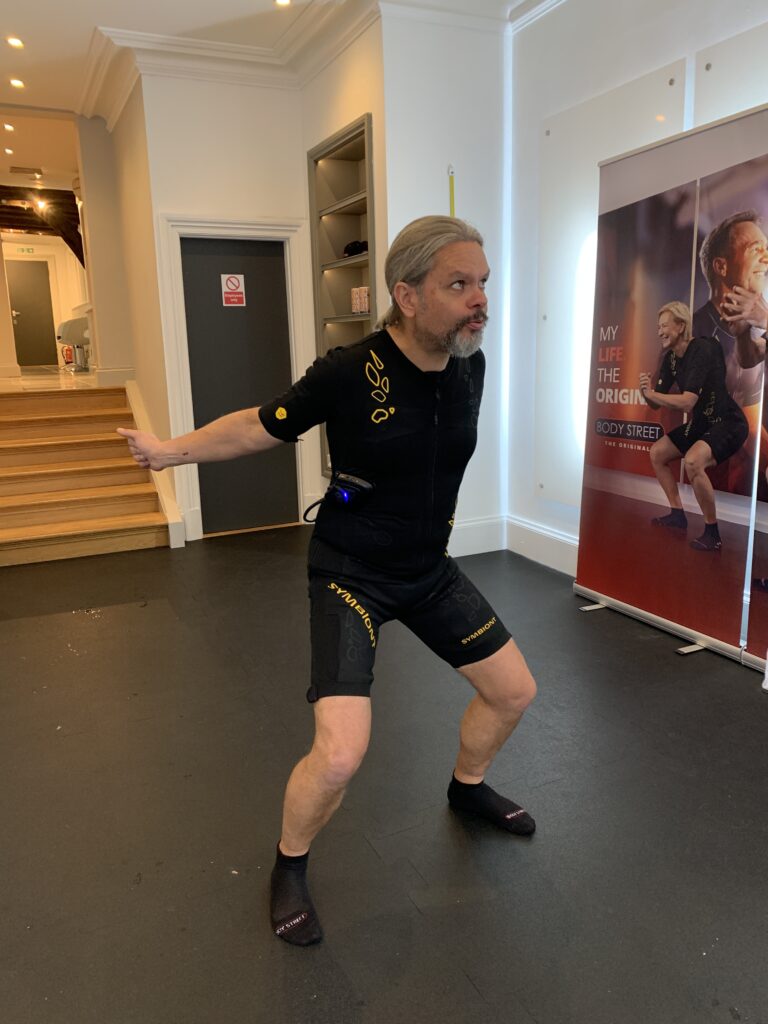
Most of the exercises required getting into a particular position and engaging muscle groups by tensing them in time to ride the electrical wave.
This started off at a fairly low level, but as the regime continued my trainers would adjust the settings to build up the power.
If you’ve ever tried one of those electrical abs stimulators you stick onto your belly then you’ll have an idea of how this feels. It’s like a deep vibration within your muscles which gradually builds in intensity, and you can feel the burn deep inside in the same way that you might after an extreme workout.
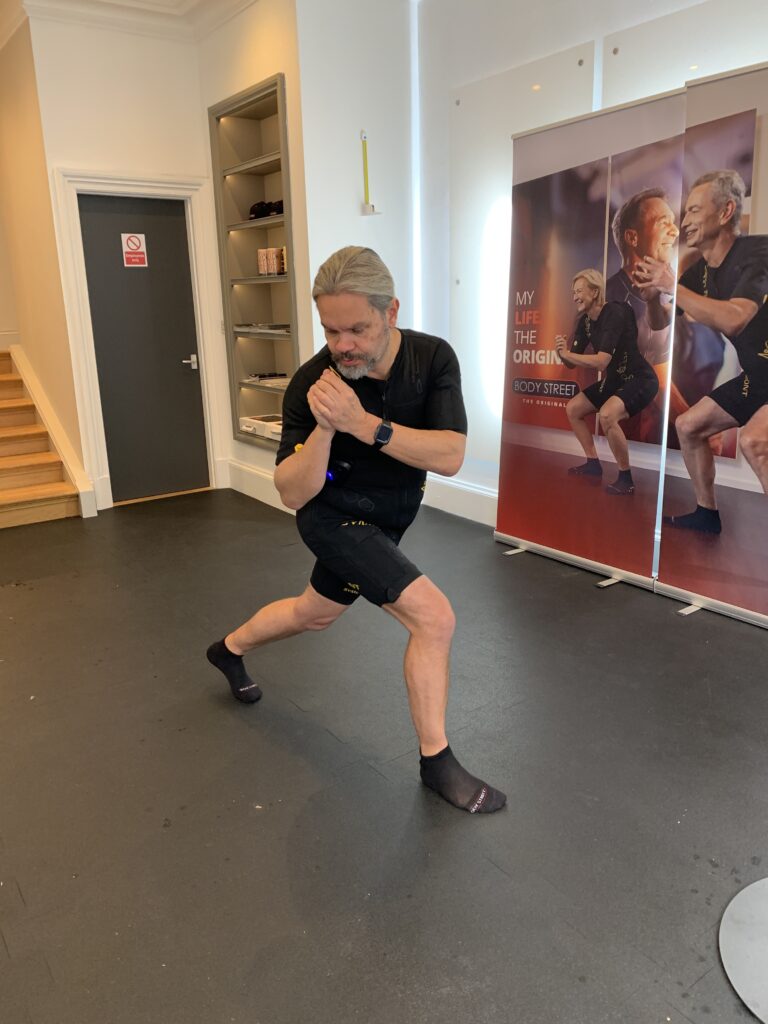
We do some lunges and different combinations of stretches and muscle contractions, with a focus on keeping my core engaged, breathing out as the pulse wave kicks in, and making sure I’m tensing all the relevant parts of my body for each exercise. Was it difficult? Not once I got into the swing of it, and the second week was much easier as I understood what was required from the process.
And the time passed very quickly. So much so that it seems impossible to think that the overall routine is supposed to be the equivalent of a 90 minute conventional workout in the gym.
Although immediately afterwards I was a little bit tingly and sore, the real pain didn’t kick in until a few days later, when it felt as though I’d completed some sort of extreme assault course challenge, so at least I could tell it was working.
What sort of permanent results it produces only time will tell, as this is really just the start of my journey and there’s a long way still to go. In the meantime, I’ll be watching my diet, ensuring I drink at least two to three litres of water daily, and supplementing the process with the odd run and plenty of walking.
You can find out whether Bodystreet has the transformational effects on my physique it claims to produce in the next part of this series in a few weeks’ time, but if you’re interested in finding out more about the process, visit the website at https://www.bodystreet.co.uk/studio/bodystreet-st-albans to book a trial appointment.