16 Dec 2024
WARNING: This article contains images of surgery some readers may find distressing.
“Gentlemen, we have the technology…”
TV’s Six Million Dollar Man might have had cybernetic parts implanted into his body, but today’s surgeons are using robots to assist in carrying out operations with a skill and precision impossible to achieve with the naked eye.
This is not science fiction, it’s cutting edge medicine taking place on our doorstep at St Albans City Hospital.
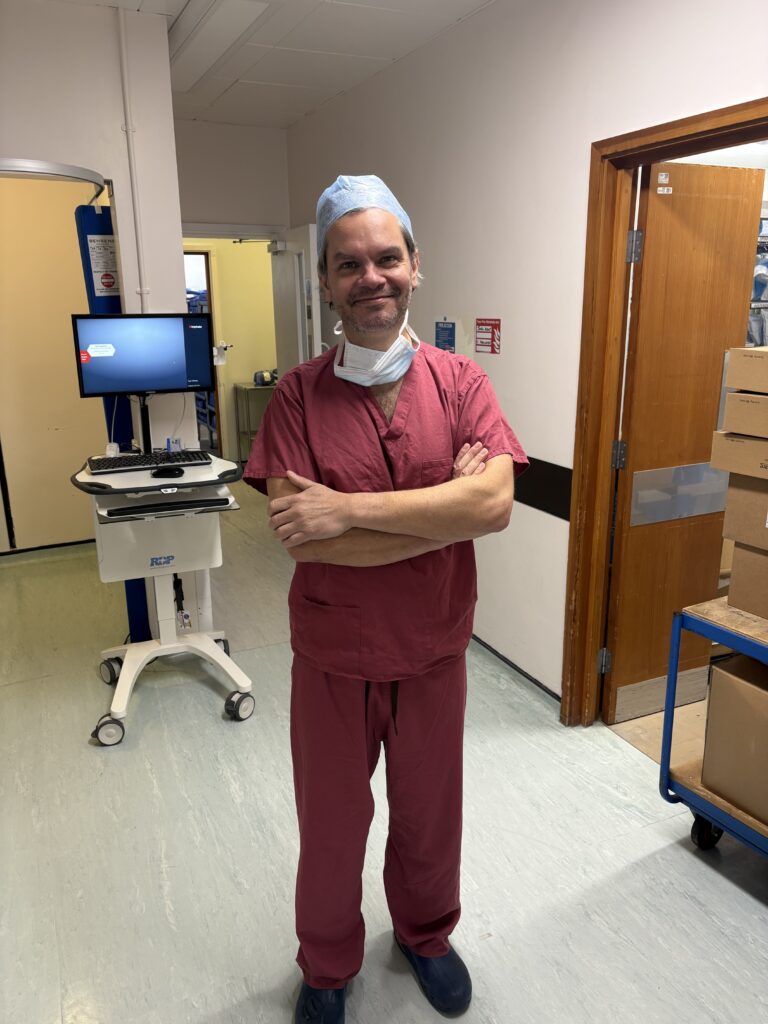
Clad in full scrubs, I am in theatre with orthopaedics consultant Ravi Popat and West Herts Teaching Hospitals NHS Trust director of communications Nick Foley.
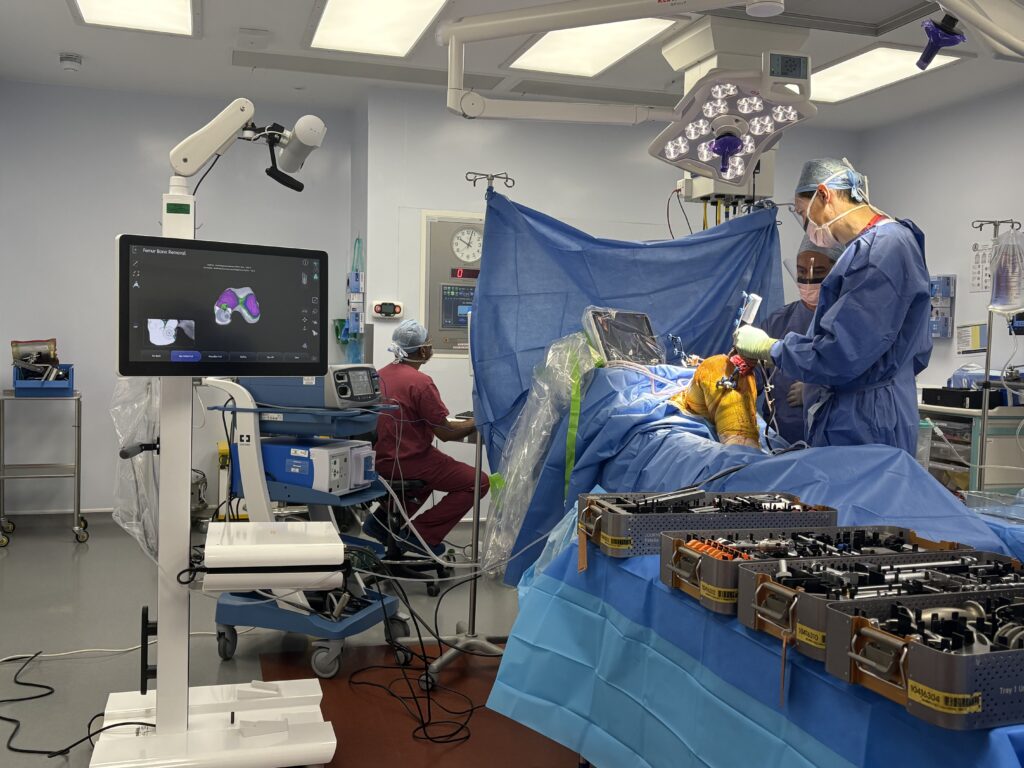
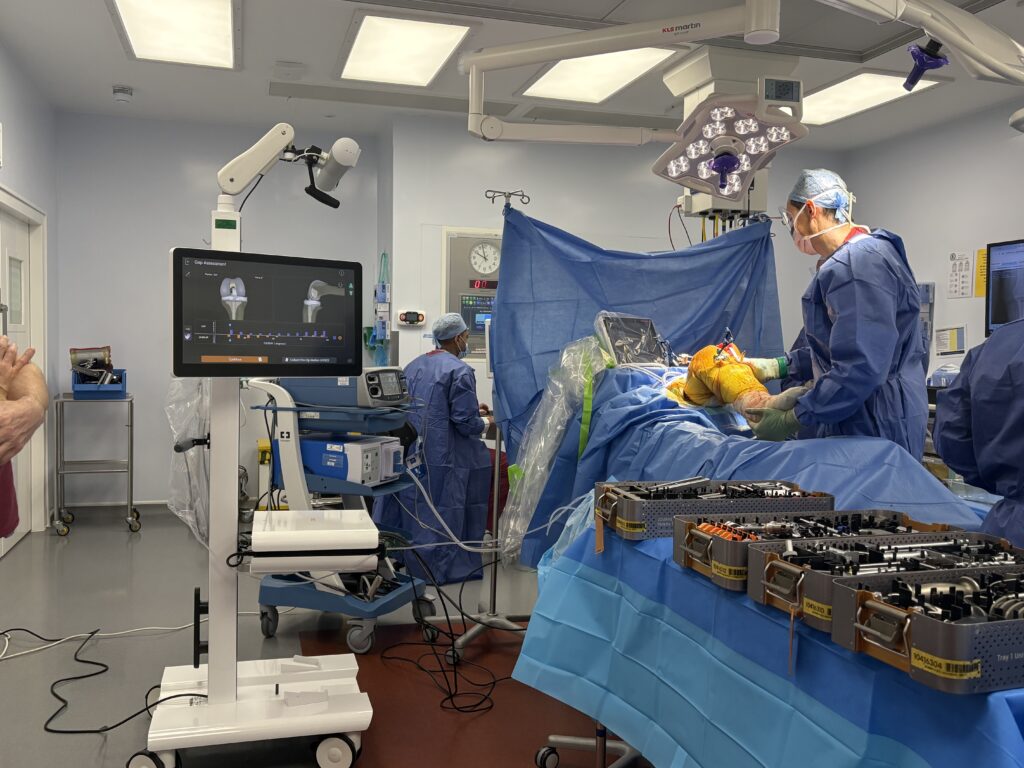
We’re watching surgeon Ben Spiegelberg carry out a robotic-assisted knee replacement using a Smith & Nephew Cori robot, which builds a 3D model of the patient’s anatomy in real time, allowing for precision placement of the component.
But before the operation began, I had time to grab a cup of coffee to talk to Ravi about the process while he caught up on breakfast with a bowl of granola.
He explained: “Doing a knee replacement without a robot generally involves using instruments to put a metal rod down the femur itself, generally to increased blood loss, and in essence using your eye to guide your cuts.
“By using the robot, we’re inputting a lot more data, which helps us to get more accurate cuts, and place the components with greater accuracy. By doing all of that, we expect patients to have a better functioning joint replacement that will result in better outcomes.
“There’s a lot of evidence to show that it results in reduced blood loss, so reduces the risk of infection and means patients can get up and moving more quickly.”
The programme itself started about four months ago, and all the department’s surgeons were trained up quickly, meaning they are already carrying out 20 to 30 operations a month using the robot.
“This Trust in particular has been very open to putting in that initial capital investment in order to provide new technology, which district general hospitals don’t have a great track record of doing.”
The benefits of having robotic joint replacement surgery far outweigh traditional procedures, he told me: “The alignment is supposed to be better. It also enables more surgeons to use partial knee replacements, which I’m very passionate about as it’s a quicker operation and patients get up and out of the hospital more quickly, potentially the same day.”
The average length of stay for a traditional knee replacement is about two to three days, so this procedure also frees up bed space for patients who might need it.
But before any prospective patients start worrying about the robots taking over (Hello Skynet!) and carrying out operations on their own, Ravi doesn’t think he’ll be out of a job for at least the next decade or two: “I think we very much need a surgeon present to determine the final plan. We still have overall control and we make the cuts.
“I’ve never had a scenario where the robot has failed mid-operation or anything along those lines, but a surgeon will be in a position to step in with their previous instruments if that is necessary.
“The robot is really just a tool to augment our performance of the operation, with the components of the knee replacement put in better than we would have otherwise.”
The operation tends to be performed under a spinal anaesthetic, which is much better for the patient’s pain control, and means they don’t experience the nausea and dizziness which comes with a general anaesthetic.
“The great thing about spinal is that the sensory part lasts the longest and the motor block wears off the quickest, so they’re actually able to get their knee bending pretty quickly without any pain because the motor supply is working before the pain starts to settle in.
“It also means we give them less medication, so it’s really cutting edge stuff, right at the forefront of where the NHS should be going.”
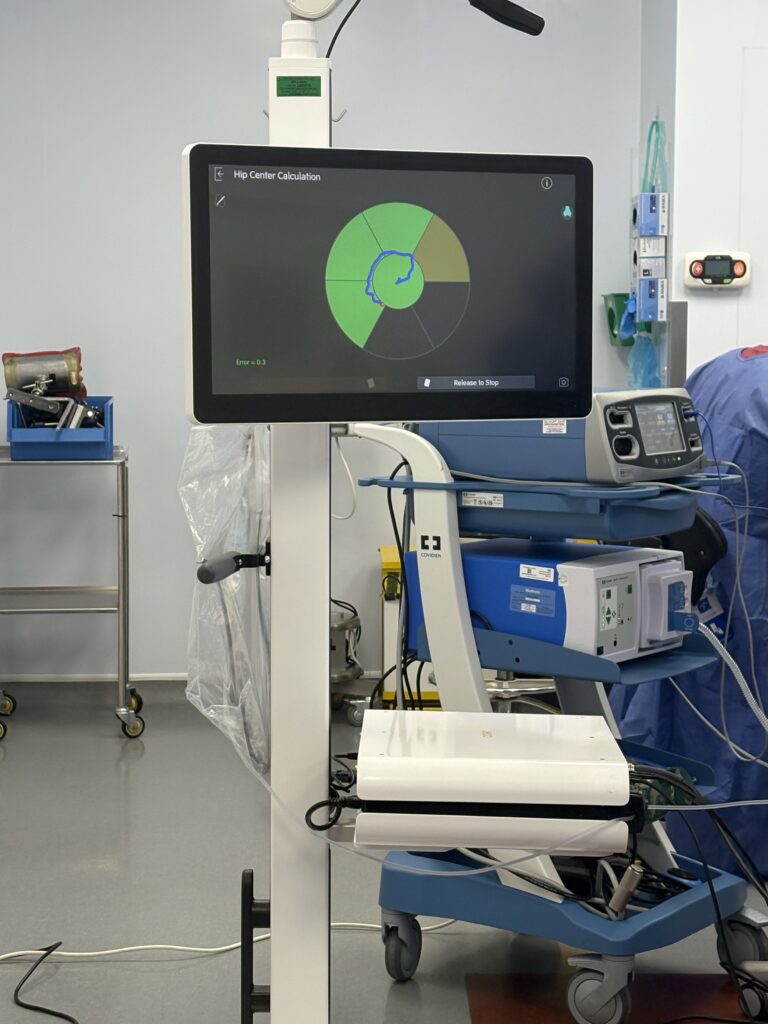
The robotic part of the procedure involves implanting anatomical markers into the patient’s leg to provide data about how and where the knee moves, if the soft tissues are tight, and any other specific details so the surgeon can place the knee replacement into a position specific for a patient.
Robotic handheld technology then does all the work in terms of making the bone cuts so the replacement is bespoke for that patient and the amount of trauma to the knee is greatly reduced.
“It’s all about alignment now, and robotics helps us to determine that in more detail. Previously you’re in a position where you’re eyeballing it, whereas we’re talking adjustments of a fraction of a degree with the robot, which is just so much more accurate.”
As well as using a really advanced robotics programme, the team are also able to use cutting-edge components – for example the femur is made from oxidised zirconium and the tibial component from a cobalt-chrome alloy – which are designed to mimic the native anatomy and how the knee normally moves, and also last much longer than traditional implants.
Having been briefed on the principles behind the programme, it’s off to theatre, with masks on to prevent any infection – one of the main risks when carrying out knee replacements.
“If you start feeling a bit painful or nauseous or anything like that, just let us know and let us know quickly so we can take care of you,” Ravi tells me, by which I imagine he means whisk me out of the room before I start to hurl.
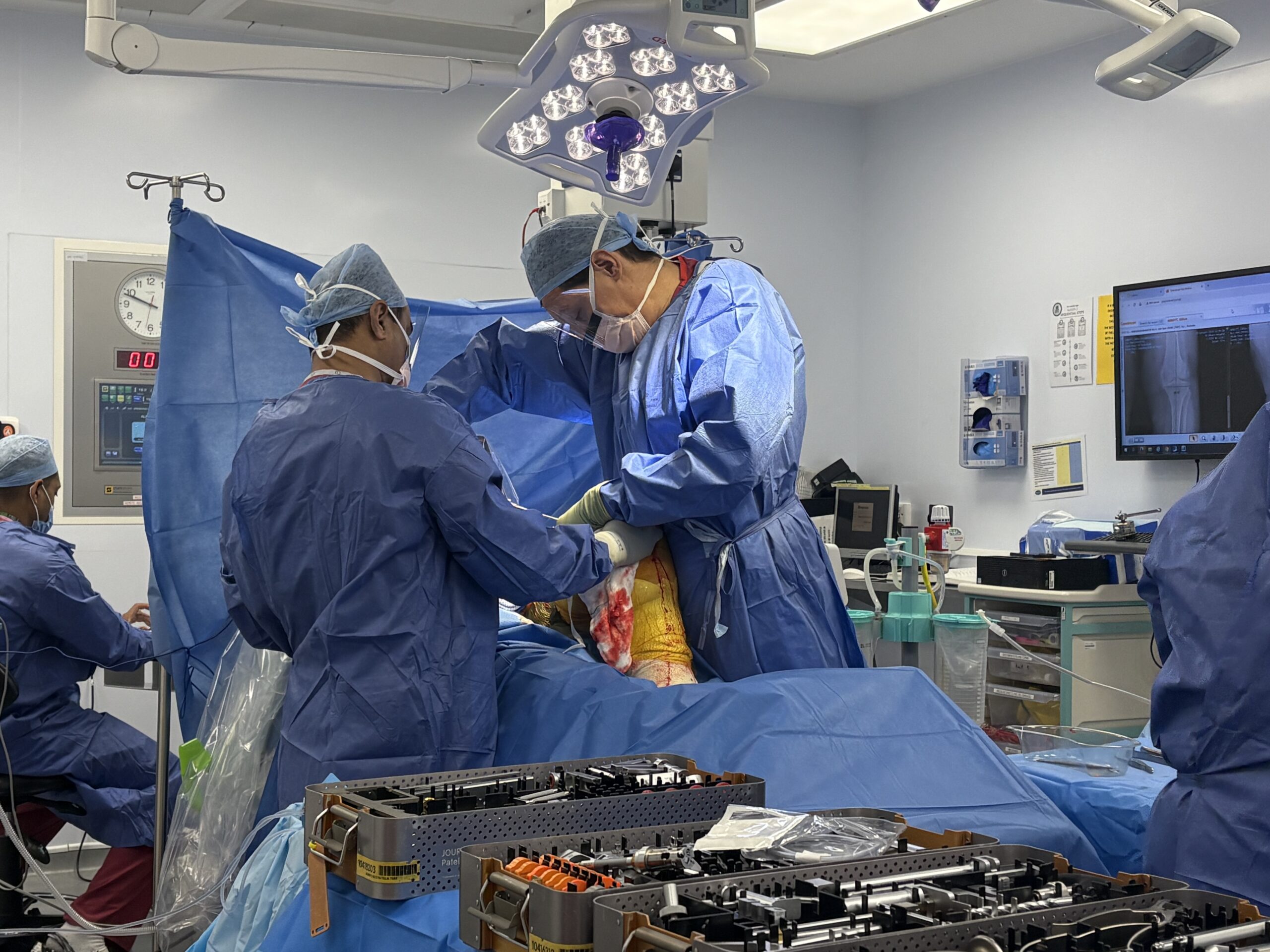
Whether it’s from years of watching TV medical dramas or just a particularly strong stomach, but none of what I watch actually makes me feel queasy, even when Ben slices open the patient’s knee and starts removing some of the soft tissue around it.
In fact, there’s something quite remarkable about being able to look inside a living being in this way, peering behind the curtain of creation to understand more about the complicated anatomy which allows our bodies to function.
It didn’t induce any sort of religious epiphany mind you, just an appreciation for what an incredible machine the human corpus actually is, and just how skilled the surgeons are who act as the metaphorical mechanics under the bonnet.
Meanwhile, because of the spinal anaesthetic used, the patient is awake and breathing on her own, but has been given a slight sedation to make her comfortable and take away any anxiety. She gave her full consent for us to witness this operation beforehand, for which we are very grateful.
And if you’re wondering why her leg looks orange in the photos, it’s because it has been coated in a special solution designed to reduce any infection, not because she’s had a particularly unfortunate spray tan.
Ravi explains: “It doesn’t hurt, but you can feel the pressure. This is a pretty worn-out knee as you’d expect.”
The markers are attached to her leg, and while the robots pick up the relevant data about how it moves, Ravi shares a story about the first operation he carried out completely on his own.
“I was about three or four years out of medical school and I was fixing a person’s hip. I was clearly really, really nervous, but it was going absolutely brilliantly.
“Then about half-way through the operation, I realised that my trousers were falling down, and so as time went on I was standing with my legs getting wider and wider to keep them on. At that point I thought it was best that I tell everybody what was going on!”
After that amusing Carry On-style interlude (“Ooh Matron!”) we return to the procedure at hand…
Ravi continues: “A big part of this robot is how it helps us plan the operation, so what Ben’s doing now is straining the knee, applying force to really stress the soft tissues, which shows that the knee is unbalanced in its current form, whereas you want both flexion and extension to be equal.”
Once the knee replacement has been modelled, the handheld device is used to remove parts of the bone in order to fit, perhaps the most technical part of the operation, which also involves making holes for the component to fit.
The robot allows for an accuracy of within half a millimetre and a tenth to a fifth of a degree, whereas without it the surgeon could be off by whole millimetres or degrees.
“The robot has now done the majority of its work. So Ben is now going to prepare the bone surfaces to receive the components.
“Then the last bit that we’ll use the robot to do is to just make sure that we got the outcome that we wanted. As with anything where the stakes are high, you’re planning, checking, doing. There are lots of checks and balances in place to make sure we get this right the very first time.”
The whole process was over and done within an hour, and we exit the theatre while Ben is finishing off, with the robot now free to be wheeled into another theatre if needed, allowing for more operations to be carried out on a daily basis.
Following the operation, the patient will undergo physiotherapy elsewhere in the hospital, but should be ready to return home in the evening, which is quite remarkable when you consider what we have witnessed.
“We want this to be the normal way of doing a knee replacement and for us to become a centre of excellence for it,” Ravi adds.
The future of surgery might not be anything like I imagined it (Rather like car robots carrying out automated surgery on a production line of patients!) but that doesn’t make it any less exciting when it comes to medical care, and it’s fantastic that St Albans is at the forefront of this revolution.
I left the theatre feeling truly privileged to have witnessed this procedure taking place, and with a newfound respect for everybody involved in carrying out operations of this nature.
This is Trust money being spent on technology which really does make things better for the patients and that’s certainly the sort of investment that should be encouraged.