


24 Jan 2025
From exploring hydrothermal vents in the depths of the ocean to running an acclaimed independent school in St Albans is not your typical career path, but then Amber Waite is far from your typical headteacher.
Traces of her natural Texan accent can still be heard when she speaks, her office is decorated with pictures from favourite films like ‘Withnail & I’ and a suffragette’s outfit from a past school production, and she is a beaming explosion of colours and warmth when I arrive on a chilly Friday morning.
In short, she is fathoms away from any preconceptions of a cold and aloof private school head, with an encouraging openness in response to my questions and obvious passion which drives her work.
Amber’s proper title is actually principal of the recently formed St Albans Education Group, established last September by merging St Albans High School for Girls – both senior and prep – with Stormont School in Potters Bar to form a new foundation.
One term in, and she feels things are progressing well with the new structure.
“I think in general there is a real trend towards independent schools coming together to build a stronger place. It means you’re less vulnerable to very sudden shifts in the landscape, which we’ve seen with the new Government coming in.
“Luckily we were already thinking that way and coming from a position of strength gave us the ability to set up a foundation rather than joining one.”
She stressed that the foundation was not on a landgrab mission or putting out a message for any old school to join them.
“We’ve been approached by around 13 schools since last Christmas, and the vast majority just aren’t suitable. It’s really important to us that all the schools share core values around real ambition.
“It doesn’t mean all of our schools need to be academically selective, like we are, but they do have to have real academic ambition for their children, which means they have to have an exciting curriculum that we believe in.
“It is my firm belief – and it’s quite controversial – but I do think there are plenty of prep schools out there who get away with offering quite a boring and very old-fashioned model of education because they have well-behaved children who go on to good senior schools, so there’s no real scrutiny.
“So, it’s important that any prep schools that join us are not joining us from the 1950s, and with any senior schools we have to make sure that we both complement each other, but also have that same core value so that it doesn’t feel like a clash of cultures.”
Although STAHS has a very close relationship with many other very strong prep schools, it was the girls’ school connection with Stormont which made the partnership so attractive.
“We’re keen to protect girls’ prep schools, which are the most vulnerable schools in the country, because I think it’s really important that parents have a choice and that option remains open. We also routinely get 50 per cent of their Year Six students, so we knew that for families it would feel like a really natural fit and it was.
“Every family that got in touch about the merger conveyed expressions or real happiness and pleasure rather than any concerns, which I think means we made a good decision.”

So, what is it that you can do as a group that was either impossible or very difficult to achieve as separate schools?
“It goes back to this idea of excellence in prep school education. I don’t come from an education background, it’s my third career. I trained later as a teacher and I don’t come from the world of independent schools, so, this is completely foreign territory for me.
“But my personal belief is that you need to have top quality education from the time you start and all the way up, There’s no point in waiting until you’re 11 or 12 to suddenly turn on the academic rigor, but I don’t believe all prep schools follow that model, and I started to look at why that was.
“Why is it difficult for prep schools to jump into the 21st century and to be ambitious and creative and bold in the curriculum that they offer? As I started to do this research, one of the things that jumped out at me was isolation.
“Prep schools exist in a competitive marketplace in the independent centre, and their heads are operating in these little bubbles. They don’t have an extensive network of colleagues in the sector, because they are their main competitors. There’s also a little bit of arrogance in independent education that if you’re an independent school then you’re providing the best education, so there’s an element of sitting on one’s laurels.
“There’s also a bit of pandering to either a perceived or real desire from parents to send their parents into this imaginary world of perfect prep school life where they have little straw boaters and skip off happily to learn Latin.”
This led her to realise that a group incorporating a number of prep schools would create a natural and engaging professional network, and provide a much clearer idea of the journey their children are on.
“In many ways if you know where they go, it’s easier to plan backwards to make sure they get there in the best possible way, and float ideas without giving away any state secrets.”
This also extends to having a good relationship with the state sector, with STAHS enjoying a close link with their immediate neighbours Maple Primary School, as well as other local establishments.
“It’s about not accepting the arrogance of not looking at what state schools are doing because they’re not doing as well, because it’s just not true.
“As an independent school we are absolutely dependent on maintaining pupil numbers, and it would be crazy not to look around at what excellence looks like and make sure you are meeting or beating that.
“Why would parents pay for outcomes that look similar to what you’d get at St George’s, Dame Alice Owen’s or wherever? We have to make sure our offer is really compelling.”
There are very few schools in Herts or London that can compare with their results, pupil-for-pupil, but outside of the classroom, one of STAHS’ biggest selling points is the fact they are also national champions in a number of sports.

Before coming to St Albans, Amber worked in south London at St Dunstan’s College, and before that she was in Oxford at Abingdon School, both very different schools and environments.
But it is her background as a research scientist which really establishes her as a very different sort of leader, with lived experience that sets her apart from her education peers.
“My specialist area was making equipment used to monitor the geochemical environment of hydrothermal vents in the deep ocean.
“I did a lot of work in the South Pacific, because there’s a lot of tectonic activity there, a little bit in the North Atlantic, a little bit by the Galapagos Islands, and quite a lot of primary research in the Gulf of Mexico.”
She eventually left oceanography for a string of reasons, not least of which was having to spend so much time at sea away from family and home.
“The nature of funding for research science means that my work was at the mercy of obtaining appropriate grants, and job security is only as good as your current and next grant, and deep-sea oceanography is eye-wateringly expensive to carry out, with the cost of running research ships and submersible vehicles.
“But as much as I loved the actual science – solving problems, building equipment, collecting and analysing data – I didn’t love writing papers, or the long hours in the lab with only samples and computers for company.
“I enjoyed my job the most when I was teaching undergraduate chemistry alongside my research, and that sort of convinced me to look at teaching as a potential career change.”
She explained how did her other experiences in this field also translated to running a school: “I don’t think there are many school leaders who have worked in a really fast-paced environment where your have to make quick decisions where the wrong decision can literally cost a million dollars.
“Each time an unmanned submersible goes over the edge of a ship will cost you $1 million, so if you don’t get really good data at the bottom of it, you’ve got some explaining to do.
“I think having that agility and that fleetness of foot, and the realisation that there are probably a lot of institutions out there who are just as good, if not better than you, with the idea of having to compete, I think it really does set us apart.”
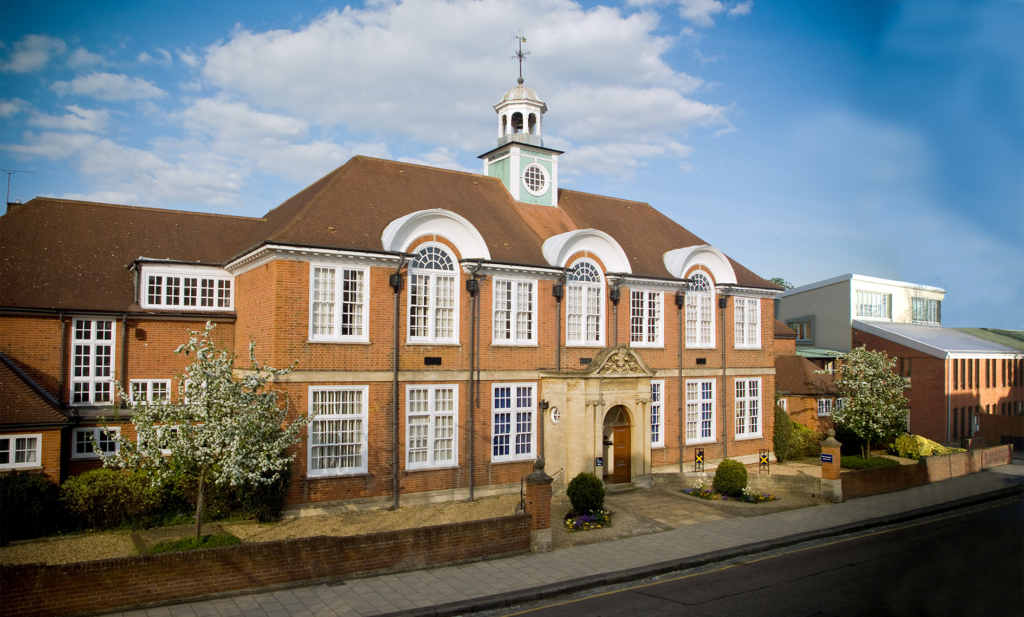
Walking around STAHS doesn’t have the feel of a traditional 1950s girls’ school, let alone your average independent, with not a straw boater in sight.
Amber agrees: “The girls have fun, we really value fun, and I think the parents who choose us buy into the idea that we want our girls to be shown what the real world looks like.
“We’re always reviewing our curriculum. I brought in environmental science, which a lot of independent schools put their nose up at, because it’s not one of the traditional subjects.
“But the high number of our top students who are taking environmental science just goes to show that it’s really important to them. It’s massive. The climate fear that our children live with is huge, and we often do not acknowledge that.
“I’ve got girls who take it alongside art and DT, because they want to go into sustainable architecture, others who do it alongside geography and science because they realise the Earth is a scientific system, and others who have no interest in science whatsoever but want to be informed about the world they’re growing into.”
Somewhat surprisingly, one of the first things Amber did when she arrived at STAHS was to create a new brand identity.
“What I found was that the girls and their parents didn’t match the school. I felt that the school hadn’t cottoned on to the fact that we are a self-selecting community here, and they were actively choosing this school over others because of the fit and feel of this place.
“And yet all of our marketing, the way our teachers had been trained and nurtured, the former leadership team, all of that was presenting us as a school like [other independents] St Paul’s, Channing or City of London School for Girls, whereas it’s not that kind of school.
“If those schools attract you, you would be horrified by our uniform alone, which is a mess because that’s not the most important thing here.
“So after about a year of looking around, talking to the girls and parents and realising how they refreshing they found us and the straightforward nature of things and how down to earth we were, I realised we had to square the circle and make the school reflect the people in it.”
Although Amber is herself Jewish, STAHS is a Christian foundation school with close links to both the Cathedral and the neighbouring church of St Peter’s.
“Our churches are great, they’re just great community places, and I think young people often don’t realise they serve much more than a religious purpose.
“We’ve got a great relationship with St Peter’s and do a lot of teaching and learning in the church with their kind, kind permission. We also do a lot of concerts and hold assemblies over there.
“It’s great to have a church next door that is so happy to have us there, you know, and using the entirety of their facility in that way.
“We’ve also got a great relationship with the Cathedral, and the Dean is one of our governors. I regularly pop down there to meet with her about the spiritual and moral development of the kids, and she really supports our chaplain, so that’s a really strong link.”
The school also works closely with local charities, with Herts Young Homeless chosen as their current beneficiary by the girls themselves.
“I think they like HYH because these are children their age, and everytime we get a speaker in they tell anecdotes about young people who come from families that aren’t that dissimilar to their own.
“I think the children here can really see how close any of us really is to homelessness or poverty, particularly when they talk about the prevalence of young LGBT people finding themselves homeless, that really hits home.”
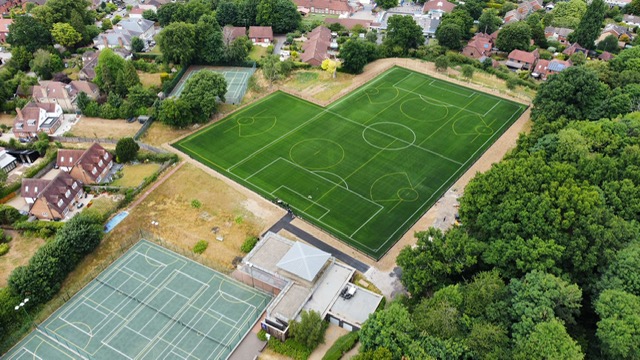
One of the conditions Amber imposed on the school’s governors when accepting the post was that she could introduce football, getting away from the snobbery often found in independent schools about the most popular sport in the world.
“I actually went to university on a soccer scholarship, so I’m a massive football fan. Since we introduced it not only are we now national champions, but it’s the most popular sport at the school.
“Everyone plays football, it’s easy, and they love it. This year we are having our first festival of football, which is for children aged nine and ten from the wider St Albans community, with a particular emphasis on girls, because nationally, the average age for a girl to completely drop out of physical activity in school is 12, and we want to help buck that trend.”
She’s also introduced a new debating shield to raise the importance of oracy in young people: “We know the reason that women tend to be five years behind their male counterparts when it comes to promotion is because they won’t put themselves forward, so we’re working on that.”

But perhaps the most exciting innovation she has introduced is to annually commission different playwrights to pen female-centric productions on behalf of their theatre group.
This year it is the turn of professor of theatre Dr Paul Pfeiffer, former chair of the Theatre and Dance Department at Salisbury University in Maryland, who Amber has known for around 30 years.
“His specialism is 17th century English history and the plays of that time, and he’s writing a ghost story for us which is set in St Peter’s and will actually be performed there.
“He’s done a lot of research around the history of Hertfordshire in the 16th and 17th centuries, and how far the witch craze made it here. It’s a fantastically fun script, it’s really a little bit over the top in terms of its magic and fantasy, but the girls love it.”
So how did the school come to take the unusual step of actually commissioning its own plays?
“Well we’ve always had really strong drama at the school, but you can only put on so many massive productions a year and for them to be good and meaningful.
“So this idea came about from the girls and our fantastic drama department to create a theatre company which would allow them to really get into theatre and to think about taking plays travelling, whether it’s to Fringe or a lot of drama competitions around the company.
“They wanted to have a troupe to do that, but also to have a female-heavy repertoire. We’ve never had any problem playing men, but there is that whole disparity in the whole world of theatre, and particularly in film and television, of disparity between men and women. It’s also the gender of the writers, the gaze of the writing, because even with quite feminist plays, they’re often written by men and they often still contain a real male gaze.”
STAHS subsequently became one of the founding schools behind the Write the Girl project, helping train women playwrights to actually write for girls, and commissioned plays to be performed at the school.
These included Rebellious Women, about the suffragette movement (which explained the costume in Amber’s office), and Milady, a true story of female spies in the 17th century. But despite these successes, the school wanted to expand their horizons beyond Write the Girl and look at other playwrights.
“Whilst female heavy casts are still important to us, we didn’t want to be limited in any way.
“So Dr Pfeiffer was our first male commissioned playwright, but he’s got 50 years of experience in writing and is really excited as he’s never written for a 100 per cent female cast.
“The girls themselves give a lot of feedback on what they like, what they think they would say and act, so it’s really interactive. A few years ago we had a play which wasn’t a good fit between the playwright and the cast, and they were quite righteous in their indignation and brave to say ‘this isn’t working’, so we had to do another commission quite quickly.”
One of the biggest challenges facing the independent schools sector is the new Labour Government’s introduction of VAT on school fees, something which Amber has been open with parents about from the start.
“We don’t sugarcoat things. Our parents are smart, so you can’t fool them and there’s no reason to try.
“We took a really hard look at things when it came to VAT. We talked to our parents and said, look, we have to pay 20 per cent on all your fees, the Government is going to bill us so we don’t have a choice.
“We can either pass on all of it or most of it to you and continue to offer everything that you expect from us. Or we can pass on less of it and cut our provision, or we can pass on less of it and destroy our reserves.
“We’re in a really fortunate area, and most of our parents put the education of their children at the top of the values, so accepted the best option was to pass on most of it.
“We have had lot of parents who’ve done some remarkable things to keep their children in independent education, but it’s been really tough.
“For me personally, I hate it because all it is doing is making this school inevitably more elitist, and that’s something we’ve really been trying to move away from. It’s an elite school but not an elitist school.
“I found it deeply frustrating trying to talk to government officials, they just are not interested. It’s so ideological for them that we’re now at a point where they can’t even see beyond that.
“Interestingly, I have had off-the-record conversations with politicians, backbenchers in particular, who actually don’t stand by the policy, and I think that Rachel Reeve’s chancellorship is in real crisis at the moment.”
The issue of fees aside, and to wrap things up, what would she say to any parent considering whether to send their daughter to St Albans High School for Girls?
“Come and have a look at us. If you think you know what a girls’ school looks like, come and look at us, and think again.
“If you think you know what British independent education looks like, come and have a look, because people always come away surprised.”
