


18 Oct 2025
To mark Baby Loss Awareness Week and highlight the devastating impact of losing an infant, one St Albans mum has bravely shared her heartbreaking story.
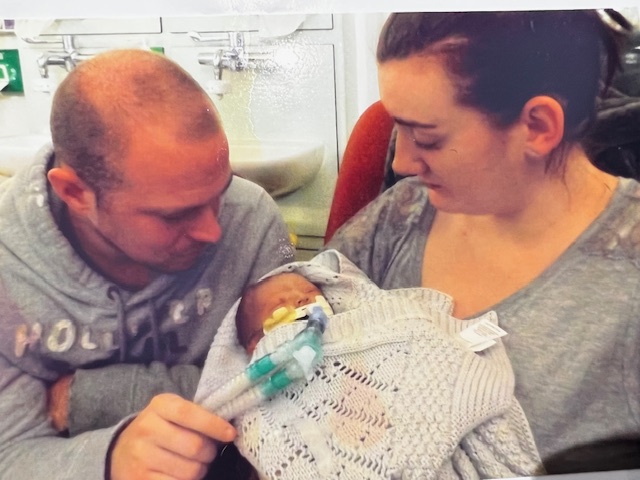
When Lynsey White gave birth to her first child in November 2014 – a son, Frankie – it was a time filled with much excitement and joy, yet less than 24 hours later, Frankie was on a life support machine fighting for his life.
Lynsey explains why she wants to tell Frankie’s story: “This is the way I can be a mother to him now.”
Many people who lose a loved one say talking about them is a way of keeping them alive, and that is true no matter their age.
“At the time we had absolutely no idea why he was so poorly and what had caused such a deterioration in his health,” she tells me.
“Over the next three days we had to watch our newborn son suffer seizures, be pumped full of drugs and at one point he was given CPR right before our eyes.
“After being given the best possible care, and chance of life unfortunately Frankie didn’t get any better. Although we remained hopeful, with the guidance of many doctors my husband and I had to make the heart-breaking decision to remove life support – a decision no parent should ever have to make.”
They were told that their healthy baby had died from a combination of multiple organ failure and septicaemia caused by the Group B Strep infection.
“It was literally unbelievable – we just could not comprehend what had happened. We had never heard of the infection let alone the devastating consequences of developing it.
“Following the inquest into Frankie’s death we learnt that my temperature was high in labour and I had a slow leak of waters. Frankie had low blood sugar which was an early indicator that something was wrong.
“Also, his skin was mottled and blotchy and it was noted that he was crying a lot, even for a baby.
“There was another baby in special care at the same time who was prioritised as they believed him to be more unwell, and I feel that no-one connected the dots, and by not doing this, he became so poorly there was no way back.”
An inquest ruled that Frankie died of multiple organ failure due to an infection – GBS septicaemia – and the coroner said there had been five failures in his care which could have resulted in a different outcome.
“If he had been given antibiotics only six hours earlier he would still be here today. This was extremely hard for us as a family to deal with. To find out his death was entirely preventable was absolutely devastating. Learning more about GBS and realising a simple test would have meant I could have been treated was astonishing. Why did nobody tell me?
“I had been to every appointment, had every test that was on offer – why was this not one of them? If I have been told and given the information that I could have paid £40 for a private test that would have saved my baby’s life – would I have done it? Without question!”
According to Group B Strep Support charity, the UK does not routinely test pregnant women for GBS, unlike most high-income countries, including the United States, Canada, Germany, France, and Spain.
The impact of Frankie’s death has been felt far and wide.
“Our parents have struggled, not only did they lose a grandson they have had to watch their children suffer. We have had to explain to nieces and nephews why their cousin didn’t come home.
“My husband and I have suffered with PTSD. Our lives have changed beyond recognition.
“We also vowed for Frankie’s death not to be in vain and have spent a lot of time over the past years sharing his story, educating others on GBS and fundraising for the fabulous charity that is Group B Strep Support.
“We are now navigating through a very different journey of parenthood.
“My husband Craig and I have been fortunate enough to have three healthy daughters, but going through each of their pregnancies and births was extremely difficult.
“We were full of fear, full of anxieties and at times full of anger that Frankie was no longer with us. I was GBS positive with all of my girls, but this was treated in labour and the girls were given antibiotics – some may say that this was unnecessary – for us it was a necessity to ensure neither of them suffered the way their brother did.
“Going into pregnancy again after the loss of a child is absolutely terrifying and full of mixed emotions – you want a child, a child to mother and hold, but you don’t want to replace the child that you lost. You are full of guilt, the guilt for the child that you lost and the new
baby who you don’t want to feel like second best. Questions continually run through your head – what if it happens again? Am I selfish for potentially putting another baby through this?”
Lynsey said she believes that a huge amount of support is needed for parents who go through baby loss, describing it as “a very isolating place” to be: “I had people not make eye contact with me, or even cross the road when they saw me. I understand they didn’t know what to say, but it is incredibly difficult to navigate your loss whilst feeling so misunderstood.
“The charity Saying Goodbye has been a voice for all parents experiencing baby loss and their posts on social media have made me feel so validated at times.
“I feel I was lucky to receive the support I needed from family, friends and different charities however also know that others aren’t so lucky. Baby loss is still a huge taboo subject, but Saying Goodbye is not only giving parents the opportunity to find their voices but also breaking down the taboo of the subject, and one of the only ways to do that is to talk about it.”
Devastatingly, thousands of parents and families are experiencing the heartbreak of pregnancy and baby loss every year in the UK. According to baby loss charity Sands, 13 babies die shortly before, during or soon after birth every day in the UK. At least one in six pregnancies end in miscarriage. Nine babies die unexpectedly in England and Wales every week.
In a recent survey of 1,300 people Saying Goodbye found that 79 per cent believe had better resources been available at the time of their loss then it would have helped them process their grief.
They also found that 66 per cent of people were offered no support from a medical professional.
Baby Loss Awareness Week is an opportunity for those affected by pregnancy and baby loss and their families and friends to unite with others “It is heartbreaking but talking about Frankie also fills me with joy! He was a person who showed strength and deserves to be talked about and celebrated. I truly believe that every baby deserves to be shared with the world.”
across the world to commemorate their babies’ lives and lost pregnancies.
The week helps raise awareness of how pregnancy and baby loss affects people. It is an opportunity to help people commemorate their babies, whether it be in public or private, and feel less isolated and alone by giving them the opportunity to join with others.
Chief executive of Sands and chair of the Baby Loss Awareness Alliance, Clea Harmer said: “Baby Loss Awareness Week helps to unite the pregnancy and baby loss community; we come together and speak out across the week to increase understanding of the impact of loss and remember all our much-missed babies gone too soon.
“It also plays a crucial role in raising awareness of the importance of ongoing bereavement support and the essential work required to improve pregnancy outcomes and save babies’ lives.”
Their Pregnancy Loss Review put forward 73 recommendations to overhaul the clinical care and support of anyone affected by baby loss.
Saying Goodbye provides a wide range of resources that are used across the NHS, online support and daily social media messaging and support, information and videos, befrienders and the Saying Goodbye services of remembrance such as the one at St Albans Cathedral which Lynsey attended this week.
Lynsey said that alongside there needing to be more training for health professionals, the key message here is to remember that a parent doesn’t ‘just’ lose a baby: “You lose the one, five and 10-year-old that they would have become. You lose the Christmas mornings, the first steps, the first school picture, the university drop-off. You lose everything! Ignoring their existence because it might seem uncomfortable to talk about just isn’t fair or just to anyone.”
Find out more about Sands and Baby Loss Awareness Week at https://www.sands.org.uk/
