



02 Feb 2026
Community campaign group Keep Chiswell Green has lodged a High Court claim challenging SADC’s decision to grant planning permission for 191 homes in the village.
The development is part of a site on land south-west of Chiswell Green Lane which already has outline planning permission for up to 391 homes, a primary school, and associated features.
Councillors on SADC’s development management committee approved Taylor Wimpey’s reserved matters application for the site in November, which confirmed the details of appearance, landscaping, layout and scale for the project.
They were acting on advice from planning officers despite overwhelming opposition from residents, parish and district councillors.
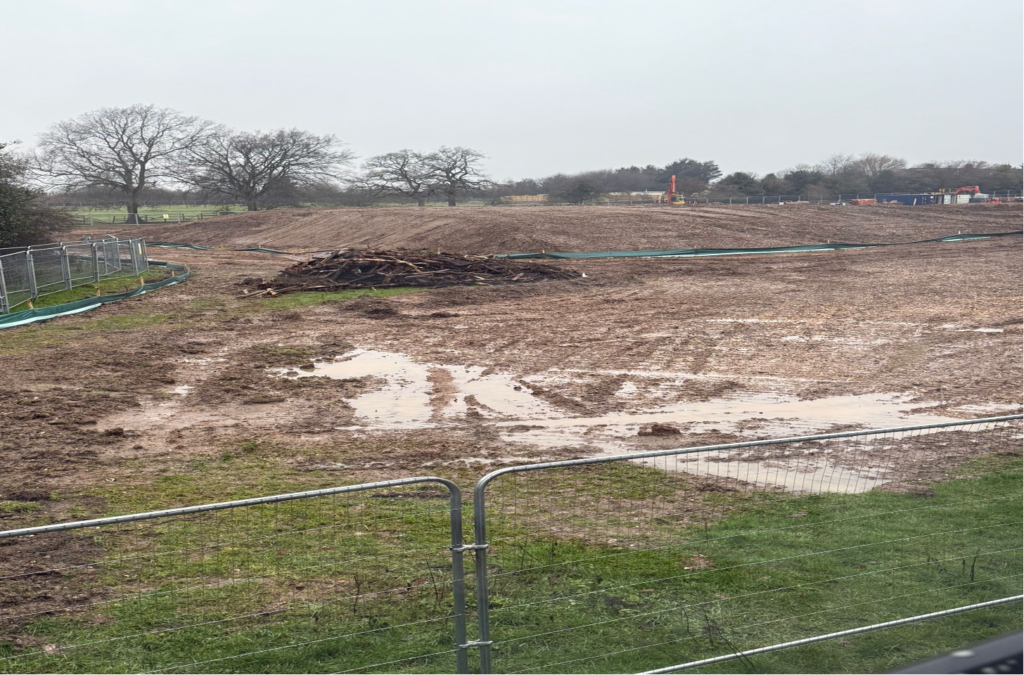
Taylor Wimpey has already begun work at the site, including clearing trees which were it is believed were supposed to have been staying.
With the financial backing of local residents, KCG took advice from barrister Harriet Townsend KC and specialist planning solicitors Leigh Day, who advised that the officer recommendation and the decision itself were legally flawed.
But despite offering to meet with SADC to resolve the situation without having to go to court, the council refused, and the High Court claim was formally served on December 29.
Taylor Wimpey subsequently submitted a response which asked for a ‘rolled-up’ hearing, which would avoid waiting for other objections and the judge looking at all the submissions, but going straight to a hearing. SADC has yet to respond.
The KCG case rests on two separate points. Their first grounds for challenging the decision is that they believe the committee was misled by officers that the proposal was a ‘high quality’ development and complied with all of the relevant planning policies.
However, the officers’ own report on the proposal identified several areas where the scheme caused harm, particularly to existing homes along the eastern boundary of the site; the new houses are proposed to be built much closer to existing properties than policy normally allows, and the loss of privacy, daylight and sunlight, and general amenity will be exacerbated by the position of the new properties on higher ground than the existing houses and by the removal of the current trees and bushes along the boundary.
Conflicts with planning policy in areas such as what types of houses were to be built and how much parking was to be provided were acknowledged within the report itself but were not reflected in the stated ‘reason for approval’ or clearly explained to councillors during the meeting.
As a result, KCG say councillors were left with a misleading impression that there were no serious design problems capable of justifying refusal or change.
The second point is that KCG argue councillors were given legally incorrect advice that they had no power to impose conditions to protect neighbouring residents.
During the committee meeting, councillors repeatedly asked whether conditions could be imposed to reduce the impact of development on neighbouring residents – for example by increasing separation distances, improving boundary treatment, or requiring further assessment of impacts such as daylight or flooding.
Officers advised councillors that they had no power to impose such conditions because doing so would require changes to the layout of the development and the road network.
KCG says that advice was wrong in law – planning authorities routinely impose conditions at the reserved matters stage to require modest design changes, improved landscaping, or additional safeguards for neighbours.
By being told they had no such powers, KCG argue that councillors were wrongly led to believe they faced a binary choice: approve the scheme as it stood or refuse it outright. That incorrect advice materially affected the decision that was made.
Keep Chiswell Green chair Shirani St Ledger McCarthy explained why they have taken further legal action: “It is a catastrophe for the district that, under the current Government, our council has a huge housing target imposed on them, with no regard for the Green Belt, the climate crisis and the crisis in the natural world, the value of the history and setting of St Albans, or whether the infrastructure can cope with the additional population.
“However, despite this backdrop, the council is not entirely impotent. We recognise that SADC has a responsibility to ensure that housing is permitted to meet the Government’s housing targets, but the council also has an equal responsibility, as defined in the National Planning Policy Framework (NPPF), to existing residents. This is the key issue in our claim against the permission granted by SADC for the reserved matters application for the Taylor Wimpey development.
“SADC should have respected their responsibility to existing residents and told Taylor Wimpey that their proposals did not conform to guidelines laid down in planning regulations for new developments.
“The NPPF is clear that new developments should ‘add to the overall quality of the area’. It instructs planning authorities that ‘development that is not well designed should be refused’.
“In contrast, SADC recommended that approval be granted for the development that the Civic Society described as ‘materially deficient as a design for 21st century living’.
“The council admitted that the development is going to cause harm to nine of the neighbouring properties; in fact, it is going to negatively affect all 19 properties that border the site, of which 11 will be severely affected.
“One existing house will have two new families looking into their conservatory from only 6 metres away. Another will have the occupants of the new houses looking into every window of their house while they are trying to deal with the excess water that is coming off the development onto their land, which sits a metre lower than the site.
“Even before any concrete has been laid, the recent rain has turned the patio of this house into a lake.”
Taylor Wimpey was contacted for comment.
