04 Nov 2023
Former local newspaper editor turned author Aaron Gransby reveals how St Albans came to feature heavily in his debut novel…
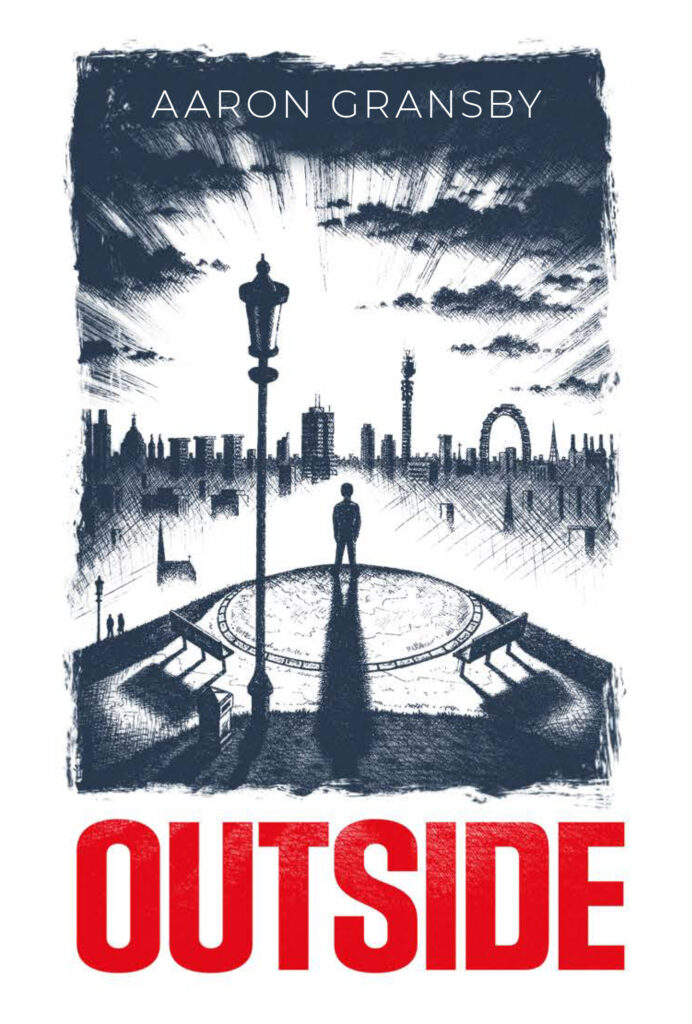
My first book, Outside, focuses on the difference between The City (London) and the suburban Outside of the title – ie the areas around the fringes of London that, once prosperous, have been left behind by The City’s ever-growing riches and the incessant focus on making money.
In the book, that difference is exacerbated by a change in the system of government, so that The City has become a self-governing mini-state of its own that is run by an unelected government, called The Board.
I decided to set most of the action of the book, not inside The City itself, but on the Outside, and the main focus of that is here in St Albans.
All of us who live here know that we are fortunate to do so – the history, the beautiful and inspirational surroundings – and the fact that, compared with so many areas, our own city is by and large quite affluent and well-to-do.
So I liked the challenge of taking this remarkable place and, while leaving the heritage and architecture in place, turning it into the area of the have-nots, rather than the haves; and of describing how – in a mythical near future or plausible alternate present – it had suddenly become the poor relation rather than the desirable home that everyone wanted to move to.
Using landmarks such as the cathedral and the High Street, the Vintry Garden, the Abbey Gateway, Verulamium Park, St Peter’s Street and the market, I retained the grandeur of our city but made it faded.
For example, the cathedral, dominating the area from on top of the hill, is “like a giant beacon of hope overlooking a sea of resignation”.
But taking a place so attractive and turning it into somewhere less so posed a problem – how to ensure St Albans isn’t seen by readers in a negative light.
So I made the characters here on the Outside positive – they are seen in a much more favourable light than those in The City, whose lives are dominated by materialism and the constant need to work hard for the sake of money and status and play harder for the sake of the thrill.
The characters on the Outside, who the book’s hero, Rory Kennet, encounters “restored his faith in humanity”.
They may have little of the material success of the Citizens but have so much more of a sense of community and look out for each other in their attempt to live decent lives in spite of their constant struggles to make ends meet.
To me, St Albans is a microcosm of everything I write about in my books.
On the one hand, The City in Outside and Destination is successful, vibrant and rich – all descriptions that could easily be attributed to St Albans.
The Outside is very much less so – but it does have the sense of community and suburban cosiness that areas of St Albans still retain.
Similarly, there are pockets of our city and neighbouring areas where people are not so fortunate, and that juxtaposition is also reflected in the dichotomy between The City and the Outside in my books.
And, of course, the location offers so much scope for a writer.
In Outside, many scenes are set in different parts of the city centre, even referencing individual streets such as Abbey Mill Lane and Lower Dagnall Street. But this is only the start.
The opening chapter of the follow-up to Outside, which will be out next year, is set in Holywell Hill, and I plan to use many more well-known landmarks and lesser-known hidden hideaways in both that book and others in the future.
For my writing, which is rooted in our recent past but set in our near future, both the historic nature of our city and its continual embracing of the opportunities ahead of us combine to make it the perfect setting and inspiration.
Outside is out now.