


30 Sep 2023
Traffic congestion, air pollution and parking in Harpenden – and how they might be alleviated – were key issues addressed at the autumn public meeting of the Harpenden Society.
Guest speaker Stephen Joseph, from the Smart Mobility Unit at the University of Hertfordshire, was asked to review the transport and traffic issues facing the town and to suggest some ways forward.
An audience of almost a hundred Society members and other town residents at Katherine Warington School heard Mr Joseph’s analytical assessment of what are widely-acknowledged and seemingly intractable problems, while offering a number of potential solutions.
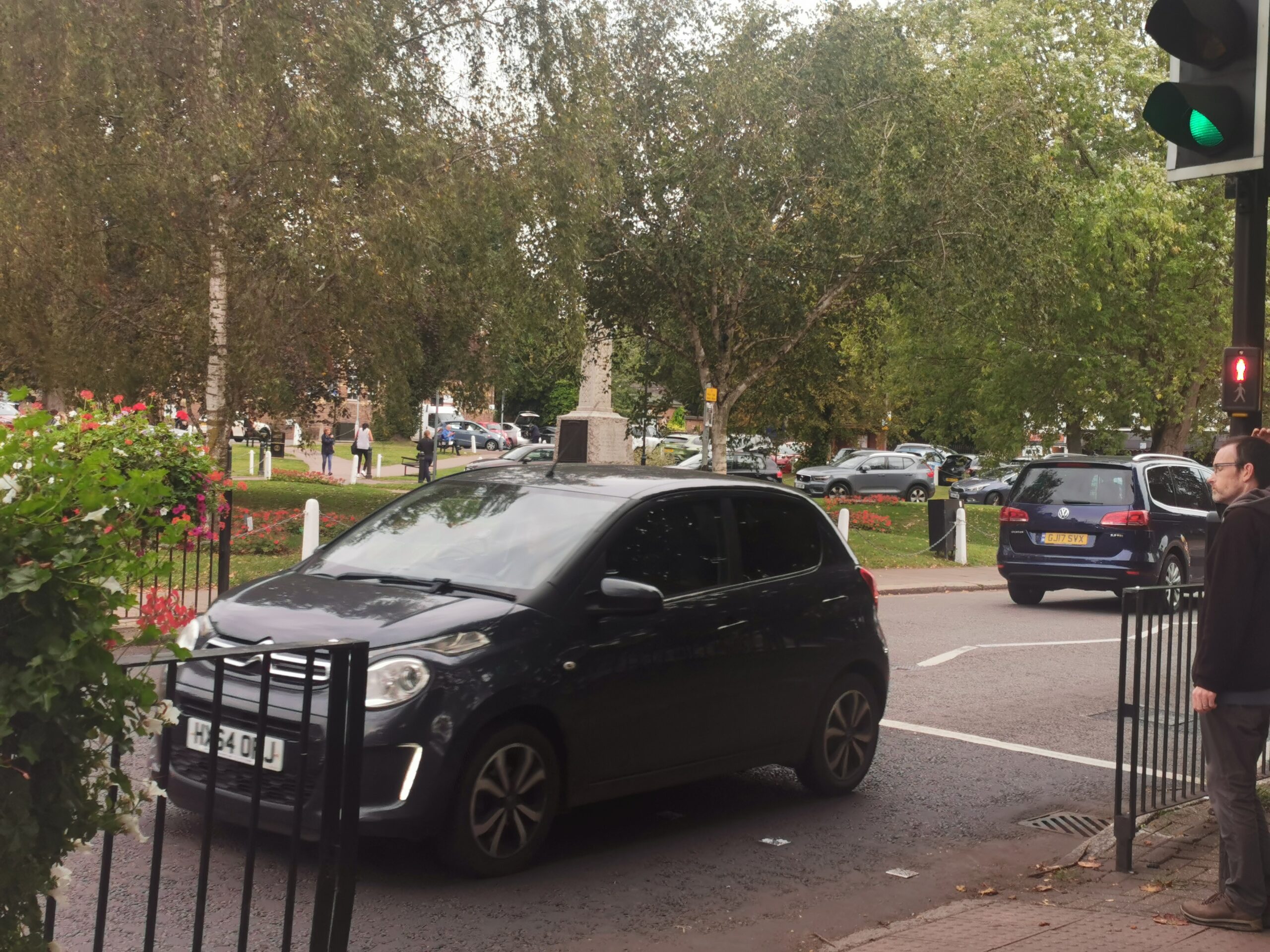
He said levels in Hertfordshire are among the highest in Britain (6.6bn vehicle miles or 55,230 per head) and Harpenden is one of the county’s congestion hotspots. Air quality in Church Green (pictured above) actually breaches three World Health Organisation pollution limits, despite Harpenden being considered a country town.
This could be down to the fact that car ownership is higher than the average for England, with 1.38 per household compared to 1.16. Harpenden carbon emissions from car driving are 1,620 CO2 per person per year, compared to an average of 962 for England as a whole.
He highlighted factors which he believes have contributed to reaching this situation:
· Cost: until recently the cost of motoring has fallen in real terms, while bus and rail fares have increased;
· Public transport services – especially buses – don’t offer a choice for many of the journeys in and around Harpenden;
· Active travel has not been promoted: there is a lot of walking in Harpenden, but no strategy for making it easier;
· Limited infrastructure for cycling apart from the Nickey and Lea Valley lines;
· New developments have been planned around the car with lots of cheap/free parking.
There are options for improving the situation going forwards, including changing commuting habits and journeys to school, better public transport, active travel and car clubs, but all of these bring choices, as increasing space for buses, pedestrians and cyclists may reduce space for cars.
Mr Joseph suggested the following strategy should be introduced to reduce congestion and other traffic issues affecting the town.
·Review car access to Bowers Parade/Lower High Street;
·Options for reducing speed limits to 20mph should be considered;
·A parking strategy for Harpenden should be developed including better enforcement, more spaces for electric vehicles, car clubs and bike parking and a review/expansion of residents parking zones;
·If any new housing developments are car-based and with limited local services and alternatives to cars, they will only add to congestion in Harpenden. For example, current proposals for north Harpenden [the L&G scheme] don’t reflect best practice or any of these concepts. Transport assessments need to take place for all major developments with clear targets and measurements for high levels of sustainable travel.
Stephen Joseph told the St Albans Times: “Everyone there knows that Harpenden suffers from traffic congestion – our report shows that this has wider consequences including poor air quality and very high carbon emissions.
“This is not inevitable – our report has set out steps that could be taken now to reduce car traffic around Harpenden, especially for commuting and school travel, and improve public transport and walking and cycling routes.
“Car clubs, e-bike hire and e-cargo bikes could also be looked at – especially since these already are working in other parts of Hertfordshire or similar places.
“However, we’ve also pointed out that there are choices to be made, especially on car parking and road space, if bus services are to improve and walking and cycling are to feel safer and more attractive.
“These choices are not for us to make – we’ve suggested that there should be a transport partnership or forum for Harpenden, with all the councils involved, plus businesses, community groups and transport operators, to develop the ideas we have set out and discuss them with Harpenden residents. We hope our report will stimulate debate and lead to some action.”
The Harpenden Society is now taking steps to set up an investigative meeting with Harpenden Town Council to assess the best way forward to establish a Harpenden Transport Partnership or forum which can consider Mr Joseph’s findings and implications.
