10 Nov 2026
Elena Hogg, founder of local culinary company FOOD by Elena, introduces her mother Marialba as guest columnist this week…
This issue, I’m shaking things up and, after a nostalgic conversation we had last week about seasonal treats, have asked my mum to write about her fondness for the humble chestnut. Over the years I’ve been writing these fortnightly columns, I’ve mentioned my Italian mother Marialba countless times, so some of you may already feel she’s familiar. Passo a te, Mamma!
Autumn. The nights draw in, the air is crisp and cool, the mind turns to comforting, warming food. Pumpkins, of course, are ubiquitous for Halloween, but also for soups, pies and all things nice, both savoury and sweet.
In Italy we have a seasonal equivalent, chestnuts. In cities at this time of year you see ‘i caldarrostai’, the chestnuts roasters, who, placed on strategic street corners while their chestnuts roast steadily on the hot embers, fill their paper cones with the beautiful hot nuts. We used to roast them at home too, of course, on the hob in a special perforated pan, which allows the heat to have direct contact with the chestnuts for a smoky, charred flavour.
Alternatively, boiling them in water with a bay leaf or a fennel sprig and a pinch salt would bring out their distinctive sweetness. I am also very fond of marrons glacés, or candied chestnuts, a common sight on supermarket shelves from September onwards; a real treat, the memory of which still makes my mouth water. Though not as popular, it is certainly possible to find marrons glacés in this country as well.
We have a long history of chestnut gathering and eating in Italy.
Before the post-war economic boom, ours was a poor country, and chestnuts were often a godsend, especially in the countryside, when little grew at this time of year. Farmers eked out a precarious existence, and chestnuts were appropriately called ‘the bread of the poor’, especially in the Apennine regions, where chestnut trees were plentiful.
Wheat being so expensive, chestnuts, which could be foraged in the woods and cost nothing, saved many people from starvation. Hard to think that times were so difficult then, in these days of relative affluence, but it is no bad thing to be reminded sometimes and not take things for granted.
Like pumpkins, chestnuts can be used for both sweet and savoury dishes, and a lot of them need chestnut flour rather than the actual nut. Unlike gram, or chickpea, flour which is found in every shop and supermarket, it’s not so easy to source chestnut flour. Some Italian delicatessens stock it – though not all by any means – and here in St Albans you can find it at this time of year in Eat Wholefoods on Hatfield Road, and possibly other small retailers.
One savoury dish I encountered in Tuscania, an Etruscan town in Northern Lazio where we used to have a house – look it up, it’s an amazing place – is a soup made with both chestnut and chickpea flours. We had gone to a restaurant in an old but still functioning abbey, where the monks were both cooks and waiters. It has since been converted to a hotel-cum-chef-training establishment.
The soup was so delicious I had to ask the monk who was serving us for the recipe. He reluctantly told me the ingredients and roughly how to put them together.
Now, when I manage to find chestnut flour, I make a version of it which bears a passable resemblance to the original.
In a nutshell (excuse the pun), garlic, chilli and rosemary are chopped very finely and sweated in olive oil to release the aromas, then the two flours and some salt are added, and finally enough vegetable stock to achieve a creamy consistency. I find a whisk useful for this purpose. No quantities given – you can leave out the chilli, or only add a smidgen, but it’s fun to experiment. The result is subtle and satisfying; perfect for an autumn evening.
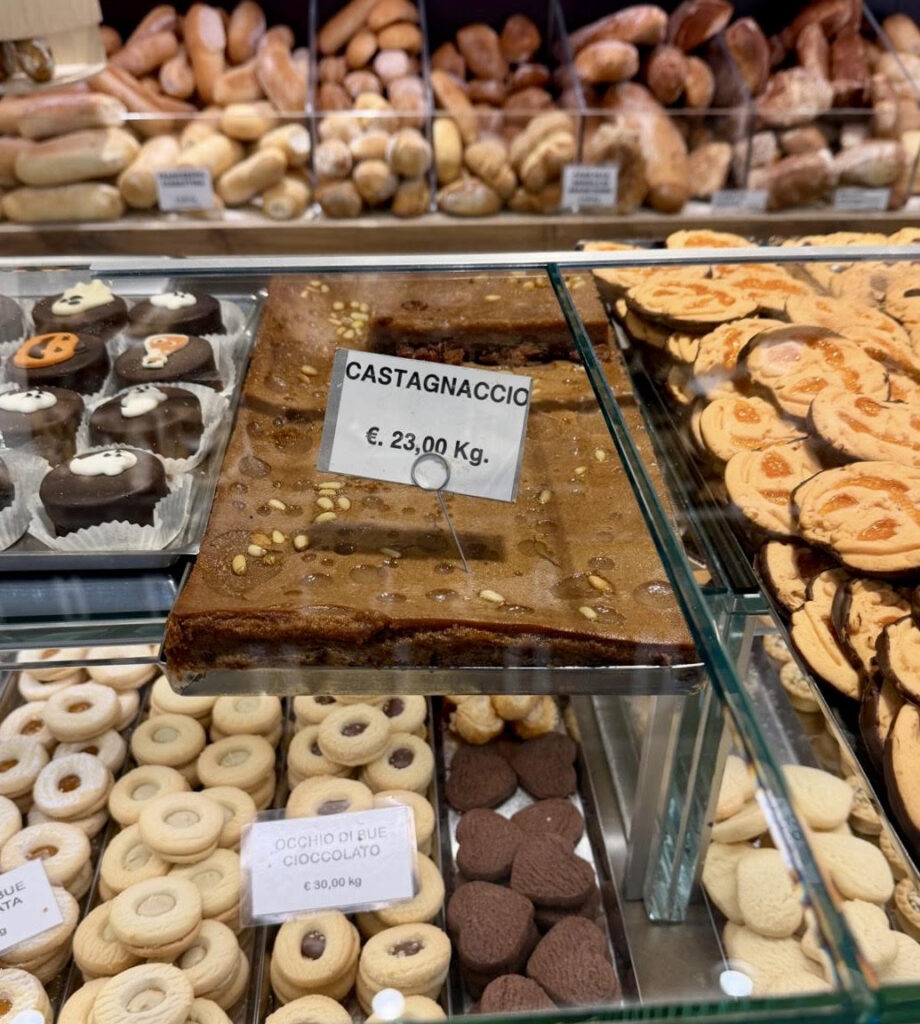
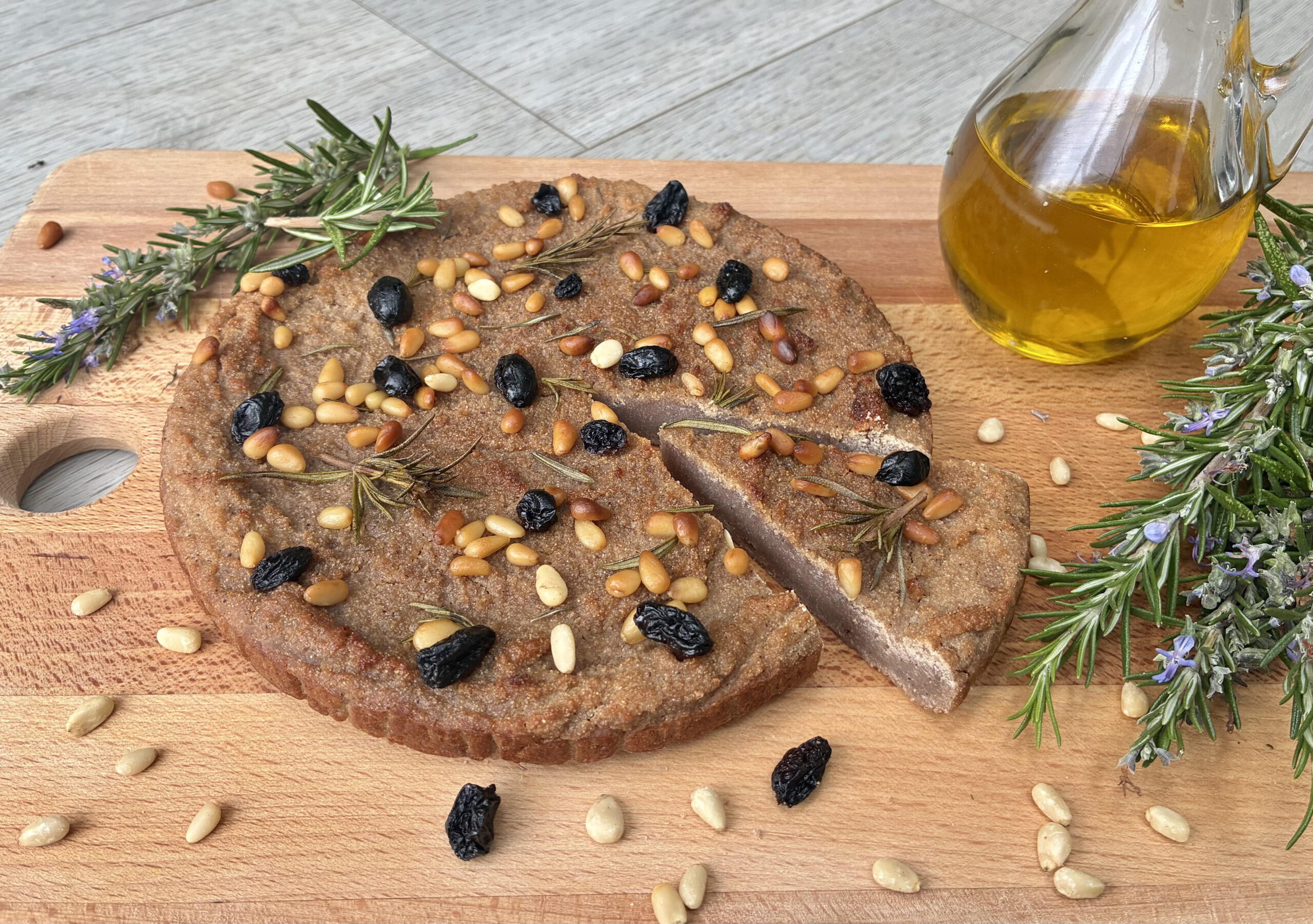
But the dish which for me epitomises the chestnut season is castagnaccio. It is originally from Tuscany, from where it spread more widely across central Italy and beyond. It is a strange, aromatic flat cake, a bit of an acquired taste, especially for non-Italians, who may be less familiar with cakes made with olive oil and rosemary. It isn’t overly sweet and not too difficult to make at home.
You need to gradually mix 300g of chestnut flour with 350ml of water until you achieve a loose, batter-like consistency. At this point you add 2 tbsp of olive oil, 50g of sugar and a pinch of salt. Pour into an oiled 24cm round tin and scatter pine nuts, sultanas or raisins and a few sprigs of rosemary on the surface.
Drizzle some olive oil over it, and bake in a preheated oven at 180C for approximately 45 minutes. The cake is ready when the top starts developing a few cracks.
You can eat it hot or cold, and it will last a few days.
You’re now set up to withstand the rigours of the season, or bask in its mellowness, whatever our climate decides to offer, smug in the knowledge that your body has been well and truly nourished.