29 Aug 2026
Irreplaceable archaeology could be lost forever as works proceed on the Park Street roundabout redevelopment.
The location is the site of the Watling Street Roman road – perhaps the most important of its kind in Roman Britain – and a major route through old Verulamium.
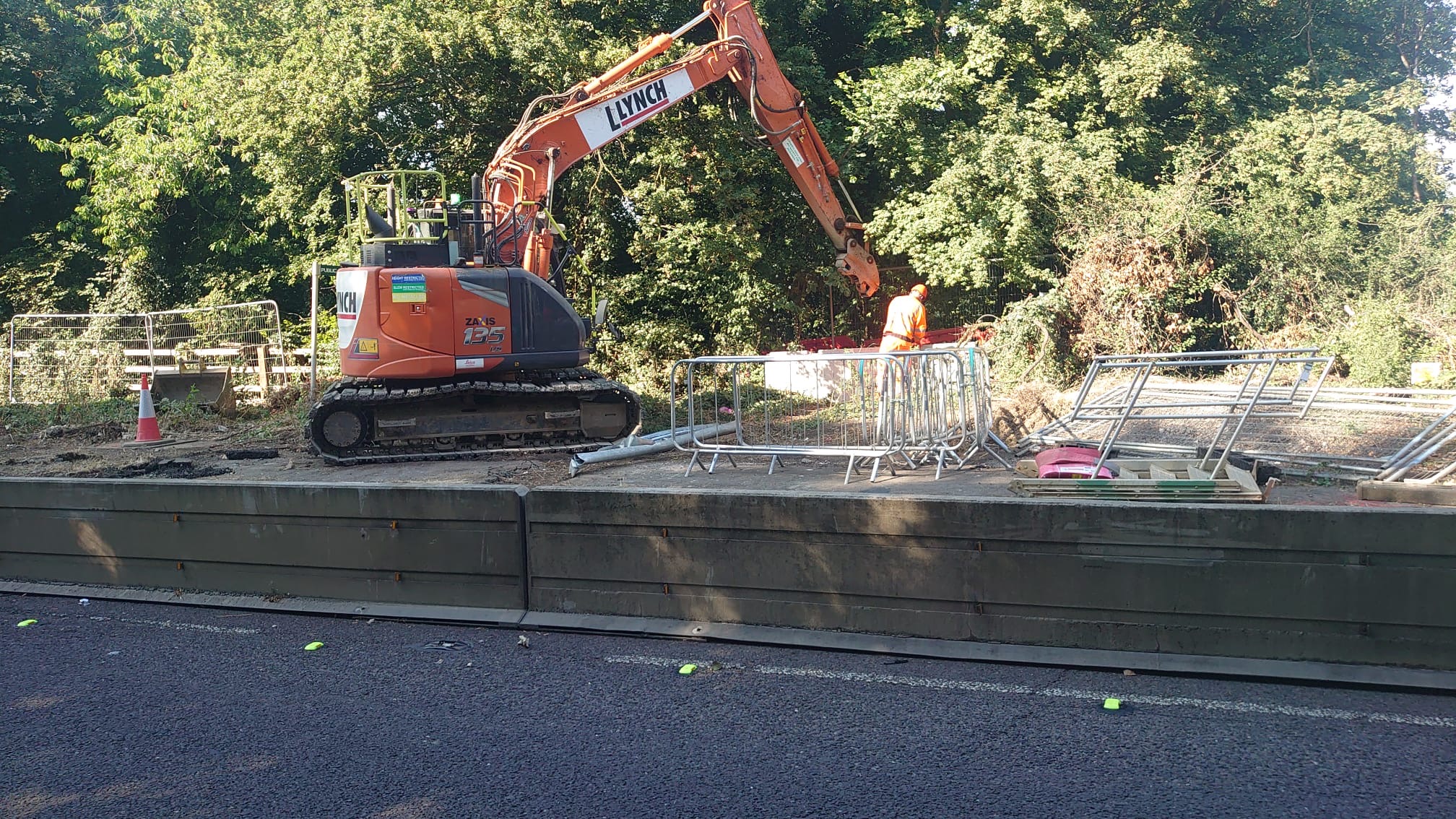
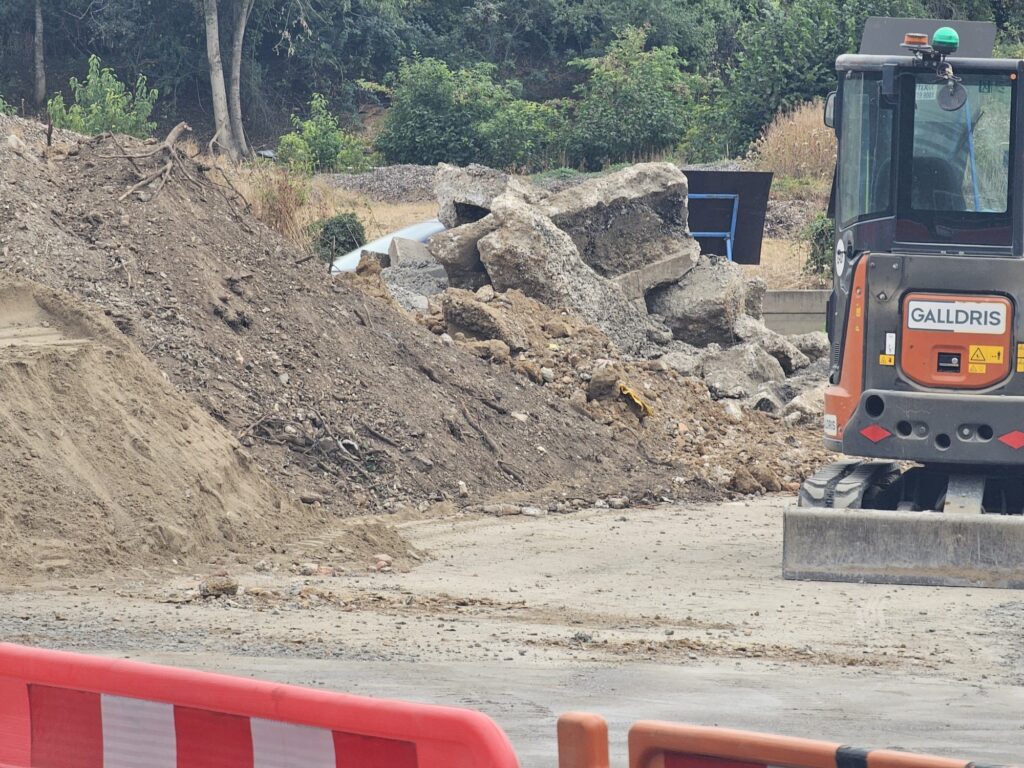
But efforts to involve archaeologists during extensive earth clearance have failed to stop the removal of tons of road foundation and flint by heavy machinery.
The A5183 passes through Park Street roundabout on its way to Verulamium and the route of the original Roman Watling Street is known to follow closely that of its modern counterpart through the Park Street roundabout.
The Roman road is assumed to exit the 1959-constructed roundabout to the left of the modern St Julian’s Hill – exactly where a new filter lane is being constructed as part of the roundabout expansion required under the planning permissions for the new rail freight depot.
Roman Watling Street is considered by many as perhaps the most important of its kind in Roman Britain, running from Dover to Wroxeter. It was a major route through Roman Verulamium, Britain’s third most important Roman town.
Watling Street was crucial to the Romans as a major arterial road for military movement, trade, and administration across Roman Britain. The route of Watling Street was also the site of historic battles and the defeat of Boudicca by the Romans was thought to have been one of these confrontations.
However, no assessment or measures to record and protect any historical remains during the Park Street roundabout works appear to have been put in place, and materials excavated from trenches dug at the site have been removed to undisclosed locations.
This is despite concerns continually being voiced as to the historical sensitivity of the site where the digging was taking place.
Planning permission for the Strategic Rail Freight Interchange (SRFI) was granted by the Department for Communities and Local Government via former Secretary of State Eric Pickles in 2014, and included both archaeology assessment of the former Radlett Aerodrome site and other nearby locations – but not the Park Street roundabout works.
However, the lack of an archaeological assessment for Park Street roundabout seems to have stemmed from the fact that the DCLG did not recognise the Park Street roundabout as requiring an environmental impact assessment.
This would have meant SADC could have specified any heritage requirements.
Because Park Street roundabout was not considered of historical interest by Eric Pickles, there was no obligation for the developer or Hertfordshire Highways to do anything more with regards to an archaeological assessment. There has been nothing to show that either party was unhappy with this outcome.
A Section 278 Agreement for the Park Street roundabout between rail freight developers SEGRO and Herts Highways was because major highway improvement works were required. The upgrade works include deep drainage installations, new filter lanes and footpath upgrades over an estimated 60-week construction timeline.
However, although an archaeological assessment did take place on the site of the former Radlett Aerodrome where the rail freight depot is being built, one was not undertaken at the roundabout site.
It is presumed that the original planning application did not highlight the Park Street roundabout works was a location of historical interest and that any extensive works might disturb or destroy Roman archaeology.
This omission also appears to have been an oversight by the Secretary of State and the Planning Inspectorate, despite the fact that the ancient Watling Street route is shown on many detailed maps as crossing the roundabout site and is referenced by Ivan Margary, a leading authority in Great Britain on Roman roads.
Had an environment impact assessment been required for the Park Street roundabout before planning permission was granted, it may have raised concerns about preserving and recording any archaeology underneath the roundabout and approach roads.
As reported previously, Hertfordshire County Council have pointed the finger at SADC for not using their archaeological services for advice on such matters, while the district council responded that they weren’t involved in the S278 Agreement drawn up between SEGRO [then HelioSlough] and Herts County Council so were unable to get involved in the process.
Hertfordshire Highways did make assurances that a watching brief would be present who could halt works should the excavations at the Park Street roundabout uncover anything of a historical interest. However on at least two consecutive days, a watching brief was not found to be present and workmen on site said that it was not deemed to be required by the main contractor.
A test trench that was opened up several weeks before works started at the bottom of St Julian’s Hill is now the subject of a Freedom of information request to determine who requested it, why it was dug, what were the findings and why was it filled in when questions were being asked about its historical interest.
This trench was totally excavated in the last week and all materials were removed from site.
Mike Haken, chair of the Roman Roads Research Association, said: “This is a mess that should never have happened, and unfortunately nothing can be done now and any damage is likely to have already happened.
“Neither the county council or St Albans district council have shown any regard for heritage or the law. It is their responsibility under the Roman section of the National Planning Policy Framework to make sure that any archaeology is properly recorded.
“They can’t pretend the Roman road is not there, so they’ve just ignored it. It’s deplorable.”
Under the NPPF, Roman remains are treated as heritage asset with archaeological interest, requiring local planning authorities to assess how new developments impact them.
The Department for Communities and Local Government have also washed their hands of any involvement in the works.
This week we highlighted that the issue over a lack of any archaeological assessment seemed to stem from the fact that DCLG did not include the Park Street roundabout within the planning conditions, therefore there is no obligation on the developers of the site and highway works to do anything more.
We pointed out that this is the site of one of the country’s major Roman roads and therefore of huge archaeological importance, and asked as this oversight is down to the DCLG, is the Department prepared to intervene to take action at this stage?
The response received was short and to the point.
“Planning permission was granted on 14 July 2014 for the construction of a Strategic Rail Freight Interchange (SRFI) at land in and around Former Aerodrome, North Orbital Road, Upper Colne Valley, Hertfordshire.
“This decision was in line with the recommendation of the independent Planning Inspector. Ministers have no further role in this matter.”