


14 Aug 2026
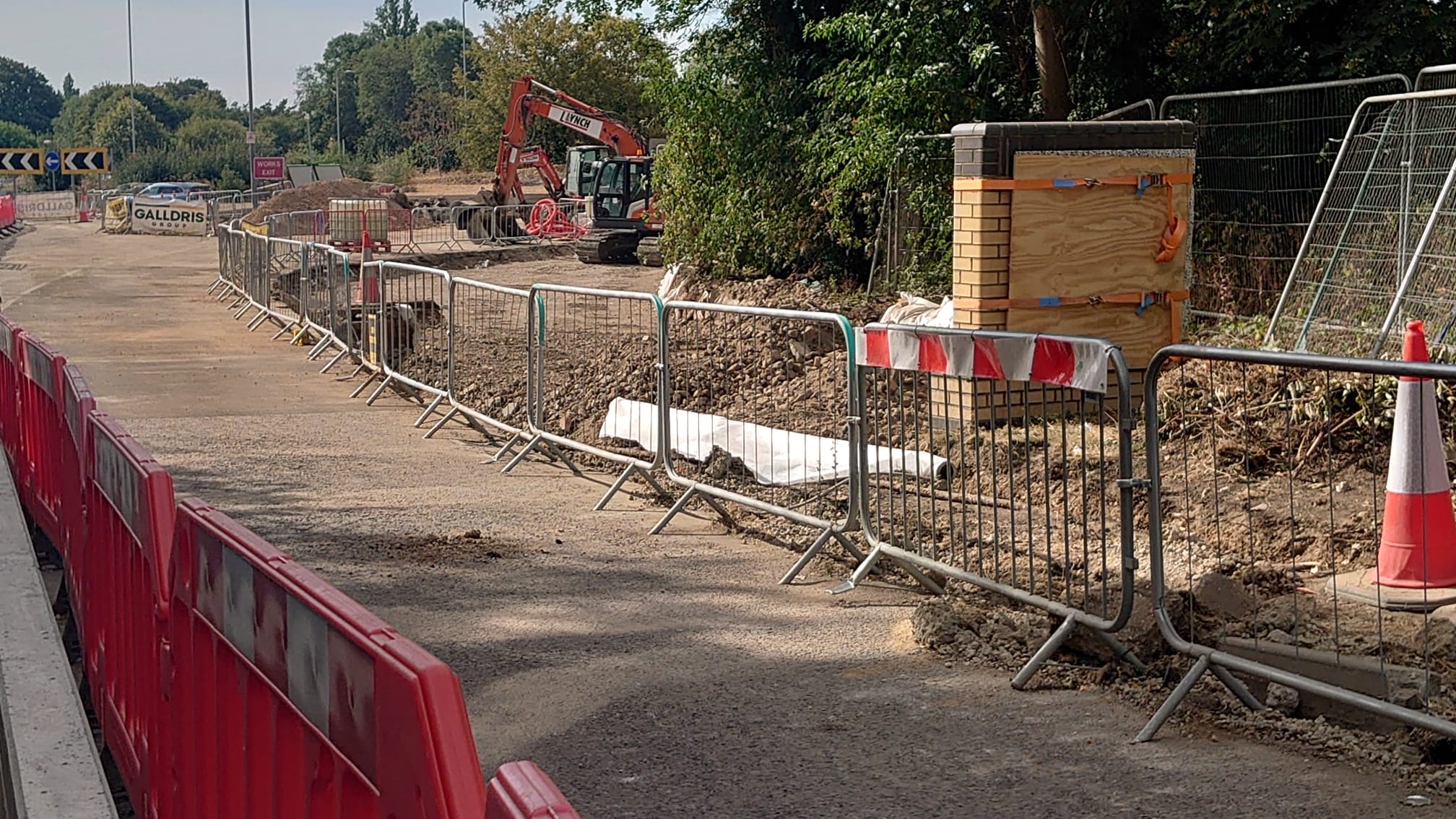
The blame game continues over whether the correct archaeological procedures were followed in advance of construction work starting on the Park Street roundabout improvements.
The location is the site of the Watling Street Roman road, a major route through old Verulamium, and a full archaeological assessment should arguably have been carried out before the roadworks started in May.
The matter is now being investigated by the Roman Road Research Association, a body formed to investigate and protect what remains of the historic Roman road network across Britain.
A Section 278 Agreement for the Park Street roundabout between rail freight developers SEGRO and Herts Highways involves major highway improvement works including deep drainage installations and footpath upgrades over an estimated 60-week construction timeline.
However, although an archaeological assessment did take place on the site of the former Radlett Aerodrome where the rail freight depot is being built, there were no planning conditions insisting one was necessary at the roundabout.
A spokesperson for Herts County Council said they had no obligation to carry out any archaeological assessment ahead of the roadworks: “The archaeology investigation extents referenced were conditions placed on the developer by the then-DCLG [Department of Communities and Local Government] at the time of granting approval for the scheme.
“While the Park Street roundabout works are included within the same planning permission, the requirement for investigation was not included within the required extents, and therefore there is no planning requirement to undertake a stand-alone assessment for this area.
“Despite there being no requirement for an investigation, to mitigate we have agreed with the designer’s risk assessment which suggested a watching brief in the event of findings as part of the works.
“We have received no concern or suggestion from the local planning authority that this approach is not in line with the permissions granted.”
SADC has insisted they have no part in the process: “We would refer you to our [previous] statement which explains this is not an SADC matter.
“To be clear, the planning permissions were not granted by us and we were not involved in the 278 Agreement. The latter is a highways issue not a planning one.”
Rail freight developer SEGRO said: “The Park Street Roundabout works are being delivered under a Section 278 Agreement with Hertfordshire Highways. As is standard practice on highway and construction projects, should any previously unidentified archaeological remains be uncovered during the works, construction in the affected area would stop and the appropriate specialists and relevant authorities would be notified.
“Any necessary investigation, recording or mitigation measures would then be undertaken before works restart, in accordance with established archaeological and construction industry procedures. SEGRO follows a rigorous procurement and tender process to appoint contractors with a strong track record of responsible working practices, a thorough understanding of all relevant regulations, and the ability to deliver construction projects to the highest standards.”
Local campaigner Andy Love has been digging into the issue: “Ultimately it appears that all responsibility for assessing any archaeological remains, which covers many other aspects along as well as the presumed Roman road, has been handed over to SEGRO by HCC and SADC. The watching brief also appears to be engaged by the developer.
“From the developer’s point of view, delays mean additional costs. Significant finds at the works stage of the upgrades might not only delay the works but also possibly limit the design and expansion of the roundabout.”
He believes the discovery of archaeological remains could have scuppered the whole rail freight project. “In my opinion, the need to expand the roundabout’s capacity was fundamental to [former DCLG Secretary of State] Eric Pickles’ decision-making and the outcome of an archaeological assessment may have changed his mind to approve the whole scheme.
“The results could potentially have prevented it being widened, deep drainage installed and utilities moved, which could have ruled out the strategic rail freight interchange because there are no other exists which could be enlarged.”
He believes urgent action is needed now to protect any potential archaeological finds: “If the Roman Watling Street still exists in some form, it would give archaeologists a great opportunity to study it given that the road has probably been protected to some degree by the modern road being built above it. So many Roman roads are damaged or destroyed from ploughing and I’m not aware of any other areas in St Albans where the Roman Watling Street is viewable.
“From my limited knowledge of Roman roads, there can be various methods used to construct them which would surely provide valuable information for recording whilst the road is exposed. I’m sure local residents and schools would value such information. There would also have been kerb stones bordering the road and ditches on either side.
“For SEGRO and the local authorities not to proactively include and allow local archaeologists the time to assess and record any finds, in my opinion, would be an absolute tragedy. From my correspondence with representatives of Highways and SEGRO, it doesn’t appear that they were even aware of the potential presence of a Roman road running through the Park Street roundabout along the A5183!
“If the archaeological assessment had been undertaken then any delays to the roundabout upgrades would have been preventable and works done sympathetically to mitigate the damage to any historical remains. It must also be noted that there is probably very limited knowledge as to what actually lies under the Park Street roundabout and St Julian’s Hill. Being the last hill before entering Roman Verulamium, it could hold significant historical value.”
As one of the organisations involved in the roundabout upgrades National Highways should be aware there are strict planning requirements to follow when building infrastructure in an area of historical interest.
Their guidelines state: “It’s a requirement of the UK’s planning regulations. These recognise the importance of protecting our cultural heritage, and require all developers to have their sites assessed and excavated by archaeologists. Evidence such as human burials, animal bones, pottery, tools and even soils, charcoal, ancient seeds, nuts and shells can help reconstruct the past.”
Mystery also surrounds the test pit that was dug at the bottom of St Julian’s Hill several weeks ago. It is unclear who arranged for this test pit – numbered 30 – to be dug, or why it was subsequently filled. Questions also remain unanswered over whether there was any assessment of it, and why is there now total silence from Herts Highways and SEGRO on its purpose.
Two archaeologists who visited the site said it needed further investigation with a hand trowel to establish whether it was Roman or of historical interest.
Local county councillor Sandy Walkington, former President of St Albans and Hertfordshire Architectural and Archaeological Society said: “Everything has been done properly by Hertfordshire County Council. The requirement for prior archaeological investigation was for the pieces of land purchased by SEGRO, whether for the lorry terminal itself or the areas of ‘country park’.
“The specific requirement did not pertain to the consequential highway works away from the site such as at Park Street.
“Nevertheless the county council has quite rightly put the contractors on notice that they should stop work and report if anything significant is found – just as happens with any piece of major road engineering.
“My own personal view as someone who has always been passionate about local history is that there are plenty of places where the remains of Watling Street can be excavated and explored, not least where it runs across Verulamium and up the Gorhambury driveway. And of course these stretches have not been chewed up by prior highway and roundabout works.
“My first concern here is for my residents. We need to minimise the disruption to them caused by the closure of the northbound lane of Watling Street. Getting the highway back into use as quickly as possible is the obvious priority.”
