12 May 2026
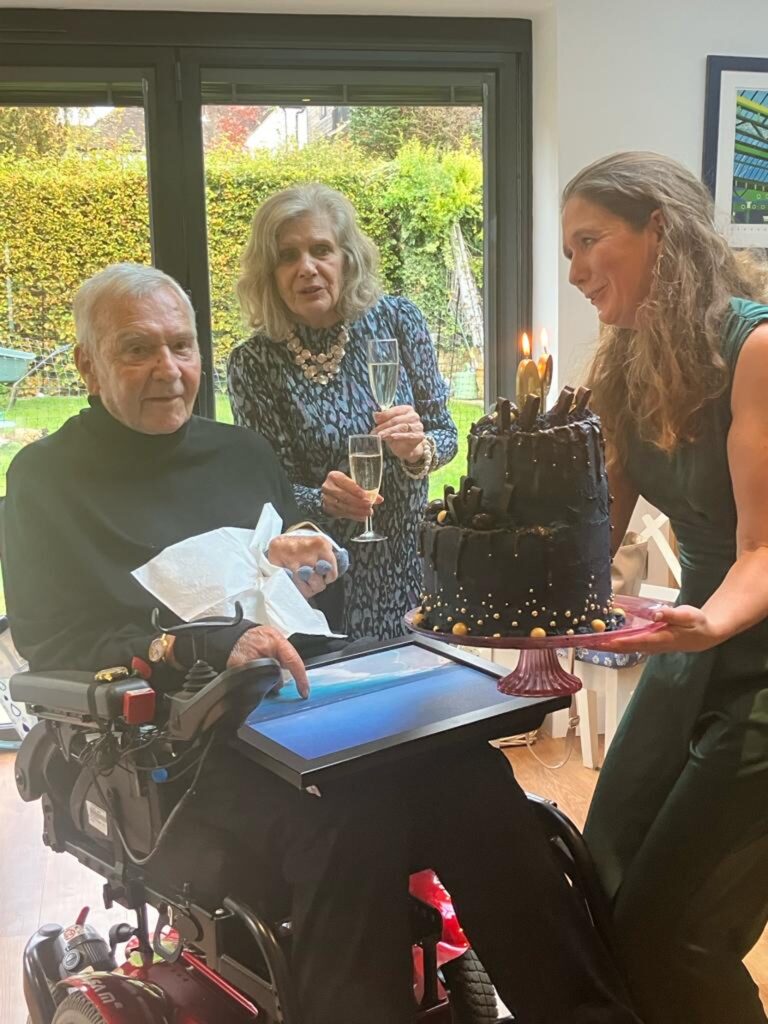
A Harpenden family is speaking out to challenge the perception that spinal cord injuries only affect younger people, after a 92-year-old former BBC producer – who once travelled the world covering royal tours – was left tetraplegic following a sudden accident at home.
Marking Spinal Cord Injury Awareness Day (SCIAD) on May 15, Susan Kerr has shared her family’s experience of navigating life after her husband Michael sustained a severe spinal cord injury in March 2019.
“I heard this almighty thump and found him unconscious on the floor,” recalls Susan. “That was the start of a long life lesson and a huge change in life for both of us.”
Michael, who was 85 at the accident, sustained a severe spinal cord injury, leaving him tetraplegic. After initial treatment, he was transferred to Stoke Mandeville Hospital – a move Susan now describes as critical.
“We were told, ‘This is the Oxford and Cambridge of spinal injury care – you’ve got to go to Stoke,’” she says. “It’s so important to get the right specialist care – the difference is huge.”
After four months of rehabilitation, Michael returned home, but arranging care proved overwhelming.
“We were told he’d be coming home in a few weeks, and I had no idea how to arrange care – no help at all,” Susan says. “You don’t know what you don’t know.
“There should be a ‘how-to’ guide in every spinal hospital about arranging care – because there isn’t.”
The couple initially explored agency live-in carers dubbed personal assistants (PAs) but struggled with consistency.
“The idea is they help you live your life, not just look after you,” Susan explains. “But continuity is everything, and that’s one of the hardest things to achieve.”
After a series of mixed experiences, Susan turned to St Albans-based homecare provider Abbots Care – a decision she says transformed their situation.
“They came up with the goods,” she says. “They are reliable, they’re talkable – and we always knew they had our back. Always.”
As Michael’s needs became more complex, Abbots Care delivered a flexible package of live-in and overnight care, supporting everything from mobility and personal care to complex clinical routines.
Camille Leavold, CEO of Abbots Care, said: “Spinal injuries affect every aspect of daily life, from mobility to complex medical needs. The right care isn’t just about practical support – it’s about helping people feel in control again and live life on their own terms.
“Every spinal injury is different, which is why care has to be built around the individual – their routines, their goals and what matters most to them. Our focus is always on empowering independence, dignity and confidence for both the individual and their family.”
After a pilot programme with the Spinal Injuries Association (SIA), Abbots Care, a trusted partner of the SIA, is one of eight specialist care providers chosen by the association as part of a new three-year programme to help people affected by spinal cord injuries to get the right care and support, when and wherever they need it.
Susan also praised the consistency and professionalism of the team. “Every single person, even the office staff, was calm, polite and supportive. That makes such a difference when you’re under pressure.”
Earlier this year, after more than six years at home, Michael moved into a local care home – a transition supported by Abbots Care, including help with handover and continuity.
“Having someone Michael knew and trusted during that move made all the difference,” Susan says. “They didn’t just provide care – they supported us as a family.”
Reflecting on their journey, she adds: “Nothing about this is easy. Mind you, I was still in charge of contact with district nurses, GP, chemist, social services and more. But having the right people around you makes all the difference.”
During his lifetime, Michael travelled the world as a BBC producer covering royal visits, joining the royal entourage on overseas tours to South America, the United States, Japan and Russia.
Susan recalled one story that Michael had told her about his travels with the royal family. “During one royal tour, Michael was invited to a drinks reception with Queen Elizabeth II after working on the broadcast. He’d been working in extreme heat to get everything ready on time and had ended up wearing his hotel bedroom slippers.
“As he was introduced, the Queen smiled, glanced down at his slippers, then back up again – clearly amused. She didn’t say anything, but he always remembered that moment.
He later heard that she and Prince Philip enjoyed it when things didn’t go entirely to plan – when something human slipped through.”
The SIA says stories like Michael’s highlight the importance of protecting access to specialist spinal cord injury services across England.
The Spinal Injuries Association said: “In the lead-up and on SCIAD this year, SIA will be bringing attention to the provision of spinal cord injury services and NHS England’s intention to transfer commissioning from national to local (ICB) level in April 2027.
“Our messaging focuses on ending the postcode lottery and safeguarding SCI services. We are co-ordinating some Parliamentary engagement that highlights the current issues and the All-Party Parliamentary Groups on SCI report published in October 2025 and will be asking the community to engage with their MPs about NHS SCI services, through a template letter on our website.
“We welcome further discussions on how we can align our messaging around the benefits national oversight and coordination of NHS SCI services has provided, the current situation and future risks of decentralising SCI commissioning.”