


01 Aug 2023
Imagine if you lived in Tudor St Albans. Would you mourn Henry VIII’s destruction of its Abbey? The loss of centuries of scholarship, as well as its infirmary? The disappearance of the pilgrimage trade which had brought prosperity to the town?
Or would you celebrate the new found freedom from the Abbey’s feudal rule? Perhaps you enjoyed an ale in one of St Albans’ many inns and laughed drily with your mates at the pronouncement by a disapproving Lady Anne Bacon of Gorhambury that “tippling, taverning, drunken idleness and gaming is almost this town’s profession”. A bit harsh. Or perhaps you gawped at Elizabeth I and her fashionable courtiers on their stately processions to visit the Bacon family at Gorhambury?
Perhaps you fancied wearing some of these bejewelled and embroidered clothes yourself? Well, think again.
There were some seriously weird fashion trends.

The Tudor period started with bloodshed, the savage death of a king and the seizing of the throne by Henry Tudor, (to be crowned King Henry VII). His victory at the Battle of Bosworth in August 1485 ushered in the new Tudor dynasty. It was to last 117 years, comprise five monarchs (two of whom were women) and change England’s religious landscape for ever.
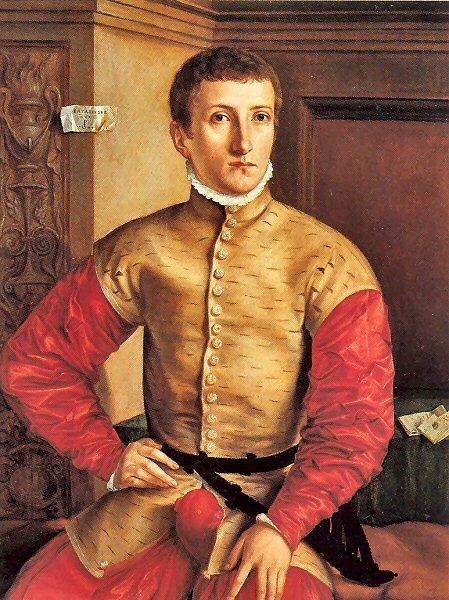
The Tudor period is known for many new and useful innovations, from redesigned military fortifications to the first flushing toilet. But there was another innovation, slightly less useful, and surely one of the most bizarre fashion trends in history. The codpiece. Someone, omewhere, must have been having a quiet laugh, but fashionable men of the 16th century wouldn’t have been seen dead without it.

So what was it? The codpiece, stuffed with wool, was a piece of male dress which performed the dual function of both covering and, at the same time, drawing attention to a part of the male anatomy. And that meant, of course, that its size wasn’t necessarily anatomically accurate. In fact, when discussing the television production of Hilary Mantel’s ‘Wolf Hall’ actor Mark Rylance, who played Thomas Cromwell, mentioned that his costume’s codpiece had to be made smaller than it would have been in the 1500s. Modern audiences, he explained, could be confused as to “what’s going on down there”.
Portraits of the second Tudor monarch, Henry VIII, and other royal or noble figures show that the codpiece grew to startling proportions. Often made in embroidered velvet and decorated with jewels, even young boys were expected to wear them. Male fashion was definitely about enhancing manly features, with shoulders also heavily padded.
And although the codpiece gradually fell out of fashion, it was replaced by another trend, the peascod. This was a style of doublet – jacket – padded and tapered to look like a pea pod ready to be picked. If you’re wondering why a pea pod? It was seen as a symbol of virility.
You’ll probably be relieved to hear that by the 1570s, breeches had arrived. Most men would wear breeches to the knee, made of serge or leather. For the aristocracy, the fashion was for shorter breeches of damask, velvet or satin worn to mid-thigh, sometimes stuffed with wool to make them firmer and rounder. Underneath, the courtiers wore embroidered linen drawers, fastened by a waist cord.
So what did women wear? For the poor, it was very simple – a smock under a simple gown. But the wealthy, well, what didn’t they wear? A chemise, hose, waistcoat, a bodice stuffed with whalebone or wood, petticoats, a stomacher. This would all take some time to put on, even with the help of a maid, but there was more – a farthingale. This was a framework of whalebone. attached to the waist over which the petticoat or gown would be draped. The Spanish-style was of cone-shaped but the French fashion was for a cartwheel shape around the waist, dropping down in the shape of a drum. Those who couldn’t afford farthingales would use a bum roll, a padded bolster encircling the waist, to create a fashionable structure to the gown. All these layers would have kept you warm but surely must have restricted your movements?

One fashion trend started as a simple collar band for chemises and shirts but evolved into an incredibly elaborate trend for both men and women – the ruff. By the late 1500s, ruffs were the height of fashion and, thanks to the invention of the starching process, developed to include up to 600 pleats using around six yards of material.
A Tudor fashion which has lasted the test of time was high heels. Until the mid-1500s, shoes were flat. Then shoemakers, like the ones working in St Albans marketplace, started to try out wooden heels and arches for their female customers. And by 1595, Elizabeth I was wearing her first pair of high heels. The fashion for the “well-heeled” was well and truly set.
Mass-produced (sort of) silk stockings were another new creation. Pretty much everyone wore woollen hose, but then in 1561, Alice Montague, silk-woman to Elizabeth I, found a way to knit silk stockings. They were an instant success at court and much in demand, but it was a slow process which made them both expensive and exclusive. This was short lived as William Lee invented a machine able to knit silk stockings in 1589, and gradually more women could afford silk instead of wrinkly woollen hose.
What about make-up? For the Tudor courtiers, it was pretty lethal stuff. Pale skin was seen as desirable as it differentiated the gentry from those who had to toil outside in all weathers. So a mix of water, vinegar and lead, known as Venetian ceruse, was applied to the skin. Not the healthiest option – indeed highly toxic – but it covered up smallpox scars. A non-lead alternative could be made from the lard of castrated pigs.
Spare a thought for the people who needed to clean all the fine clothes – women, of course. The whole process was seriously hard work, with strong arms required and hands reddened by caustic soaps made from ashes, lime and animal fat.
More costly was imported black soap made with whale blubber oil, but the finest was Castile soap, imported from Spain. Expensive but the best way to keep those linen shirts white.
As during the medieval era, Sumptuary laws ensured that you wore materials ‘appropriate’ to your status. This was a way of maintaining the social order. Another law passed by Elizabeth I in 1571 determined that working people over the age of seven should wear a woollen cap every Sunday and holy day. Perhaps to support the domestic wool trade? A fine of over three shillings was levied for every day of disobedience. Perhaps culprits were summoned to appear in St Albans’ Tudor courtroom, now WH Smiths? Velvet caps were also worn but felt hats with high crowns became fashionable from the 1560s, decorated with feathers and coloured hatbands.
Elizabeth, as a young princess, was admired by Puritans for her modesty in dress and her choice of a black and white colour palette. To Puritans, black meant constancy and white symbolised purity. But once she became Queen, Elizabeth threw herself into glorious, colourful trends from all over Europe, becoming a fashion icon.
Then in the early hours of 24th March 1603, Elizabeth I died. The Tudor era was over and the time of the Stuarts had begun. Read in our next instalment how their colourful flamboyance was to conflict with the monochrome discipline of the Puritans.
To hear more about the people of Tudor St Albans, join our guided walk at 2.30pm on 6th August.
Details and how to book can be found on the St Albans Guides website at www.stalbanstourguides.co.uk

