15 Apr 2026
Elena Hogg, founder of local culinary company FOOD by Elena, has been out foraging for some wild garlic..
If you’re anything like me, you’ll have had more than you’re fair share of Easter treats over the past few weeks and now feel instantly nauseated every time you walk past the chocolate egg shrapnel littering the kitchen surfaces.
The over-indulgence has left me hankering for some fresher, cleansing food in the hope of achieving some kind of detox. Nothing too severe, of course, but eating something that isn’t ninety per cent sugar and fat wouldn’t go amiss this week.
This was at the forefront of my mind the other day as I walked home from the local playing fields with the children and we passed some small white flowers
swaying in the breeze. I realised with a small utterance of joy that they were three-cornered leeks, and that wild garlic season is fully upon us. I’d not even noticed amid the Easter fanfare.
There are various kinds of wild garlic and all of them offer an exciting mixture of fiery intensity and fresh, grassy zing. Granted, there’s some sweetness too, which is what I’m trying to avoid, but hardly in the quantities of a bag of mini eggs, so I felt safe to proceed.
So we gathered a few bunches of these pretty, white posies that spring from triangular stems, giving them the name ‘three-cornered’. Some of the flowers made it home, but others went straight into our mouths, my daughter being a particular lover of all things foraged. She’s become quite adept at avoiding any areas likely to have been ‘visited’ by the local dogs.
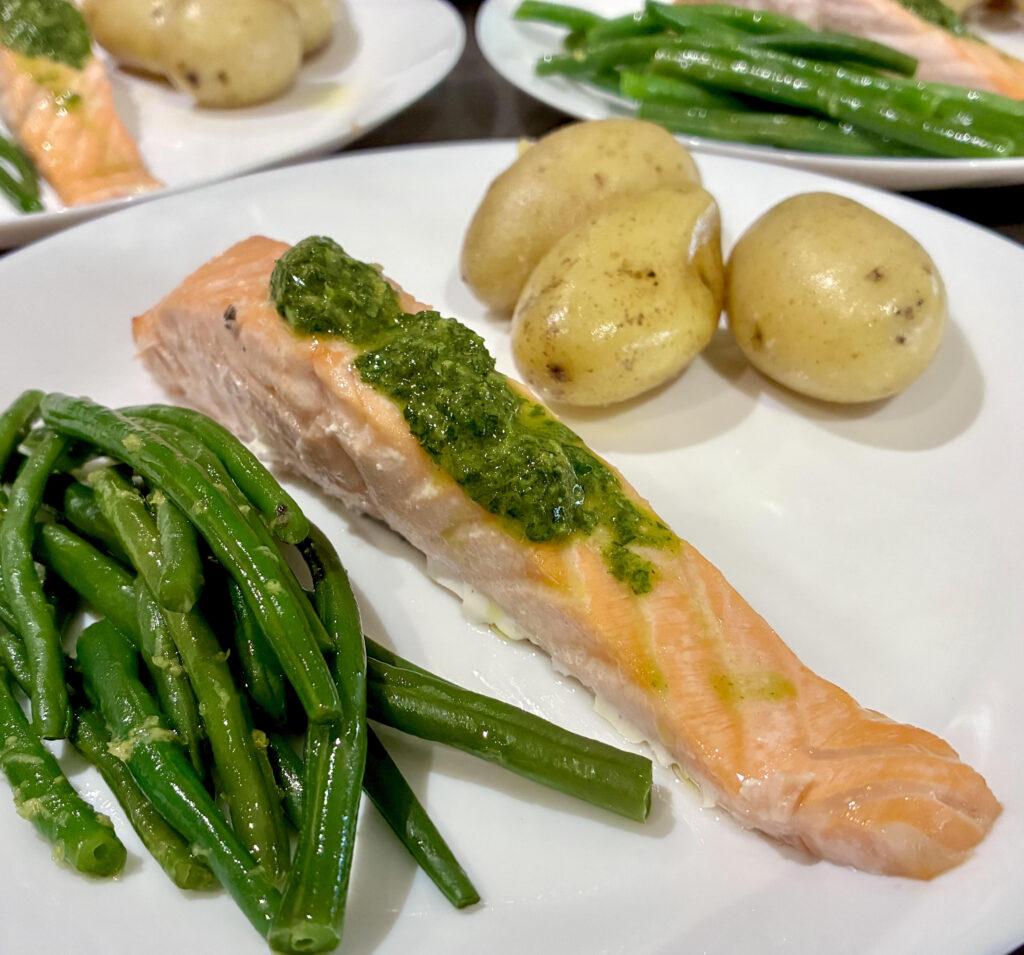
Once home, I contemplated what to make with them, for they will last a day or two in water, but not much longer. The stems are more pungent than the flowers, and are certainly less decorative, and so I decided to use the stems to make a pesto, and reserve the flowers to adorn a different dish, thus spreading the garlicky goodness as widely as possible.
As it goes, the pesto ended up becoming a kind of gremolata, because dinner that evening was to be salmon fillets that needed eating, and pesto contains
parmesan which I simply can’t eat with fish. It’s the Italian in me: I can’t eat chicken with pasta or drink a cappuccino after midday, either. It’s terribly burdensome.
Gremolata, traditionally, is a concoction of parsley, lemon, garlic and oil. Like all great foundations, they allow for plenty of experimentation, hence using three-cornered leek stems instead of garlic and parsley.
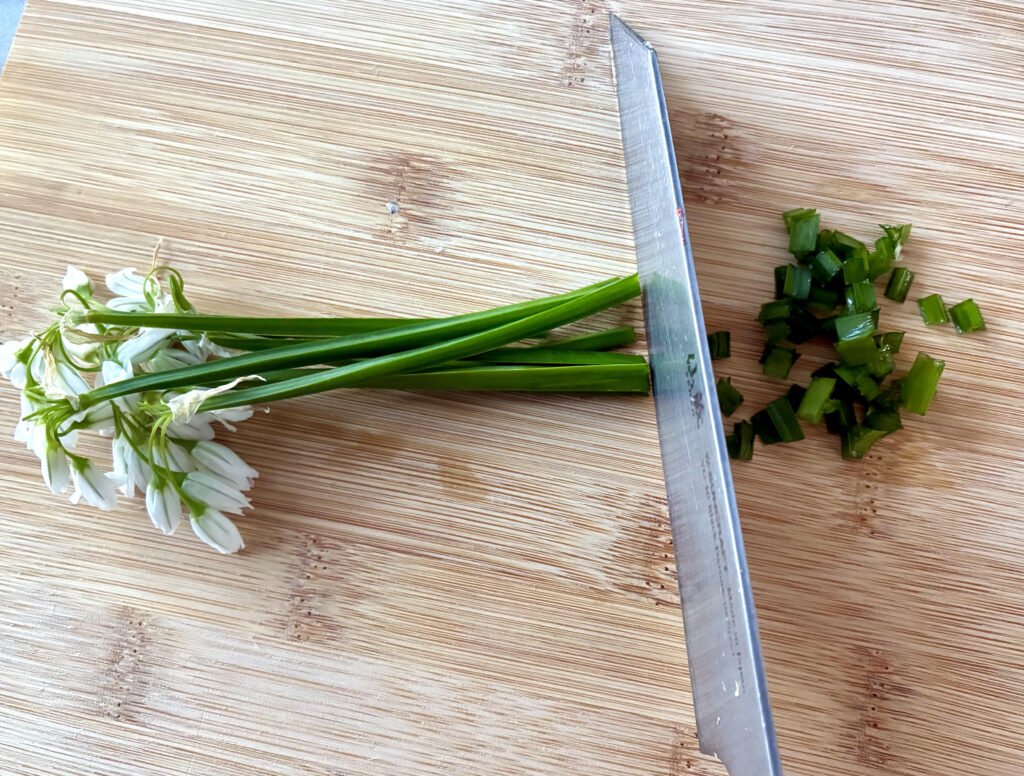
My foraged bounty provided both the herbal punch that parsley would bring and the garlic flavour too, without having to peel a single clove. I didn’t quite have enough to make a meaningful quantity, though, so I went to the bottom of the garden to ransack our wild garlic plant, which happily was in full bloom too.
I added lemon zest and olive oil to my pestle and mortar full of herbs, plus some fleur de sel, which helps break the leaves down as well as adding seasoning. The verdant, garlicky purée against the pink of the salmon was just as satisfying to the eye as the taste was in the mouth, especially with some buttery new potatoes alongside.
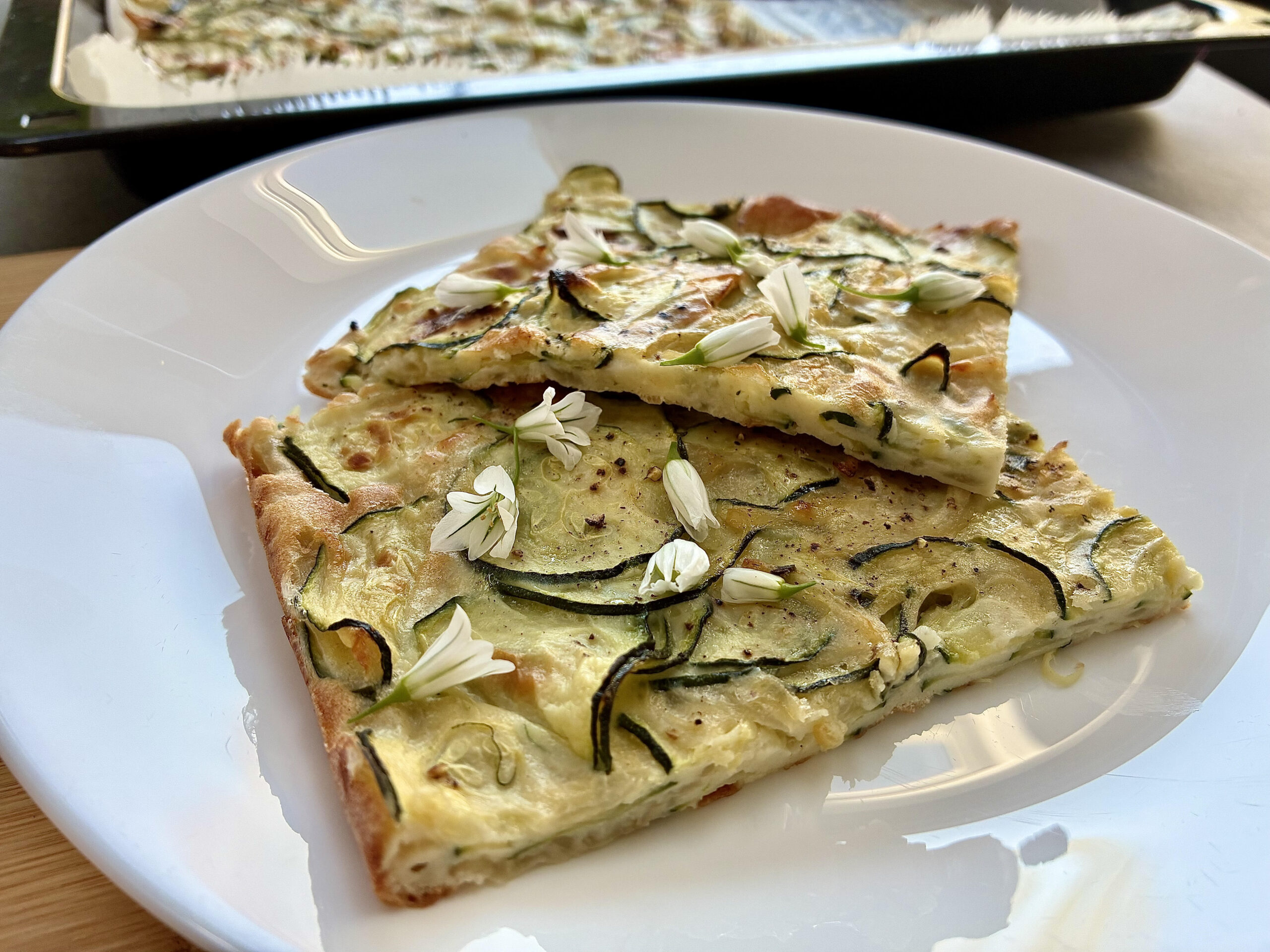
As for the dainty-but-fierce flowers, I had other plans for them. One of my mum’s favourite childhood memories is of eating ‘scarpaccia’, a dish from Tuscany, where she was born. The name roughly translates as ‘dirty old shoe’ and admittedly doesn’t sound too appetising. It’s a sort of courgette ‘slice’, for want of a better description; its name denotes the peasant-like nature of this unfussy dish and also its similarity to the sole of a shoe – in flatness, not flavour I should add.
There is a deep nostalgia associated with this dish for both my mum and me, having eaten my mum’s version of it so many times growing up. It was the perfect dish to make on a week when I’m reducing sugary, processed food and upping my veg intake. You see, you need about a thousand courgettes to make it.
I exaggerate, but a good three or four went into the dish you see photographed.
Mandolin the courgettes into thin slices, then salt them and put them in a colander weighed down with a plate holding heavy cans or similar.
Let them drain for a couple of hours, and keep the liquid they produce.
When the courgette slices are ready, make a batter with about 120g flour, half a teaspoon of baking powder and three large eggs.
Instead of milk, add the drained courgette water until the right consistency is achieved – you don’t want it to be too thin. If the courgette water doesn’t suffice, use milk to make up the quantity.
Whisk till smooth and rest in the fridge while you slice an onion thinly, then fry till soft, adding some garlic (wild or otherwise) after five minutes or so. Combine the courgette slices, the onions and the batter in a bowl and mix well.
Add a few handfuls of grated parmesan to the party and tip the lot into a lined baking tin large enough to allow the mixture to spread out to about a centimetre in thickness. Bake for about half an hour or until it’s golden on top.
Leave to cool a little before slicing and, in my case and hopefully yours if you keep your eyes peeled for those hedgerow offerings, scattering with those tasty white flowers. Scarpaccia is the most delicious blandness you’ve ever eaten, if that doesn’t sound too oxymoronic, but the addition of garlic flowers catapults it squarely into the realm of the moreish. Buon appetito!