01 Apr 2026
Most people think they already know how colour-changing lenses work.
Usually because they remember the old ones.
You know the type. The lenses that took ages to darken… and then seemed to stay tinted long after you’d walked indoors, leaving you looking slightly like you’d forgotten to take your sunglasses off.
Modern lenses are a completely different story.
Today’s technology reacts within seconds to changes in sunlight, adjusting smoothly as the light around you changes. Step outside and the lenses begin to darken. Walk indoors and they gradually return to clear again.
It can feel a little bit like magic (we’ll even show you with the special machine we’ve got in the shop).
But there’s actually some rather clever science happening – science that is being honed and improved at an amazing rate. We’re seeing the difference even from when we opened the shop in 2018.
Inside the lenses are tiny light-sensitive molecules. You can’t see them, but they respond to ultraviolet light from the sun.
When UV light appears, the molecules change shape. As they do, the lens darkens to reduce brightness and glare. When the UV light disappears, the molecules simply return to their original shape and the lens becomes clear again.
Think of it like thousands of microscopic umbrellas opening and closing depending on the weather.
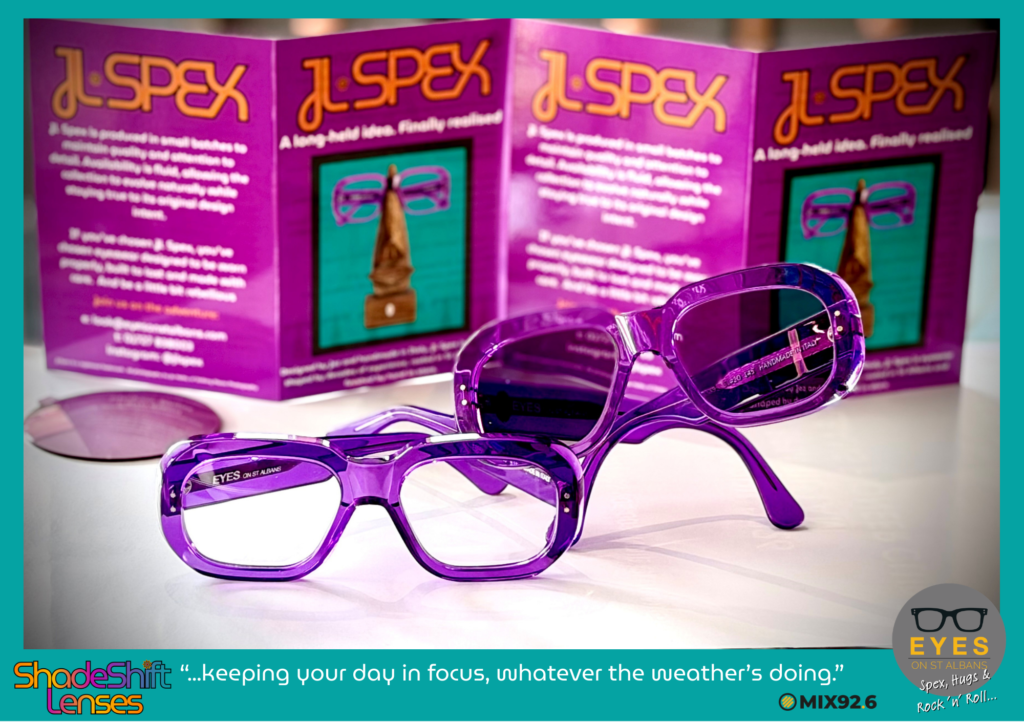
At EYES on St Albans we’ve taken this idea a step further with ShadeShift lenses.
Instead of just darkening to grey or brown, ShadeShift lenses can shift from completely clear to more than twenty different colours. Blues, ambers, greens and rose tones all add a little personality alongside the practical benefits.
And that’s where the Spex, Hugs & Rock’n’Roll part comes in.
Glasses should make life easier, of course. But they should also feel fun – colour does that!
Spring is often when people notice the benefit of colour-changing lenses most. The sun sits lower in the sky, reflections bounce off pavements and cars, and the brightness can feel surprisingly sharp even on cooler days.
Instead of swapping between glasses and sunglasses all day, your lenses simply adapt as the light changes.
You step outside, they darken.
You walk into a café, they clear.
No rummaging around in bags looking for sunglasses. No swapping frames every five minutes. Just one pair of glasses quietly keeping up with whatever the British weather decides to do next.
For people who remember the slower lenses from years ago, the difference can be a bit of a revelation.
Technology has moved on.
And with spring sunshine (oh, what are we saying, let’s keep building an ark, just in case) finally returning to St Albans, it might be the perfect moment to let your glasses do a little bit of the clever work for you.