


31 Oct 2025
In the subterranean depths of the Civic Centre, past obsolete steel barricades which would have been used in the event of a nuclear attack, and behind a nondescript door which offers no clue as to where it leads, can be found the secret eyes of St Albans.
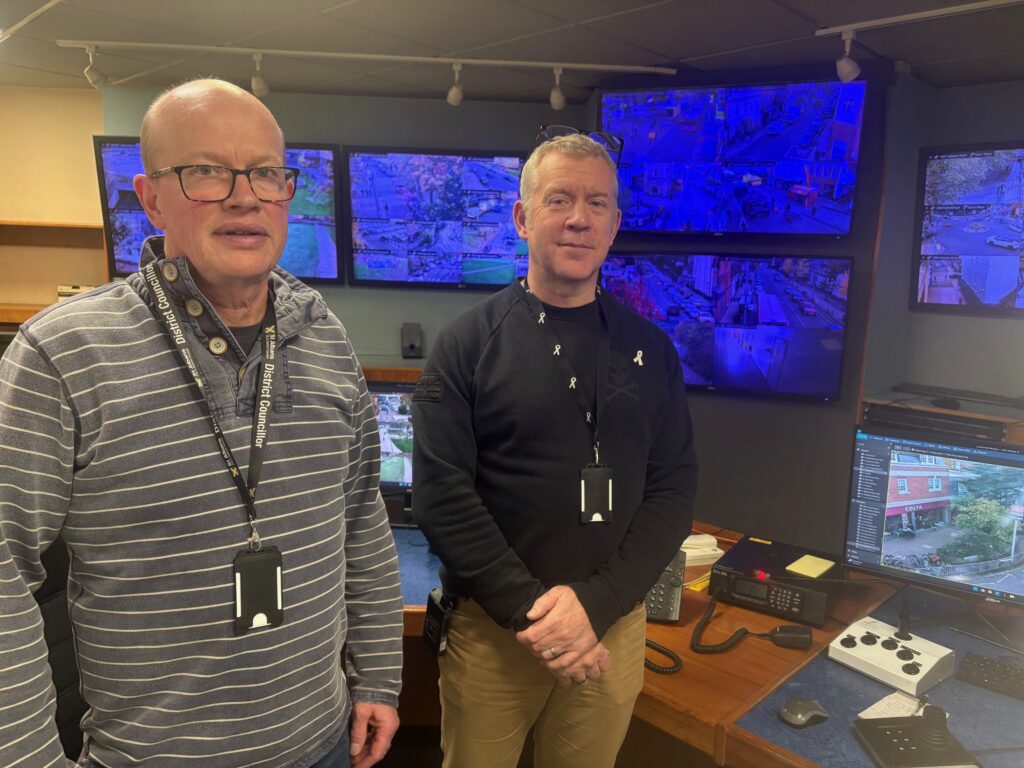
In a control room kept cool by the constant whirring of giant server fans is something akin to a super-villain’s lair, filled with dozens of monitors offering a fascinating insight into the daily lives of people living, working and visiting the district.
But instead of being used to plot world domination, this room is actually one of the frontline resources in combating crime and detecting disorder, protecting the public, and ultimately keeping everyone safe.
It is the control centre for St Albans’ CCTV network, overseen by a tight team of highly skilled operatives whose remit is first and foremost to ensure community safety – which means finding a missing child will always take priority over tracking down a shoplifter.
After reports from the police, these operators are the second highest source when it comes to spotting incidents of note, demonstrating their continued proactive monitoring pays off.
For example, for the period from April to the end of September, operators dealt with 601 incidents ranging from shoplifting and assault to locating a wanted person and concern for welfare incidents.
They were personally responsible for spotting three men wanted for robbery elsewhere preparing to rob a premises in St Albans, resulting in their arrests. They also saw two men running to fetch a machete and a metal pole following a fight outside Club Veeda nightspot, tipping off police so they could arrest them before the incident escalated.
Joined by SADC leader Cllr Paul de Kort, we were led down to the control centre by system manager Neil Kieran, who points out a Cold War escape tunnel leading to a trap door at an undisclosed spot in the city centre. It is actually still in perfect working order should the need for an emergency escape from the Civic Centre ever arise…
Neil explained how interactive the system is in terms of real-time responses: “We have access to the police band radio so we can update them very quickly, and we’ve also got a Shopwatch radio system which communicates with all the shops, churches and various officers around the area.”
The control centre covers central St Albans, Harpenden, Wheathampsted, London Colney and Redbourn, with 220 cameras located at various locations across the district. These are constantly reviewed to check they are still needed, or can be moved to another area if there’s an ongoing requirement.
To illustrate, Jubilee Square now has a camera providing a bird’s eye view from the top of one of the buildings, using a camera which was relocated from Telford Court because the site is being redeveloped. Batchwood Hall is another example of a location which no longer needs a camera since the nightclub shut its doors.
In Harpenden, the town council paid for the installation of cameras in Rothamsted Park to deal with repeated incidents of anti-social behaviour which are now monitored by the team.
To offer a comparison with other locations in Hertfordshire, Three Rivers council has just 11 cameras across the whole district, highlighting how much importance SADC place on their resource.
The office space is divided into the main camera room and a replay suite used for researching past events and editing footage into some sort of narrative. The whole system has its own secure internet connection with an encoded dedicated wi-fi link, with security and anti-virus measures updated constantly to ensure it cannot be accessed externally.
The equipment used is state-of-the-art, with the ability to zoom in from a camera located at the top of Chequer Street and read car licence plate numbers at the crossing for Westminster Lodge in staggering clarity. They also have the ability to implement facial recognition technology, but have yet to get it up and running, although it’s unlikely to be long before it’s in operation.
Thanks to a new arrangement with a 4G provider they have been able to expand into areas where they previously didn’t cover, like the bridge over the railway station which enables them to see people jumping over the barriers, all the way down Victoria Street and across The Quadrant.
As we’re looking in on a live working environment, one of the control team shows us a view from the top of the Cathedral of a man being arrested in Sumpter Yard. He had been acting drunk and disorderly in St Peter’s Street and officers asked the CCTV operators to track him down.
Another incident kicks off outside Tesco Metro, with an obviously inebriated man becoming increasingly aggressive after being ejected from the store by security staff.
“I saw him earlier today drinking, and he’s obviously had a lot by now,” says the operator.
Neil explains: “We obviously can’t hear what’s being said but we’ve got an angry person there, he’s putting off quite a few people from going into the shop and it’s also going to impact on the Tesco staff, who might not be used to having somebody shouting and screaming in their face.”
Having realised his efforts to get back into the store are futile, the drunk eventually staggers off down St Peter’s Street, and I spot my partner popping in to Tesco for some shopping, highlighting just how unaware we all are of the cameras above our heads.
Apart from reacting to what they see unfolding before their eyes, the team also take a proactive approach to other incidents: “On average we catch one drink-driver a month. Operators will call the police is they see someone exiting a pub who looks unsteady on their feet and is getting into a vehicle, or even if someone seems worse for wear the next morning.
“There was a gang we spotted who were robbing mobile phone shops and all wore virtually identical clothing – masks, black trousers etc – and we alerted police just before they went into a city centre phone shop so they were able to arrest them.
“At night it’s a very different environment, we’re getting a few more people coming in from outside the area because other towns are turning them away from their nightclubs, which is resulting in a few more assaults.
“We look at bus stops and takeaways, because they’re flashpoints for incidents, but we are also aware of suspicious behaviour like people being robbed in the queues for pubs.”
Although the service is funded by council taxpayers, it does its bit to generate extra revenue by charging insurance companies for footage of accidents, and by monitoring the Welwyn Hatfield area on behalf of their borough council. Efforts by the Conservative group on SADC to reduce the service earlier this year were firmly rebuffed by the Lib Dem administration, who are champions of what it can achieve.
Cllr de Kort says his party is keen to maintain the full extent of the operation: “It’s important to recognise that it’s not a statutory service, and a huge amount of councils aren’t maintaining it to the same extent we are – Broxbourne has about the same size city centre as St Albans but Three Rivers are clearly not spending what we are.
“The funding decision is discretionary each year – the officers will tell us how much we are spending on CCTV and we then decide if we want to maintain it, reduce it, or as in recent times increased the spending.”
Neil adds: “The council has committed to a consistent improvement budget which allows me to keep all the technology up to speed, for monthly checks on every camera, and ensuring we have an operator present at all times. The only other way to go is like Broxbourne, where they are record-only, so can’t respond to any live events and just provide historical footage.
“It’s really important to stress that it’s not just the number of cameras we have in place, it’s the two-way response system we use, so we can direct the police to incidents, businesses can call in to report things, and that ultimately means the detection rate for offences is much higher than with static cameras.”
Surely offenders are aware of the CCTV coverage in St Albans and react accordingly? “People think if a camera’s facing a particular direction then it’s not recording them, but we can use cameras to record other cameras, and because normal shoppers don’t tend to pay attention to them, one of the things we will look for is people looking up at a camera to check where it’s facing and other suspicious behaviours.”
The operators also keep up to date on changes in legislation such as the new Martyn’s Law, aka the Terrorism (Protection of Premises) Act, which requires organisations and publicly accessible locations to bring in security measures in order to reduce the risk of a terrorist attack in the wake of the Manchester Arena bombing.
One of the public’s biggest requests is an increase in frontline policing, the idea of “bobbies on the beat” patrolling local neighbourhoods, which is something that has been introduced by local stations. But what makes these even more effective than just wandering the streets looking for trouble is the targeted support they receive from the CCTV operators.
“It’s all about time and efficiency,” Neil adds. “A lot of time offenders will plead guilty because the police can produce CCTV evidence which we provided, and this never shows up as evidence so we can’t claim credit for it, but it is used in the interview which makes all the difference.”
Far from a Big Brother watching our every move, the district’s CCTV operation is ultimately another partner in the efforts to protect the public, and seeing exactly how it functions confirms the benefit of such a resource in our city, towns and villages.
Further evidence comes in a testimonial from St Albans neighbourhood team sergeant James Keene, who adds: “The network of CCTV cameras in the St Albans district is incredibly beneficial to local policing, especially in keeping people safe and to prevent and detect crime.
“We are very fortunate to have such widespread coverage through high quality cameras, 24/7.
“There is a strong working relationship between the highly skilled and experienced CCTV operators and local officers. They support us with monitoring live incidents, can review footage retrospectively and work proactively by continuously surveying the area – they do not hesitate to inform us if they discover something that doesn’t seem right!
“Local officers can communicate directly with the CCTV operation room which ensures information can be shared directly and instantly; it truly is an invaluable tool for us.”
