20 Jul 2025
Elena Hogg, founder of local culinary company FOOD by Elena, celebrates the complex fragrance and flavours of basil.
Basil hates me. Any basil plant I’ve ever owned has invariably died within days, no matter how shady or sunny the spot it inhabits, the amount of water I give it,
or the level of tender care I bestow upon it. The feeling is, however, not remotely mutual. Basil is one of my absolute favourite herbs.
It’s often associated with Italian cuisine and, the half of me that’s genetically Italian thinks it’s quite fitting that such a punch-packer of a herb be used so prolifically in Italian cooking. Italy has one of the most unapologetically riotous cuisines I’ve come across, with powerful, garlicky, herby flavours abounding.
Basil fits right in.
Flavour-wise, basil is often deemed somewhere between black pepper, mint and anise. Botanically, it is part of the mint family, and so this comparison is to be expected. But where mint is bright and zingy in flavour, basil hits lower tones, with spicy notes and some sweetness too. It’s more complex than its minty counterpart.
The smell is almost better than the taste: fragrant with promised sunshine (in flavour if not in the meteorological sense). Much like the vine of ripe tomatoes, the smell of a sprightly basil plant transports me immediately to my childhood holidays in Italy.
I remember mealtimes in Poggio Murella, the hilltop village where my aunt Jo and uncle Maurizio lived in a beautiful stone house with a large, fecund garden that overlooked a steep, olive-tree valley. They owned one half of this valley and the olives it bore would be taken for hand-pressing nearby and yielded many bottles of cloudy green oil.
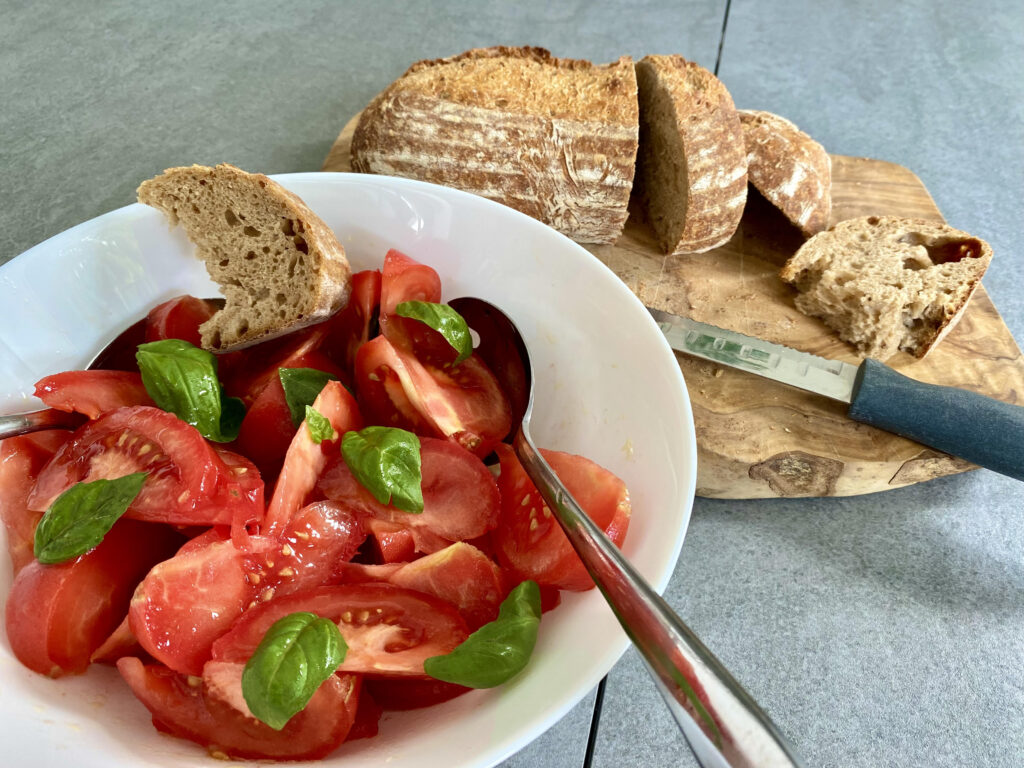
This same oil would be drizzled over plump tomatoes grown in the garden, which in turn would be scattered with basil leaves grown in the pots placed along the stone wall flanking the garden.
We’d lie on this wall in the evenings around August 10th – the night of San Lorenzo – which is when shooting stars are said to be most visible. The pitch black of the valley falling away beyond the low wall provided the perfect conditions in which to spot a fleeting flash of starlight. I never saw many, though, because while the stone wall was picturesque, it wasn’t overly comfortable.
Returning to basil and the inspiration my aunt‘s cooking provided, I often now use an entire stalk from the basil plant, with leaves attached, to sit in a bowl of salted tomatoes drizzled with oil, mixing every so often for an even infusion, and sniffing the bowl deeply as I do. Why the whole stalk? Basil leaves have one fault: they’re not very robust and will discolour and shrivel fast once no longer basking in the sun on a Tuscan stone wall, attached to their plant.

Fishing wilted basil leaves out of the tomatoes is a thankless job and so using a whole stalk provides perfume without the painstaking aftermath. You just pull the whole stalk out in one go.
Clearly, when it’s time to eat, a fresh handful of basil leaves can be thrown in for immediate consumption and for that unmistakable, aniseed hit. And when the sad reality dawns that the tomatoes are all gone, there’s a salty, basil-y brine at the bottom of the bowl begging for a piece of bread to soak it up.
Basil is at home in pasta dishes, on pizza or bruschetta, in salads and pesto, and anywhere at all a tomato goes. But it’s a dark horse, our basil, and you may not know how beautifully it complements strawberries.
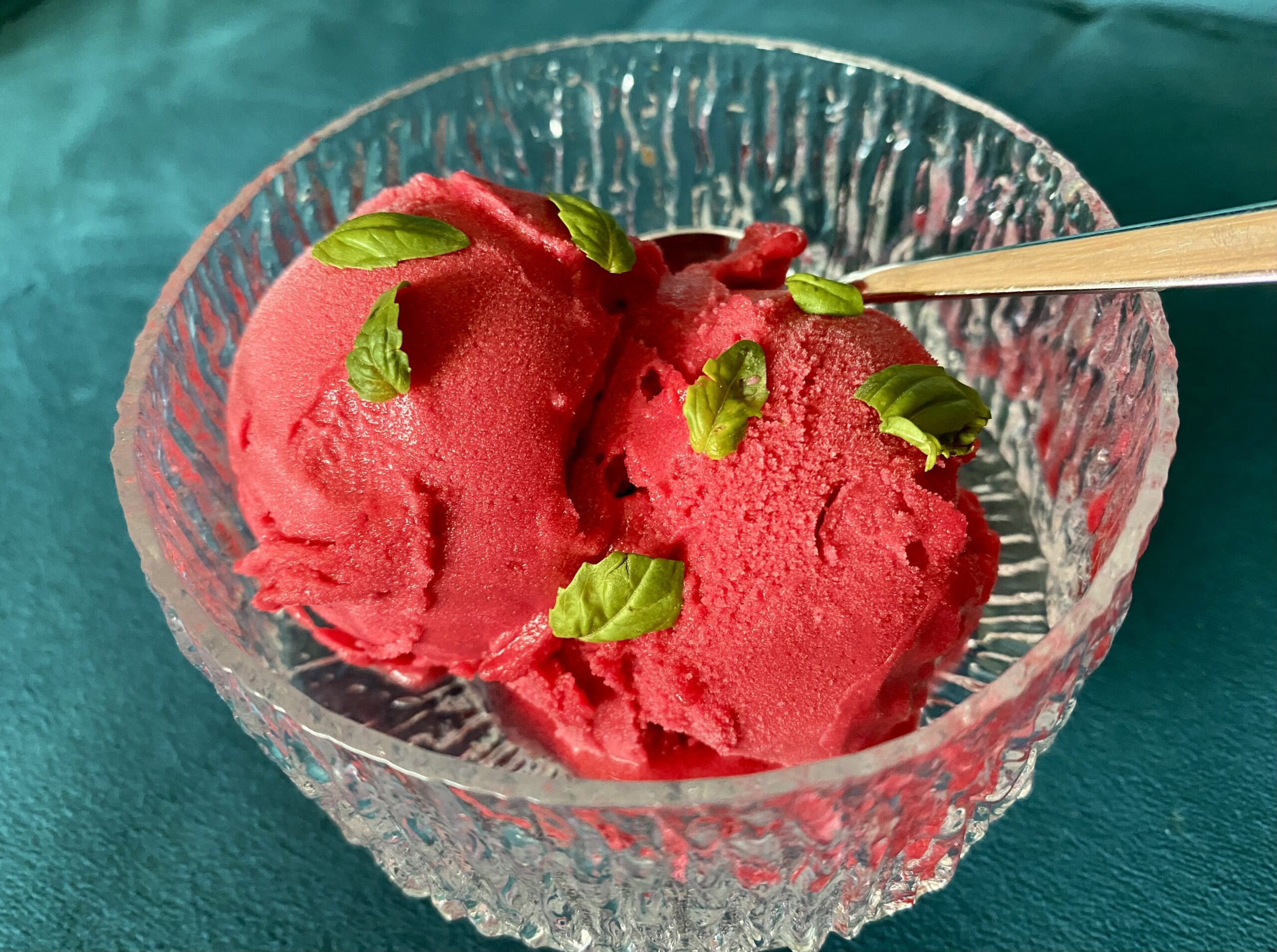
I once had a gin cocktail that was made with strawberry purée and festooned with small basil leaves. But it wasn’t the alcohol content that felt intoxicating; it was the heady combination of sweet fruit on the tongue and herby fragrance on the nose. The effect was quite dizzying and I have tried to recreate it in a strawberry and basil sorbet.
Hull about 300g of strawberries and chop them roughly into a bowl. Add a good squeeze of lemon juice – perhaps half a lemon’s worth – and a grind or two of black pepper if you’re feeling cheeky. Add about 100g of caster sugar (taste your strawberries for sweetness first and add a little more or less accordingly) and a stalk or two of basil and let everything sit and macerate for about an hour, mixing frequently and swapping the spent basil stalks for fresh ones halfway through.
Tip the contents of the bowl into a sieve over another bowl, and use a big spoon to push as much juice as possible through the sieve. Discard what’s left in the sieve and pour the pulpy juice into a freezer-proof container. Find a space in the freezer for the container to lie flat (which is probably the trickiest part of this recipe if your freezer is anything like mine) and, as ice crystals start to form round the edges, use a fork every hour or so to break them up and bring them into the centre. Repeat this process over the next several hours till it’s all mostly frozen – you don’t want to start this recipe too late in the day or you’ll be mixing sorbet in the wee hours.
To serve, allow the sorbet to warm up for ten minutes out of the freezer and use an ice cream scoop to make balls. Accompany with a shortbread biscuit and a scattering of shiny, young basil leaves, and assure your potentially confused guests they will love what they’re about to eat.