26 May 2025
Imagine a device, small enough to hold in the palm of your hand, with no internal power source, yet capable of broadcasting half-way around the globe. Then consider how such a gizmo might have been used during the dark days of the Cold War to reveal international secrets which shaped the course of world politics.
The stuff of spy novels, surely? But the truth behind ‘The Thing’ – known as SATYR in official circles – does indeed prove stranger than fiction.
How its existence was discovered, theories about its creation, and steps to retro-engineer and ultimately block its use are the subject of a new documentary by St Albans filmmakers Ben Kilner and Emily Barnard.
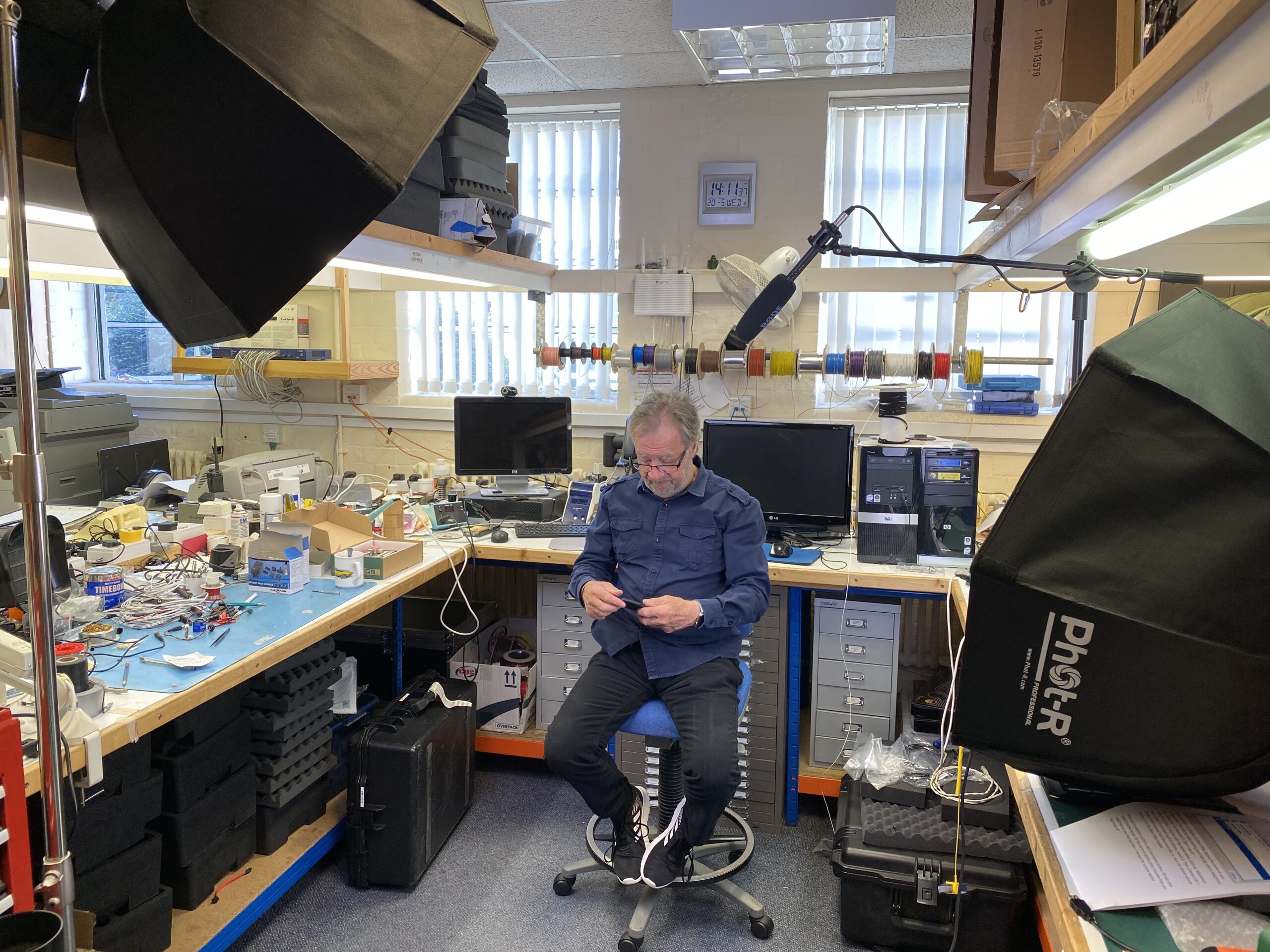
They have spent five years working on ‘The Thing’ alongside Technical Surveillance Counter Measures (TSCM) expert John Little, who has spent his career manufacturing equipment for counter-espionage purposes.
Ben, who has known John since 2012, explained: “Basically he works for the good guys but has to identify what the bad guys are up to in order to stop them. The stories he tells are phenomenal, I nicknamed him the local James Bond when I first met him because of all the stuff he got up to at various levels.
“He’s a proper engineer and absolutely pin sharp in terms of intelligence and his passion; everything he works on has to be perfect, it’s got to be the absolute best, and that’s the engineer within him.”
Although Ben reveals how John is one of the few people with contracts in certain parts of the world that he’s allowed to deliver in the UK, he isn’t sure how much detail he can actually disclose.
“But that gives you an idea of not only the quality of work, but also the standard that he’s held up to.”
From their initial meetings as consultant and client for Ben’s creative agency Oomph, their relationship grew over time, initially working together on a company which focused on sweeping for electronic bugs everywhere from houses and office blocks to boats and planes.
“Then in 2020, just pre-pandemic, he contacted me and said, ‘Look, I want to make a documentary about something called The Thing, codenamed SATYR.”
The true name of the device was released in breach of the Official Secrets Act in the exposé Spycatcher, the memoir of former MI5 officer Peter Wright, released in 1987 to the embarrassment and fury of the Thatcher government.
British scientist and ex-Marconi technician Peter had run the investigation into The Thing, also known as the Great Seal bug, but John wanted to tell the story of his involvement and the research he had conducted over 50 years.
But days after Ben and Emily agreed to make a documentary, the country went into lockdown, and so they had to set up a camera for John to explain further, while they watched remotely.
“He went on for about an hour and a half and gave us this almost PowerPoint-style presentation – I said, ‘Stop, stop, stop, stop, you’ve got me, I’m really interested!’ In fact I was no further forwards because his brain goes from here to here to here to here, so we had to sit down with him and go through the whole thing to find out the detail behind it.
“We then listed the bullet points he’d told us, and used these to establish different parts of the story. It took five years, because the day job is the main job, so it was a case of finding the time to deliver on it. But we built up the story, put it into chapters, and made it sequential.”
Part of the filming took place at Bletchley Park and in the National Computer Museum, where John originally had his office, which now contains part of the Enigma Machine.
“It was just into lockdown, so there was literally no one there and was amazing, absolutely incredible to see all this stuff.”
Ben freely admits having to make some assumptions to fill in narrative gaps, but says this relied on using John’s intellect and level of research and detail.
“He freely admits there’s a period of time where he’s not really sure what happened between this and that, but there are only so many ways and so many permutations you can use to get there, so he’s done all of that to bridge the gap.
“You can now get a real idea of how the whole thing moved forwards and involved America, the USSR, the UK and I’m sure others. It involved people like the Cambridge Spies, Peter Wright and [computing pioneer] Tony Sale.”

The Thing was a listening device concealed in an American Seal given by the Soviet Union to W. Averell Harriman, the United States Ambassador to the Soviet Union, on August 4, 1945, and put up in his study, just weeks before Churchill declared that an Iron Curtain had divided the West and the East.
The seal was presented by a delegation from the Young Pioneer Organisation of the Soviet Union as a “gesture of friendship” to the USSR’s war ally. It hung in the ambassador’s study at Spaso House in Moscow for seven years, until it was accidentally uncovered and exposed by a radio operator at the British Embassy.
“It was a UK listening post that found it. They recognised the voice and the Americans went in and did a big sweep, which was when they found it in the Seal.”
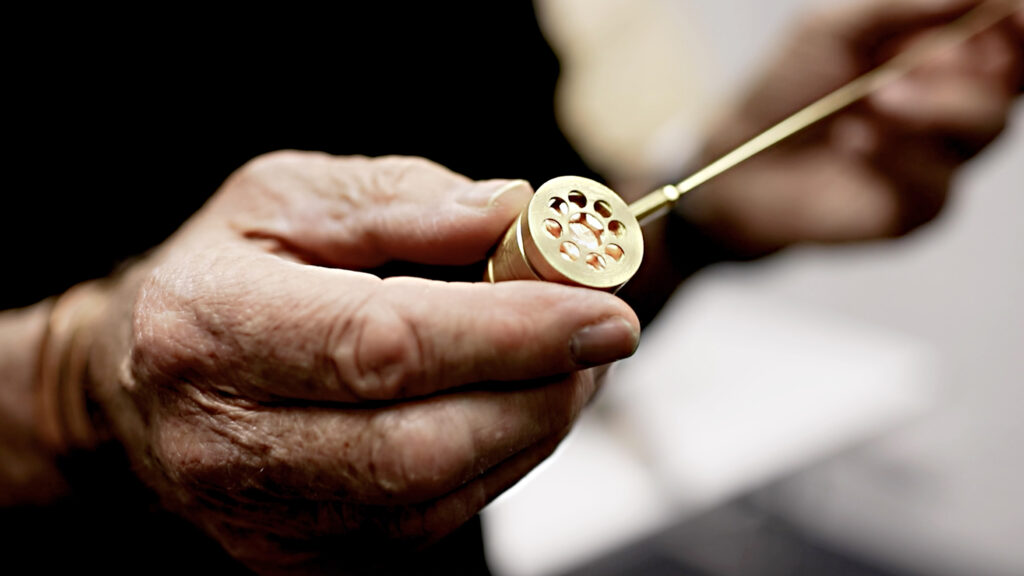
Ben explained: “The device itself was so incredibly clever, and to this day John says he doesn’t know of anything else ever being designed like it. It doesn’t need any form of external power or have any electronic components…”
He freely admits that the technical details of The Thing are beyond his comprehension as a non-scientist, but in layman’s terms, it seems it needs electromagnetic energy from an outside source to become energized and active. This means it only functions when a radio signal of the correct frequency was sent to the device from an external transmitter, which then allows it to pick up sound waves which can be picked up by a radio receiver using the right frequency.
The Thing was designed by Soviet inventor Leon Theremin, known for inventing the electronic musical instrument which bears his name. it weighed just 31g, and consisted of a 23cm antenna attached to a ‘can’ measuring 17.5mm long and 19.7mm wide, so it was very small indeed.
“Initially at that time John reckons its range was about 1,000 feet, but John has designed a modern version you can listen to half way round the world. He combined Leon Theremin’s genius with John Little’s genius, and magnified its original range.
“A lot of that is to do with how you actually pick it up now rather than what it generates, so it’s more the pull than the push.”

John found out about the device when he was working at Bletchley Park in offices next to Wright and Sale, who were trying to replicate it and create a British version, later known as SATYR.
“That’s where the passion came from – these were really super bright people and John became fascinated by their work.”
It was subsequently mentioned following the 1960 U-2 mission as proof the Russians were also spying on the Americans, and involved the Cambridge Five spy ring prior to their defection to the Soviet Union.
“When you start to realise the spread of it, all the links and how everybody knew everybody it is quite incredible. The whole thing’s interweaved and actually dates back to the Russian Revolution when Leon Theremin went to live in America.
“My focus on this from a documentary point of view was to get John’s take on it rather than know how it physically works. I’ve seen how it works, but I couldn’t tell you why, it’s beyond my capacity and capability.
“What I know now is literally puddle deep in comparison to the depth of knowledge John has, but I love the human element of it.
“For me, it’s not about East versus West or the US and Russia, it all comes down to who can you trust or can you trust nobody?
“Which is quite a bleak thought if you think about it.
“The good thing about unearthing this kind of story is it’s fascinating from a historical point of view, but the downside is that you think, ‘Oh my God what’s happening now, and what else was going on at the time?’”

The 35-minute long documentary premiered at The National Museum of Computing at Bletchley Park last week, with a second screening in September after the first sold out in just 72 hours.
“I had no idea what the interest level would be as it’s a niche market, and I thought we might have to work really hard with the marketing circles, but we didn’t do anything other than get the poster done and send information out on social media, so it was a bit of a surprise.”
The next step is to see if any TV companies would be interested in picking up the story.
“I think we’ve only really touched the surface, but we didn’t have the budget to go any deeper. I hope that we get the information across to the viewer for them to disseminate, and if they’re interested then they can look into the technical side of things.”
He added: “I’ve thoroughly enjoyed working with John and just being in his presence, actually.
“He’s a really, really lovely guy, and he’s not aware of his genius, so there’s no arrogance to him, there’s no ego attached…
“He just knows his shit I think is the technical term!”