18 Feb 2025
Elena Hogg, founder of local culinary company FOOD by Elena, shares her tips for the perfect roast chicken…
I’ve started buying fewer packs of individual chicken pieces, such as breasts, thighs and drumsticks, in favour of the whole chicken. I’ve come to realise that not only is this a more cost-effective way to enjoy chicken, but it’s more time-efficient too.
For, say, about an hour and a quarter in the oven, you get a substantial amount of resultant food, especially if you also tossed some veggies into the roasting pan halfway through. When you consider that you’re free to do other things while the chicken cooks in the oven (aside from a few bastes if you remember to do them), whole chickens make for a favourable time/effort/output ratio. And certainly compared with packs of chicken breasts, we can add cost to that ratio, too.
That said, low cost isn’t something I look too hard for with chicken. I’d rather eat it less often (which I do compared with, say, ten years ago) and buy free-range or organic. I won’t wax lyrical about how much nicer free-range chickens are to eat, because for me the flavour is largely similar. And as for texture, although you don’t get any nasty sponginess in the meat from a free-range chicken, the darker meat can actually be quite a bit more sinewy, no doubt because the bird actually moved its tendons and muscles while alive.
But the overarching reason I steer clear of low-grade chicken meat is that I simply cannot un-know what I’ve learnt over the years about battery farmed chickens, and so I cannot buy them. I’m happy to spend the extra in the knowledge that on the occasions we do eat chicken, it’s higher quality meat raised far more ethically than its less fortunate counterparts.
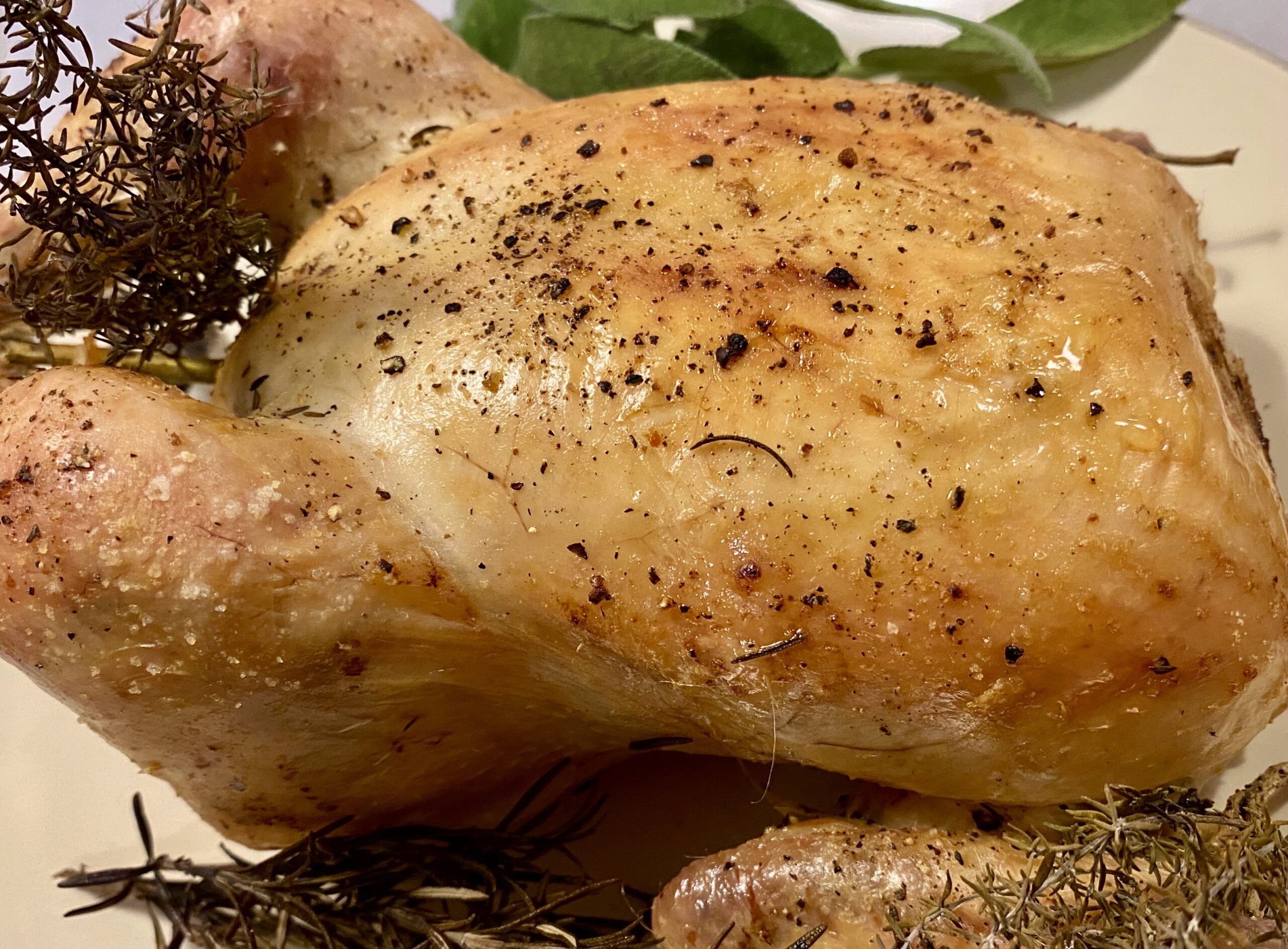
The first recipe that comes to mind for cooking a whole chicken is, of course, roasting it. Much as it’s a little pedestrian, it is without doubt my favourite way to eat chicken. From the heavenly smell that permeates the entire house as it roasts to the golden gleam of crispy skin as you pull it from the oven, my salivary glands reach frenzy-level and those all-important 20 minutes of resting time are torture.

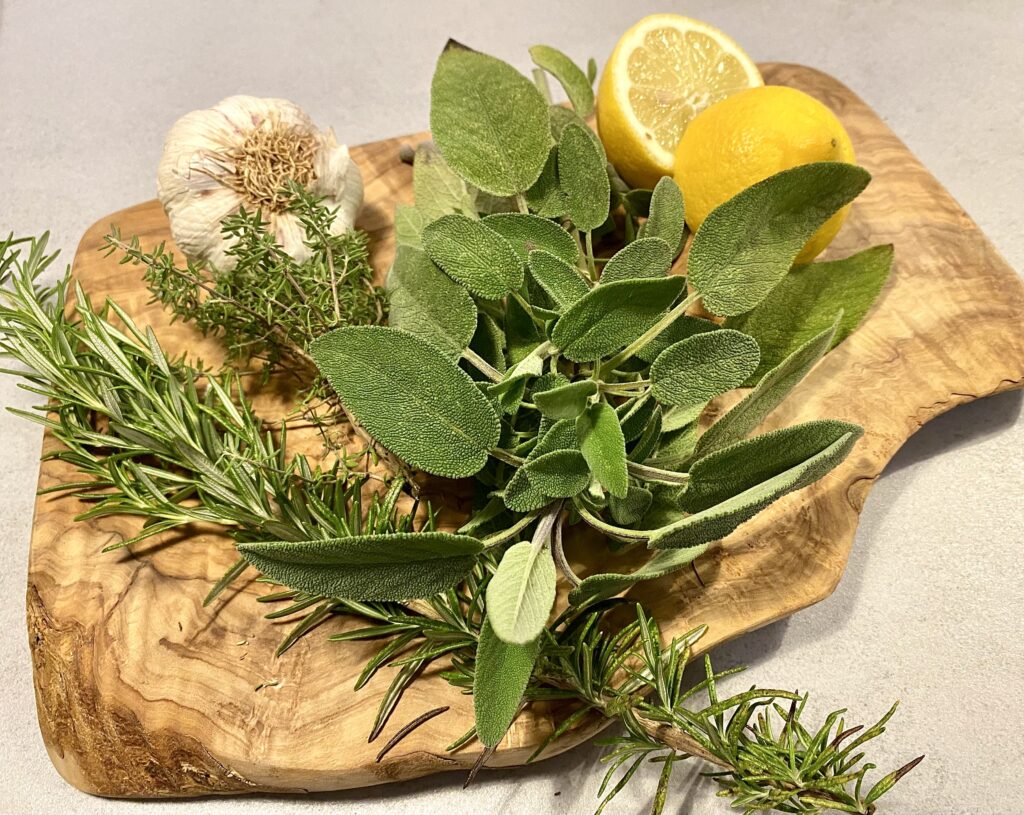
Part of the aroma is down to the spray of various herbs I like to gather from the garden to add to my roast chicken.
My favourite is thyme, but our thyme plant is always less proliferant than the sage and the rosemary, and because the latter two can produce a slightly soapy flavour, I am cautious with how much I use.
There are many strategies expounded by chefs of all kinds when it comes to the hallowed roast chicken. I’m certain they all have great merit: brining the chicken a day before cooking, resting the chicken upside-down to send the juices to the breasts, and there’s the to-foil-or-not-to-foil question, of course.
I remember following a recipe for a garlic-and herb-infused butter which had to be pushed under the bird’s skin to add both flavour and succulence to the meat, and help crisp the skin as well. It certainly did the trick, though the residual lake of butter in the pan after roasting was a stark reminder of how much less healthy your otherwise rather virtuous lean protein meal had become.
Talking of juices in the pan, these are always an excellent base for a jus. I know jus has a reputation for being a bit la-di-da, but growing up with an Italian mother means jus is normal and gravy is a strange and stodgy anomaly. These days I make something between the two: tip the pan juices into a pan via a sieve, but give the sieve contents a good press with a spoon so all the ‘Marmitey’ bits (as Jamie Oliver calls them) end up in the liquid and only things like spiky rosemary stalks or lemon pips remain trapped. You don’t want those.
Swirl the pan and have a taste.
Every starting point is slightly different, depending on what you used to dress the chicken before roasting. If you used a lot of citrus, for example, you might want to add some sweetness like honey or redcurrant jelly. If you need more salt, consider adding soy sauce or anchovy ketchup to add some umami notes as well. And in place of (or as well as) black pepper, a teaspoon of mustard gives a nice kick of heat.
But my best tip for you is this: when you roast the chicken, add a head of garlic with the tip sliced off so the individual cloves are exposed a little. Pop it cut-side down in the pan and let it roast along with the chicken. When it comes to making the jus-vy (that’s jus and gravy combined in case you’re confused), squeeze the garlic head so that the soft and unctuous cloves slip out and into the liquid.
Use a potato masher to break them down and, if you don’t like any texture at all, either whizz or re-sieve the contents. The faff is worth it, believe me: the roasted garlic adds richness and depth that nothing else quite can, according to my years of attempting to create the perfect jus-vy.
It’s sweet but peppery, strong but mellow, and helps thicken things up too.
A whole chicken doesn’t just give us jus-vy, you can make a delicious stock, too. I don’t mean from the carcass of the roasted bird – this gives a mild stock very much in need of extras to help boost flavour.
No, I mean poaching the whole chicken, which means you have really tender meat and a heady, steaming stock to eat with it.
Season and brown your whole chicken first, then add it to a casserole dish along with enough water to cover, adding some white wine if you have any open. Add some parsley stalks, bay and peppercorns, then simmer on a really low heat for half an hour.
At this point add some chunks of carrot, celery, leek, potato, courgette… anything that you deem comforting and chicken-friendly.
Once the chicken’s had long enough to cook through, about another 20 minutes, your veggies should be tender.
Remove everything from the heat and take the chicken out. Pull away the meat, adding it back into the broth, then add parsley leaves and ladle into your favourite bowl.
This is soul food at its best – zero pretention, maximum nourishment and full marks for being something you can make blindfolded and with whatever vegetables you have available.
Consider swapping the potatoes for rice, barley or noodles – whatever you find most soothing.
The potential to soothe us is possibly food’s most valuable superpower, and mine is certainly the joy I take in eating it. Even just a lowly poached chicken. Now where did I leave my cape?