04 Dec 2024
On 22nd May, 1455, for a few bloodsoaked hours, St Albans became the most important place in the kingdom.
The sound of clashing swords and war cries rang through the town. Our eye witness wrote that “sword wasagainst sword, shield against shield, the wounded with arrows in their throats, the whole street full of corpses”.
Our streets and alleys were full of men fighting for their lives. The blood spilled then was the first in what was to be a 30 year series of battles between royal cousins for control of the kingdom. We now know these as the War of the Roses – a very romantic name for such a vicious fight for the throne, known then as the Wars of the Cousins. And although Shakespeare referred to roses over 100 years later, it wasn’t until the 1820s that the name, ‘Wars of the Roses’, was used by Sir Walter Scott in one of his novels.
Why roses? These were just one emblem among many used by the opposing sides.
A common misconception is that the war was fought between the neighbouring counties of Yorkshire and Lancashire but this is not so. These were the names of the Dukedoms, the Houses. By the way, this isn’t a history lesson. We’re not going to drown you in historical detail. This is pretty much about what happened right here in St Albans.
So why here? Why did two battles disturb the peace of a bustling market town clustered around its Abbey?
During this period, the mid-late 15th century, St Albans’ population is believed to be around 1,500. The town was said to have remained neutral throughout the war. But its location put it right in the path of armies on the move. Just 20 miles from London, straddling a major route between the capital and the northwest, St Albans had been accommodating travellers for centuries.
The Abbey itself was Benedictine with a tradition of providing free accommodation to its pilgrims so Abbey hostels lined the streets. At the Abbey itself, there were fine quarters kept specially for important guaests. King Henry VI and his entourage were frequent visitors. The Abbey was also home to our eyewitness, Abbot John of Wheathampstead. He was present for both battles and wrote a searing record of events.
The Abbey’s power stretched out beyond its walls. Where now stands the Museum + Gallery, once stood the Moot Hall, the meeting place of the Abbot. On 22nd May 1455, anyone in the Moot Hall would have heard the clamour of around 2,000 of the King’s men. They encamped in front of it, setting up the Moot Hall as the King’s Command Post.
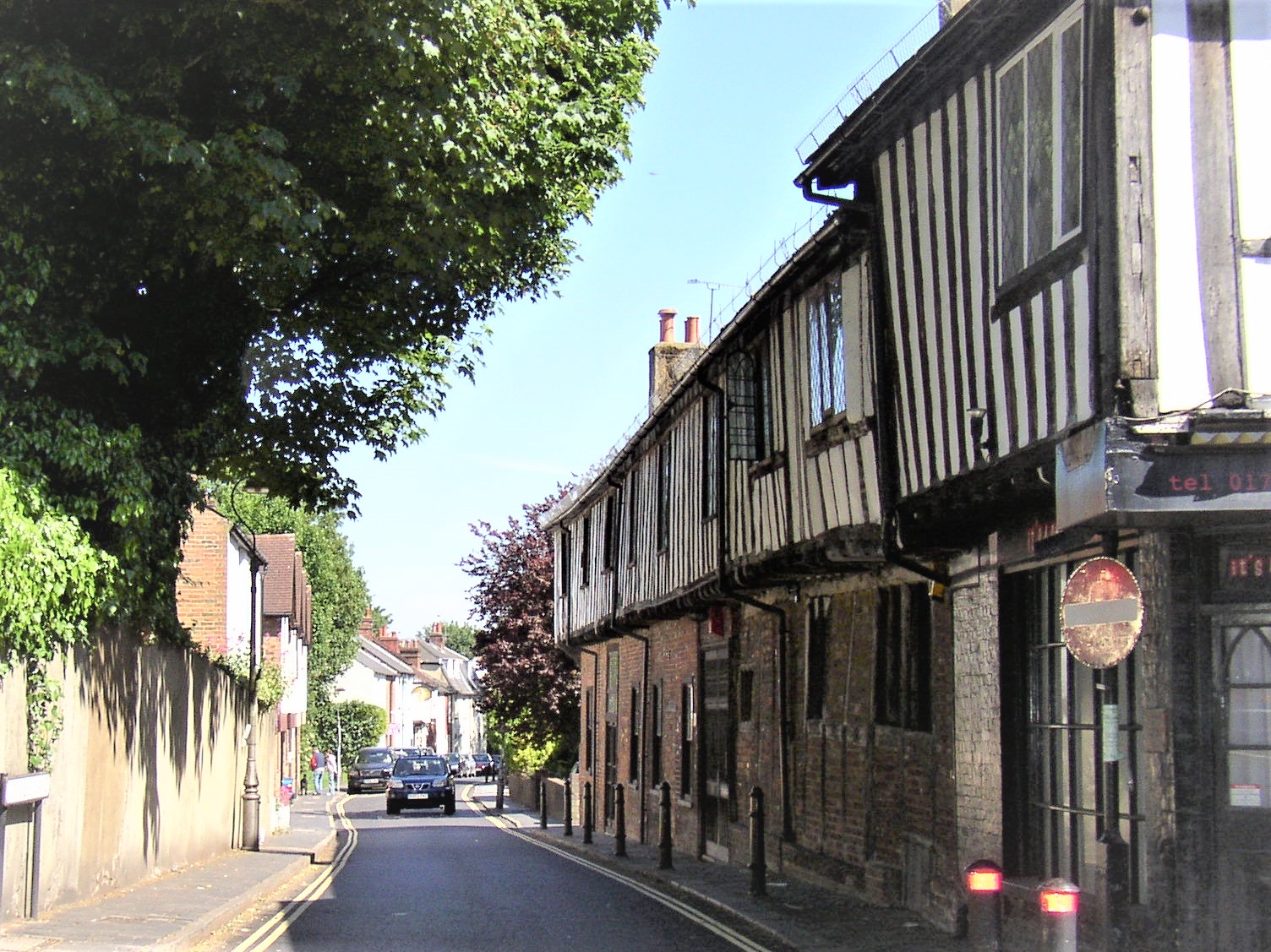
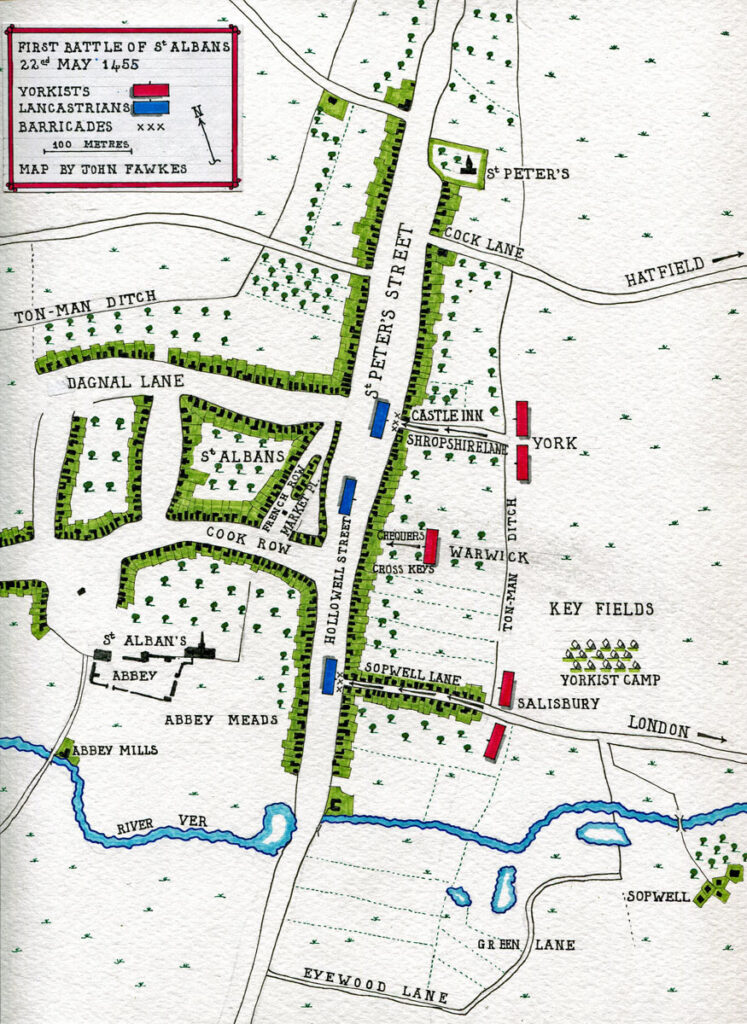
Imagine standing amongst the noise and bustle of the King’s camp, looking towards what is now Victoria Street. Known then as Shropshire Lane but also locally as Butts Lane because further down were the archery butts. By law, all men between 16-60 had to practice archery. Many of the timbered houses looking onto the King’s camp would have had long backyards containing outbuildings, hen houses and vegetable beds. These long backs ran down around 150 yards to the Tonman ditch. This was a defensive ditch which ran around most of the town – around 3 ¼ miles. Believed to be 15ft deep, 20ft wide. Probably topped with wooden stakes.
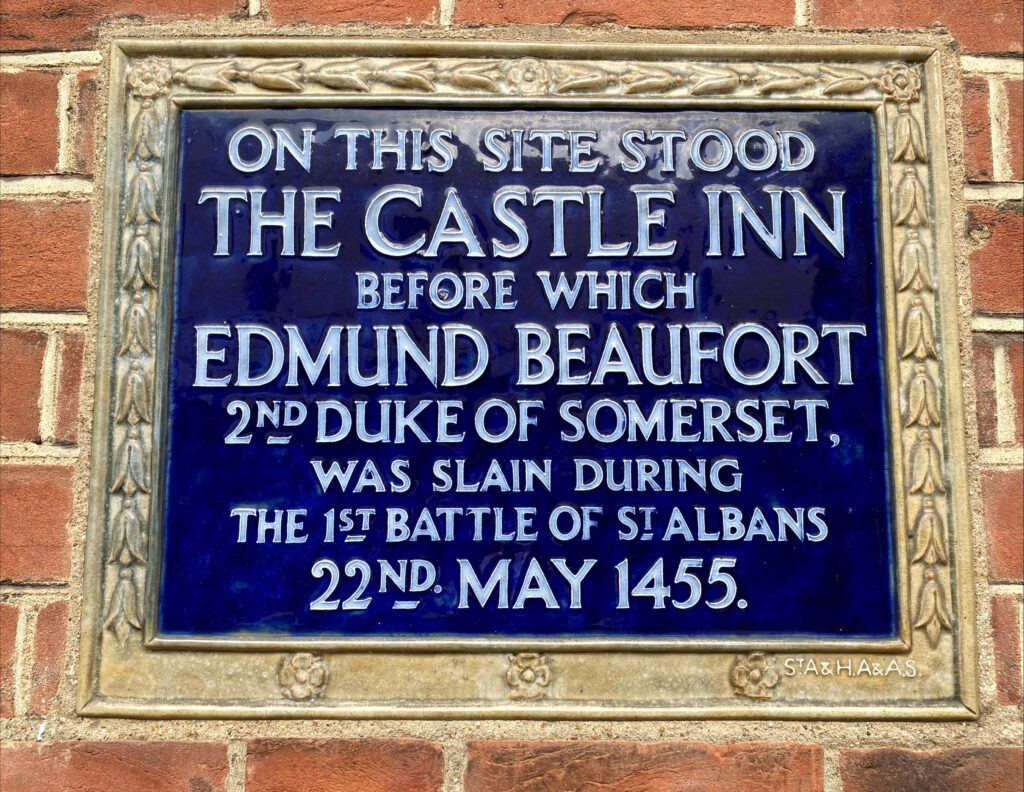
The Castle Inn once stood on the corner of Shropshire Lane. A defensive barricade is believed to have been erected just by the inn wall. Further up was Cock Lane, now Hatfield Road. The Cock Inn, which gave the road its name, was used as a dressing station during the battle. In later years, its floor was made of bones and urban myth said that these were from the victims of that battle. But they were later found to be animal bones.
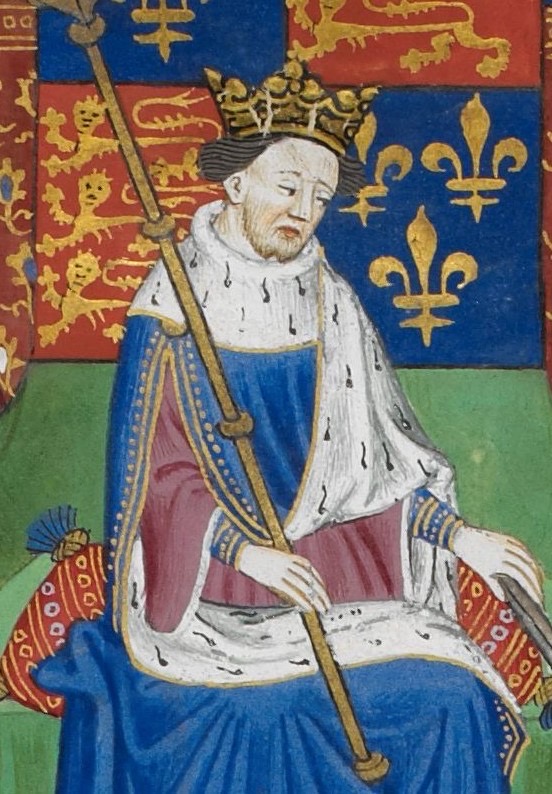
Why are the King’s men encamped here on Thursday, 22nd May, 1455? This is the point our main players enter the scene. The House of Lancaster is on the throne in the form of Henry VI – seen as weak, easily led by favourites and prone to bouts of what appeared to be madness.
Two years before the battle here, Henry suffered a severe mental collapse. So, another very important main player enters the stage, his royal cousin, Richard, Duke of York.
York was appointed Protector of the Realm and was quick to exploit his position to make life difficult for his main rival at court, another royal cousin, Edmund Beaufort, Duke of Somerset. York imprisoned him in the Tower of London.
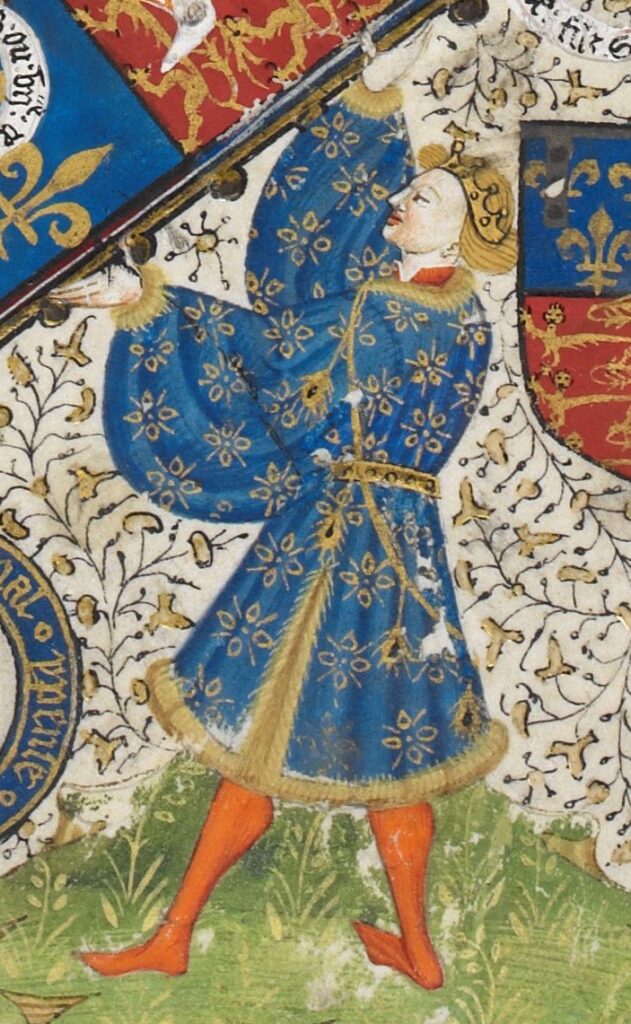
But Henry VI recovered, Somerset was released and returned to favour. Richard of York prudently withdrew to his northern estates where he and his allies, the Nevilles quietly trained and prepared their men. Tension between the two Dukes and their supporters festered and grew. Things came to a head in May 1455. A great council was called at Leicester, apparently for the purpose of reviewing York’s loyalty. Richard, Duke of York was under threat. When the King’s court left London for Leicester, York and his men headed south. On 22nd May, 1455, the two forces met here in St Albans. And all hell let loose.
The Yorkists had around 3,000 men in fields on the east side of town. Although he proclaimed loyalty to the throne, York asked that the Duke of Somerset, the ‘King’s evil advisor’ be surrendered to them. There was a flurry of negotiations which came to nothing. And the Yorkists prepared to fight.
Sometime between 10-11am, Yorkists launched simultaneous attacks against the King’s defences. Their archers first sent down a deadly rain of arrows. Some of the King’s men were woefully unprepared – scrabbling to put on their armour.
In Shropshire Lane, the Yorkists, led by the 5th Earl of Salisbury, a Neville, tried to break through defences. But at first they were repulsed. Then his son, the young Richard Neville, Earl of Warwick broke through the Tonman ditch defences. His men hurtled through backyards of the houses shouting Warwick’s name.
Imagine hens scattering in fear and parents fearfully dragging their curious children inside. They pelted up Chequer Street, coming up behind the defenders. There was fierce hand-to-hand fighting in St Peter’s Street as the Yorkists converged on the King and his standard.
Edmund Beaufort, Duke of Somerset was trapped in the Castle Inn. He and his men came out fighting but they were surrounded by Yorkists. Somerset was said to have killed four men before being cut down by an axe.
At the Clock Tower built 50 years before this battle, imagine the bell ringer frantically ringing the great bell, Gabriel to warn the townspeople of danger. They would be running for cover, making sure their womenfolk were out of view, slamming shutters closed, blocking doors, trying to stay safe.
In a simultaneous attack, Yorkist soldiers had broken through Lancastrian defences in Sopwell Lane. They fought their way uphill to join the mêlée by Shropshire Lane. A shower of lethal arrows hit the King himself in the neck, forcing him to take shelter in a baker’s shop. His chief negotiator, the Duke of Buckingham was hit by arrows in his face and hand. Henry Percy, 2nd Earl of Northumberland, (son of Hotspur) was killed in the Market Place. After that, it didn’t take long for the fighting to end.
So what came next? This first battle resulted in victory for Richard, Duke of York. It is now seen to be more of a skirmish, compared to what came later – out of 5,000 men, only around two hundred were killed. But it was the trigger which set off a 30-year trail of bloodshed. York’s main rival, Somerset was dead. As were Clifford and Northumberland, other noble supporters of the King. Their families vowed revenge and the wheel of vengeance began slowly to roll.
The King had little choice but to forgive York and the Earl of Warwick. York was reinstated as Protector of the Realm. He was always very careful to say he was loyal to the King and the blame lay with the King’s evil advisors. It wasn’t the first time that ‘evil advisors’ had been blamed and it certainly wouldn’t be the last.
The townspeople and monks of St Albans quietly put their lives together and prayed that they would remain safe in this conflict between royal cousins, but, six years later, the armies were back. And this time, the consequences for St Albans were much more severe.
What happened? An uneasy peace existed for a few years, then things kicked off again and by 1460, Henry VI was back in captivity. Richard of York had tried to seize the throne. He failed but was able to extract an agreement that he and his descendants would inherit the throne on the death of Henry VI. This disinherited Henry VI’s own son, Edward of Westminster. This did not go down well with Henry’s Queen, Margaret of Anjou.
But later that year, Richard of York himself was killed at the Battle of Wakefield, as was his 17-year-old son, Edmund, Earl of Rutland, by Lord Clifford, apparently in revenge for the killing of Clifford’s father here. It is said that as Richard of York lay dying, Clifford presented him with a handkerchief soaked in the blood of his young son. Richard’s head was taken to the city of York where it was impaled on Micklegate as, later Shakespeare wrote, “York could look upon York”.
A main player was dead, but the fight wasn’t. The Yorkist claim to the throne now shifted to the oldest son, Edward, Earl of March, a very able commander of men. Strongly supported by Richard Neville, Earl of Warwick.
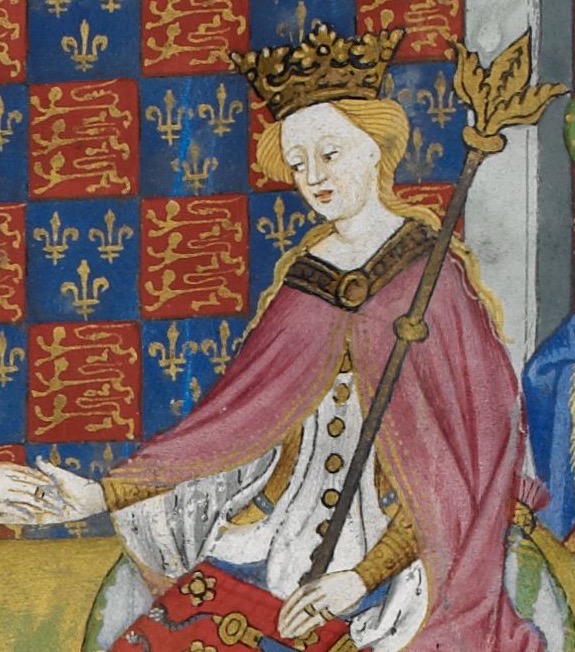
The main players weren’t just men. Certain women played a significant role and one of them was Margaret of Anjou, known as the She-wolf of France.
Just 15 when married to Henry VI, 10 years older, said to be beautiful, intelligent and brave but also ruthless. Certainly seen as stronger than her husband, so she sometimes ruled the Kingdom in his place.
Her son, Edward of Westminster, had been dispossessed. She was fighting for his inheritance. Henry had been captured by the Yorkists which is why Margaret was leading the Lancastrian army.
And on 17th February, 1461, she led the army in the Second Battle of St Albans. Also with her were the Duke of Somerset, Earl of Northumberland and Lord Clifford, all sons of the men killed at the First Battle of St Albans.
All looking, one imagines, for revenge.
Why was there a second battle here? After the Battle of Wakefield, the victorious Lancastrian army led by Margaret of Anjou, slowly moved south. Warwick, the most powerful Yorkist supporter, marched north with his men from London. St Albans was once more the place where the two armies clashed.
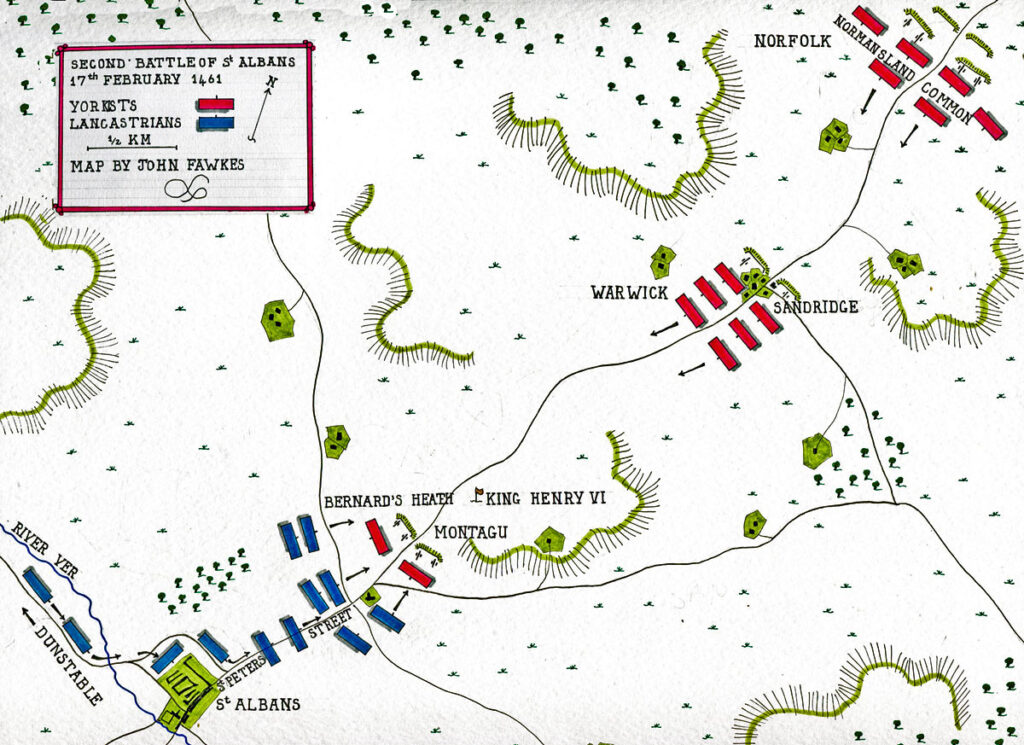
Warwick reached here first. He had around 6,000 men, the bulk of which were positioned to the north of town near St Peter’s Church, their backs to the town and their cannon facing north. This proved a fatal mistake.
The Lancastrians attacked soon after sunrise. From the south. They knew exactly where the Yorkshire defences were because these had been betrayed to them.
The Lancastrian army was said to have been nearly twice the size of the Yorkist forces. The Lancastrians stormed up George Street, past the Abbey. But the Yorkists had wisely positioned their archers in the windows of the buildings around the Clock Tower and they repelled the attack. The Lancastrians regrouped, relaunching an attack along the top of the town, (Folly Lane and Catherine Street) and outflanked the Yorkist archers. They, however, continued to desperately fight house to house for several hours. It was brutal.
The rear guard of the Yorkists stationed on Bernard’s Heath was now exposed. Everything went wrong for the Yorkists – their powder was damp which meant their cannons couldn’t fire. They were outnumbered, outflanked, demoralised and they ran for it.
Abbot John wrote that Lancastrians on horseback ran down fleeing Yorkists, viciously cutting them down. So many dead were left, there were not enough townspeople to bury them all.
Because what happened to the people of St Albans? Sadly, what usually happens to innocent bystanders caught up in other people’s wars.
Many had fled. Which was wise given what was to follow. Terrifying plundering, assault and destruction. The town and Abbey stripped bare.
Henry VI had been released from capture by his victorious men. On route to his quarters in the King’s Lodging at the Abbey, Henry was intercepted by Abbot John who begged the King to order the looting and violence to stop. Which he did but no one took any notice. In fact, his Queen, Margaret of Anjou is said to have joined in, looting from the Abbey Shrine its finest jewel, a ruby.
It’s at this point, it’s believed, that an incensed Abbot John switched his allegiance from Lancastrians to Yorkists, describing the Lancastrian Army as “boisterous and swaggering northerners who have plundered, despoiled and ravaged everywhere south of the Trent where they’ve been”.
John put their victory down to the fact that northerners, being born so far from the sun, had more blood, making them more aggressive. Unlike most southerners of the Yorkist Army – weak-blooded and lacking stamina.
The looting finally stopped when the Lancastrians withdrew. But by then they had stolen so much property, cattle, crops and household goods, that the townspeople were left with little to live on through the winter.
At the Abbey, Abbot John gathered in the cloister all those monks who hadn’t fled, saying that while they still had walls and rooms, there was little else left. He advised the community to leave, except for those essential for the basic duties of the church. Praying for peace, the town and Abbey slowly began to rebuild itself.
What happened after the Second Battle of St Albans? Did it end the war?
Fat chance. Whilst the people and monks here were picking themselves up, another battle several weeks later on 29th March proved decisive. The Battle of Towton in Yorkshire, believed to be the largest and bloodiest battle fought on English soil. Over 10 hours of brutal hand to hand fighting resulted in a Yorkist victory.
Thousands died, adding to the legacy of bitterness. Margaret of Anjou, with her young son, escaped to Scotland. Henry VI eluded his hunters for a while but was captured and imprisoned in the Tower.
Edward, Earl of March was finally crowned as King Edward IV. But his secret marriage to Elizabeth Woodville, instead of an advantageous one with European royalty lost him the support of Richard Neville, the powerful Earl of Warwick.
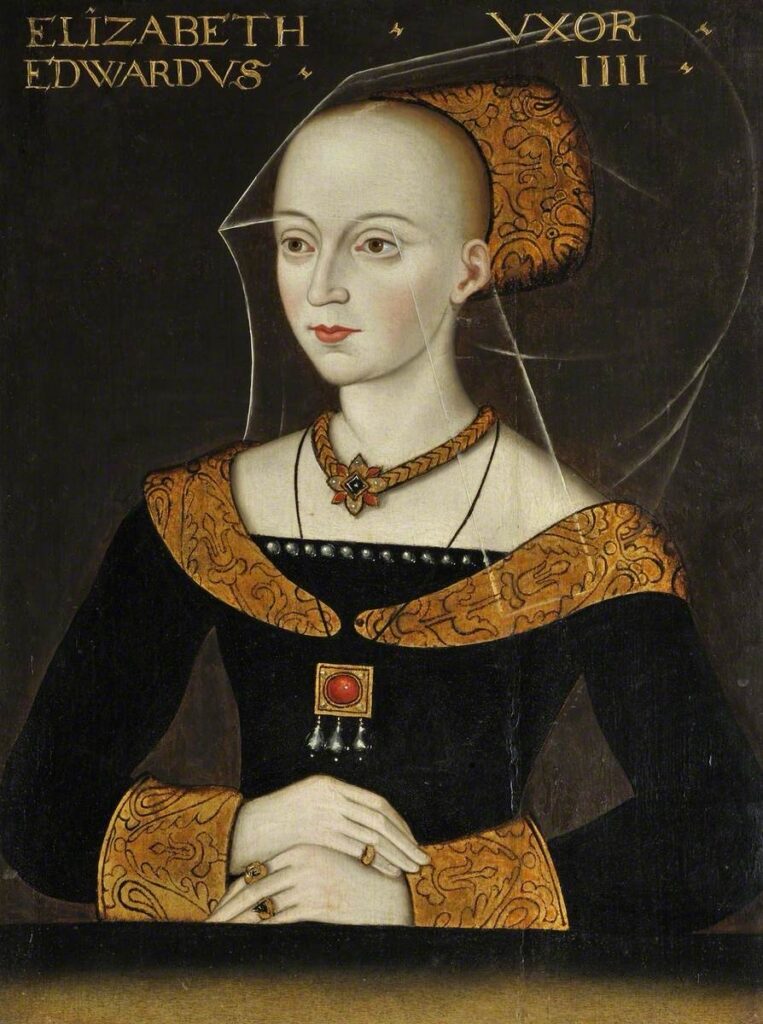
Which meant that Henry VI regained the throne briefly but his son, Edward of Westminster was killed at the Battle of Tewkesbury in 1471. When Edward IV regained power himself, Henry was imprisoned in Tower of London where he apparently died of ‘melancholy’.
The House of Lancaster was at an end. Or so it seemed. 12 years of uneasy peace followed. Then in 1483, Edward IV died leaving his 12-year-old son, Edward V to rule. A young boy in the hands of ambitious men. He lasted only 78 days before being deposed by his uncle, Richard of York, crowned Richard III. This was highly controversial and many prominent Yorkist supporters switched sides.
Then enter, amongst the chaos, Henry Tudor. But that’s another story.
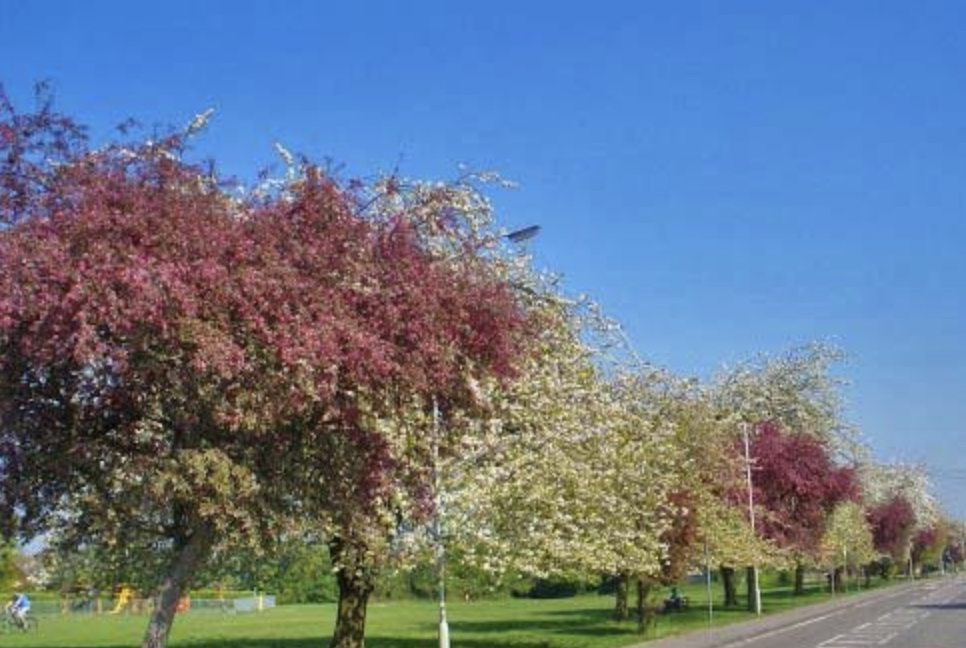
So when you next walk along Sopwell Lane or admire the red and white spring blossom of the commemorative trees planted along Sandridge Road, think of that desperate fighting, the dead under your feet and the people of St Albans, once again trying to stay safe from trouble brought to their homes.
To walk through the streets where once Yorkist and Lancastrian troops once fought, join us on our Wars of the Roses guided walks; www.stalbanstourguides.co.uk