09 Oct 2024
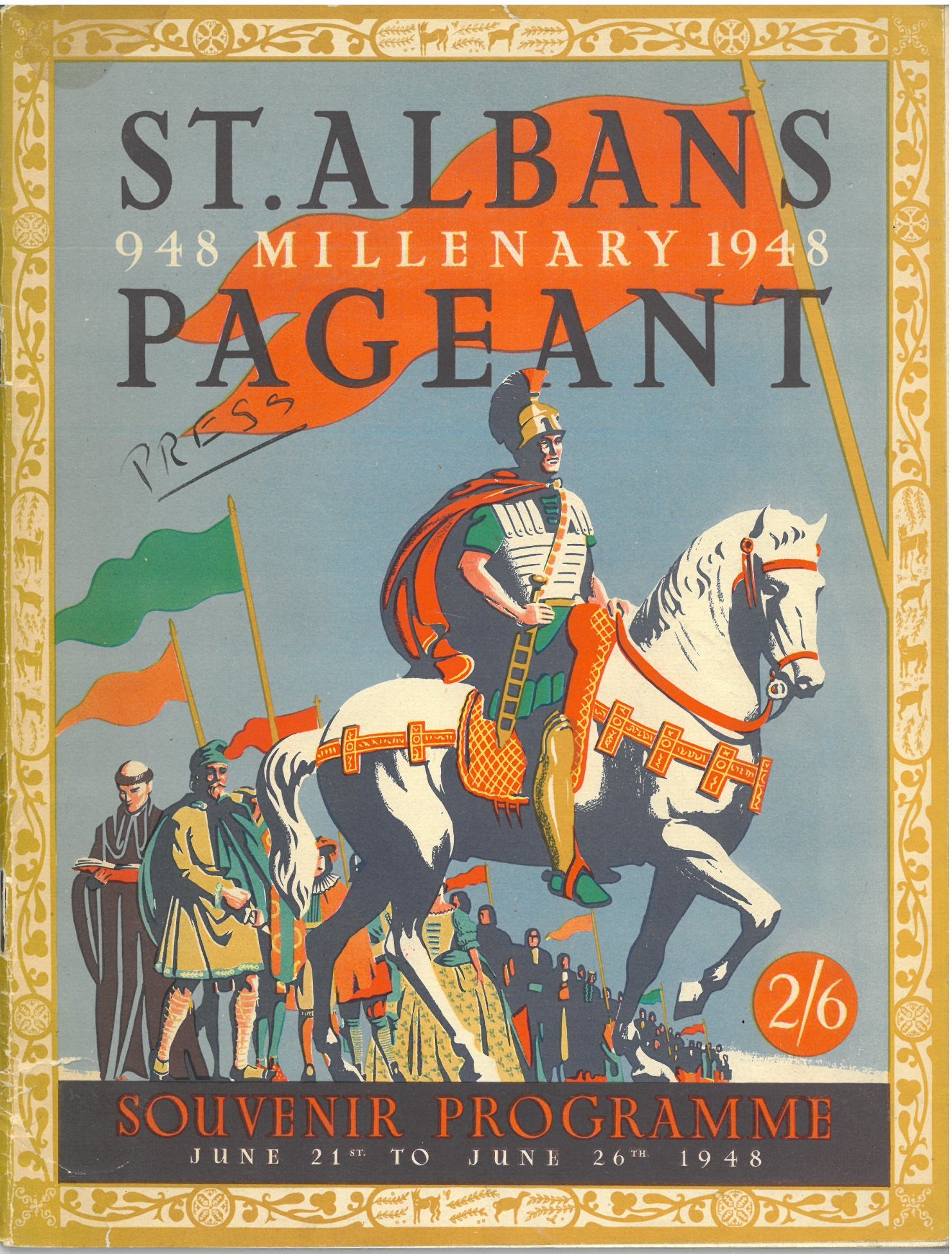
In June 1948, despite post-war austerity and the continuation of rationing, St Albans held its Millenary Pageant, marking the thousandth anniversary of the founding of three churches, a school and the market.
In the midst of Verulamium Park, scenes were re-enacted from key moments in St Albans’ rich history, including one set in 948AD, when the Abbey’s sixth abbot – a man known as Ulsinus or Wulsin – not only laid out what would become the town of St Albans, but also established St Albans School and the three churches of St Stephen, St Michael and St Peter.
It was followed by other scenes including the martyrdom of St Albans, King Offa establishing the Abbey in 793AD, the Sovereign Way General Election scandal of 1722, and Queen Elizabeth I’s visit to Gorhambury House in 1572.
The final sequence featured the celebrations surrounding the Royal Charter of 1877, which gave St Albans city status, and the creation of the diocese of St Albans later that year, with city councillors playing their own predecessors.
Further information on the pageant is readily available from St Albans Museums and the website historicalpageants.ac.uk, but that isn’t the point of this particular article.
We have in our archive a copy of the souvenir programme for the 1948 pageant, which provides a remarkable snapshot into life in the city at this time through advertisements, editorial pieces and illustrations alongside a complete script from the performances.
Many of the businesses featured in its pages have either disappeared or changed their names, but we’ll try to take you on a journey back in time to get a better picture of what companies could be found in and around post-war St Albans.
In Chequer Street, we find Mandley & Sparrow estate agents, on the site of what is now Connells, and Lloyds Bank in the same building it occupies today. Also in the same road was a branch of Elliotts music store and record shop.
WS Green Ltd, Chequer Street’s specialists in fashions, fabrics, children’s wear, household linens, furnishings and travel goods, dated back to almost a century before the pageant, but was only to last a few more years before being bought out by Army & Navy Stores in 1955.
The Herts Ad, still in its Dagnall Street offices, promised a full report and pictures on the pageant, but revealed that despite a request to the Board of Trade for permission to exceed its paper ration, no extra copies would be printed.
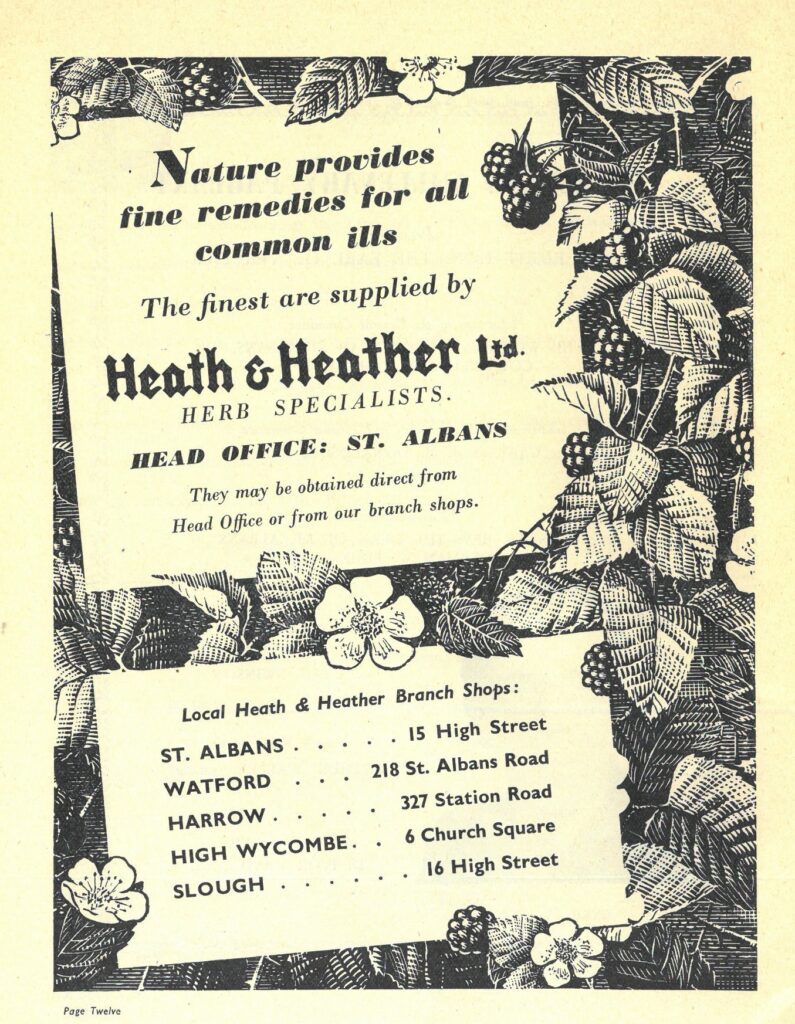
In 1948 the home of Raindrops and Roses at 15 High Street was occupied by herb specialists Heath and Heather Ltd, a company founded in the early 1900s by Samuel Ryder which had its head office in Holywell Hill. Although the brand survives today, its stores were renamed Holland & Barrett in 1971.
Neighbouring 17-31 High Street was the home of James Fisk & Son Ltd, drapers, furnishers, outfitters and footwear specialists dating back to 1834. Founder James Fisk was three times Mayor of St Albans, and his shop was later replaced by Blundells department store before being largely demolished to make way for Heritage Close.
From 5 High Street, publishers HA Richardson were preparing a five volume autobiography of Winston Churchill, based out of what is now Waterers menswear shop.
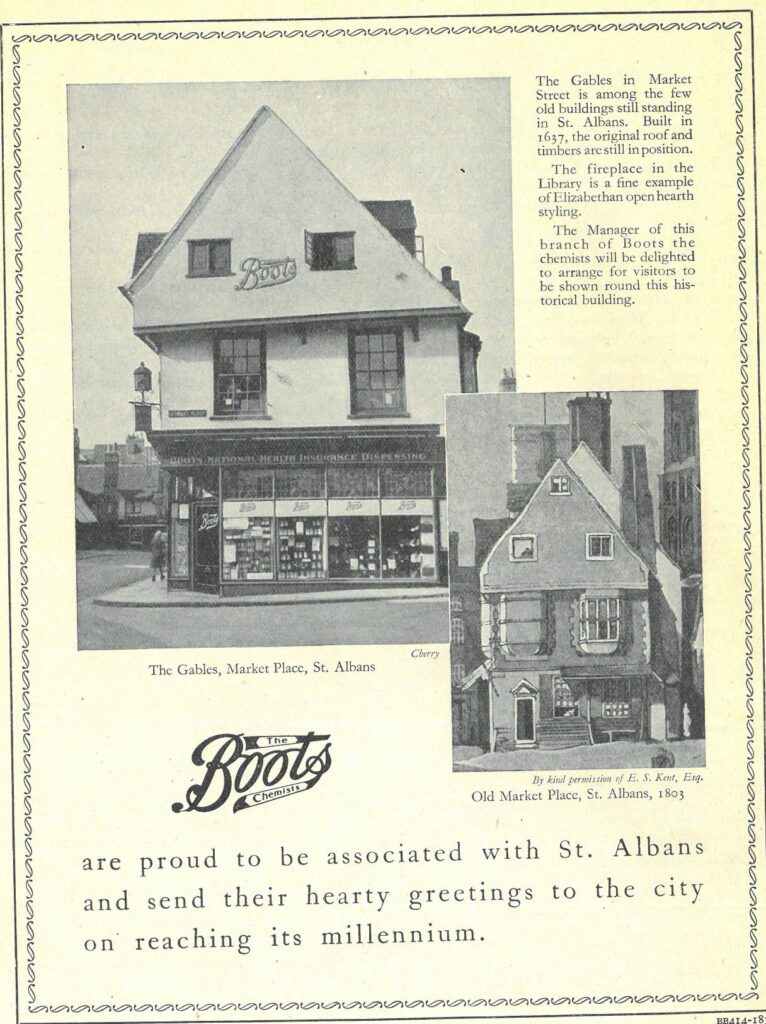
At the time of the pageant, Boots the Chemists occupied The Gables in Market Place, what is now Anthropologie, and an advertisement in the pageant programme highlighted how the fireplace in the building’s library was a fine example of Elizabethan open hearth styling.
“The Manager of this branch of Boots the chemists will be delighted to arrange for visitors to be shown round this historical building,” it added. Can you imagine any retailer having a side-line in history tours today?!
One advert mentions Nicholson & Co, based at Beaumont Works in Sutton Road, and established by raincoat manufacturer and woollen cloth merchant Arthur John Nicholson in the 1800s.
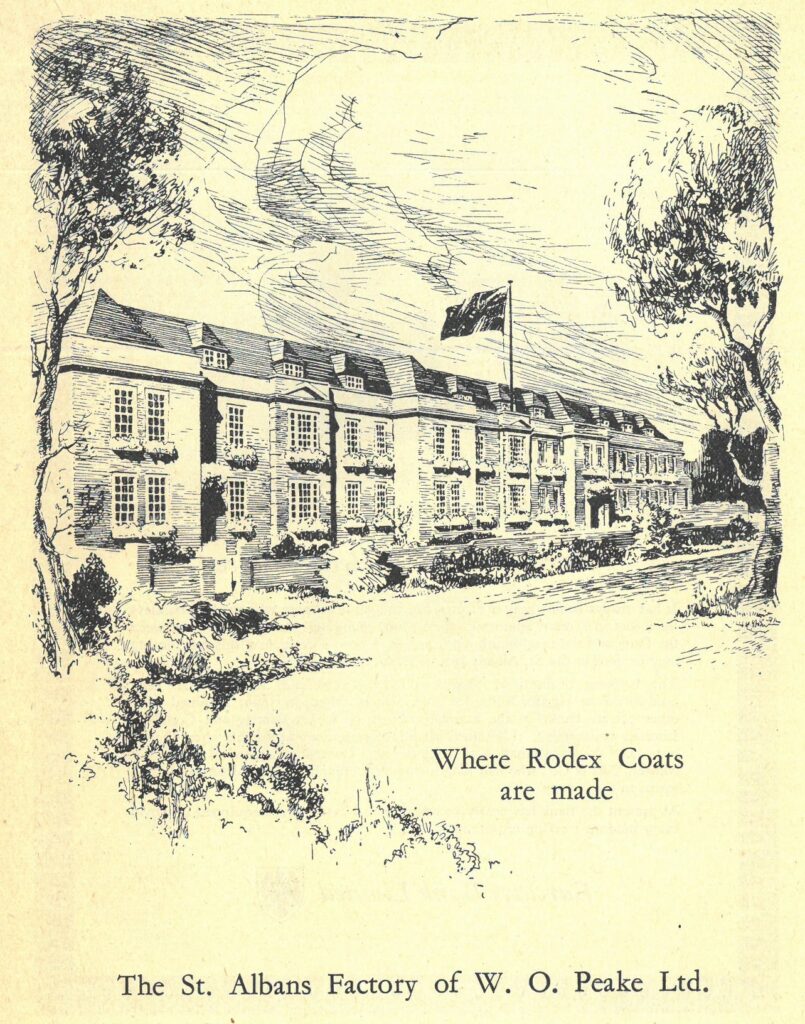
Another coat factory was that of WO Peake Ltd, making Rodex coats from premises in Hatfield Road near Granville Road. The factory was closed in the 1980s and replaced with residential properties, but an illustration of the premises is included in the programme. It also made the cheaper Cotsmoor brand which gave its name to the retirement housing development now located on part of the site.
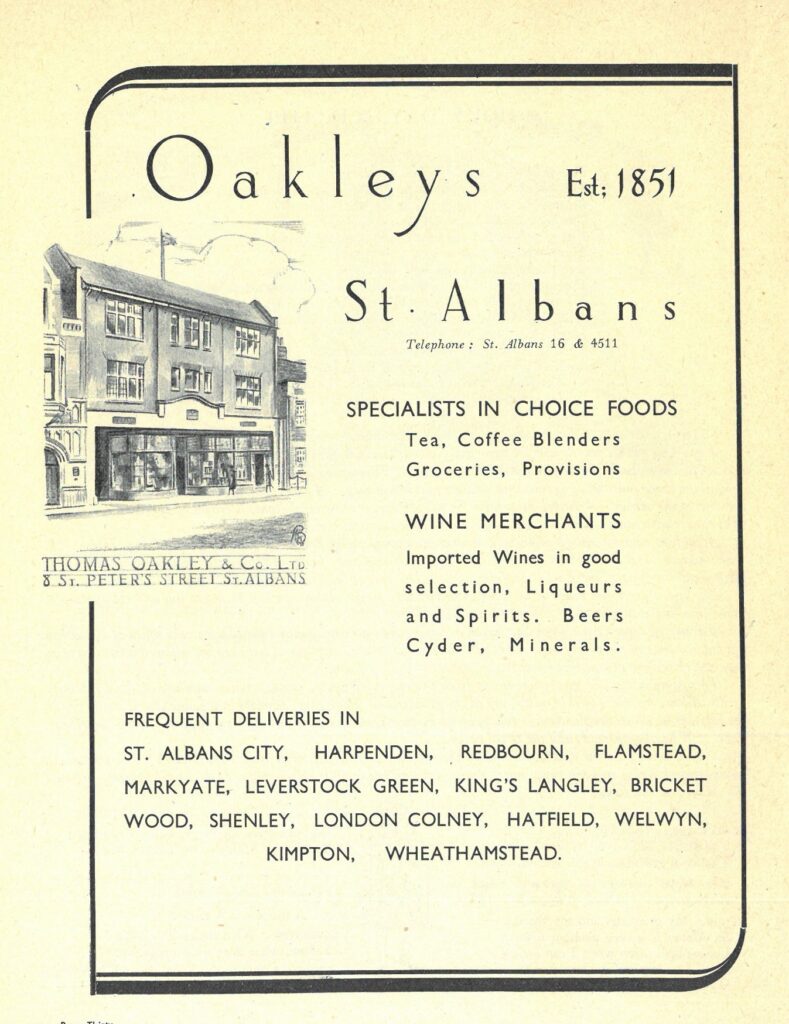
Long before it housed booksellers Waterstones, 8 St Peter’s Street was the home of Oakleys, established in 1851 and described as specialists in choice foods and a wine merchants. Examination of a hand-drawn illustration of the building suggests very little seems to have changed in the shop frontage since then.
Also in St Peter’s Street was “ethical pharmacy” Freeman Grieve Ltd at no 97 – the old Anastasia restaurant – and before the Meera Pharmacy occupied 4 Beech Road there was a dispensing chemist there run by DS Evans, specialising in “horticultural chemicals” for some reason.
The Electric Light and Engineering Company (ELECO) was a manufacturer of street lights based at Sphere Works in St Albans’ Campfield Road, having been established in the city in 1895, while the St Albans Rubber Co Ltd could be found nearby at The Camp.
An advert for the Watford and St Albans Gas Company, which was founded in January 1930, says it supports a 40-hour week for housewives, with the first step being “the immediate abolition of unnecessary drudgery by means of automatic cooking, heating, hot water and home laundry appliances”.
At 44-45 Alma Road could be found AC Strofton, for regular deliveries of “wines, spirits, beers, cyders and minerals”, and the legendary Ballito Hosiery Mills is also featured in the programme, the factory which occupied the site of what is now Morrisons.
Marlboro’ Motors, which catered for Vauxhall and Bedford owners, had its showroom at 103 London Road (where the Esso garage is now), and a service depot in Watson’s Walk, and an advert reveals that Room for Dessert at Capstan House, 184 Hatfield Road, was once the site of hatshop Service Headwear Co Ltd.
A potted history of the Waterend Barn is included in their advertisement for what was then a restaurant owned by Thrales Ltd.
“This Barn was originally built at the end of the sixteenth century at Waterend House, near Wheathampstead, the reputed birthplace of Sarah Jennings, Duchess of John, Duke of Marlborough, the victor of Blenheim.
“Waterend afterwards passed from the Jennings family and eventually became a farm on the Brocket Estate. In the year 1938 Waterend House was once more made into a private residence by Lord Brocket, and the Barn, which greatly obscured the view, being no longer required for its former purpose, was brought to St Albans and re-erected by him.”
In 1948 we could find photographic chemists Shields and Warren at 7 London Road (now Clockhouse Court), 5 The Broadway (part of St Peter’s Street, now Leightons Opticians), and 2 Clarence Road (now What Alice Wore bridal shop); watchmaker and jeweller E Vasen at 8 Holywell Hill (the currency exchange shop), The Music Box, aka Crossley-Stocker Ltd, next door at no 6 (Rebecca Clark Interiors) and drapery shop Pamphilon at 73-77 St Peter’s Street (Card Factory to Metro Bank).
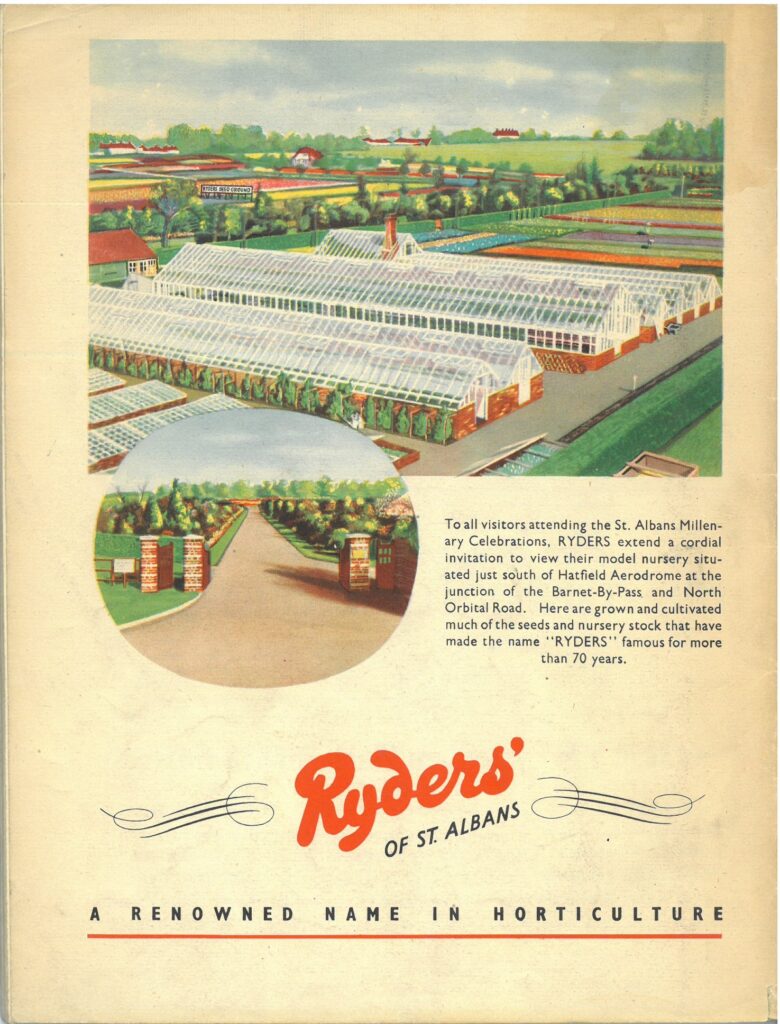
But perhaps the best of all the advertisements found in the programme is saved for last, taking up the whole of the back page in full colour.
“To all visitors attending the St Albans Millenary Celebrations, RYDERS extend a cordial invitation to view their model nursery situated just south of Hatfield Aerodrome at the junction of the Barnet-By-Pass and North Orbital Road. Here are grown and cultivated much of the seeds and nursery stock that have made the name ‘RYDERS’ famous for more than 70 years.”
The site, at Roe Hyde, is remembered by the name Ryders Avenue, but the nursery business has long since disappeared.